

Financial Planning & Analysis (FP&A) | Career Guide | MentorMe Careers
Let’s be honest. Most people hear FP&A and think it’s just budgeting and Excel. It’s not.
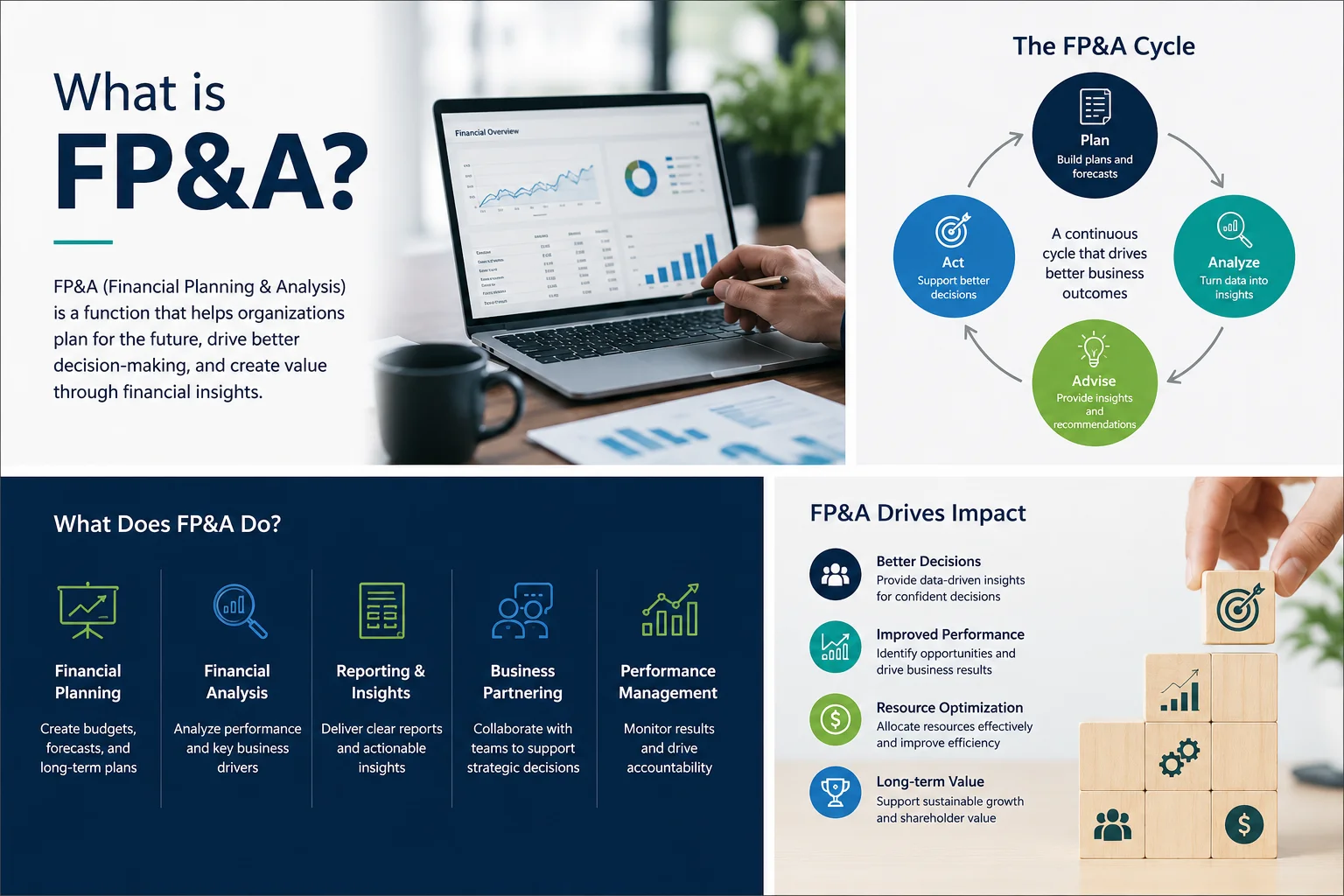
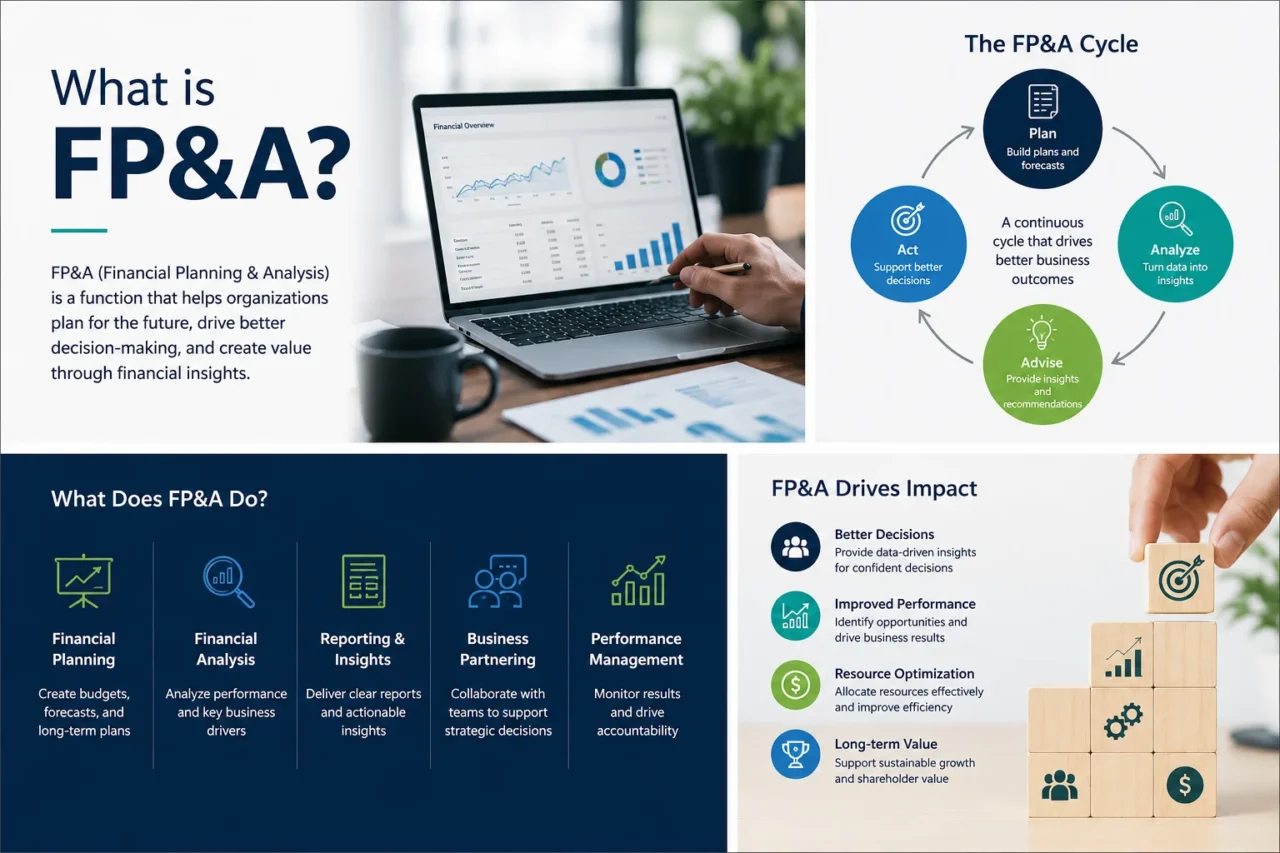
FP&A — Financial Planning & Analysis — is the function inside a company that tells leadership where the business is going, how fast, and what to do about it. The CFO’s office runs on FP&A. Big decisions — hiring freezes, market expansion, acquisition targets — come from FP&A analysis.
If you want a finance career with real influence, not just compliance work or journal entries, FP&A is worth your serious attention.
This guide covers everything: what FP&A actually involves day to day, how it differs from accounting and investment banking, what skills get you hired, and what the career and salary trajectory looks like in India.
What Does FP&A Stand For?
FP&A stands for Financial Planning and Analysis. It is a corporate finance function responsible for helping senior leadership and management make data-driven financial decisions. The FP&A team acts as the internal financial advisor to the business — translating complex financial data into actionable insights.
Unlike accounting teams that focus on recording and reporting past transactions, FP&A is forward-looking: it focuses on budgeting, forecasting, long-range planning, and performance analysis.
What is FP&A? (Definition)
FP&A stands for Financial Planning and Analysis. It’s a corporate finance function — typically sitting within the CFO’s office — that is responsible for forecasting, budgeting, performance analysis, and helping management make better financial decisions.
The simplest way to understand FP&A: accounting tells you what happened. FP&A tells you what’s going to happen and why it matters.
That forward-looking orientation is what makes FP&A professionals valuable to leadership — and what makes the work genuinely interesting.
Key Functions of FP&A
Here are the six core activities that define FP&A work:
1. Budgeting
Once a year, the FP&A team coordinates with every department — sales, marketing, HR, ops — to set financial targets. Revenue goals, headcount plans, capex budgets. They consolidate all of it into a master budget that reflects the company’s strategy for the year.
This process is more political than people expect. FP&A has to push back on departments that are sandbagging their numbers or being unrealistic. You need to understand the business, not just the numbers.
2. Rolling Forecasts
The budget is set once. The forecast is updated constantly — usually monthly or quarterly — as actual results come in and market conditions shift. This is where most of the modeling work lives.
A good FP&A analyst can update a rolling forecast model in under an hour. A poorly built one takes all day. That’s why financial modeling skills matter so much in this function.
Related: What is Financial Modeling? | Importance of Financial Modelling
3. Variance Analysis
Every month, FP&A compares actual results to the budget and forecast and explains the gaps. Revenue came in ₹2 crore below plan — was it pricing? Volume? A specific region or product? That explanation goes to the CFO and business heads.
This sounds mechanical but it’s not. Good variance analysis is half detective work and half storytelling. You have to know the business well enough to explain why the numbers moved.
4. Long-Range Planning
Beyond the annual budget, FP&A builds 3- to 5-year financial plans. These are used for board presentations, fundraising, M&A discussions, and long-term resource allocation. The further out the horizon, the more judgment and assumptions drive the numbers.
5. Management Reporting & KPI Dashboards
FP&A owns the monthly and weekly dashboards that senior leadership uses to monitor business health — revenue growth, EBITDA margins, cash burn, utilization rates. Getting these right requires both technical skill and an understanding of what decisions each metric is meant to inform.
6. Business Partnering
This is where FP&A has evolved the most in the last decade. Instead of sitting in a back office, modern FP&A professionals are embedded with business units — attending sales reviews, challenging marketing ROI, helping ops understand unit economics.
At companies like Maersk, Siemens, and Cummins in Pune, the FP&A business partner role is now as much about influence and communication as it is about numbers.
FP&A vs. Accounting: The Real Difference
This is one of the most common points of confusion for people entering finance. Here’s a clean way to think about it:
| FP&A | Accounting | |
| Time Orientation | Future-focused | Past-focused |
| Key Question | Where are we going? | What happened? |
| Primary Output | Forecasts, models, insights | Financial statements, filings |
| Works Closest With | CFO, Business heads | Auditors, Regulators |
| Core Tools | Excel, Power BI, Anaplan | SAP, Tally, ERP systems |
Accounting is non-negotiable for a business. But FP&A is where financial professionals get a seat at the strategy table. If you have an accounting background — especially CA — that foundation is genuinely useful in FP&A. You just need to layer on modeling and business acumen.
FP&A vs. Investment Banking: Which One Is for You?
People often ask us this. The honest answer is that they attract different personalities and offer very different lifestyles.
| FP&A | Investment Banking | |
| Hours | 45–55 hrs/week typically | 80–100 hrs/week at peak |
| Work Type | Internal strategy & planning | External deals & transactions |
| Career Destination | CFO, VP Finance | PE, Hedge Fund, Corp Dev |
| Compensation (India) | ₹8L–₹40L mid-senior | ₹12L–₹80L+ senior |
| Stability | High | Variable, deal-dependent |
Investment banking pays more at the top, but the grind is real and the attrition is high. FP&A at a strong MNC or GCC in Pune or Mumbai offers competitive pay, genuine business exposure, and a career path that goes all the way to CFO.
We’ve seen investment bankers in their mid-30s actively move into corporate FP&A roles because they want sustainability and influence without the deal pressure. Both directions happen.
Related: Can a CA Become an Investment Banker? | Private Equity Firms in Mumbai
One of our students — a B.Com graduate from Pune who had been working in an accounts payable role at a mid-size manufacturing firm — came to us frustrated. She was doing good work but had no visibility into business decisions. After completing our financial modeling program, she moved into an FP&A analyst role at a multinational GCC in Hinjewadi within five months. Her words: “I finally feel like I’m part of the conversation.”
Skills You Actually Need for FP&A
Let’s be specific about this. Not every skill matters equally, and some things people obsess over are far less important than they think.
1. Financial Modeling — Non-Negotiable
This is the most important technical skill, full stop. Every core FP&A deliverable — the budget, the forecast, the long-range plan — is built on a financial model. If your models are slow to build, hard to update, or break when assumptions change, you will struggle in FP&A.
You need to be able to build a dynamic 3-statement model from scratch. Scenario analysis, sensitivity tables, driver-based forecasting — these are everyday tools, not advanced techniques.
Related: Financial Modeling Training | Free Financial Modeling Course | Sample Financial Model in Excel
2. Advanced Excel
Excel is still the dominant tool in FP&A across most companies in India, including large MNCs. INDEX-MATCH, XLOOKUP, Power Query, dynamic arrays, structured references — you need these cold. Not “I know what they are” but “I use them every day without thinking.”
Related: Beginners Guide to Excel Financial Modeling
3. Understanding Financial Statements
You will be working with the P&L, Balance Sheet, and Cash Flow Statement every single day. More importantly, you need to understand how they connect — how a revenue change flows through to cash, how a capex decision hits depreciation and cash simultaneously.
Related: Types of Financial Analysis | Ratio Analysis Problems with Solutions
4. Business Acumen
This is the skill that separates good FP&A professionals from great ones. Numbers don’t explain themselves. If revenue dropped 8% in Q3, you need to know whether that’s a pricing problem, a sales execution problem, or a market problem. That requires knowing the business, not just the model.
5. Data Visualization & BI Tools
Power BI is increasingly standard in FP&A at MNCs and GCCs. Tableau is common in tech companies. You don’t need to be a Power BI developer, but you need to be able to build and maintain a dashboard that leadership can actually use.
6. Communication
FP&A is useless if the insights stay in a spreadsheet. You will present variance analysis to the CFO. You will challenge a business head’s cost assumptions. You will simplify a 5-year plan into three slides for the board. If you can’t communicate clearly and confidently, the technical skills don’t translate into influence.
FP&A Tools and Software
| Tool | Where It’s Used |
| Microsoft Excel | Core modeling and analysis — universal across all FP&A teams |
| Power BI | Dashboards and management reporting — standard at MNCs and GCCs |
| Anaplan | Enterprise planning platforms — large corporations |
| Workday Adaptive | Cloud-based budgeting and forecasting |
| SAP BPC | Consolidation and statutory reporting |
| Tableau | Data visualization — common in tech companies |
| Python / SQL | Advanced analytics — increasingly relevant in data-heavy FP&A roles |
At entry level, Excel is what matters. Enterprise tools like Anaplan and Adaptive are learned on the job. Don’t let not knowing them stop you from applying.
FP&A Career Path: From Analyst to CFO
FP&A has one of the clearest career paths in all of finance. Here’s how it typically progresses:
Entry Level (0–3 Years)
- FP&A Analyst
- Financial Analyst
- Business Finance Analyst
At this stage you’re building models, preparing variance reports, supporting the budgeting process, and learning the business. The learning curve is steep and fast.
Mid-Level (3–7 Years)
- Senior FP&A Analyst
- FP&A Manager
- Finance Business Partner
You’re now owning deliverables, managing relationships with business units, and starting to drive the agenda rather than just support it.
Senior Level (7–12 Years)
- Director of FP&A
- Head of Financial Planning
- VP of Finance
At this stage, your work is largely strategic. You’re influencing business decisions, presenting to boards, and managing a team of analysts.
C-Suite (12+ Years)
- Chief Financial Officer (CFO)
- Chief Operating Officer (COO)
A large proportion of CFOs at Indian MNCs and GCCs came up through FP&A. The function gives you exposure to every part of the business — which is exactly what you need to lead at the top.
FP&A Salary in India
Salaries vary by company size, industry, and city. Here’s a realistic range based on what we see from placed candidates and market data:
| Level | Salary Range (Per Annum) |
| FP&A Analyst (0–3 Years) | ₹5 LPA – ₹12 LPA |
| Senior Analyst (3–5 Years) | ₹10 LPA – ₹20 LPA |
| FP&A Manager (5–8 Years) | ₹18 LPA – ₹35 LPA |
| Director of FP&A (8–12 Years) | ₹30 LPA – ₹60 LPA |
| VP / Head of FP&A (12+ Years) | ₹50 LPA – ₹1 Cr+ |
MNCs and GCCs — especially in Pune’s Hinjewadi, Mumbai’s BKC, and Bangalore’s Whitefield — consistently pay at the top of these ranges. BFSI, tech, and pharma tend to be the highest-paying sectors for FP&A.
One important point: FP&A compensation grows faster after the 5-year mark than almost any other corporate finance track. The early years are building blocks.
Related: Financial Modelling Salary in Pune | Financial Modelling Salary in India
A candidate who came to us was an MBA Finance graduate from a Tier-2 college in Mumbai — solid academics, but struggling to break into a role with real analytical work. He had been doing MIS reporting at a logistics company for two years and felt stuck. After building his financial modeling skills and a portfolio of three models, he landed an FP&A analyst role at a well-known FMCG company’s GCC in Navi Mumbai at ₹9.5 LPA. The portfolio is what made the difference in the interview.
How to Break Into FP&A: What Actually Works
Here’s the straight version — no padding.
Step 1: Get your financial modeling right first
This is where most people skip ahead and regret it. Before you apply for FP&A roles, you need to be able to build a 3-statement model from scratch, set up a budget template, and do basic scenario analysis. These come up in every FP&A interview, at every level.
Related: Financial Modeling Training | Financial Modelling Syllabus
Step 2: Build something you can show
A financial modeling certification matters. But what matters more is having actual models you can walk an interviewer through. Build a 3-statement model of a real listed company. Build a budget template. Build a variance analysis example. Upload them somewhere accessible.
Related: Sample Financial Model in Excel
Step 3: Target GCCs and MNCs in Pune and Mumbai specifically
For FP&A roles in India, GCCs are the most accessible entry point for candidates who are upskilling. Companies like Cummins, TIAA, Fidelity, Siemens, and Maersk have large FP&A teams in Pune and Mumbai and hire regularly at analyst level. They value technical skills and structured thinking over pedigree.
Step 4: Get certified
A recognized financial modeling certification tells an employer you’ve done structured, hands-on work. It reduces the risk of hiring you. At the analyst level, a certification combined with a model portfolio is often enough to get the first interview.
Related: Top Financial Modeling Certification Courses | How a Certification Boosts Your Career
Step 5: Prepare specifically for FP&A interviews
FP&A interviews are different from equity research or investment banking interviews. They test financial modeling, business judgment, and communication — often in the same question. Practice walking through a P&L, explaining a variance, and presenting a recommendation.
Related: Financial Modeling Interview Questions | Top 40 Valuation Interview Questions
Why Financial Modeling is the Core Skill for FP&A
Every major FP&A deliverable has a financial model behind it. There’s no way around this.
| FP&A Deliverable | Financial Modeling Skill Required |
| Annual Budget | Driver-based budget model, assumptions logic |
| Rolling Forecast | Dynamic 3-statement model, live linkages |
| Long-Range Plan | 5-year integrated financial model |
| Scenario Analysis | Sensitivity tables, scenario toggles |
| Variance Report | Actual vs Budget comparison framework |
| Investment Decision | DCF, capital budgeting model |
This is the reason we built our entire training program around financial modeling as the foundation. Everything else in FP&A — the business partnering, the communication, the strategic thinking — builds on top of it.
Related: Importance of Capital Budgeting | Degree of Financial Leverage | Prototyping in Financial Modeling
FP&A in India: Why the Timing Is Good
The demand for FP&A professionals in India has grown significantly over the last five years. Here’s why:
- GCC expansion: Over 1,500 Global Capability Centers now operate in India. Pune, Mumbai, Bangalore, and Hyderabad are the biggest hubs. Most large GCCs have dedicated FP&A teams that support their global operations from India — and they hire continuously.
- Shift from MIS to FP&A: Many companies that previously ran large MIS teams are transitioning them into FP&A functions. If you’re currently in MIS or management reporting, you’re closer to FP&A than you think.
- Remote and hybrid work: FP&A roles — especially at GCCs — have become accessible without relocating. We have students in Pune working for teams based in the US, UK, and Europe.
- Compensation catching up: Three to four years ago, FP&A salaries at GCCs lagged behind investment banking significantly. That gap has narrowed, especially at the manager and director level.
We had a student — a CMA working in a manufacturing company’s accounts team in Thane — who had never built a financial model professionally. She was skeptical that modeling skills alone would move her into FP&A. She did the program, built a model on a listed auto-ancillary company she knew well, and used it in her interview at a Pune-based GCC. She got the offer. Her takeaway: “The interviewers had seen hundreds of resumes. The model made me real.”
FP&A Across Industries: What Changes, What Doesn’t
The core skills stay the same — modeling, forecasting, analysis, communication. But the context shifts by industry:
- Technology / SaaS: Heavy focus on ARR, churn, CAC/LTV, and headcount planning. Fast-moving assumptions.
- BFSI: Regulatory capital planning, NIM analysis, credit loss forecasting. More compliance overlap.
- Manufacturing: Cost of goods, capacity utilization, supply chain impact on margins. Strong ops interface.
- Pharma / FMCG: Brand-level P&Ls, distribution economics, R&D spend management.
- PE-backed companies: EBITDA bridge analysis, working capital optimization, investor reporting. High pressure, high visibility.
Related: Top Consulting Firms in India | Private Equity Firms in Bangalore | Detailed Survey of Private Equity Salary India
FP&A — Common Questions
Is FP&A a good career in India?
Yes — and the window right now is particularly good. GCC expansion, rising salaries, and the shift from back-office MIS to strategic FP&A means demand is outpacing supply of qualified candidates. If you build the right skills, the opportunities are real.
Can a CA get into FP&A?
Absolutely, and the accounting foundation is a genuine advantage. CAs already understand financial statements deeply. Add financial modeling and business partnering skills and you’re a strong candidate.
Related: How to Become a Financial Analyst in India
How is FP&A different from equity research?
FP&A is internal — you’re analyzing and planning for the company you work at. Equity research is external — you’re analyzing listed companies to generate investment recommendations for clients. Different output, different audience, different day-to-day.
Related: Equity Research Analyst Salary & Career Growth | Research Analyst Career Guide
What does an FP&A analyst do on a typical day?
Update the rolling forecast model, prepare the monthly variance report, respond to ad hoc analysis requests from the business, maintain the KPI dashboard, and support the next planning cycle. It’s busier than it sounds, and no two months are identical.
Do I need an MBA for FP&A?
Not necessarily. An MBA helps, especially from a strong program. But we’ve seen B.Com and BBA graduates move into strong FP&A roles with the right technical skills and a certification. What matters to most hiring managers is whether you can do the work — not which degree you hold.
How MentorMe Careers Can Help
We’ve trained thousands of finance professionals across India who’ve moved into FP&A, equity research, investment banking, and related roles. Our courses are built around the one skill that opens every door in this field: financial modeling.
We cover 3-statement modeling, budgeting and forecasting models, valuation (DCF, comps, precedent transactions), LBO and M&A modeling, and real case studies on Indian and global companies. Everything is hands-on. No slides-only theory.
Courses available in:
- Financial Modeling Course in Pune
- Financial Modeling Course in Mumbai
- Financial Modeling Course in Bangalore
- Financial Modeling Course in Delhi
- Financial Modeling Course in Chennai
- Financial Modeling Course in Indore
Final Word
FP&A is not a backup plan for people who couldn’t get into investment banking. It’s a legitimate, well-compensated, strategic career path that puts you at the centre of business decisions.
The candidates who break in fastest are the ones who don’t wait to feel ready — they build the skill, build a model, and show up to interviews with something tangible. That’s the pattern we’ve seen work, repeatedly.
If you’re serious about FP&A, start with the fundamentals: our financial modeling training is the best place to begin.
Also Read
The Best Financial Modeling Course for Beginners
Net Asset Value — Complete Guide

A CFA charterholder with hands-on experience across investment analysis and finance education. At MentorMeCareers, he writes and reviews content on CFA, financial modeling, and investment banking careers — grounded in real market data rather than generic advice, and shaped by what actually helps candidates and professionals succeed.