
Last updated on September 28th, 2026 at 06:50 pm
CFA exam can be a daunting experience for someone who has not experienced such an exam before. Usually in my own live lectures, I have seen candidates being overwhelmed by the CFA Level 1 syllabus. However in most cases, the challenge with clearing CFA exam is not so much about studying more, that it is about studying right. In this article I will share my unfiltered how to study for cfa plan for cfa candidates.
Key Takeaways
- CFA exams challenge candidates due to a vast syllabus, low pass rates, and the need for both conceptual understanding and memorization.
- A structured approach is crucial; start with full curriculum readings, then practice end-of-chapter and blue box questions consistently.
- Choose a study plan based on your background: 6 months is ideal for working professionals, while 4-5 months suits those with some finance knowledge.
- In your last month, focus heavily on revision, practice at least 25 questions daily, and prioritize high-weight topics like Financial Reporting and Ethics.
- Mock exams are essential; take them in the last 45 days, analyze results thoroughly, and adapt your study plan based on weak areas.
What Makes CFA Difficult?
CFA Level 1 feels difficult because the syllabus is very large and covers 10 different subjects. You need to understand concepts clearly, but you also have to remember many formulas and definitions. This mix of understanding and memorising makes preparation challenging. On top of that, you get only about 90 seconds per question in the exam, so you must think fast and stay accurate. Many students also struggle because the pass rate is low, usually around 35% to 45%, which means you need a strong strategy to clear the exam.
You can also check the CFA exam pattern to understand the structure better.
Approach on How to Study For CFA
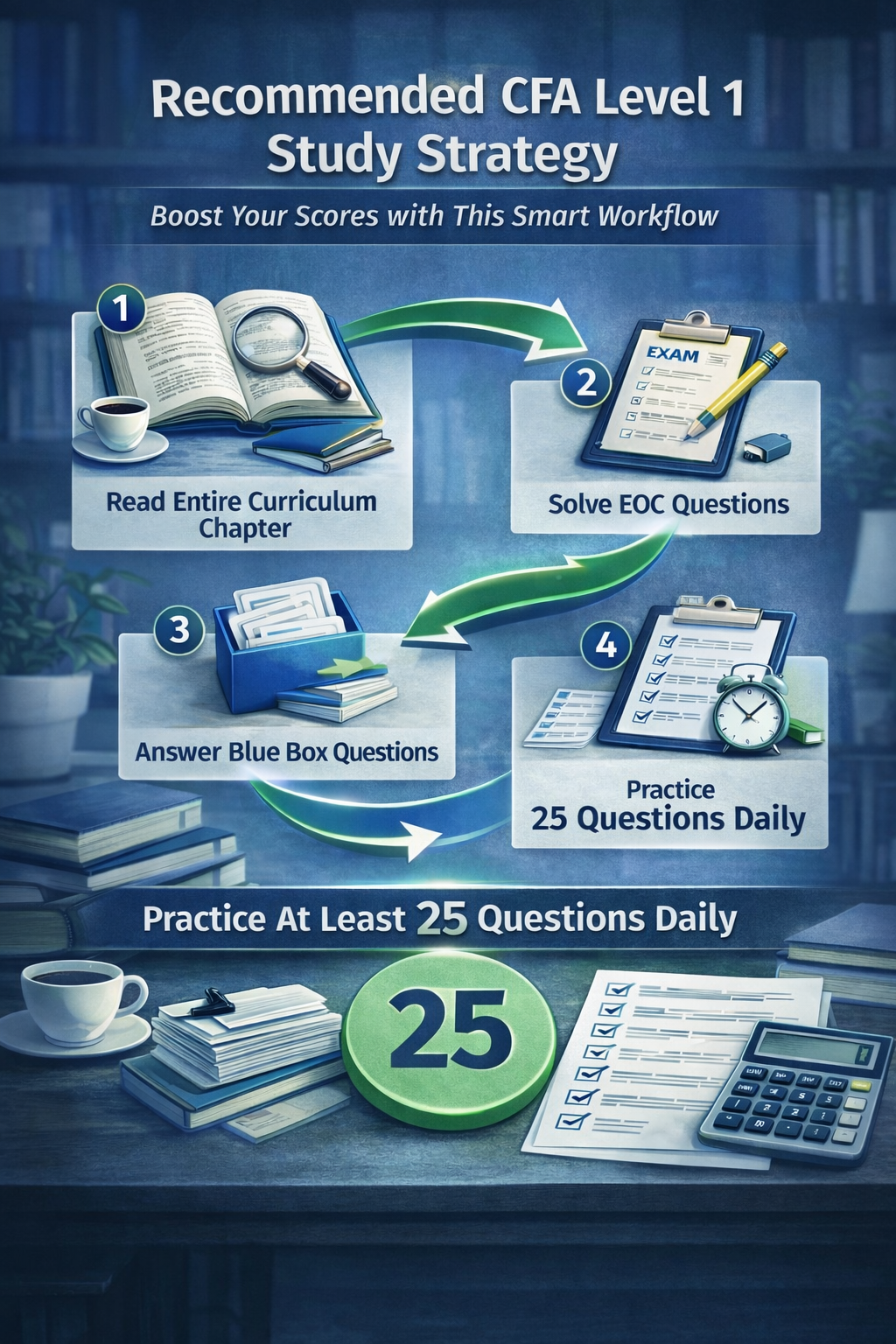
You should follow a structured approach if you want to clear CFA Level 1 confidently. Don’t study randomly. Instead, use a clear system that helps you understand concepts and build strong problem-solving skills. This is the prime strategy below on how to study for CFA Level 1.
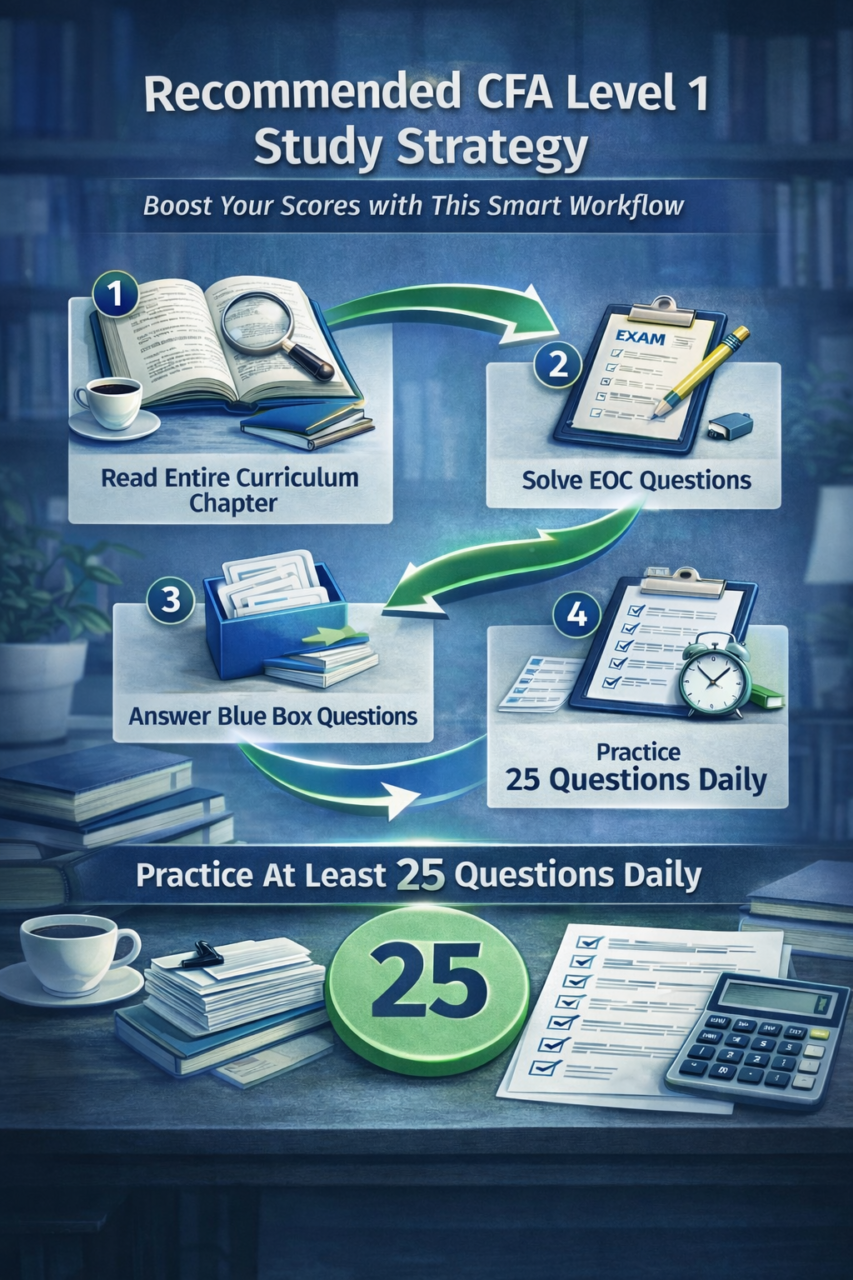
- Start each chapter with a complete reading of the curriculum book. Focus on understanding the concepts, not just finishing the pages. After that, solve the end-of-chapter (EOC) questions. These questions test whether you truly understand the topic.
- Once you complete them, move to the blue box questions, as they help you apply concepts in a practical way.
- After finishing one chapter, move to the next, but keep one rule constant: practice daily.
- You should solve at least 25 questions every day from the chapters you have already completed. This habit improves retention and helps you revise continuously without feeling overwhelmed later.
Also, follow a smart subject priority. Start with Fixed Income, Quantitative Methods, Financial Statement Analysis (FSA), Equity, and Ethics, because these subjects carry higher weight in the exam and appear frequently in questions. Covering these early gives you a strong base and boosts your confidence.
This approach ensures that you don’t just complete the syllabus—you actually prepare to perform well in the exam.
How to Study For CFA Level 1 – 3,5,6 Month Plan
Most candidates need around 300 to 400 hours of focused study to prepare for CFA Level 1. The exact time depends on your background, daily schedule, and how quickly you understand financial concepts. Instead of thinking only in hours, it is better to plan your preparation in months.
If you study consistently, a 6-month plan works best for most students, especially working professionals. This allows you to cover all subjects properly and still have enough time for revision and mock exams. A 4–5 month plan can work if you can dedicate more hours daily and already have a basic finance background. A 3-month plan is possible but very risky and usually works only for candidates who can study full-time.
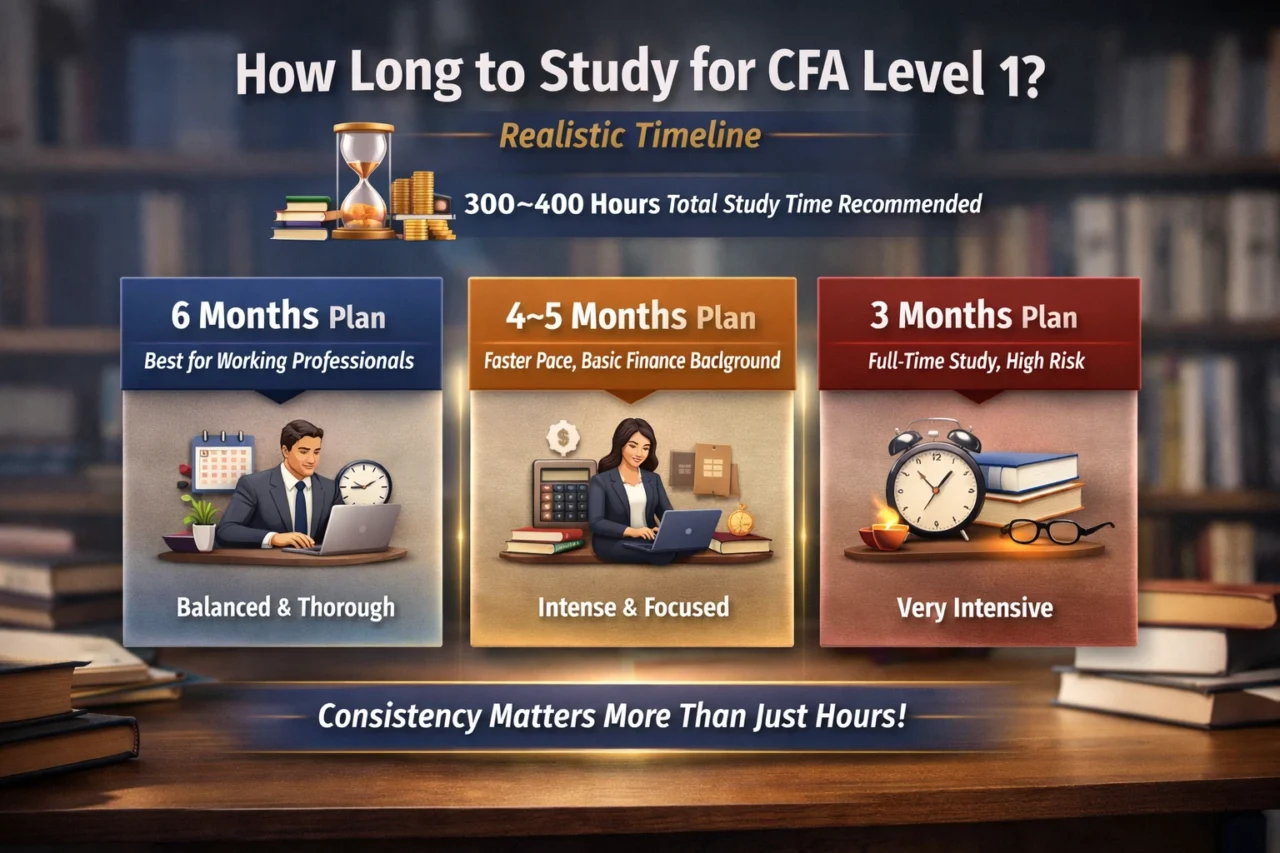
Many discussions online, including “how long to study for CFA Level 1 reddit,” often mention 300 hours, but in reality, consistency matters more than total hours. It’s not just about how long you study—it’s about how effectively you revise, practice questions, and take mock exams.
How to Study for CFA In 3 Months Plan (Aggressive – Not Recommended for Beginners)
In a 3-month plan, you must follow your study strategy very strictly and move fast. Start each chapter with a full curriculum reading, then immediately solve end-of-chapter (EOC) questions, followed by blue box questions. You cannot spend too much time on theory—you must focus heavily on practice.
At the same time, you must solve at least 25 questions daily from the chapters you have already completed. This is non-negotiable, because revision time is very limited in this plan.
You should prioritize high-weight subjects like Fixed Income, Quants, FSA, Equity, and Ethics first to maximize your score.
This plan requires 5–6 hours of daily study and works only if you already have a strong finance background or can study full-time. Beginners usually struggle with revision and retention in this timeline.
How to Study for CFA In 4–5 Months Plan (Balanced Approach)
A 4–5 month plan allows you to follow your strategy in a more structured and comfortable way. For each chapter, you should:
- Read the full curriculum
- Solve EOC questions
- Practice blue box questions
- Then move to the next chapter
Alongside this, continue solving 25 questions daily from completed topics. This builds strong retention and reduces pressure during revision.
You can also maintain your subject priority:
Fixed Income → Quants → FSA → Equity → Ethics, so you cover the most important scoring areas early.
With 2–4 hours on weekdays and more on weekends, you get enough time to understand concepts and revise properly. If you are thinking how many months to study for CFA Level 1, this is the most practical option for most candidates.
How to Study for CFA In 6 Months Plan (Best for Working Professionals)
A 6-month plan lets you execute your strategy in the most effective way without burnout. You can go deeper into each step:
- Read the curriculum slowly and clearly
- Solve EOC questions with understanding
- Practice blue box questions carefully
- Maintain a daily habit of 25 questions
You also get time for multiple revision cycles, which is the biggest advantage of this plan.
Follow the same subject priority:
Fixed Income → Quants → FSA → Equity → Ethics, so you build a strong base early and gain confidence.
With 2–3 hours daily, this plan is ideal for working professionals and beginners. It gives flexibility, consistency, and better long-term retention. For most candidates, this is the safest answer to how many months to study for CFA Level 1.
Comparison of Three Approaches on How to Study for CFA
Notice that the framework is more or less same, but the difference is that the curriculum reading is faster in case of a 3 months plan versus a 6 months plan.
| Plan | Daily Study | Strategy Execution | Daily Practice | Best For |
|---|---|---|---|---|
| 3 Months | 5–6 hrs | Fast (less depth) | 25 Q mandatory | Full-time, strong background |
| 4–5 Months | 2–4 hrs | Balanced | 25 Q consistent | Commerce/finance students |
| 6 Months | 2–3 hrs | Deep & thorough | 25 Q + revision cycles | Working professionals, beginners |
How to Study for CFA in Right Order of Topics
Most students make a big mistake—they study subjects randomly. This leads to confusion, poor retention, and weak performance in exams. Instead, you should follow a structured study order so that each subject builds on the previous one.
Start with Quantitative Methods, because it builds your base in time value of money, statistics, and calculations used across many subjects. Then move to Financial Reporting & Analysis (FRA), which is one of the most important and scoring areas in the exam.
After that, study Corporate Issuers and Equity, as they help you understand how businesses operate and how valuation works. Once your basics are strong, move to Fixed Income, which is technical but highly scoring if understood well.
Next, cover Derivatives and Alternative Investments, which are smaller but concept-based topics. Then study Economics and Portfolio Management, as they are more theoretical and easier to grasp once your core concepts are clear.
Suggested Study Order:
- Quantitative Methods
- Financial Reporting & Analysis
- Corporate Issuers
- Equity
- Fixed Income
- Derivatives
- Alternative Investments
- Economics
- Portfolio Management
- Ethics – parallel everyday 1 hr before sleeping
A clear routine helps you stay consistent and avoid last-minute stress. Instead of long, irregular study hours, you should follow a simple daily system + focused weekend plan + regular revision cycles. This approach improves retention and keeps you exam-ready at all times.
How to Structure a CFA study Plan
On weekdays, focus on consistency over intensity. Even 2–3 hours daily can give strong results if you follow a structured flow:
- Step 1: Learn (60–90 mins)Read the curriculum for one topic or sub-topic
- Step 2: Practice (45–60 mins)Solve EOC + Blue Box questions
- Step 3: Daily Revision (30 mins)Solve 25 questions from previously completed chapters
This ensures you don’t forget what you studied earlier while still making progress.
Weekend Deep Work Strategy
Weekends are where you gain an edge over other candidates. Use this time for deep focus and consolidation:
- Study 4–6 hours (split into 2–3 sessions)
- Complete pending chapters or difficult topics
- Take sectional tests or mini-mocks
- Review mistakes and update your weak areas
Weekend = Catch-up + Strengthening + Testing
Revision Cycles (Spaced Repetition)
Don’t leave revision for the last month. Use spaced repetition to retain concepts better:
- Daily: 25 questions from old topics
- Weekly: Revise all topics studied in that week
- Monthly: Take a mock or cumulative test
- Last 45 days: Focus heavily on mocks + weak areas
This method helps you remember concepts longer and improves accuracy
| Day | Study Plan for CFA |
|---|---|
| Monday | New Topic + EOC Questions + 25 Q Revision |
| Tuesday | New Topic + Blue Box + 25 Q Revision |
| Wednesday | New Topic + EOC Questions + 25 Q Revision |
| Thursday | New Topic + Blue Box + 25 Q Revision |
| Friday | Light Study + Weekly Revision + 25 Q |
| Saturday | Deep Study (2–3 Topics) + Sectional Test |
| Sunday | Mock Test + Weak Area Revision |
Best Study Techniques to Pass CFA Level 1
Don’t just study harder. Study smarter. These proven techniques help you understand concepts better, retain information longer, and perform well in the actual exam.
Active Recall
Don’t just read and highlight. Close the book and test yourself. Try to recall formulas, definitions, and concepts from memory. This improves retention far more than passive reading.
Practice After Every Topic
Solve practice questions as soon as you finish a topic. This helps you check whether you truly understood the concept and prepares you for the exam style early.
Formula Sheet Building
Build your own formula sheet while studying. Writing formulas in one place helps you revise faster and remember key concepts before mocks and the final exam.
Mock Exams Strategy
Don’t keep mocks for the very end. Start them in the final phase of preparation and treat each mock as a learning tool. Review every mistake carefully after each test.
Error Log Tracking
Keep an error log of wrong answers, weak concepts, and repeated mistakes. This gives you a clear picture of what to revise and helps you avoid making the same errors again.
How to Use Mock Exams Effectively
Mock exams are not just for testing—they are your most powerful learning tool. The right mock strategy can easily improve your score by 15–20%.
When to Start Mocks (Last 45 Days)
You should start taking mocks in the last 45 days before the exam. By this time, you should have completed most of the syllabus at least once.
- Start with 1 mock per week
- Gradually increase to 2–3 mocks per week
- Always simulate real exam conditions (timed + no distractions)
Target Score Benchmarks
Use these benchmarks to track your progress:
- Below 60% → You need strong revision
- 60–70% → You are on the right track
- 70%+ → You are in a safe zone
- Don’t panic if your first few mocks are low. Improvement matters more than initial scores.
How to Analyze Mocks (THIS is Key)
Most students take mocks but don’t analyze them properly—that’s a big mistake.
After every mock:
- Review every wrong answer
- Identify why you got it wrong (concept, formula, or time pressure)
- Note weak areas in an error log
- Revisit those topics within 2–3 days
Your score improves not from taking mocks, but from analyzing them deeply.
🧠 Reddit How to Study For CFA Advice vs Reality (What Actually Works?)
If you search “how long to study for CFA Level 1 reddit”, you’ll see many candidates saying 300 hours is enough. But this is not always true.
Myth vs Reality
- Myth: 300 hours is enough for everyoneReality: It depends on your background, discipline, and study quality
- Myth: If others passed in 3 months, you can tooReality: Many of those candidates already had finance knowledge
- Myth: Just complete the syllabus onceReality: Multiple revisions and practice are required
Survivorship Bias
Most people who post online are the ones who passed. You don’t see stories of candidates who failed despite studying hard. This creates a false sense of ease.
Overconfidence Traps
Many candidates think:
- “I understand concepts, so I’m ready”
- “Mocks are not necessary”
But in reality:
- Exam pressure is different
- Speed and accuracy matter
Always trust a structured plan, not random internet advice.
How to Study for CFA Based on Your Background
Your preparation should depend on where you are starting from.
Commerce / Finance Students
You already understand basics like accounting and finance.
- Move faster through concepts
- Focus more on practice + mocks
- Spend extra time on Quants and Derivatives if weak
- Advantage: Faster syllabus completion
Engineers / Non-Finance Background
You may find subjects like FRA and Equity difficult initially.
- Spend more time on concept clarity
- Don’t rush the first reading
- Practice more application-based questions
Advantage: Strong logical and problem-solving skills
Working Professionals
Time is your biggest challenge.
- Follow a 6-month plan
- Study 2–3 hours daily consistently
- Use weekends for deep study + mocks
Advantage: Discipline and consistency
How to Study for CFA Level 1 in the Last 30 Days
The last 30 days decide your result. This is where you shift from learning to performance mode.
Focus on High-Weight Topics
Prioritize:
- FSA
- Fixed Income
- Ethics
- Equity
These subjects contribute the most to your score.
Daily Mock + Revision Cycle
- Alternate between mock tests and revision
- Example:
- Day 1 → Mock
- Day 2 → Analyze + revise weak areas
Repeat this cycle consistently
Ethics Priority
Ethics is a scoring and deciding subject.
- Revise it multiple times
- Practice different question scenarios
- Ethics often helps candidates cross the passing line
Formula Revision
- Revise your formula sheet daily
- Focus on high-use formulas
- Avoid learning new concepts at this stage
Final rule: Don’t try to learn new topics in the last month. Focus on revision, mocks, and accuracy.
Frequently Asked Questions (FAQs)
How to study for CFA Level 1 from scratch?
Start with a structured plan. Read the CFA curriculum, solve end-of-chapter questions, and practice blue box questions. Follow a clear subject order and solve at least 25 questions daily to build consistency and retention.
How many months to study for CFA Level 1?
Most candidates need 4 to 6 months to prepare effectively. A 6-month plan works best for beginners and working professionals, while a 4–5 month plan suits candidates with a finance background.
Can I pass CFA Level 1 in 3 months?
Yes, but it is very difficult. You need to study 5–6 hours daily and already have a strong finance background. Most beginners should avoid this timeline due to limited revision time.
How many hours should I study daily for CFA Level 1?
You should study 2–3 hours daily on weekdays and more on weekends. Consistency matters more than long study hours done irregularly.
When should I start mock exams for CFA Level 1?
Start mock exams in the last 45 days before the exam. Begin with one mock per week and increase frequency as the exam approaches. Always analyze your mistakes after each mock.
Is 300 hours enough for CFA Level 1?
300 hours is a general guideline, but it depends on your background and study quality. Some candidates may need more time, especially if they are new to finance.
Which subjects are most important for CFA Level 1?
High-weight subjects include Financial Reporting & Analysis (FRA), Ethics, Fixed Income, and Equity. Focusing on these early can significantly improve your score.
What is the best way to revise for CFA Level 1?
Use daily practice questions, weekly revision cycles, and mock exams. Maintain a formula sheet and error log to track weak areas and improve accuracy over time.

Related Articles

A CFA charterholder with hands-on experience across investment analysis and finance education. At MentorMeCareers, he writes and reviews content on CFA, financial modeling, and investment banking careers — grounded in real market data rather than generic advice, and shaped by what actually helps candidates and professionals succeed.