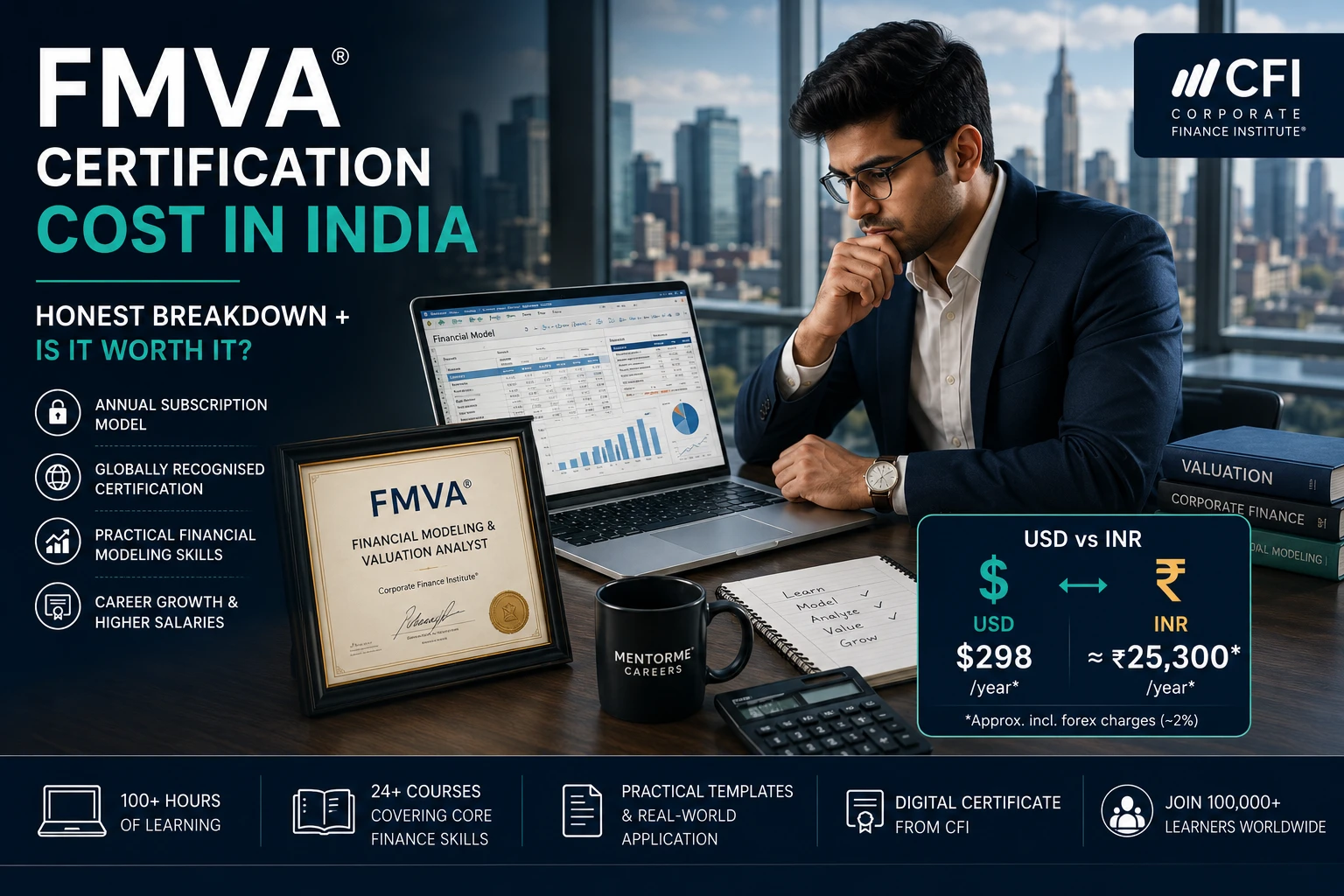


If you’ve been researching financial modeling certifications, you’ve almost certainly come across the question of FMVA Certification Cost. It shows up everywhere — LinkedIn profiles, job descriptions, finance forums.

Before you pay for it, there are some things you should know. Especially if you’re based in India.
The FMVA — Financial Modeling and Valuation Analyst — is a certification offered by the Corporate Finance Institute (CFI), a Canadian online education company. It covers financial modeling, valuation, Excel, and corporate finance. On paper, it sounds exactly like what a finance professional needs.
But the cost, structure, and real-world value look very different depending on where you sit. A USD-priced annual subscription feels very different in New York versus Pune. An all-MCQ exam format matters when you’re deciding whether a certification actually signals skill or just completion. And “globally recognised” means something very specific when Indian employers are the ones doing the hiring.
This article covers all of it — the actual FMVA certification cost in India, what you get at each price point, the genuine pros and cons, how it compares to alternatives, and who should or shouldn’t bother with it.
Related: What is Financial Modeling? | Top Financial Modeling Certification Courses | Financial Modeling Training
What is the FMVA Certification?
FMVA stands for Financial Modeling and Valuation Analyst. It is a certification program offered by the Corporate Finance Institute (CFI) that teaches financial modeling, business valuation, Excel, accounting fundamentals, and corporate finance — all online, at your own pace.
CFI launched the FMVA in 2016 and it has grown quickly — over 100,000 students enrol annually from more than 170 countries. It positions itself as a practical, skills-based alternative to traditional academic finance credentials.
The program is structured in four stages:
- Prep Courses (optional) — 9 foundational courses covering accounting, Excel, and math
- Core Courses — 14 required courses on financial modeling, valuation, FP&A, and analysis
- Elective Courses — choose 3 from 27 available specialisations
- Final Exam — score 70% or above to earn the FMVA designation
Total time to complete: 100–120 hours on average. Most candidates finish in 3–6 months studying part-time.
Here’s the important framing: FMVA is not a unique skill set. Financial modeling and valuation is what it is — whether you learn it through CFI, through a structured Indian training program, or through self-study with a mentor. What FMVA gives you is a structured curriculum and a certificate from a globally recognised provider. The skills themselves are the same across providers.
Related: Importance of Financial Modelling | Financial Modelling Syllabus | What is FP&A?
FMVA Certification Cost: The Full Breakdown
CFI uses an annual subscription model. You pay per year, not once. This is the single most important thing to understand about FMVA pricing before you commit.
CFI Pricing Plans (2025)
| Plan | Regular Price (USD/year) | Discounted Price (USD/year) | Approx. INR/year | What’s Included |
| Self-Study | $497 | $298 (with ~40% discount) | ₹25,000 – ₹42,000* | All courses, certifications, templates, digital certificate |
| Full Immersion | $847 | $508 (with ~40% discount) | ₹43,000 – ₹71,000* | Everything in Self-Study + AI Tutor, personalised guidance, premium tools (PitchBook, FinChat, Koyfin) |
*INR conversion based on USD/INR rate of approximately 84–85 as of 2025. CFI processes payments in USD only — your bank converts at the prevailing rate. No India-specific pricing exists.
What the Subscription Model Actually Means
This is where many Indian candidates get surprised. CFI’s subscription is annual. When your year ends, your access stops — including access to your course materials and the ability to retake the exam.
If you don’t complete the FMVA within one year, you pay again to continue. This is documented in CFI’s terms and in user reviews — some candidates have reported losing access to study materials after their subscription lapsed before they could complete the program.
There is no lifetime access option for the FMVA. Once your annual subscription ends, you need to renew to maintain access. The certificate itself, once earned, does not expire — but the study materials and exam access are tied to an active subscription.
The practical implication for Indian students: if you’re a working professional studying part-time, give yourself enough runway. Don’t assume you’ll finish in three months if your schedule is unpredictable.
Discounts Available
- Standard discount: CFI regularly offers 30–40% off on both plans. The pricing page almost always shows a discounted rate — treat the discounted price as the real price.
- Student discount: If you sign up with a university email address, you may qualify for up to 50% off. This brings the Self-Study plan down to approximately $150–$200 (₹13,000–₹17,000).
- Financial aid: CFI has a financial aid program for candidates who genuinely cannot afford the fee. Application-based, not automatic.
- Group/team pricing: Available for companies enrolling multiple employees. Custom pricing through CFI’s enterprise sales team.
Related: CFA Course Fees in India | Top Financial Modeling Certification Courses | Free Financial Modeling Course
FMVA Certification Cost in India: What It Actually Works Out To
There is no India-specific pricing from CFI. You pay in USD and your bank converts it. Here’s what that looks like in practice:
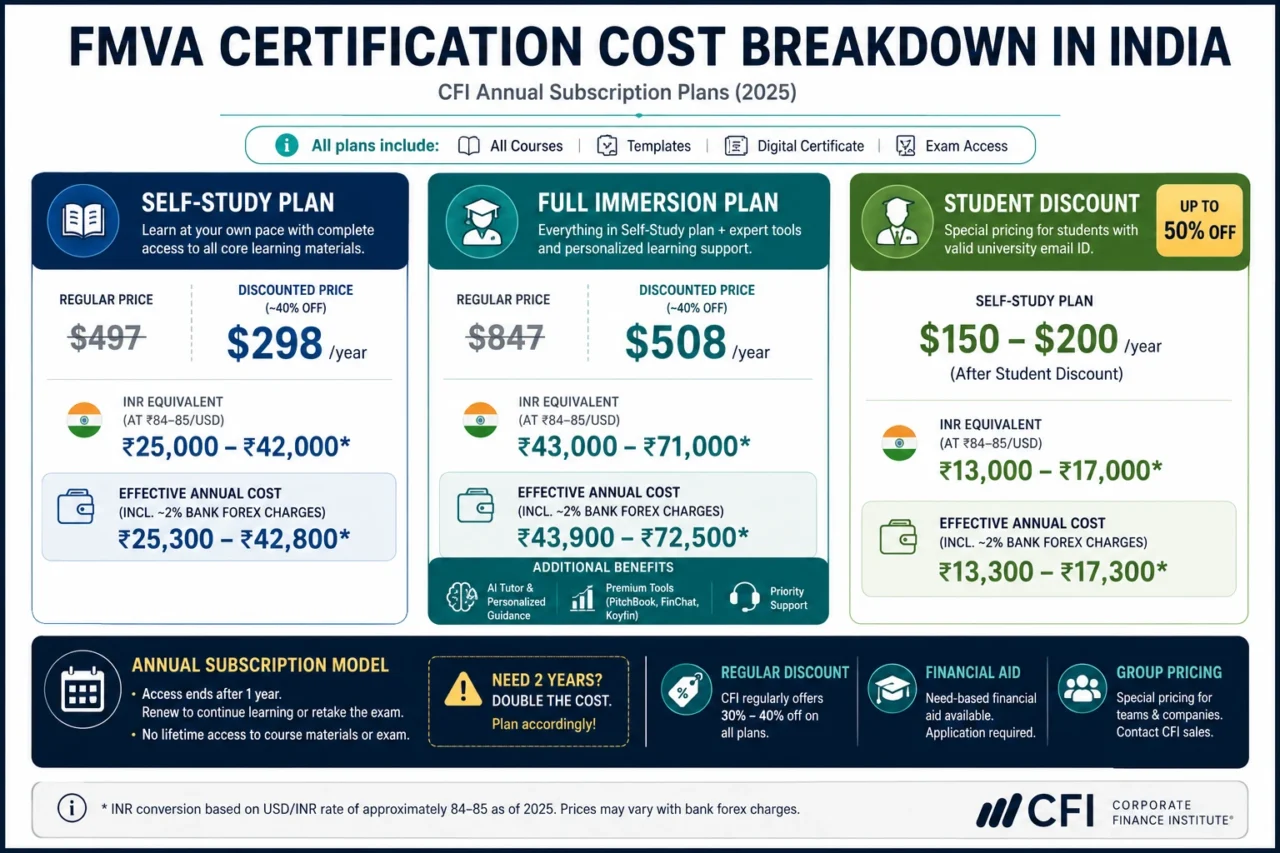
| Plan | USD Price (After Discount) | INR Equivalent | With Bank Forex Charges (~2%) | Effective Annual Cost |
| Self-Study | ~$298/year | ~₹25,300 | ~₹500 | ~₹25,800/year |
| Full Immersion | ~$508/year | ~₹43,200 | ~₹860 | ~₹44,000/year |
| Self-Study (Student 50% off) | ~$149/year | ~₹12,700 | ~₹250 | ~₹13,000/year |
*Approximate figures based on USD/INR ~84.5. Check current rates before enrolling.
For context: this is an annual cost. If you need two years to complete the program, double it. The total cost for most Indian candidates who don’t finish in year one ends up being ₹50,000–₹85,000 across two subscription periods — significantly more than the headline figure suggests.
How Does This Compare to Other Certifications in India?
| Certification | Approx. Total Cost (India) | Exam Format | Recognition in India | Placement Support |
| FMVA (CFI) | ₹25,000–₹85,000/year | Online MCQ (70% to pass) | Growing, stronger in MNCs/GCCs | None |
| CFA (All 3 Levels) | ₹3,00,000–₹5,00,000 total | In-person, rigorous | Very high — universal | None (self-driven) |
| FRM (GARP) | ₹1,00,000–₹2,00,000 total | In-person, rigorous | High — especially BFSI | None |
| MentorMe FM Certification | ₹25,000–₹60,000 (one-time) | Project + practical assessment | Strong in Indian market | Yes — job placement support |
| NSE Financial Modeling | ₹15,000–₹30,000 | Online exam | Moderate | None |
The honest comparison: FMVA’s cost is not dramatically cheaper than Indian alternatives once you account for the subscription model and USD conversion. The difference is that CFI has stronger global brand recognition, while India-based programs typically offer better localisation, placement support, and one-time pricing.
Related: CFA Full Form & Course Details | CFA vs Financial Modelling — Which is Better? | FRM Course Details | NSE Financial Modeling Courses
What Does the FMVA Actually Teach You?
The curriculum is genuinely solid. Here’s what the core program covers:
| Module | Key Topics Covered |
| Accounting & Financial Statements | Reading financial statements, accounting principles, debits/credits |
| Excel for Financial Modeling | Advanced Excel, shortcuts, formulas, data tables, dynamic models |
| 3-Statement Financial Modeling | Building integrated P&L, Balance Sheet, and Cash Flow models |
| DCF Valuation | Discounted cash flow analysis, WACC, terminal value, sensitivity analysis |
| Comparable Company Analysis | Comps methodology, trading multiples, normalisation |
| Precedent Transaction Analysis | Transaction multiples, deal premiums, M&A valuation |
| Budgeting & Forecasting | FP&A models, driver-based forecasting, scenario analysis |
| LBO Modeling (Elective) | Leveraged buyout structure, returns analysis, debt waterfalls |
| M&A Modeling (Elective) | Merger models, accretion/dilution analysis |
| Real Estate Modeling (Elective) | Property valuation, development models, cap rates |
The electives are genuinely useful — you can specialise in areas like real estate, oil and gas, mining, or fintech depending on your target industry.
One thing to note: the FMVA covers the same core skills that any good financial modeling program teaches. 3-statement modeling, DCF, comps, LBO — these are industry-standard skill sets, not proprietary to CFI. The value is in how well they’re taught and what credential you earn at the end.
Related: What is Financial Modeling? | Tesla Financial Model Tutorial | Leveraged Buyout Model — Step by Step | Sample Financial Model in Excel | Valuation of Equity Shares Guide
FMVA Certification — Genuine Pros and Cons
I’ll be direct here. There are real advantages to the FMVA, and there are real limitations. Both matter before you spend money.
The Genuine Pros
- High-quality content: CFI’s course material is genuinely well-produced. The Excel-based modeling exercises are hands-on and industry-relevant. The instructors know their material.
- Self-paced and flexible: You study when you want, as fast or slow as you need. For working professionals, this is a significant advantage over classroom-based programs.
- Breadth of curriculum: One subscription gives you access to the full CFI library — not just FMVA but also CMSA (Capital Markets), CBCA (Commercial Banking), and 270+ individual courses.
- Global brand recognition: CFI has built real recognition, particularly in North America, Europe, and with MNCs and GCCs in India. It is increasingly appearing in job descriptions and LinkedIn filters.
- Affordable vs. CFA: Compared to the CFA (₹3–5 lakh total) or even the FRM, the FMVA is significantly cheaper to obtain — especially with the student discount.
- Lifetime certificate: Once earned, the FMVA designation does not expire. You don’t need to pay continuing education fees or renew the credential.
The Genuine Cons
- Annual subscription, not one-time: This is the biggest catch for Indian students. If you don’t finish in a year, you pay again. The total cost for a two-year completion timeline is ₹50,000–₹85,000 — not the ₹25,000 headline figure.
- All-MCQ exam format: Every assessment in the FMVA — including the final exam — is multiple choice. You can retake them as many times as you need. This makes the pass rate very high, but it also means the credential signals completion more than it signals ability. Employers who know this nuance may value a practical, project-based assessment more.
- USD pricing — no India parity: CFI charges in USD with no purchasing power parity adjustment for India. At ₹84/USD, $297 is not cheap for a fresh graduate or early-career professional in India.
- No live instruction or mentorship: Everything is pre-recorded. There is no live Q&A, no mentor to guide your career, and no cohort to build a network with. The AI Tutor in the Full Immersion plan is a chatbot, not a human.
- No placement support: CFI does not help you get a job. The certificate gets you to the interview — what happens after is entirely up to you.
- Limited India-specific case studies: Most of the modeling case studies use US and Canadian companies. For Indian students analyzing Nifty-listed companies or preparing for Indian IB/PE interviews, the India-specific context is thin.
- Lower recognition in Indian boutique firms: At large MNCs, GCCs, and global IB firms, FMVA carries weight. At Indian boutique investment banks, CA-led firms, and domestic PE/VC shops, local credentials and practical skills tend to be weighted more heavily than the FMVA brand.
The FMVA is a good product. But it’s not a magic door-opener in the Indian market the way the marketing sometimes implies. It works best as a complement to other credentials and practical experience — not as a standalone differentiator.
Is FMVA Worth It in India? The Honest Answer
It depends on exactly who you are and what you’re trying to achieve. Here’s how to think about it:
FMVA is worth it if:
- You’re targeting MNC, GCC, or global firm roles in Pune, Bangalore, Mumbai, or Hyderabad — where international credentials carry weight
- You’re already working in finance and want to upskill in financial modeling without taking time off
- You qualify for the student discount (50% off) and can complete the program within one year
- You’re supplementing an existing strong credential (CA, MBA, CFA Level 1) and need a practical modeling add-on
- You’re targeting roles outside India — in the UAE, Singapore, UK, or North America — where CFI has stronger recognition
FMVA may not be worth it if:
- You’re a fresh graduate in India with a tight budget — the subscription model and USD pricing make the total cost unpredictable
- You want placement support — CFI offers none, and breaking into Indian finance without a network or placement assistance is genuinely hard
- You’re targeting Indian boutique IB, domestic PE, or CA-firm roles — where practical skills and local credentials matter more than global certifications
- You want live mentorship, doubt-solving sessions, or a peer cohort — FMVA is entirely self-paced and pre-recorded
- You cannot realistically complete the curriculum within one year — the subscription resets and you pay again
One of our students — an MBA Finance from Nagpur — had completed the FMVA on his own before coming to us. He had the certificate on his LinkedIn. What he didn’t have was the ability to build a 3-statement model from scratch without referencing notes. The FMVA gave him familiarity with concepts. What he needed was hands-on practice, India-specific case studies, and interview preparation. That’s the gap a structured, mentor-led program fills.
Related: How a Financial Modeling Certification Can Boost Your Career | Financial Modeling Course Online Pune | Financial Modeling Course Online Mumbai | Financial Modeling Course Online Bangalore | How to Become a Financial Analyst in India
FMVA Certification Salary: What Can You Expect?
Let’s be clear upfront: no certification guarantees a salary. What the FMVA does is make you more qualified for roles that pay well. The salary you earn depends on your role, company, city, and experience — the certificate is an enabler, not a guarantee.
That said, here’s what financial modeling and valuation professionals with this skill set earn in India:
| Role | Experience | Typical Salary Range (India) |
| Financial Analyst | 0–2 years | ₹4 LPA – ₹10 LPA |
| FP&A Analyst | 1–3 years | ₹6 LPA – ₹14 LPA |
| Equity Research Analyst | 1–3 years | ₹6 LPA – ₹15 LPA |
| Investment Banking Analyst | 0–2 years | ₹8 LPA – ₹20 LPA |
| Corporate Finance / Valuation | 2–5 years | ₹10 LPA – ₹25 LPA |
| FP&A Manager | 5–8 years | ₹18 LPA – ₹40 LPA |
| Senior IB / PE Associate | 4–7 years | ₹25 LPA – ₹60 LPA+ |
The FMVA certification by itself won’t move you from ₹5 LPA to ₹20 LPA. What it does, combined with strong practical modeling skills and relevant experience, is make you a credible candidate for the higher-paying roles above.
MNCs and GCCs in India — particularly in Pune, Bangalore, and Mumbai — pay at the top of these ranges and are the most receptive to international certifications like FMVA.
Related: Financial Modelling Salary in India | Financial Modelling Salary in Pune | Equity Research Analyst Salary & Career Growth | Investment Banker Salary India | What is FP&A?
How to Get the FMVA Certification: Step by Step
- Go to corporatefinanceinstitute.com and choose your plan — Self-Study (~$298/year with discount) or Full Immersion (~$508/year)
- Sign the CFI Honor Pledge — mandatory before starting
- Complete optional Prep Courses if you need to refresh accounting, Excel, or finance fundamentals
- Complete 14 Core Courses — these are the backbone of the FMVA curriculum
- Choose and complete 3 Elective Courses from the 27 available
- Attempt optional Case Study Challenges for practical application practice
- Pass the Final Exam with 70% or above — retakes are allowed with no limit
- Download your blockchain-verified digital FMVA certificate
Time required: Most candidates complete in 3–6 months studying 8–10 hours per week. If you have a stronger background, 2–3 months is realistic for the core curriculum.
One practical tip: don’t rush straight to the final exam. The hands-on modeling exercises in the core courses are where the real learning happens. Spend time on those — the exam is the easy part.
Related: Beginners Guide to Excel Financial Modeling | Financial Modeling Interview Questions | Financial Modelling Interview Questions for Freshers
Is FMVA Certification Free? What CFI Offers for Free
CFI does offer free content, but the full FMVA certification is not free. Here’s what you can access without paying:
- Free courses: CFI offers a selection of individual courses for free — typically introductory content in accounting, reading financial statements, Excel basics, and corporate finance. These are genuine learning resources, not just teasers.
- Free trial: CFI occasionally offers limited free access to explore the platform before committing to a subscription.
- Financial aid: Candidates who cannot afford the fee can apply for financial aid through CFI. Approval is not guaranteed and is assessed on a case-by-case basis.
The free courses are worth doing before you commit to a paid subscription. They give you a real sense of the teaching style, production quality, and curriculum depth — so you’re not paying blind.
If cost is the primary concern, there are legitimate free and low-cost alternatives for learning financial modeling fundamentals before committing to a paid certification.
Related: Free Financial Modeling Course | Free Excel Course | The Best Financial Modeling Course for Beginners
FMVA Course in India: Is There a Better Alternative?
This is the question most Indian candidates should be asking more seriously.
The financial modeling and valuation skills the FMVA teaches are not proprietary. A 3-statement model is a 3-statement model. DCF analysis is DCF analysis. The difference between providers is in how they teach it, how they assess it, and what support they provide after you’ve learned it.
Here’s what Indian candidates should weigh when choosing between the FMVA and India-based alternatives:
| Factor | FMVA (CFI) | India-Based FM Certification (e.g. MentorMe) |
| Pricing Model | Annual subscription (USD) | One-time fee (INR) |
| Cost Certainty | Unpredictable if you need > 1 year | Fixed upfront cost |
| Live Interaction | None — fully pre-recorded | Live sessions, doubt-solving, mentorship |
| India-Specific Content | Minimal — US/Canada case studies | Indian companies, NSE/BSE listed firms |
| Placement Support | None | Dedicated placement assistance |
| Exam Format | MCQ — unlimited retakes | Project-based + practical assessment |
| Recognition in India | Strong at MNCs and GCCs | Strong across Indian market + MNCs |
| Network | Online community only | Peer cohort + alumni network in India |
| Best For | Self-driven learners targeting global roles | Career changers and graduates targeting Indian market |
The honest recommendation: if you’re a self-directed learner targeting MNC or GCC roles and you’re confident you’ll complete the program within a year, the FMVA is a solid choice. If you need structure, mentorship, placement support, and India-relevant case studies, an India-based financial modeling certification will serve you better.
Some candidates do both — they complete a structured India-based program for the foundational skills and mentorship, then add the FMVA for global recognition. That combination is genuinely strong.
Related: Financial Modeling Course Online Pune | Financial Modeling Course Online Mumbai | Financial Modeling Course Online Bangalore | Financial Modeling Course Online Delhi | Financial Modeling Course Chennai | Financial Modeling Course Indore | Financial Modeling Course with Placement
Is FMVA Harder Than CFA?
No. Not even close — and this isn’t a criticism of the FMVA. They’re simply built for different purposes and tested at completely different levels of rigour.
| Factor | FMVA | CFA |
| Exam Format | Online MCQ, unlimited retakes, open book | Closed-book, in-person, strictly proctored |
| Pass Mark | 70% | ~45% (historically) |
| Study Hours Required | 100–120 hours total | 900+ hours across 3 levels |
| Levels | 1 program | 3 levels over minimum 2.5 years |
| Total Cost (India) | ₹25,000–₹85,000 | ₹3,00,000–₹5,00,000+ |
| Topics | Financial modeling, valuation, Excel, FP&A | Ethics, quantitative methods, economics, financial reporting, equity, fixed income, derivatives, alternatives, portfolio management |
| Recognition | Growing globally, strong in corporate finance/FP&A | Universal — gold standard for investment management |
| Difficulty | Moderate — accessible to motivated learners | Extremely challenging — among the hardest finance exams globally |
The FMVA is more accessible by design. CFI built it to be completable in months, not years. The CFA is a multi-year commitment that tests across the entire spectrum of investment management knowledge.
Comparing them as equivalents isn’t fair to either — they serve different career paths. The FMVA is for people who want to build financial modeling and corporate finance skills quickly. The CFA is for people who want to establish themselves in investment management over a long career horizon.
Related: CFA Full Form & Course Details | Which is Better: CFA or Financial Modelling? | CFA vs MBA — Which is Better? | Is CFA Really Worth It? | CFA Salary in India
Is the FMVA Exam Difficult to Pass?
Compared to the CFA or FRM — no. The FMVA final exam is considered moderate difficulty. Here’s what to expect:
- Format: Online, multiple choice, open book. You can reference your notes.
- Pass mark: 70% or above
- Retakes: Unlimited — no penalty for retaking
- Content: Tests concepts covered in the core and elective courses — financial modeling theory, valuation methodology, Excel applications, and accounting fundamentals
The course assessments (end-of-module quizzes) are more important to take seriously than people expect. The final exam pulls heavily from the same type of questions. If you’ve completed the courses properly and engaged with the material, the exam is manageable.
Where candidates struggle: rushing through courses without building the hands-on modeling skills, then finding that the exam questions require applied understanding, not just memorisation. The open-book format helps, but it doesn’t compensate for not knowing the material.
One documented limitation worth knowing: because the exams are all MCQ with unlimited retakes, it is technically possible to pass through trial and error. This is a genuine criticism from the finance community — it reduces the signalling value of the credential compared to rigorous in-person exams. This is why practical demonstrations of your modeling skills (actual Excel models, case studies) matter alongside the certificate when you’re applying for roles.
Related: Top 40 Valuation Interview Questions | Financial Modeling Interview Questions | Financial Modelling Interview Questions for Freshers | Capital Market Interview Questions
FMVA Certification Cost: Quick Summary
| Parameter | Details |
| Total Program Duration | Self-paced — typically 3–6 months for most candidates |
| Minimum Study Hours | 100–120 hours (core curriculum) |
| Subscription Period | Annual (1 year) |
| Core Courses Required | 14 |
| Elective Courses Required | 3 (from 27 available) |
| Final Exam Pass Mark | 70% |
| Self-Study Plan Cost | ~$298/year after discount (≈ ₹25,000–₹26,000) |
| Full Immersion Plan Cost | ~$508/year after discount (≈ ₹43,000–₹44,000) |
| Student Discount | Up to 50% with university email (≈ ₹12,000–₹13,000/year) |
| Certificate Validity | Lifetime — does not expire once earned |
| Payment Currency | USD only — no INR pricing |
People Also Ask
Is FMVA certification worth the cost?
For the right candidate, yes. If you’re targeting MNC, GCC, or global finance roles and can complete the program within one year, the FMVA offers solid value — good content, a globally recognised credential, and flexible self-paced learning. The caveat: it’s an annual subscription in USD, the exam is MCQ-only with unlimited retakes, and there’s no placement support. If you need mentorship, India-specific content, or job placement assistance, you’re better served by an India-based financial modeling program — or a combination of both.
Is FMVA harder than CFA?
No — significantly easier. The FMVA is an online, open-book, MCQ exam with unlimited retakes and a 70% pass mark. The CFA is a three-level, closed-book, in-person exam series requiring 900+ hours of study with historically low pass rates. They are not comparable in difficulty. The FMVA is accessible; the CFA is one of the most demanding professional exams in finance.
Is FMVA worth it in India?
Conditionally yes. It carries real weight at MNCs, GCCs, and global firms operating in India — particularly for FP&A, financial analysis, and corporate finance roles. It carries less weight at Indian boutique IB firms, domestic PE shops, and CA-led practices, where practical modeling ability and local credentials matter more. The USD pricing and subscription model make it disproportionately expensive for fresh Indian graduates relative to the value received. Students with a university email getting the 50% discount get the best deal.
Is the FMVA exam difficult to pass?
The exam is moderate difficulty and considered manageable for candidates who have worked through the course material properly. It is open-book, online, multiple choice, with a 70% pass mark and unlimited retakes. The bigger challenge is building genuine modeling skills during the course — not the exam itself. Candidates who rush through the curriculum often struggle more than those who take time with the hands-on modeling exercises.
People Also Search For
FMVA Course Duration and Fees
The FMVA is self-paced with no fixed duration. Most candidates complete in 3–6 months studying 8–10 hours per week. The total program is 100–120 hours of content. Fees are annual: approximately $298/year (Self-Study) or $508/year (Full Immersion) after the standard discount, which converts to roughly ₹25,000–₹44,000 per year at current exchange rates.
FMVA Certification Free
The full FMVA certification is not free. However, CFI offers a selection of free individual courses — including introduction to accounting, reading financial statements, and Excel basics — that you can access without paying. CFI also has a financial aid program for candidates who cannot afford the fee. For structured free learning, MentorMe also offers a free introductory financial modeling course that covers the fundamentals before you decide on a paid certification.
Related: Free Financial Modeling Course
FMVA Certification Salary
The FMVA itself doesn’t come with a salary bracket — your compensation depends on your role, employer, city, and experience. That said, the roles FMVA prepares you for in India pay between ₹5 LPA (entry-level financial analyst) and ₹60 LPA+ (senior IB or PE professional). MNCs and GCCs in Pune, Bangalore, and Mumbai pay at the higher end of these ranges for candidates with strong financial modeling skills.
Is FMVA Certification Worth It
Worth it for: candidates targeting MNC/GCC roles in India, working professionals who want flexible self-paced upskilling, and anyone who can access the student discount. Not worth it for: fresh graduates on tight budgets who can’t guarantee completion in one year, candidates needing placement support, and those targeting Indian boutique firms where practical ability and local credentials are weighted more than global certifications.
FMVA Course in India
There is no India-specific version or India office of CFI. The FMVA is available online globally and Indian candidates access it at the same USD price as everyone else. There is no INR pricing, no India-specific content, and no physical presence in India. For India-focused financial modeling training with local case studies, live mentorship, and placement support, India-based programs are a better fit — either as an alternative or complement to the FMVA.
Related: Financial Modeling Course Online Pune | Financial Modeling Course Online Mumbai | Financial Modeling Course Online Bangalore | Financial Modeling Course with Placement
How to Get FMVA Certification
Visit corporatefinanceinstitute.com, choose a subscription plan (Self-Study or Full Immersion), complete 14 core courses and 3 elective courses, and pass the final exam with 70% or above. The entire process is online and self-paced. Most candidates complete within 3–6 months.
Best FMVA Certification
The FMVA is offered exclusively by CFI — there is no other provider that offers this specific designation. If you’re asking which financial modeling certification is best overall, that depends on your goals. For global recognition and self-paced online learning, the FMVA (CFI) is one of the strongest options. For India-specific training with placement support and hands-on mentorship, a structured Indian financial modeling program may serve you better. Many strong candidates hold both.
Related: Top Financial Modeling Certification Courses | The Ultimate Guide to Choosing the Best Financial Modeling Course | How Online Financial Modeling Courses Can Transform Your Career
Final Word: Should You Do the FMVA?
The FMVA is a legitimate, well-built certification from a credible provider. The curriculum is solid, the content is genuinely useful, and the credential carries real weight in certain markets — particularly with MNCs and GCCs operating in India.
But it’s not the only path to financial modeling competence, and for many Indian candidates it’s not even the most practical one. The subscription model, USD pricing, MCQ-only assessment, absence of placement support, and limited India-specific content are real limitations — not marketing noise.
Before you spend ₹25,000–₹45,000 on an annual subscription, ask yourself: do I have the discipline to complete this independently in 12 months? Do I need live mentorship and doubt-solving? Do I need placement assistance? Am I targeting Indian firms or global ones?
The answers to those questions should drive your decision more than any certification brand.
If you want to explore a structured, India-first financial modeling program with live sessions, India-specific case studies, and placement support, explore our Financial Modeling Training programs. Or start with our free financial modeling course to get a feel for where you stand before committing to any paid program.
Also Read
Top Financial Modeling Certification Courses
Free Financial Modeling Course
Which is Better: CFA or Financial Modelling?
CFA Full Form & Course Details
Financial Modelling Salary in India
Investment Banker Salary India
How to Become a Financial Analyst in India
Financial Modeling Course with Placement
Equity Research Analyst Salary & Career Growth
Top 40 Valuation Interview Questions
Leveraged Buyout Model — Step by Step
Sample Financial Model in Excel

A CFA charterholder with hands-on experience across investment analysis and finance education. At MentorMeCareers, he writes and reviews content on CFA, financial modeling, and investment banking careers — grounded in real market data rather than generic advice, and shaped by what actually helps candidates and professionals succeed.