
Last updated on February 18th, 2026 at 05:32 pm

So, most of the time when I have interviewed candidates, I ask them the importance of financial modelling 99.9% of the time, the answer is that it helps us forecast future financials. While, I am not saying that, the answer is wrong but you missed out the broader benefit. Which is decision making.
What is Financial Modelling?
Financial modelling is a process, skill which is needed in day to day finance jobs. It is a process of creating structured and quantitative representation of a company’s financial performance. We do this with help of Microsoft Excel which is a tool through which we perform financial modelling. This involves building dynamic models based on historical data and business variables to forecasts, valuation also cash flow.
These models serve as decision-making tools that help businesses and investors evaluate the impact of strategic choices such as fundraising, mergers and acquisitions (M&A), capital budgeting, pricing decisions, and business expansion plans.
Financial modelling is a skill which comes under core finance jobs. Where a financial model is used to transform raw data and assumptions into actionable insights. Financial Modelling is widely used by investment bankers, financial analysts also corporate finance teams.
In short, financial modelling is not just about numbers it’s a strategic tool which helps businesses make decisions.
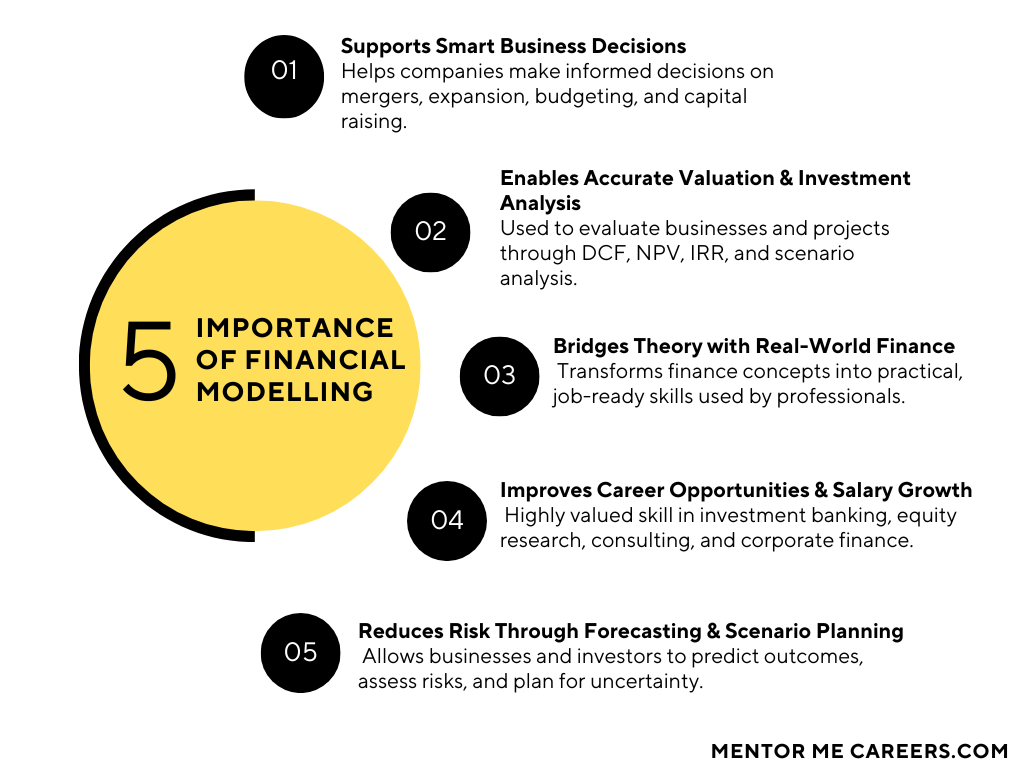
Importance of Financial Modelling
Now, let me put up some scenarios which would be rather simple. What I want you to notice, is the bridge that financial modeling creates for that crucial “Yes” or “No”.
Structuring Your Plan
For a moment imaging you are planning your investments for retirement. And you are thinking, where do I start thinking about this? That’s the beginning of the importance of financial modeling.
So, may be your financial modeling brain starts thinking about the process and comes up with the following structure;
- Firstly, what is my source of income and what are my expenses?
- Secondly, what will be probably my aspirational income needed to meet aspirational expenses in the future.
Now, suppose the lifestyle you want to maintain 20 years from now looks like 1.5 Lacs per month today. So, then what amount would you need to save and in what you need to save is where the importance of financial modeling kicks in.
Just imagine this for a sec! You are an entrepreneur who has no family history of business and you want to start a business. So, as a layman you think. I will start a restaurant. Your friends cheer you up and you are willing to invest Rs. 50 Lacs to start the business. But only to realize the following
- That the Restaurant or food business in general is the worst business to start with.
- The margins are low and initial investment is high.
So, would you still bet your 50 Lacs. Hence the importance of learning financial modeling, helps you in answering these questions before you commit.
Tweaking the Plan
The importance of financial modelling is also realized when I must change gears. Sometimes, I can make the best plans on a spreadsheet, but the word is a complex place to operate. Hence, as soon as I start implementing a plan it might not go as planned, which requires that you make changes. But the question is what?
For example, you might realize that your sales have started dropping, hence you might have to tweak the price but how much will you reduce. How will affect your margins? How will it effect your cash flows?
Assessing your risk
No matter how safe an investment might look like, it does carry risk. But at the same time not all risk is bad, because without risk there is no return. So, how much risk are you willing to take? Also, there might be options which give you the highest return for the lowest amount of risk in the category. Again a crucial aspect, for the importance of financial modelling.
Valuation
Everything can be valued including your house, car, land, gold. And eventually everything is valued basis the cash it can generate in the future. So the importance of financial modelling in valuation is unparalleled.
Scenario Analysis
For this let’s assume you are going to start a transport business. Where you take passengers from one point to another. Now imaging the moving factors that can effect your profitability? Firstly fuel, second the number of passengers, thirdly maintenance, or interest rates. So now financial modeling can actually run these scenarios without any manual work which helps in decision making
Optimum Taxation
So, businesses can optimize of taxes by pre-planning expenses which are beneficial for it. Which also requires financial modeling. For example; let’s say you have a business and you want to increase the expenses but at the same time use those expenses for the benefit. So, you see that your machinery is outdated and is consuming higher fuel. Now, if you are able to upgrade the system, then your output can improve while improve cost but at the same time also give you extra depreciation expense, which reduces tax liability.
Real-World Applications of Financial Modelling
Financial modelling is widely used in real-life business and investment decisions, making it a critical skill across industries. Companies rely on financial models to evaluate strategic choices such as mergers, acquisitions, budgeting, and capital raising. In investments, models help assess returns and risks using structured valuation techniques. This clearly shows how financial modelling in real life directly influences high-value financial decisions.
Key real-world applications include:
- Business decisions like mergers, acquisitions, budgeting, and fundraising
- Investment analysis using DCF, NPV, and IRR models
- Equity research and stock valuation for buy/sell decisions
- Forecasting cash flows and profitability for long-term planning
Financial Modelling vs Theoretical Finance Knowledge
Theoretical finance focuses on concepts and formulas, while financial modelling emphasizes practical, hands-on application. Recruiters prefer candidates who can apply theory to real financial scenarios, build working models, and interpret results. This is why practical modelling skills often outweigh academic knowledge in hiring decisions.
Key differences include:
- Hands-on modelling vs textbook-based learning
- Practical problem-solving vs conceptual understanding
- Recruiters value job-ready modelling skills
- Real cases where students convert internships into full-time offers due to modelling expertise
Who Should Learn Financial Modelling?
Financial modelling is a versatile skill suitable for individuals from various educational and professional backgrounds. It enhances employability by providing practical exposure to finance applications used in real business environments.
Financial modelling is ideal for:
- Commerce and finance students seeking practical skills
- Engineers entering finance roles like investment banking or equity research
- MBA aspirants and working professionals in corporate finance or consulting
- Career switchers targeting investment banking, PE, or equity research
Mistakes to Avoid While Learning Financial Modelling
Many learners struggle because they focus on tools instead of understanding the underlying financial logic. Financial modelling is about reasoning and assumptions, not just Excel formulas.
Common mistakes to avoid:
- Overfocusing on Excel and ignoring business logic
- Copy-pasting models without understanding assumptions
- Skipping hands-on practice with real case studies
- Jumping to advanced models without mastering basics
How to Start Learning Financial Modelling
Learning financial modelling requires a structured roadmap combined with consistent practice. Starting with core tools and gradually moving toward advanced models ensures a strong foundation and long-term success.
Recommended learning approach:
- Master tools like Excel, PowerPoint, and financial ratios
- Follow a roadmap: basic accounting → 3-statement models → valuation → LBO
- Practice with real-world case studies
- Use structured resources such as blogs, YouTube, and guided programs like Mentor Me Careers
Here’s an SEO-optimized, reader-friendly section based on your input designed to rank and engage:
Benefits of Learning Financial Modelling
Financial modelling is no longer a niche skill; it’s a must-have across all major finance roles. Whether you’re aiming for investment banking, equity research, or corporate finance, mastering financial modelling gives you a competitive edge.
Key Benefits:
- High-demand skill across finance domains like IB, VC, FP&A, and consulting
- Improves business decision-making and sharpens analytical thinking
- Increases placement and internship chances for students, MBAs, and CFA aspirants
- Enhances your resume with job-ready skills recruiters look for
- Builds financial confidence to model real-world companies and scenarios
Financial modelling bridges theory with hands-on application making your profile far more attractive to hiring managers in India’s competitive finance job market.
Financial Modelling Careers & Salaries in India
Learning financial modelling unlocks a variety of high-paying career paths. It’s a core skill recruiters expect in modern finance roles.
Popular Roles:
- Financial Analyst
- Investment Banking Associate
- Valuation Analyst
- Equity Research Associate
- FP&A Manager
Salary Range (India):
| Role | Average Starting Salary (₹) | Mid-Level (₹) |
| Financial Analyst | 4–7 LPA | 10–15 LPA |
| Investment Banker | 10–15 LPA | 20–35 LPA |
| Valuation Analyst | 6–10 LPA | 12–20 LPA |
| FP&A Analyst | 5–8 LPA | 12–18 LPA |
Major firms like EY, KPMG, JPMorgan, and boutique banks actively hire candidates with strong modelling backgrounds, especially when backed by certifications or case-based learning.
Essential skills needed for financial modelling
- Advanced Excel
- Understanding of accounting and financial statements
- Financial analysis and valuation skills
- Analytical thinking
- Presentation skills
I did not mention power Bi and tableau because as a fresher financial analysts you wont be using those skills. When u gain experience as a analyst you should those skills.
Tools wise learn Excel and google sheets for handling the data. Learn to use accounting and if possible some ERP software.
Best Practices for Success with Financial Modelling
Now, let me discuss some of the best practices to incorporate while using this tool. So that you gain the maximum benefits.
Data Accuracy:
Your model is as good as the data and assumptions. The lower the accuracy of your data the lower the quality of output
High Quality Research:
Always and one of the most important advice while using financial modeling is to do the best research. The better the research, the more conviction you will have on your financial model
Regular Updating
A financial model is like a map, which needs to be upto date with new information. For example; you are making a financial model for a publicly listed company. If there is new business information in the quarter related to drop in demand or rise in raw material expenses. Then you must update this to make your map useful.
FAQ’s on Importance of Financial Modelling
The bigger companies for sure use this tool but for smaller business’s this becomes even more critical. Because if you have to take the best possible decisions which can match up to the standards then your best option is with the best plan which is using financial modeling
So, financial modeling is used in investment banking, equity research, credit analysis, Risk management and even trading models
The basic structure of a financial model, is data( In a valuation model, that could be financial statements), second is the metrices of the model( Again in a business that means business drivers), and final is the decision parameters( For eg In business it is NPV, IRR, Intrinsic value etc)
There are many ways of learning financial modeling. You can do self study using our youtube playlist of financial modeling, or you can also join our full time live online courses to learn this and also get placed in finance