Last updated on September 24th, 2026 at 06:23 pm


The path to success, is to find your passion, embrace uncertainty and not worry about outcomes” If the thought of doing CFA after CA has occurred in your mind, you are not alone!I have come across many CA finalists, who start planning for CFA a year before the actual preparation.You have come to the right place, and I will make sure that you don’t have to browse any more articles to find this answer.At the end I will also share some easy formula to check if this talked about qualification is for you or not. So Lets get started !I have picked up the most common questions CA background students and working professionals have about CFA. Here is the list of questions, I will answer from.
Difference Between CFA Vs CA
Chartered financial analyst program or popularly known as CFA, is a U.S based investment finance qualification established in 1947 by FAF Foundation. CA on the other hand is a regulatory compliance qualification, specific to a country like India.
- Field: CA is a core accounting qualification, whereas CFA is an investment finance qualification. Both specialise for different domains and have their own niche that they serve
- Roles: While a CA can definitely work in the investment industry without any additional qualifications but CFA candidates or charterholders cannot work in an accounting profession without CA. That doesn’t mean that CFA is not beneficial to do for a CA or CA Inter
- Governing Body: CFA is controlled by CFA institute U.S, while CA is controlled by ICAI India
- Levels and Duration: CFA has three levels and takes about 1.5 Years to complete ( No article ship in between). CA on the other hand has CPT, IPCC, Final with articleship compulsory
- Syllabus: Both programs are widely different in terms of their core focus, while CA syllabus has may be just one subject on financial management. On the other hand CFA syllabus has 10 subjects on investments
- Difficulty: CFA and CA both are prestigious and difficult exams to clear. CFA level 1 has about 44% pass rate, level 2 – 45% and level 3 – 55%. CA has a pass rate of around 15% in its final exams
- Exams: CFA exams happen now in a computerised format 4 times a year in level 1, two times in level 2 and level 3. CA Exams on the other hand haven’t changed much.
- Pattern: CFA exams are completely MCQ based in two levels and essay in the third level
CFA vs CA: A Comprehensive Comparison
| Aspect | CFA | CA |
|---|---|---|
| Primary Focus | Finance and Investment Management | Accounting, Auditing, and Taxation |
| Global Recognition | Highly recognized globally | Primarily recognized in India |
| Industry | Investment Banking, Portfolio Management | Accounting, Auditing, Corporate Taxation |
| Aspect | CFA | CA |
|---|---|---|
| Time Required | 4-5 Years (Typically Part-Time) | 4-5 Years (Full Commitment) |
| Levels | Three Levels | Three Levels (Foundation, Intermediate, Final) |
| Exam Format | Multiple Choice and Item Set | Descriptive and Objective |
| Aspect | CFA | CA |
|---|---|---|
| Total Cost | ₹3-4 Lakhs | ₹1-2 Lakhs |
| Additional Costs | Study Material, Membership Fees | Coaching Fees |
| Aspect | CFA | CA |
|---|---|---|
| Pass Rates | ~40-50% per level | ~5-10% (Final Level) |
| Conceptual Depth | Finance and Investments | Accounting, Taxation, Law |
| Memorization | Concept-Based | Heavy Memorization |
Salary: CA vs. CA+CFA
Why the dual credential moves the needle: A CA alone gives you statutory signing authority and deep compliance expertise — valuable, but capped by function. The CFA doesn’t replace that; it adds capital markets, valuation, and portfolio management knowledge that opens roles a CA-only profile typically can’t access — equity research, M&A advisory, and buy-side analyst seats. Recruiters and industry data consistently point to a 20-35% pay premium for dual-qualified candidates in roles that need both skill sets, though it’s role-specific — a CA doing pure statutory audit won’t see this premium just from adding CFA to their resume. The premium shows up when you actually move into an investment-facing function.
Where this doesn’t apply: If you stay in audit, tax, or compliance after adding the CFA, don’t expect the salary jump — the credential only pays off when you use it to pivot into research, valuation, or investment roles. This is the honest answer, not the optimistic one. For the full India-wide salary breakdown by level and city, see our CFA salary in India 2026 guide.
| Career Stage | CA Only | CA + CFA (Dual Qualified) |
|---|---|---|
| Fresher / 0-2 years | ₹7-15 LPA (higher in Big 4 and top corporates) | Limited data — most CAs add CFA after 2-3 years of practice, not before |
| Mid-career / 3-5 years | ₹12-20 LPA (corporate finance, Big 4 senior roles) | ₹18-28 LPA in investment-facing roles (equity research, transaction advisory, M&A) |
| Senior / 8+ years | ₹25-40 LPA (CFO track, Big 4 partner track) | ₹35-60+ LPA in portfolio management, IB, or specialized advisory |
| Leadership | ₹60 LPA-₹1 crore+ (CFO, Big 4 Partner) | ₹1 crore+ achievable faster when the CFA opens front-office or buy-side roles unavailable to a CA-only profile |
Advantages of doing CFA Program after CA
I am going to answer this simply at a very broad level, since CA adds a lot of credibility already in the industry. More than just showcasing that you have many degrees, its about displaying your core interest in finance with CFA. So ill answer this from a more knowledge perspective
Top 4 Advantages of doing CFA After CA
- Gives you immense depth for finance
- Gives you an advantage over plain CFA candidates with CA
- Gives you knowledge on asset management industry
- Gives you more broader opportunities than just plain accounting
Focusing on Investment and Portfolio Management
When contemplating the CFA after CA, it’s essential to recognize the program’s focus on investment and portfolio management. The CFA curriculum delves deeply into portfolio management, financial statements analysis, and other crucial aspects of finance. For those with a CA background, this complements the accounting knowledge acquired from the Institute of Chartered Accountants of India, enhancing one’s expertise and broadening career opportunities. Understanding these areas can significantly impact your professional journey, especially if you aim to transition into roles that require strong investment management skills.
CFA After CA or During CA Inter
The question I am trying to answer here is , whether you should do this while you are doing CA or after you become a qualified chartered accountant. You can answer this with the following two points
- Your CA Inter -aspiration status: Do you fall under the category of CA candidates, who has tried multiple attempts ? In the verge of loosing the motivation to continue your first love of CA? or may be you realised you never were in love with CA but forced into an arrange marriage with it? If the answer is yes, then go for it.
- CA Completed Work Experience Status: Are you already working in an accounting field, with some considerable auditing experience? You want more exposure in other departments? May you don’t like the auditing field work? Again in this case the decision is based on the actual work, and in this case it can make sense to first explore what roles can you get into?
I would highly recommend CA’s who have at least 1 -2 years experience to first try their hands on financial modelling course before jumping to CFA. It might turnout that you don’t like finance either. Financial modelling will give you’re the practical experience, of how its going to be after doing CFA
Arjun Mehta, CFA level 1 & CA inter- Testimonial
“Balancing CFA with my CA journey was a challenge, but it turned out to be one of the best decisions I ever made.” – Arjun Mehta
During my CA articleship, I decided to take on the CFA Level 1 exam, driven by my passion for finance and a desire to gain a deeper understanding of concepts beyond the CA syllabus. For me, CFA stood out as a globally recognized qualification that complements the technical rigor of CA. It helped me strengthen my knowledge in finance, especially in areas like SFM, risk management, and IFRS, which I aced in my CA Final exams.
Preparing for CFA gave me an edge—it was concept-based and analytical, unlike the memory-heavy nature of CA. The process of working through 2,400+ practice questions sharpened my problem-solving skills and boosted my confidence, especially after setbacks during my IPCC. Clearing CFA Level 1 reaffirmed my abilities and made CA Final seem more achievable.
CFA is more than just a qualification; it’s a confidence-builder and a gateway to global opportunities. For CA students passionate about finance, I wholeheartedly recommend CFA, but timing is key. Consider pursuing it after completing your CA or during your final college years to manage the workload effectively. For me, it wasn’t just about clearing another exam—it was about becoming a well-rounded finance professional.
Common Syllabus In CA and CFA
While I don’t expect much similarity in the deeper level of CA and CFA Syllabus, leaving some core concepts which are common everywhere. Since I assume that everyone reading this is someway connected to CA, hence I will directly list the subjects in CA, which might be common or close to the CFA syllabus ( Level 1 only).
- CA intermediate: Financial management Vs Corporate Finance in CFA Level 1
- CA Final group 1- Strategic financial management Vs Corporate Finance CFA level 1
- CA Final Group 2-Financial services and capital Markets- Equity Valuation in CFA level 1
Well believe it or not that’s the only commonality between the two qualifications. To sum up I can safely say, that a CA candidate still has to learn a lot of content in CFA to clear it. You can check the detailed syllabus of CFA level 1 here
Exemptions In CFA for CA
The straight answer is None! As disappointing, as it may sound but hope you got the reason in Point 4. In fact to elaborate this further, there are no exemptions to even a candidate with PHD In finance from Harvard. That’s just how CFA is! Do I agree with this policy of CFA?, absolutely yes. I have seen a lot of CA’s with experience, and a lot of Economics masters qualification failing the exam.
So dread careful, CFA is a daunting qualification when it comes to the content and its depth. You can’t buy yourself into the designation with memorising formulas and concepts
Duration, Preparation, Fees
This entire process can be broken down into
- Duration for preparation: At least 6 months before the exam date
- Registration: If you are a CA intern and have graduated then you can easily login to CFA institute website and register. You will need a valid passport, a credit card and strong reason to purse this designation
- Fees: In total, combining all the three levels, it will cost you a $2800 for exams, around INR 30,000 per level of training. That’s about INR 2.5 Lacs to 3 lacs for all three levels
- Eligibility: You should be in the final year of your graduation or 11 months away from your final year exams. In case you are already a graduate or a CA , then nothing to worry
You can check more details of the the schedule of the exams here: CFA Course For CA
Read More: CFA exam fees in India | CFA Scholarship Window
CFA Difficulty Level Compared to CA
A simple answer to that is CFA is slightly easier than CA, if you study 300 Hrs per level. Yes! Unlike CA where there is a calculation of supply and demand, CFA pass rates are not decided like that. This is how the minimum passing score gets decided in CFA
- After CFA Exam: The paper is solved by many CFA charterholders and the question is rated for its difficulty. In other words, each question is marked, on how much an average candidate would score
- Aggregation: All such attempts are aggregated and the score calculated becomes the MPS
So if you study and prepare above average, then you should be able to clear the exam. Check out my preparation strategy video here
Read More: CFA Pass percentage | CFA exam Pattern
12-Month Study Plan for CA Professionals Pursuing CFA Alongside Work
If you’re a working CA, you already have an advantage most CFA candidates don’t: you can read a balance sheet without blinking. But that advantage covers maybe 25-30% of the CFA Level 1 curriculum (Financial Reporting & Analysis, some of Corporate Issuers). The rest — Quantitative Methods, Economics, Fixed Income, Derivatives, Portfolio Management — is genuinely new territory, and it’s where CA candidates tend to underestimate the time needed because FRA felt easy.
This plan assumes 10-12 hours/week around a full-time CA job, targeting one CFA Level 1 exam window roughly 12 months out. Adjust the pace, not the sequence, if you have more or less time.
Months 1-2: Foundation and diagnostic
Start with Quantitative Methods and Economics — the two areas with zero overlap with CA. Don’t touch FRA yet; it’ll go faster later and you don’t want early momentum eaten up by a subject you already know. Take a full diagnostic mock in month 2 to see where you actually stand, not where you assume you stand.
Months 3-5: Core build-out
Move into Corporate Issuers, Fixed Income, and Derivatives. This is the heaviest new-content stretch. Budget extra time for Fixed Income specifically — CA training doesn’t touch bond pricing, duration, or term structure, and candidates from an accounting background often need two passes through this section.
Month 6: Financial Reporting & Analysis
This is where the CA background pays off. You’ll move through FRA faster than most candidates — but don’t skip practice questions on the CFA-specific angles (IFRS vs. US GAAP reconciliation nuances, financial statement analysis for investment decisions rather than compliance). The exam tests it differently than ICAI does.
Months 7-8: Equity, Alternative Investments, Portfolio Management
New conceptual territory again. Portfolio Management in particular requires a mindset shift — you’re now valuing and allocating, not auditing and certifying.
Month 9: Ethics — start here, revisit constantly
Don’t leave Ethics for the end. Start it in month 9 and keep revisiting it in short bursts through month 12. It’s scored differently than other topics and consistently trips up strong candidates who treat it as an afterthought.
Months 10-11: Full curriculum review and timed practice
Weekly full-length mocks under exam conditions. Track weak topic areas by percentage score, not gut feeling. This is also when work crunch (audit season, month-end closing, deadline weeks) collides hardest with study time — build buffer weeks into the schedule now, not in month 12 when there’s no slack left.
Month 12: Final consolidation
Formula sheets, error logs from every mock you’ve taken, and one final full mock at actual exam-day timing. Taper new content; this month is about retrieval, not learning.
A note on pacing across levels: This 12-month structure is calibrated for Level 1. Level 2 typically needs the same or slightly more time because of the vignette format and interconnected topics; Level 3 candidates with strong Level 1/2 foundations often compress this to 8-10 months. Don’t assume the cadence shortens just because you’re one level in — for a fuller breakdown by exam window, see our CFA Level 1 exam syllabus and study plan guide
Conclusion
To sum this up. Let me leave you with a simple question to answer your self and if the answer matches with mine then go for CFA, else you need to stay away from this.
- Do you have a strong reason why you like the investment field ?- Justify this to yourself or it just a fascination
- Have you ever been related to equity markets, trading, investments? – I started trading when I was 16 years old, and even today investments excite me.
- Do you have the time and bandwith : CFA is a gruelling journey, and needs similar commitment like CA- can you give that?
- Have you researched on the finance roles?- If not read this:
If the answer to all the above questions is yes, then go for it. Else you need some soul searching to do, but you will get there. It sometimes takes a good amount of time, to find what you love. Keep searching! For any questions, feel free to write me on contact us on
FAQ’s
FAQ
Can a CA do CFA in India?
Yes, and it’s one of the more common credential combinations among Indian finance professionals. A CA qualification satisfies the CFA Program’s education requirement (equivalent to a bachelor’s degree), so you can enroll and register for Level 1 directly.
One correction worth making here, since it’s a common search and a common misunderstanding: CFA Institute does not grant CA holders any exam exemptions. You’ll sit all three levels — Level 1, 2, and 3 — like every other candidate, regardless of your CA qualification. What CA does give you is a genuine head start on the FRA sections of Level 1 and 2, since financial statement analysis is core to both curricula. It won’t shorten the exam path, but it will shorten your study time on roughly a quarter of the syllabus.
One more detail CA professionals often miss: your articleship experience doesn’t automatically count toward the CFA charter’s 4,000-hour work experience requirement. That requirement specifically needs experience in investment decision-making — research, portfolio management, valuation, or similar. Pure audit or tax articleship experience generally doesn’t qualify, so factor that into your charter timeline, not just your exam timeline.
How many attempts do CA professionals take for CFA?
There’s no official CFA Institute data segmented by prior qualification, so be wary of any site quoting a specific “CA pass rate” for CFA — that number isn’t published anywhere credible. What we can say, grounded in the actual data: CFA Level 1 pass rates run 40-56% per sitting across all candidates, and CA holders don’t get a separate, higher bucket.
In practice, CA professionals tend to clear FRA-heavy content faster and with fewer repeat attempts on that section specifically, because they’re not learning financial statement analysis from scratch. But they don’t have an advantage — and sometimes have a disadvantage — on Quant, Economics, Fixed Income, and Portfolio Management, since these are genuinely new subjects with no CA-curriculum overlap. The honest expectation: budget for the same 3-exam-level path as any other candidate, and don’t assume your CA background buys you a first-attempt guarantee on the whole exam — it buys you a head start on part of it.
Is it worth pursuing CFA along with CA?
For what is worth, this nothing related to the technicality in this process. However, in my humble opinion CA is already difficult with enough time dedicated for it. Pursuing an equally challenging charter like CFA is not sound plan. Although by all means, any one can pursue it.
Are there any benefits of doing CFA after CA(ICAI)?
Ofcourse there are but if your question is, whether it directly increases the salary? Then the answer is no. The knowledge you gain with CFA should help you in getting into profiles which would in general cases be closed for chartered accountants.
How much does a CFA gets paid?
CA (Chartered Accountant)
- Entry-Level: ₹5–7 LPA for freshly qualified CAs.
- Mid-Level: ₹13–15 LPA with several years of experience.
- Senior Roles / CFO: ₹30–40 LPA+, especially in Big 4 firms or large corporates.
- A broader perspective estimates average range: ₹6–10 LPA.
What is salary of CFA?
CFA (Chartered Financial Analyst)
- Entry-Level (after Level 1): ₹5–8 LPA.
- Mid-Level: ₹15–20 LPA common, especially in asset management, equity research, and banking. Program charterholders often reach ₹25+ LPA.
- Senior (CFA Charterholder): ₹25–30 LPA is typical; those holding the charter often climb higher.
- CFA Institute data: Average salary for a charterholder with ~6 years of experience is ₹28.6 LPA.
How to Do CFA After CA?: Step-by-Step
Here’s the actual process, not the vague version most guides give you.
Step 1: Confirm eligibility
Your CA qualification satisfies the CFA Program’s education requirement on its own — you don’t need a separate bachelor’s degree. If you’re mid-articleship and haven’t finished CA Final yet, you can still register as long as you meet CFA Institute’s standard entry criteria (bachelor’s degree, or final year of one, or the required combination of education and work experience).
Step 2: Register with CFA Institute and pick your exam window
CFA Level 1 is offered multiple times a year (typically February, May, August, and November). Register early — pricing tiers increase the closer you get to the exam date, and CA professionals juggling work commitments benefit from locking in a date months out rather than deciding last-minute.
Step 3: Get the curriculum and build your study plan around your CA background
Don’t start with a generic study plan built for fresh graduates. As a CA, roughly a quarter of Level 1 (FRA, parts of Corporate Issuers) will move faster for you; the rest — Quant, Economics, Fixed Income, Derivatives, Portfolio Management — needs full attention as new material. Use the 12-month plan above as your framework and adjust the pace to your work schedule, not the sequence.
Step 4: Clear Level 1, then Level 2, then Level 3 — no shortcuts
There are no exam exemptions for CA holders (see the FAQ above). Each level builds on the last: Level 1 is breadth and terminology, Level 2 is application through vignettes, Level 3 is portfolio-level synthesis and constructed-response questions. Most working professionals space each level 10-14 months apart, factoring in CA work cycles like audit season.
Step 5: Start tracking your 4,000 hours of qualifying work experience early
This runs separately from your exam timeline, and it’s the step CA professionals most often get wrong. The CFA charter requires 4,000 hours of experience specifically in investment decision-making — research, valuation, portfolio management, or similar — completed over a minimum of 36 months. Standard audit or tax articleship doesn’t count. If you’re still in a pure compliance or audit role, start planning your move into an investment-facing function now, in parallel with your exams, so you’re not stuck waiting on experience after you’ve already passed Level 3.
Step 6: Apply for the charter
Once you’ve passed all three levels and logged the required experience, you submit your professional references and apply for the CFA charter through CFA Institute. Approval typically takes a few weeks.
Realistic total timeline: For a working CA studying 10-12 hours a week, budget 3-4 years from Level 1 registration to charter — slightly longer than a fresh graduate with no job, but the CA background trims real study hours on the FRA-heavy portions along the way.
Exemptions in CFA After CA: What Actually Applies
This is the most searched misconception on this topic, so let’s be precise about it.
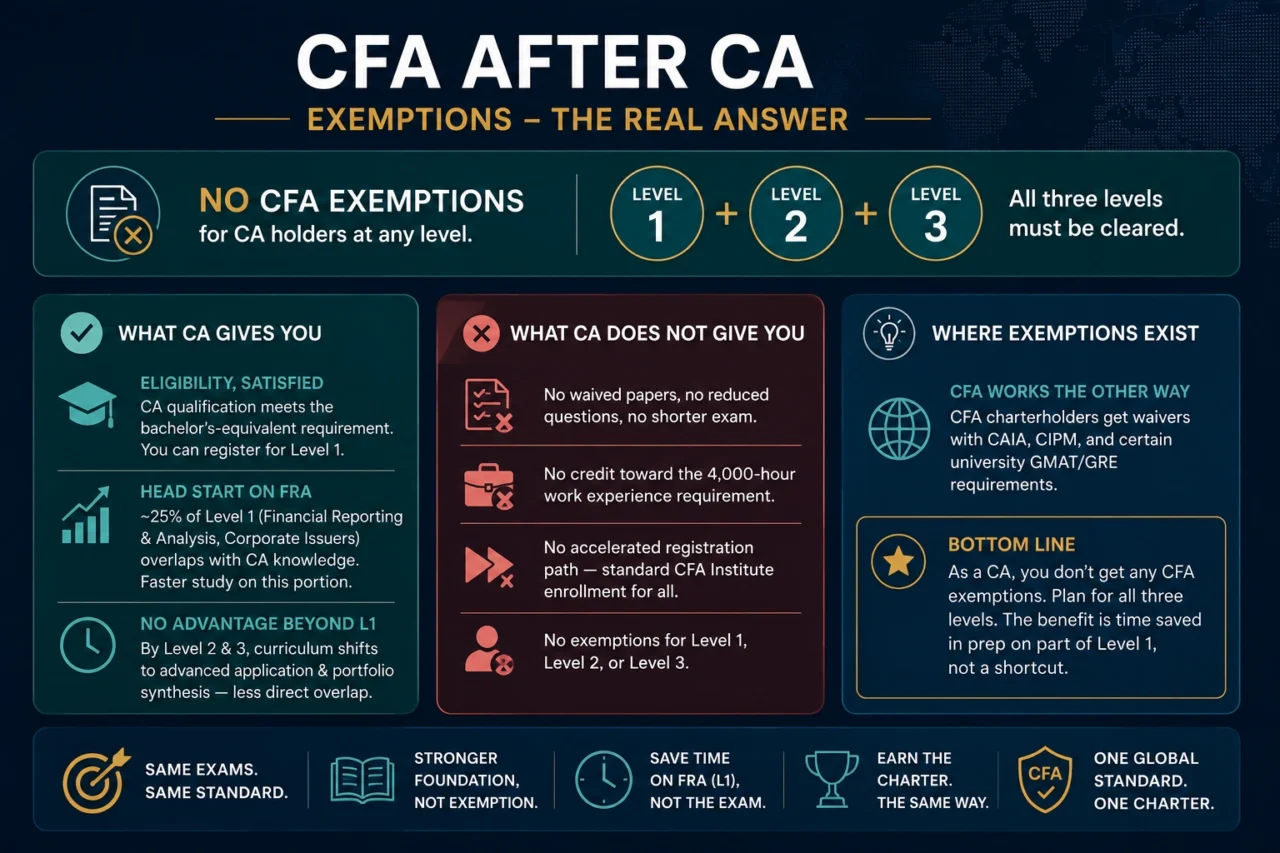
The direct answer: there are no CFA exam exemptions for CA holders. Not for Level 1, not for Level 2, not for Level 3. CFA Institute does not recognize CA — or any other professional accounting qualification, including ACCA, CPA, or CMA — as grounds for skipping any part of the three-level exam sequence. Every CA candidate sits the same Level 1, 2, and 3 exams as a fresh graduate with no finance background.
This surprises a lot of CA professionals because exemption logic is baked into how Indian professional qualifications typically interact — CA holders get exemptions into CS, CMA gets papers waived against CA, and so on. The CFA Program doesn’t work that way. It’s designed as a single, globally standardized curriculum, and CFA Institute has been consistent that maintaining that standardization — not carving out exceptions by country or prior credential — is the point of the charter’s value.
What CA actually gives you instead of an exemption:
- Education requirement, satisfied. Your CA qualification meets CFA Institute’s bachelor’s-degree-equivalent requirement, so you can register for Level 1 immediately without needing a separate university degree.
- A real head start on FRA — but only that section. Roughly a quarter of the Level 1 curriculum (Financial Reporting & Analysis, some Corporate Issuers content) overlaps meaningfully with what you already know from CA. This shows up as faster study time on that portion, not as marks handed to you or a section you can skip.
- Nothing toward Level 2 or Level 3 content. The FRA advantage is strongest at Level 1. By Level 2 and 3, the curriculum shifts into vignette-based application and portfolio-level synthesis, where your CA background offers less direct overlap.
What CA does not give you:
- No waived papers, no reduced question count, no shortened exam.
- No credit toward the 4,000-hour work experience requirement for the charter — that requirement is specific to investment decision-making experience (research, valuation, portfolio management), and standard CA articleship in audit or tax generally doesn’t qualify.
- No accelerated registration path — you still go through the standard CFA Institute enrollment process.
Where exemptions do exist (and where the confusion comes from): CFA Institute offers exemptions and waivers in the other direction — meaning if you’ve already cleared CFA levels, some other bodies and programs will waive requirements for you. For example, CFA charterholders get certain waivers with CAIA, CIPM, and specific university GMAT/GRE requirements internationally. None of this flows from CA into CFA — only from CFA outward into other credentials. If you’ve seen claims online about “CA to CFA exemptions,” they’re either conflating this reverse relationship or simply inaccurate.
Bottom line: budget for all three full exam levels regardless of your CA background. The realistic benefit is time saved in preparation on a portion of Level 1, not a shorter path through the program.
Related

A CFA charterholder with hands-on experience across investment analysis and finance education. At MentorMeCareers, he writes and reviews content on CFA, financial modeling, and investment banking careers — grounded in real market data rather than generic advice, and shaped by what actually helps candidates and professionals succeed.