

Last updated on May 8th, 2026 at 07:15 pm

So, cash ratio is like the strongest measure to to check a company’s liquidity position and is calculated by dividing cash & equivalents like liquid investments to the current liabilities of the company. The higher the ratio, the better the liquidity and low risk.
If a company went into crisis tomorrow and could only use its cash on hand — no receivables, no inventory, nothing that needs to be collected or sold — how much of its short-term debt could it actually pay off? That’s the question the cash ratio answers.
It is the strictest of the three liquidity ratios. It strips everything away except cash and cash equivalents, and divides that by current liabilities. No assumptions about how fast receivables will come in. No optimism about selling inventory. Just cold, hard cash against what’s owed right now.
This article covers the formula, how to interpret the number, what it looks like across industries, and — critically — how to use it properly in financial analysis without drawing the wrong conclusions.
Related: Liquidity Ratios — Types & Formulas | Types of Financial Analysis | Ratio Analysis Problems with Solutions | CFA Level 1 Syllabus 2025
What is the Cash Ratio?
The cash ratio is a liquidity metric that measures a company’s ability to cover its current liabilities using only its most liquid assets — cash and cash equivalents. Unlike the current ratio or quick ratio, it excludes receivables, inventory, and every other current asset that requires a step to convert into cash.
Think of it as a worst-case liquidity test. Banks use it when evaluating loan risk. Credit analysts use it when assessing whether a company can survive a sudden liquidity crunch. Equity analysts use it to flag companies sitting on too much idle cash or running dangerously thin.The cash ratio is not a measure of how well a company runs. It’s a measure of how quickly it could pay off what it owes if things went badly tomorrow
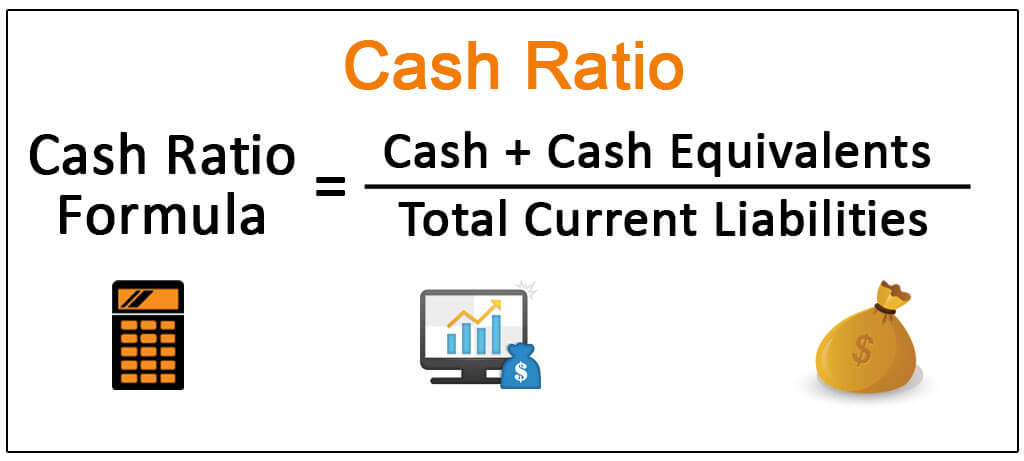
The Cash Ratio Formula
Cash Ratio = (Cash + Cash Equivalents) ÷ Current Liabilities
Where:
- Cash: Physical currency, bank deposits, and demand deposits — anything immediately accessible
- Cash Equivalents: Short-term, highly liquid investments that convert to cash with minimal risk — treasury bills, commercial paper, money market instruments. Typically maturing within 90 days
- Current Liabilities: All obligations due within 12 months — accounts payable, short-term debt, accrued expenses, the current portion of long-term debt
One important nuance: short-term marketable securities (like Apple’s bond portfolio) are sometimes included depending on the analyst’s intent. For a strict cash ratio, stick to only cash and cash equivalents as defined in the balance sheet.
Worked Example
Here’s a straightforward balance sheet extract:
| Item | Amount |
| Cash | ₹10,00,000 |
| Cash Equivalents (T-bills, money market) | ₹20,00,000 |
| Accounts Receivable | ₹5,00,000 |
| Inventory | ₹30,00,000 |
| Accounts Payable | ₹12,00,000 |
| Short-Term Debt | ₹10,00,000 |
Cash Ratio = (10,00,000 + 20,00,000) ÷ (12,00,000 + 10,00,000) = 30,00,000 ÷ 22,00,000 = 1.36
A cash ratio of 1.36 means the company has ₹1.36 in cash for every ₹1 of current liabilities. It can cover all its short-term obligations with cash alone and still have cash left over. Notice that the ₹5L in receivables and ₹30L in inventory are completely ignored — they don’t enter the calculation at all.
How to Interpret the Cash Ratio
Less Than 1
The company cannot cover all current liabilities with cash alone. This is not automatically dangerous — most healthy companies operate with a cash ratio below 1. As long as the company has stable cash flows and access to credit, a ratio below 1 is entirely normal.
A ratio of 0.3–0.5 is common and acceptable in manufacturing, retail, and capital-intensive industries.
Equal to 1
The company has exactly enough cash to cover all current liabilities. Clean, but not necessarily ideal — it may mean cash is sitting idle rather than being deployed productively.
Greater Than 1
More cash than current liabilities. The company can pay everything off immediately and still hold cash. This looks safe, but too high a ratio can signal poor capital allocation — the company may be hoarding cash instead of investing it, returning it to shareholders, or paying down debt.
A very high cash ratio is not always a good sign. A company sitting at 2.5 or 3.0 when its peers are at 0.5 may be destroying shareholder value by holding idle cash.
Related: Importance of Corporate Finance | Financial Statements — Full Guide | Vertical Analysis — How It Works
Cash Ratio vs Current Ratio vs Quick Ratio
These three ratios all measure liquidity but at different levels of conservatism. Here’s how they differ:
| Ratio | Formula | Includes | Strictness | Best Used For |
| Current Ratio | Current Assets ÷ Current Liabilities | Cash + Receivables + Inventory + All Current Assets | Least strict | Broad liquidity overview |
| Quick Ratio (Acid Test) | (Cash + Receivables + Marketable Securities) ÷ Current Liabilities | Excludes inventory | Moderate | Realistic short-term liquidity |
| Cash Ratio | (Cash + Cash Equivalents) ÷ Current Liabilities | Only cash and near-cash | Most strict | Stress-test / worst-case scenario |
In practice, analysts rarely rely on just one. You would typically check all three to build a complete picture of a company’s liquidity position. A company with a healthy current ratio but a very low cash ratio, for example, may have significant receivables that haven’t been collected — worth investigating.
Related: Liquidity Ratios — Full Guide | Financial Statement Analysis | Vertical Analysis | CFA Full Form & Course Details
Industry Benchmarks: What’s a Normal Cash Ratio?
This is where most beginners go wrong — they apply a single benchmark (“0.5 to 1 is good”) across all industries. That’s not how professional analysts think. The right benchmark depends entirely on the industry.
| Industry | Typical Cash Ratio Range | Why |
| Technology (Large-cap) | 0.5 – 1.5 | Strong operating cash flows; large cash reserves common |
| Pharma / Biotech | 0.6 – 1.2 | Cash buffers for long R&D cycles and regulatory approval timelines |
| IT Services | 0.4 – 1.0 | Asset-light model; high cash conversion from receivables |
| FMCG / Consumer Goods | 0.3 – 0.8 | Stable, predictable cash flows reduce need for large buffers |
| Manufacturing | 0.2 – 0.6 | High fixed assets; liquidity managed via credit lines |
| Automobiles | 0.2 – 0.5 | Inventory-heavy; supplier financing arrangements common |
| Retail (Non-food) | 0.1 – 0.4 | Cash tied in inventory; seasonal swings in liquidity |
| Airlines / Hospitality | 0.05 – 0.30 | High operating leverage; rely on advance bookings and financing |
| Utilities / Telecom | 0.10 – 0.40 | Regulated or recurring cash flows; lower buffers acceptable |
| Real Estate / REITs | 0.05 – 0.30 | Cash managed against lease inflows; focus on LTV ratios |
| Banks & Financials | Not comparable | Use regulatory liquidity metrics: LCR, NSFR instead |
When you analyze a company, compare its cash ratio to the median of its direct peers in the same sector and geography — not to a universal benchmark.
Case Study: Apple (2023) — When a Low Cash Ratio Isn’t What It Looks Like
Apple’s 2023 numbers are an excellent teaching case, because the strict cash ratio looks underwhelming for a company most people consider extremely well-capitalized.
| Item | Approximate Value |
| Cash & Cash Equivalents | $28 billion |
| Short-Term Marketable Securities | $21 billion |
| Current Liabilities | $125 billion |
| Annual Operating Cash Flow | >$100 billion |
Strict Cash Ratio = (28 + 21) ÷ 125 = 49 ÷ 125 ≈ 0.39
On the surface, 0.39 looks modest. Apple can only cover 39% of current liabilities using cash and near-cash alone. Does that mean Apple has a liquidity problem?
No. And this is exactly where you need to think beyond the headline ratio:
- Apple also holds over $100 billion in long-term marketable securities — highly liquid assets that don’t appear in the cash ratio calculation
- Apple generates over $100 billion in operating cash flow annually — meaning it replenishes its cash position continuously
- Apple’s credit rating is among the highest globally — it can access debt markets instantly at low rates if needed
The cash ratio is a stress-test tool. For companies with strong recurring cash flows and liquid investment portfolios, a low strict ratio is not a red flag. Always layer in OCF, working capital trends, and broader liquidity resources before drawing conclusions.
Analyst takeaway: never read the cash ratio in isolation. It is one data point, not a verdict.
When is the Cash Ratio Actually Used?
In practice, here’s where you’ll encounter the cash ratio in real analytical work:
Credit Analysis
Banks and credit rating agencies use it heavily when assessing a borrower’s immediate repayment capacity. If you’re doing credit analysis for a lending decision, the cash ratio is often the first liquidity metric you check.
Distressed Company Analysis
When a company is in financial difficulty, the cash ratio tells you quickly whether it has the liquidity to survive the next few months. Current and quick ratios are less useful here because receivables and inventory may not be realizable in a distress scenario.
Peer Comparison
In equity research, analysts often compare cash ratios across a sector to identify which companies are hoarding cash (potentially good for dividends or buybacks) and which are running lean (watch the balance sheet carefully).
M&A Due Diligence
Acquiring companies scrutinize the target’s cash ratio to understand working capital requirements post-acquisition. A target with a very low cash ratio may need immediate liquidity support.
Related: Mergers vs Acquisitions — Key Differences | What is Financial Modeling? | Financial Risk Manager (FRM) — Career Guide | Mortgage-Backed Securities Explained
Reading the Cash Ratio for Indian Companies
A few India-specific points worth knowing:
- Ind AS vs US GAAP: The classification of what qualifies as a cash equivalent can differ slightly under Ind AS. Always check the notes to the financial statements for the exact definition the company uses.
- Working capital cycles: Indian manufacturing and infrastructure companies tend to have longer working capital cycles, which means lower cash ratios are structurally normal compared to global peers.
- Promoter-driven companies: Some listed Indian companies with high promoter holdings maintain higher-than-industry cash ratios as a buffer — worth checking whether that cash is truly accessible or is parked in related-party structures.
- Seasonality: For FMCG, agrochemical, and retail companies in India, the cash ratio can swing significantly between quarters. Use the annual figure or trailing twelve months for a cleaner read.
Related: Ratio Analysis Problems with Solutions | Financial Modelling Salary in India | Working Capital Cycle — Explained | CFA Level 1 Exam Syllabus 2025
People Also Ask
What is meant by cash ratio?
The cash ratio measures how much of a company’s short-term liabilities can be covered using only its cash and cash equivalents — nothing else. No receivables, no inventory, no other current assets. It is the strictest of the three liquidity ratios (current ratio, quick ratio, cash ratio) and is used as a worst-case liquidity stress test. A ratio of 1 means the company can pay off all current liabilities with cash alone. Below 1 means it cannot — which is normal for most healthy companies.
What is a good cash ratio?
There is no single universal answer — it depends entirely on the industry. For technology and pharma companies, 0.5 to 1.5 is typical. For manufacturing and automobiles, 0.2 to 0.6 is normal. For airlines and hospitality, even 0.1 can be acceptable given their business model. The right benchmark is your company’s direct peer group median, not a fixed number. A ratio that looks low in isolation may be perfectly healthy in context.
How do you calculate the cash ratio?
Cash Ratio = (Cash + Cash Equivalents) ÷ Current Liabilities
From the balance sheet: find the “Cash and Cash Equivalents” line under current assets — that is your numerator. Find “Total Current Liabilities” — that is your denominator. Divide the two. Do not include accounts receivable, inventory, prepaid expenses, or any other current asset. Only cash and items that are immediately convertible to cash with no risk (treasury bills, money market instruments, commercial paper maturing within 90 days).
What is the cash ratio rule?
There is no single regulatory “rule” for the cash ratio in corporate finance — it is an analytical tool, not a legal requirement. However, in banking, central banks sometimes set a Cash Reserve Ratio (CRR), which requires commercial banks to hold a minimum percentage of their deposits as cash with the central bank. This is different from the cash ratio used in financial analysis. In India, the RBI sets the CRR for banks. For non-banking companies, the cash ratio is purely an analytical benchmark with no mandatory minimum.
People Also Search For
Cash Ratio Formula
Cash Ratio = (Cash + Cash Equivalents) ÷ Current Liabilities
Cash includes bank balances and physical currency. Cash equivalents include short-term liquid instruments — treasury bills, commercial paper, money market funds — that mature within 90 days and carry negligible risk. Current liabilities include accounts payable, short-term debt, accrued expenses, and the current portion of long-term debt.
Cash Ratio in Bank
In banking, the term “cash ratio” has a specific regulatory meaning — it refers to the Cash Reserve Ratio (CRR), which is the percentage of a bank’s total deposits that must be kept as reserves with the central bank. In India, the RBI mandates this ratio and changes it as part of monetary policy. A higher CRR means banks have less money to lend, which reduces money supply. This is different from the cash ratio used in standard financial analysis of listed companies.
When analysing banks as companies, analysts do not use the standard cash ratio — they use regulatory liquidity metrics like the Liquidity Coverage Ratio (LCR) and Net Stable Funding Ratio (NSFR) under Basel III norms instead.
Cash Ratio vs Quick Ratio
| Metric | Formula | Includes | When to Use |
| Cash Ratio | (Cash + Cash Equivalents) ÷ Current Liabilities | Only cash and near-cash | Worst-case stress test; credit analysis; distressed companies |
| Quick Ratio | (Cash + Receivables + Marketable Securities) ÷ Current Liabilities | Cash + receivables, excludes inventory | Realistic near-term liquidity; most common in equity research |
| Current Ratio | Current Assets ÷ Current Liabilities | All current assets including inventory | Broad overview; least conservative |
In practice, use all three together. A company with a healthy current ratio but a very low cash ratio may have receivables that aren’t being collected efficiently — worth investigating. If both the quick ratio and cash ratio are low, that is a stronger signal of liquidity concern than either one alone.
Cash Ratio Example
A manufacturing company has the following balance sheet items:
- Cash: ₹15,00,000
- Cash Equivalents (treasury bills): ₹10,00,000
- Accounts Receivable: ₹25,00,000
- Inventory: ₹40,00,000
- Accounts Payable: ₹18,00,000
- Short-Term Debt: ₹12,00,000
Cash Ratio = (15,00,000 + 10,00,000) ÷ (18,00,000 + 12,00,000) = 25,00,000 ÷ 30,00,000 = 0.83
Interpretation: The company can cover 83% of its current liabilities using only cash and cash equivalents. For a manufacturing company, this is actually quite healthy — well above the typical 0.2–0.6 range for the sector. The receivables and inventory are not included, even though they add significantly to the company’s broader liquidity position.
Cash Ratio Interpretation
| Cash Ratio Value | What It Means | Signal |
| Below 0.2 | Very limited immediate liquidity | Potential concern — check cash flows and credit access |
| 0.2 – 0.5 | Normal for capital-intensive sectors | Generally acceptable if cash flows are stable |
| 0.5 – 1.0 | Comfortable liquidity buffer | Healthy for most industries |
| Equal to 1.0 | Can cover all current liabilities with cash exactly | Strong, but check if cash is being used efficiently |
| Above 1.0 | Excess cash over current liabilities | Safe, but investigate if idle cash is being wasted |
| Above 2.0 | Significantly more cash than liabilities | May signal poor capital allocation — investigate |
Always interpret alongside operating cash flow trends, the company’s credit facilities, and industry norms. The ratio alone does not tell you whether the company is well-run.
How to Calculate Cash Ratio from Balance Sheet
Step-by-step:
- Open the balance sheet (annual report, Screener.in, or company filing)
- Under Current Assets, find the line item labelled “Cash and Cash Equivalents” — use only this number
- Under Current Liabilities, find “Total Current Liabilities”
- Divide: Cash & Cash Equivalents ÷ Total Current Liabilities
- Compare result to the industry peer median, not a universal benchmark
Important: some companies report short-term investments or bank deposits separately from “Cash and Cash Equivalents.” Read the notes to the financial statements to understand exactly what is included in each line item before calculating.
Cash Ratio is Also Known As
The cash ratio is also referred to as:
- Absolute Liquidity Ratio: Common term in Indian accounting and finance textbooks. Emphasises that only the most absolute liquid assets are included
- Cash Asset Ratio: Used interchangeably in some financial analysis contexts
- Liquidity Ratio (Strict Sense): When textbooks distinguish between strict and broad liquidity ratios, the strict version is the cash ratio
Note: Do not confuse this with the Cash Reserve Ratio (CRR) used in banking regulation — that is a completely different concept specific to monetary policy and bank reserves.
Final Word
The cash ratio is a simple formula but an easy metric to misread. The common mistake is treating it like a scorecard — higher is better, lower is worse. That’s not how it works.
It’s a stress-test tool. It tells you what happens in the worst case. For most companies with predictable revenues and solid credit access, operating below 1 is perfectly rational. For companies facing distress or operating in volatile markets, even a ratio of 0.5 may be dangerously thin.
Use it alongside the current ratio, quick ratio, operating cash flow trends, and the company’s access to credit. That combination gives you a real picture of liquidity — not just a number.
If you want to practice applying liquidity ratios in a real financial modeling context, explore our Financial Modeling Training program.
Also Read
Liquidity Ratios — Types & Formulas
Cash Equivalents — Definition & Examples
Ratio Analysis Problems with Solutions
Financial Statements — Complete Guide
Importance of Capital Budgeting
Financial Risk Manager (FRM) — Career Guide
CFA Full Form & Course Details