
Last updated on November 10th, 2026 at 05:52 pm
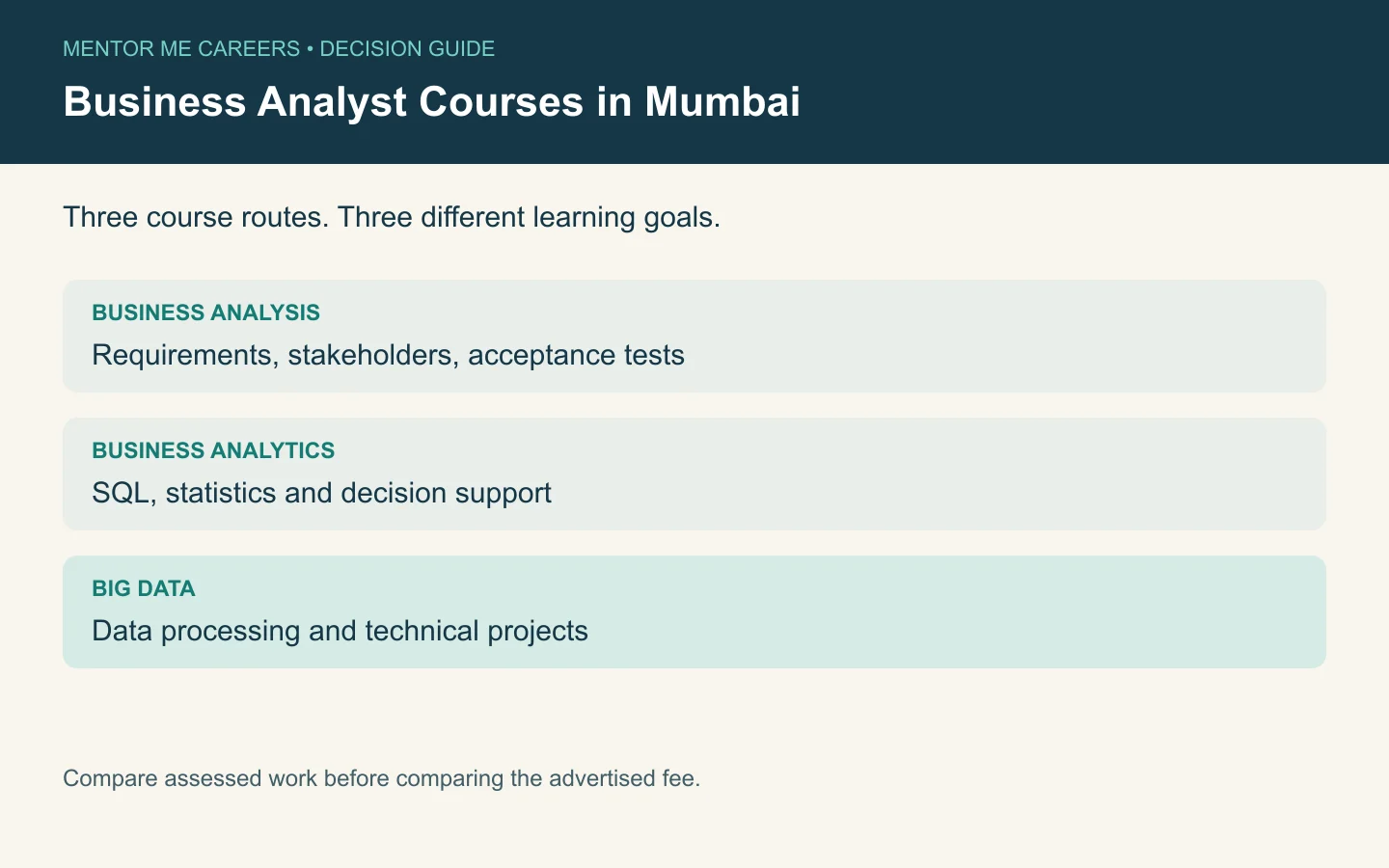
You search for a business analyst course in Mumbai, open three brochures and find three different promises. One leads with requirements and process modelling. Another offers SQL and Power BI. A third teaches Python and big-data tools. Which one prepares you for the job you actually want?
The answer starts with the role. Business analysis and business analytics overlap, but they are not the same training pathway. In this review, I separate the options, explain what each programme teaches and show you how to judge its practical value. The comparison covers Techcanvass, IMS Proschool and ISMT Business School; the order is not a ranking of teaching quality.
Reviewed 10 November 2026. Course facts come from the providers’ published offers. Prices marked “on enquiry” were not available as a complete current quote. This is a researched comparison, not a claim that we attended the courses or interviewed their students.
Business analyst courses in Mumbai: fees, duration and learning focus
| Institute / programme | Published duration and mode | Fee information | Main learning focus |
|---|---|---|---|
| Techcanvass ECBA training | Six weekends; the page describes 24 live-online hours. Domain modules extend the route to nine weeks. | Advertised starting price ₹17,800 plus GST; packages differ. | Business-analysis methods, requirements, modelling and certification preparation. |
| IMS Proschool Business Analytics | Mumbai page describes classroom, online and self-study routes, but gives both four months and 2.5 months. | Current package quote required. | Statistics, Excel, SQL, Tableau, Power BI and analytical projects. |
| ISMT Business Analytics and Big Data | Eleven-month full-time route or nine-month weekend route in Mumbai. | Current fee depends on batch; admissions quote required. | Analytics foundations, programming, dashboards, big data and projects. |
First, understand the job behind the course title
A process-focused business analyst helps an organisation understand a problem and decide what should change. The work can involve interviewing stakeholders, mapping a workflow, defining requirements, resolving conflicting needs and checking whether the proposed solution meets those needs. A polished dashboard is useful only if it answers the right question.
Business-analytics courses usually place more emphasis on the data: extracting it, checking its quality, analysing patterns and presenting an interpretation. A big-data route adds technical systems for processing and managing data. These can support business decisions, but they do not automatically teach the full requirements and stakeholder-management process.
Take a bank that wants to reduce onboarding delays. A business analyst might map the hand-offs and define an improved review workflow. An analytics specialist might identify which application types wait longest. Both contribute. However, a student applying for the first role needs more than evidence that they can operate a visualisation tool.
1. Techcanvass: a dedicated business-analysis and ECBA route
Techcanvass is the most directly business-analysis-focused option in this shortlist. Its ECBA training page describes six weekends and 24 live-online hours, with a longer domain-training route. Published topics include Agile and Waterfall approaches, process modelling, UML, prototyping and requirements documentation. It also describes two projects, assignments, practice questions and interview-preparation options.
The advertised starting fee is ₹17,800 plus GST. An exam-fee bundle is offered separately, so the starting number should not be presented as the total cost of becoming certified. The current package, recording access and included interview support need to be matched to the quote. The reviewed course is live online; I have not treated it as a verified Mumbai classroom programme.
Business-analysis skills you should practise
If your goal is to move from operations, support or a domain role into business analysis, the curriculum addresses the language of that transition. You need to explain the current process, capture what different users require and turn an unclear request into something a team can build and test. A domain module may help you connect the methods with banking or another field you already understand.
The important test is the project. Ask whether you produce a process diagram, a requirements document and acceptance criteria yourself. Then ask how the trainer responds when two requirements conflict. A completed template shows less understanding than a short document in which you can explain every decision.
Who should shortlist it?
Shortlist it for a requirements-led BA goal or structured ECBA preparation. If your main aim is Python, statistics or a substantial data portfolio, compare the analytics routes below as well. Also check the current IIBA ECBA requirements directly: completing a provider’s course and earning the professional credential are separate milestones.
2. IMS Proschool Mumbai: a stronger emphasis on analytics tools
IMS Proschool’s Mumbai page describes statistics, problem solving, Excel, SQL, Tableau and Power BI, alongside projects and case studies. It lists an Andheri address and multiple study modes. The national programme page provides the broader analytics context. For an applicant interested in reporting and data-based decisions, that is a different proposition from an exam-led requirements course.
The published duration needs clarification. The same Mumbai page describes a four-month job-readiness journey and a 2.5-month course overview. These may refer to different components, but the page does not settle the question. Get a batch-level timetable and a current fee quote rather than choosing whichever number makes the comparison look better.
Business-analytics projects to inspect
A meaningful analytics project should begin before the dashboard. You should define the business question, inspect the underlying records, explain missing values and duplicates, choose a suitable measure and interpret the result. For example, a sales dashboard that compares branches without adjusting for different opening dates can tell the wrong story despite looking professional.
Ask whether students write SQL queries and explain the output, or mainly reproduce a demonstration. Look at how project feedback handles an incorrect denominator, a misleading chart or an unsupported causal claim. Those questions reveal more about the learning process than the number of tools in the brochure.
Who should shortlist it?
Consider it if your target work involves business reporting, dashboards and analytical problem solving. For a software-business-analyst role, check how much formal requirements work the chosen package contains. A course can be useful without being a complete match for every job carrying the “business analyst” title.
3. ISMT Business School: a longer analytics and big-data commitment
ISMT’s published programme separates an eleven-month full-time route from a nine-month weekend route. It describes Python, SQL, visualisation and big-data learning, with four projects. The full-time route includes an internship component; the weekend structure differs. The current fee is supplied on enquiry.
Eligibility also differs. The weekend route asks for a bachelor’s degree and at least two years of work experience. The full-time page lists particular degree fields, so a BCom fresher should check eligibility before assuming admission. This is a larger time commitment than a short BA certificate and should be evaluated as such.
When a longer business-analytics course makes sense
It makes more sense when you want a technical analytics pathway and can explain why the additional tools matter to your target job. For example, someone aiming at data engineering-adjacent work may value exposure to larger processing systems. A candidate mainly seeking stakeholder and requirements skills may not need the same breadth.
Four projects can form a useful portfolio if you build and defend them. Ask what data students use, how individual contributions are assessed and what feedback follows submission. An internship can add experience, but you still need to know the work, supervision and completion conditions. Neither the number of projects nor the duration proves employment outcomes on its own.
Who should shortlist it?
Investigate it for a longer analytics programme, subject to the relevant entry requirements and your budget. If you work full time, map the weekend contact hours and independent assignments against your actual schedule. A course is only affordable in practice if you can complete the work you are paying for.
Compare course quality with one practical case
Here is a fictional case to take to a demo class. A bank receives 1,000 complete applications. Six hundred finish review within two days and 400 take longer. The sales team asks for “an AI dashboard to speed everything up”. A good analyst should pause before selecting the tool.
| Stage | What a useful answer contains |
|---|---|
| Define the problem | Agree when the clock starts and stops. Separate complete applications from those awaiting customer documents. |
| Investigate the delay | Compare timestamps and hand-offs. Check whether a few application types or review teams account for most delays. |
| Write a requirement | Specify who needs to see the pending stage, what event updates it and what access controls apply. |
| Test the solution | Create acceptance tests for the new workflow. Measure the agreed turnaround definition after implementation. |
| Explain the result | Report improvement against a comparable baseline. Account for changes in volume and application mix. |
The initial two-day completion rate is 600 ÷ 1,000, or 60%. That is a descriptive measure, not proof of the cause of delay. If the next month reaches 75%, you still need to check whether the application mix changed. A course that teaches you to ask those questions is giving you a skill you can use in an interview and on the job.
Business analyst course fees in Mumbai: build a complete comparison
Compare tuition, taxes, exam charges, software, live teaching, project feedback and access expiry. Keep them in separate columns. A package with a professional examination included should not be compared directly with tuition-only pricing. Equally, a longer programme may include services that a shorter one does not.
For a simple teaching example, ₹30,000 for thirty live hours costs ₹1,000 per live hour. A ₹45,000 programme with sixty live hours costs ₹750. The second has a higher total price and a lower price per hour. Neither calculation measures the quality of feedback, so add a sample assignment and demo to the comparison.
Business analyst course in Mumbai: career paths
| Role direction | Evidence to build | What to avoid |
|---|---|---|
| Process or software business analyst | Process maps, requirements, user stories and acceptance criteria. | Presenting a dashboard as proof that you can handle stakeholder requirements. |
| Reporting or business-intelligence analyst | SQL work, a reliable dataset, a dashboard and a concise interpretation. | Showing only a polished chart without explaining the data. |
| Finance-focused analyst | Financial-statement analysis, an operating forecast and a reasoned business recommendation. | Assuming every finance role requires the same course as a technology BA role. |
If your goal is finance analysis, inspect our financial modelling course for Mumbai learners and the actual work it teaches. It is a related pathway, not a substitute for every BA specialisation. Our data analytics guide can help you distinguish the kinds of analysis involved.
Choosing a business analyst course in Mumbai
For requirements-led business analysis, start by investigating the dedicated BA track. Reporting and quantitative decision support call for a closer comparison of the analytics curriculum and assessed projects. For a longer technical transition, examine whether the additional tools and time fit a specific role. There is no sensible single winner across these different objectives.
Before enrolling, obtain the current package, attend a demo and inspect one piece of marked student work. You should be able to explain what you will produce by the end of the course and how that output relates to the job you want. That is a much stronger decision than choosing the longest software list.
Questions about business analyst courses in Mumbai
Can a commerce graduate become a business analyst?
Yes, a commerce background can be relevant, particularly in finance-related domains. Admission rules differ between courses. Develop the requirements, data or domain skills required by the specific role and check each programme’s eligibility.
Do I need coding for a business analyst course?
It depends on the route. Requirements-led BA work and a technical analytics programme demand different tool depth. Check the syllabus and actual employer requirements rather than assuming that all BA roles require Python or that none requires SQL.
Does course completion guarantee ECBA or a job?
No. A training certificate, a professional certification examination and an employment decision are different outcomes. Verify the examination rules with the awarding body and read placement-assistance conditions separately.

A CFA charterholder with hands-on experience across investment analysis and finance education. At MentorMeCareers, he writes and reviews content on CFA, financial modeling, and investment banking careers — grounded in real market data rather than generic advice, and shaped by what actually helps candidates and professionals succeed.