




























MENTOR ME CAREERS

Sticky Phone Number +91 70214 50511

Equity Research Analyst Course with NSE Certification

India’s most comprehensive equity research analyst course with placement assistance &  NSE certification & Guaranteed Interviews in Equity research firms

Financial Modeling Course
4.9 50,000+ Students Trained
💼 Placement Assistance
🗓️ 3 Months Weekend or Weekday
🎓 Scholarship & Discounts

Take the Next Step Towards Your Dream Career

Placement Reports

Placement Reports - MentorMeCareers

Placement Reports

Download past placement reports to see our student success.

PeriodView Report
Q3 FY 25View Now
Q2 FY 25View Now
Q1 FY 25View Now
Q4 FY 24View Now
Q3 FY 24View Now
Q1 FY 24View Now
Achievements - MentorMeCareers

The Mentor Me Careers Advantages

Total Company Relationships: 1500+

Building strong partnerships with leading firms.

Highest Packages Offered: 14 LPA

Enabling students to achieve top-tier salaries.

Upskilled 50,000+ Students

Delivering cutting-edge skills and career growth.

Equity Research Course Overview

The Mentor Me Careers Equity Research Analyst course is an Excel-based certification designed to advance careers in core finance. Created by industry veterans including retired investment bankers, credit analysts, and fund managers it teaches practical, real-world financial applications.

Ideal for students and professionals aiming for roles in;

Investment banking or equity research. The course combines practical lectures with hands-on assignments, where students build models using actual company financials. This approach ensures each participant gains a deep, applicable understanding of financial modelling essentials.

Equity Research Placements

Equity Research Analysis Course Fees

Equity Research Course Variants

Equity Research Course

₹39,999 + GST

  • 200 Hrs offline training
  • Guaranteed Interviews
  • 12 Specializations
  • Lifetime Portal Access
Enroll Now

Financial Modeling Offline Classes

₹45,999 + GST

  • 200 Hrs offline training
  • Guaranteed Interviews
  • 12 Specializations
  • Lifetime Portal Access
Enroll Now

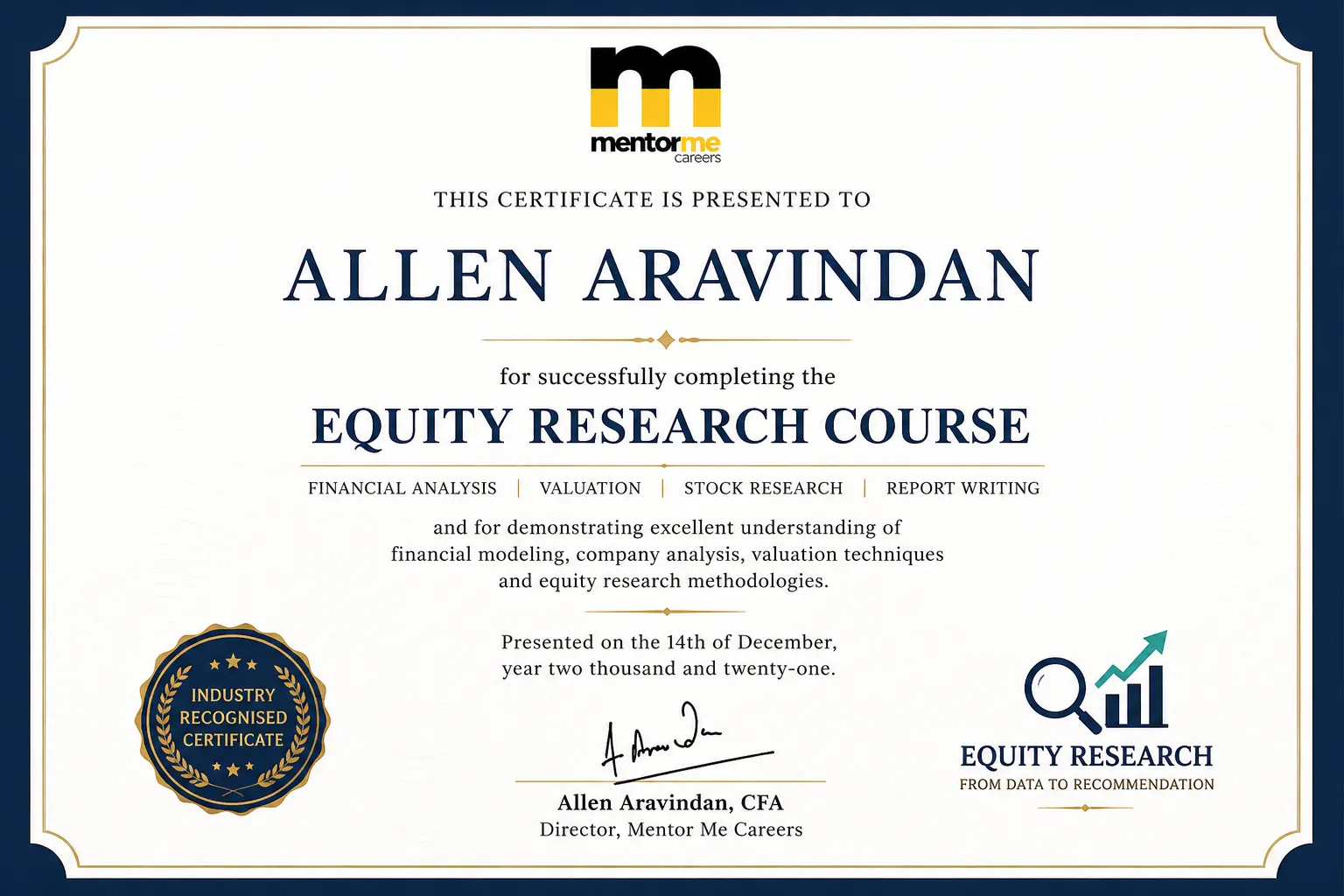
Sample Certificate

Mentor me careers Certification

Equity Research Training Syllabus

Microsoft Excel From Scratch 
Check out our financial modeling excel class here.

Our Excel workshop empowers participants with the knowledge needed for finance analyst roles in consulting, equity research or investment banking. The training starts from basic to advanced levels of excel skills so that every possible area is covered.

Key Learning Areas:

• Efficient navigation of excel using keyboard shortcuts

• Advanced techniques for sorting and filtering data

• Better management of data by freezing panes

• Making your presentation more impactful through conditional formatting

• Financial modeling linkages and formula creation

• SUM, PRODUCT, DIVISION, CONCATENATE are essential functions

• VLOOKUP, HLOOKUP and MATCH are functions used to lookup data

• You can combine functions to solve complex problems: VLOOKUP + MATCH; INDEX + MATCH; VLOOKUP + IF.

CAGR IRR EMI are examples of financial calculations.

Table usage and pivot table utilization will also be taught during this session.

Logical/reference functions such as IF SUMIF COUNTIF SUMIFS SUMPRODUCT should not miss out too!

So if you want a strong foundation in Excel or become an expert at it which is crucial for building efficient financial/business models then join us!


Curriculum of Advanced Excel Workshop

Our workshop takes you to the next level after mastering basic skills, focusing on complex formulas and advanced data analysis techniques in Excel. The emphasis is placed on using Excel for fast data analysis and presentation.

Advanced Formulas and Analysis:

Combining multiple functions (VLOOKUP + MATCH, INDEX + MATCH, VLOOKUP + IF)

Applying the OFFSET function

Techniques for Sensitivity Analysis

Application of Scenario Manager

Management of iterative calculations

Statistical Analysis (Correlation, Regression, Variance)

Summarizing data with INDIRECT function

Charting and Visualization:

Making appropriate charts (bar, pie etc.)

Using dynamic charts and Name Manager

Advanced chart types (Waterfall, Thermometer)

Charts with Sensitivity analysis

Charts with Form Controls that are interactive

Practical Application:

Building dashboards using advanced formulas, conditional formatting and charting techniques

PowerPoint Training: Creating impactful slides through data representation including effective charting as well as visual appeal.

Key Learning Outcomes:

Efficiently analyzing data with advanced excel functions

Professional charting & Data Visualization

Creation of comprehensive dashboards

Effective PowerPoint presentations fit for corporate standards.

This workshop equips you with practical skills needed for a finance analyst role where complex data analysis becomes simple yet impactful when presented.


No one can become a financial analyst without knowing accounting and financial statement analysis required for investment finance field for analysing the financial performance.  The investment banking course offered by Mentor Me will teach you financial accounting , analysis, various line items from the basics.

  • Introduction to Fundamental Analysis Framework– Annual report reading, Con Call reports, Quarterly reports, statement of change in equity, Supplementary information

  • Financial statement linkages and creating financial statement in excel

  • Income statement– Revenue recognition principles, Expense recognition principles, Diluted EPS, EPS, LIFO, FIFIO,AVCO

  • Balance Sheet– Format of balance sheet, current assets, current liabilities, Fixed assets, Non current liabilities

  • Cash flow statement– Format of cash flow statement, Direct method , Indirect method, FCFF, FCFEE

  • Ratio analysis Solvency Ratios, Profitability ratios, Activity Ratios.

Ratio Analysis Case Study- Analyse persistent systems annual report

  • How to Read an annual Report step by step

  • Franchisee Business Model Valuation- NPV , IRR, Sensitivity analysis

  • Minority Interest, Impairment, Good will analysis

Once the finance fundamentals are set now its time to dig into creating financial models in practice. We will start applying all the concepts learnt into practical real life financial decision making. Check a project finance class here.

  1.  

    Start-Up Model Travel agency Business

You will learn how to think of the template of the business model. How a three statement financial model is made . Also you will learn how small business assumptions can make the decision making difficult

  1.  

    Manufacturing Plant Business Modeling

In this financial model you will learn how funding complications affect the model. Interest capitalisation, Construction phasing , Soft cost and hard cost of projects will be taught in this section

  1.  

    Tax Modeling

Tax is an important part of investment decision making calculation. Taxation is much more complicated than calculating 30% of the PBT. Here you will learn tax loss carry forwards, Carry forward loss set off, Minimum alternate tax, MAT Credits, MAT Set off,Deffered tax liability & Deffered Tax Asset. All of this practically using excel

  1.  

    Manufacturing Plant Set Up Model

This is a real model of the industry made from scratch using real world assumptions and calculations. You will learn what it means to work in a industry level financial model from zero. All the complications thrown into one project finance case. You also learn how to create deb schedule with various interest rate calculations.

Trading Comps Valuation Technique

Investment bankers and finance professionals widely use the trading comps valuation method, which compares a company with other similar companies to find its market value. In this course you will learn:

Building Trading Comps: From choosing peers to analyzing final output.

Understanding Multiples: How they are compared and used, the reasons for their differences, and how to deal with them.

Detailed Analysis:

Constructing analyses (enterprise value, latest twelve months, cleaning financials, calculating multiples)

Convertible securities impact, leases, R&D expenses

Different multiples in same sector and why they vary

IPO valuation multiples

Regression analysis on multiples

Industry relevant multiple

High growth vs low multiple scenarios

Differences among industry multiples and their drivers

Peer selection when there are no similar listed companies available

By taking this comprehensive approach you will be able to use trading comps effectively for accurate company valuation.


Investment bankers use the precedent transaction method or deal comps as a vital valuation technique to supplement trading comps and DCF valuation. To find out what a deal is worth, this method looks at past deals that have been done under similar circumstances.

Key Points:

Building Transaction Comps: Involves calculating transaction multiples, cleaning up financials, benchmarking multiples among others.

Comparative Study: The distinction between transaction and trading comps.

Controlling Premium: Its effect on multiples and how to measure it.

Right Situations: When to apply transaction comp multiples for accurate valuation.

Market behavior is better understood through this approach which also assists in valuing firms based on historical transactions data.


Check out our demo class of financial modeling valuation .

This is the final section before the specialization kicks in. In this section we will take a publicly listed company from NSE stock exchange and create a DCF Valuation Model and Relative /Comparable analysis financial model. This is one of the other applications of financial modeling in decision making. This model is specifically useful for people who want to pursue to join equity research and Investment banking

  1. Valuation Basics- DCF, Gordon growth, WACC, Cost of equity , Levered, Un levered Beta, Terminal Value

  2. Creating a model template

  3. Data collection and data feeding in financial model

  4. Revenue Driver- breaking the business into Price and quantity metrics, so that you can forecast those metrics

  5. Cost Driver

  6. Debt Schedule , Asset schedule Forecast

  7. Free Cash flow calculation

  8. Valuation Calculation

  9. Sensitivity Analysis

  10. Report Writing

Check out our demo class of financial modeling valuation .

This is the final section before the specialization kicks in. In this section we will take a publicly listed company from NSE stock exchange and create a DCF Valuation Model and Relative /Comparable analysis financial model. This is one of the other applications of financial modeling in decision making. This model is specifically useful for people who want to pursue to join equity research and Investment banking

  1. Valuation Basics- DCF, Gordon growth, WACC, Cost of equity , Levered, Un levered Beta, Terminal Value

  2. Creating a model template

  3. Data collection and data feeding in financial model

  4. Revenue Driver- breaking the business into Price and quantity metrics, so that you can forecast those metrics

  5. Cost Driver

  6. Debt Schedule , Asset schedule Forecast

  7. Free Cash flow calculation

  8. Valuation Calculation

  9. Sensitivity Analysis

  10. Report Writing

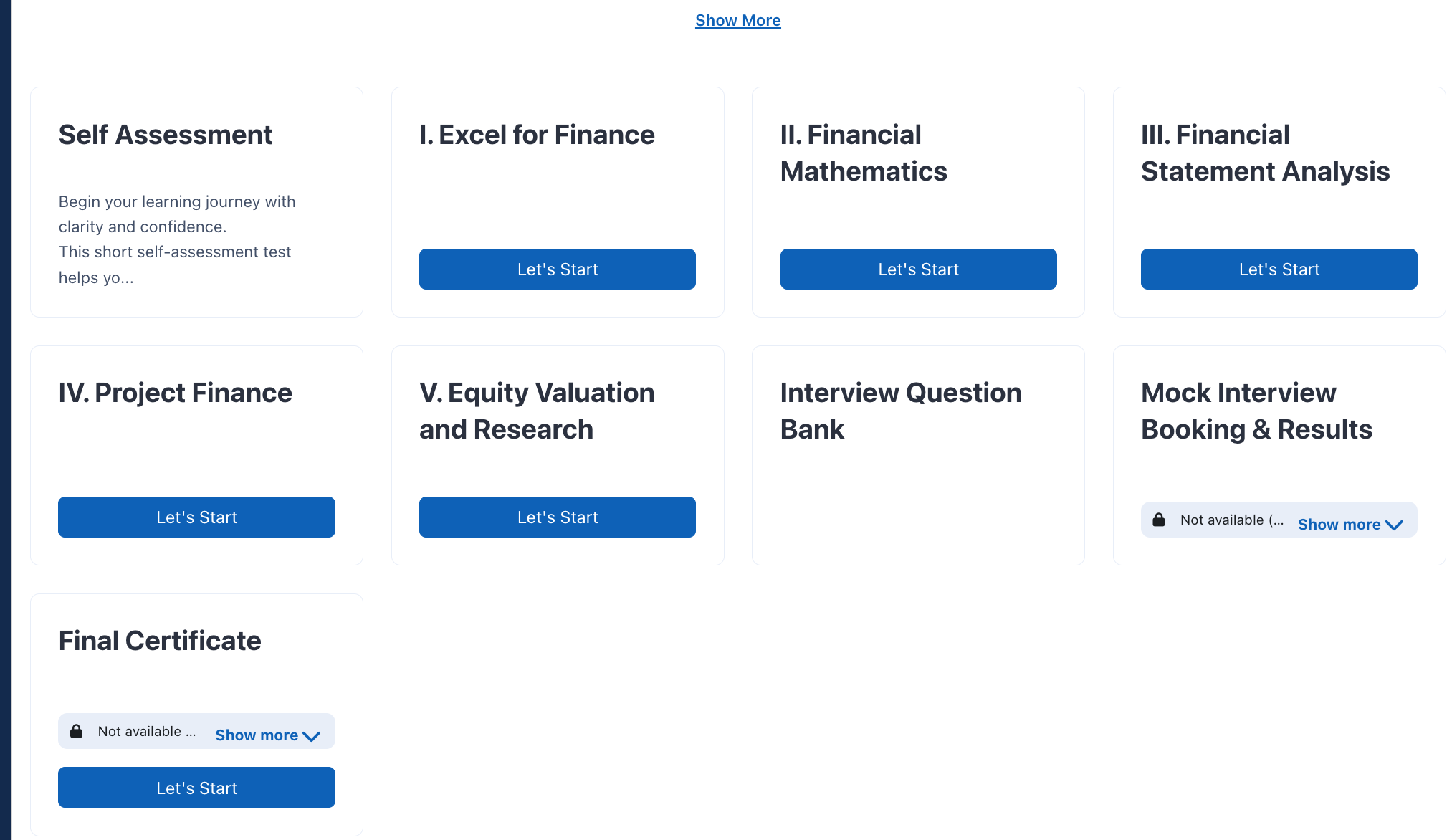
This is our major success metric at Mentor Me, your placement. With over a decade of experience in this field, we have developed resources and process which will make you polished for the interview and job in investment banking and research. This module will include

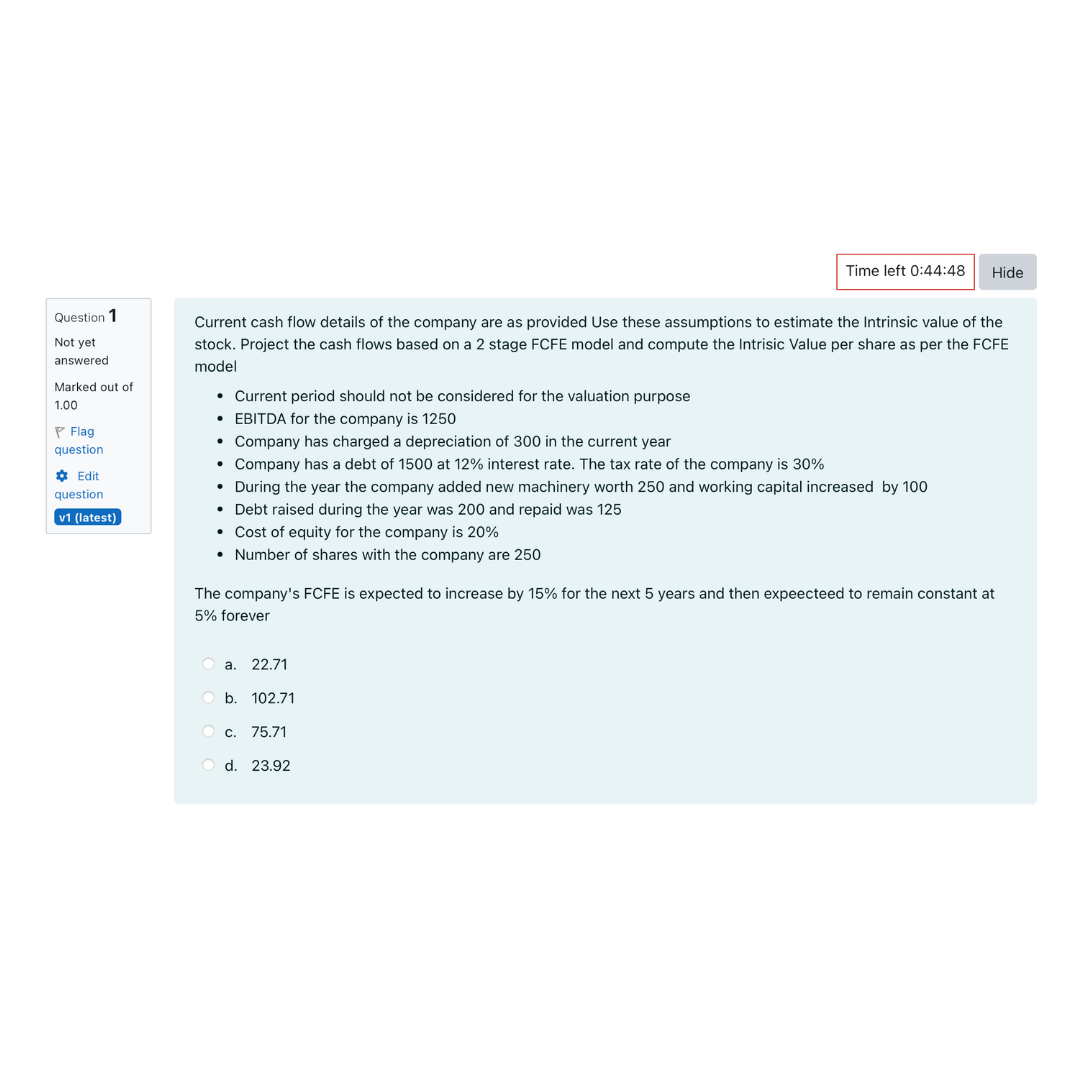
  • Employability quizzes for each skill tested in the interview

  • Case studies practice for interview

  • Written test question bank

  • Mock Interviews- Face to face

  • Stress Interviews

  • CV Edits and recommendation

  • Soft Questions practice for HR Rounds

More and more finance Jobs require candidates to know the basics of python. In the Financial modeling course with placement in the weekday program we cover

  • Python basics
  • Data Sets
  • Data visualisation using matplotlib and seaborn
  • Linear and logistic Regression machine learning models using python.

Case study for finance on python.

  Module 1: Power BI Set up

    Learn the basic set up requirements of Microsoft Power BI & Overview of the major functionalities.

  Module 2: EDA Using Power BI

   Learn how to use the easy to use power BI Functionalities, to explore the data. Before beginning any analysis further

 Module 3: Data Visualization with Reports        Learn how to create beautiful charts and data presentation using Power BI

      Module 4: Dashboards using Power BI

    Learn how to create powerful interactive dashboards to summarize the data analysis in Power B

  • Sql introduction
  • SqL Operators
  • Data tables in SQL
  • Major Sql functions
  • SQL Data base
  • 4 Technical Mocks
  • Interview cases role wise
  • Face to face advice questions  in finance 
  • General Market Questions
  • Practice Questions
  • Vocabulary Training
  • Role Play
  • Non Verbal Communication
  • Difficult HR Questions

Equity Research Analyst Related Videos

Equity Research falls under the umbrella of Investment banking services. So, an investment bank offers multiple services like

Sell Side Equity Research

  • Fund Raising
  • Underwriting
  • Debt Syndication
  • Institutitional Broking
  • Institutional Equity Research

Similarly, Equity research also takes place in the buy side, which is basically the fund side. Examples include, Mutual fund analyst,  Hedge fund analyst, Portfolio Management services. In Both the cases, the skill remains the same, which is financial modeling.

Read More on Equity Research Interview Questions.


Sample Equity Research Report & Financial Models

Expert Faculties
Allen Aravindan

Allen Aravindan, CFA, LLB

Expertise: Project Finance, Equity Research, Hedge Funds

Tap To Know More
Nikhil Jain

Nikhil Jain, CFA

Expertise: Credit Analysis, Financial Statement Analysis, Risk Management

Tap To Know More
Abhijeet Hake

Abhijeet Hake

Expertise: Buy Side Equity Research, Portfolio Management

Tap To Know More

Equity Research Course FAQ's

The choice of a good course to become an equity research analyst depends on your career objectives and the abilities which you want to acquire. Normally, the highest-ranking courses concentrate on capital structure modelling, methods of valuation as well as sector analysis. Among those recommended highly are such programs as CFA (Chartered Financial Analyst) certification, specialized Equity Research Analyst Certification or Financial Modeling and Valuation Analyst (FMVA) certification. These types of classes teach things like advanced excel skills required for equity researching jobs; financial statement analysis knowledge necessary in this field; how to value equities among others.

Even though the CFA (Chartered Financial Analyst) designation is not compulsory for equity research analysts, it is widely respected in this field. The program teaches students about investment management, financial analysis and ethics – all of which are key to succeeding as an equity research analyst. Most employers would rather hire those who have completed at least one level of the CFA exams or are currently pursuing their charter because it indicates that they are dedicated to this career and possess extensive knowledge in finance.


Yes. We are provide equity research placements across all the metro courses. and Mentormecareers is the highest rated equity research analyst course in Mumbai also.

In my opinion the most relevant best equity research courses suggested for placements should include a combination of;

  • Skills like financial modeling
  • And good qualifications like CFA, CA inter, MBA tier 1 or 2

Yes, it is possible for equity research to be a lucrative career option when you have gained experience and moved up in rank. Base salary, bonuses and sometimes stock options make up the bulk of this compensation package which can prove very profitable. Some entry level positions may start at about $60,000-$90,000 per year but as one progresses into more senior roles their income could increase exponentially. Senior analysts working for top firms or those with prestigious titles could potentially bring home anywhere from $150,000-$300,000 annually; especially if they receive performance incentives or large bonuses.

Equity research analysts who have obtained a CFA (Chartered Financial Analyst) credential often earn higher salaries due to their specialized knowledge and skills acquired through the program. In the first few years on average an individual holding this certification might expect to make between 80k – 120k per annum while working as an equities analyst. With time these numbers could rise significantly depending upon location or firm size etc., so it would not be unusual for someone with several years under their belt to pull down somewhere around 150k-250k+ annually; again depending on where they work among other factors that determine ones earning potential within any given organization.

At CRISIL which is among world top analytics companies there are various levels within the role itself along with differing amounts paid out based upon experience etc… Thusly saying what exactly each person earns here becomes difficult but still we can give some rough ideas regarding this matter too! According to my knowledge: For entry-level positions one would typically receive ₹6-₹10 LPA while more seasoned professionals occupying leadership slots should expect nothing less than ₹15-₹25 LPA (or even higher). Besides these monetary incentives CRISIL offers competitive salaries together with other benefits such as bonuses, health insurance and opportunities for professional growth.

Yes, equity research can be an extremely demanding job that often takes its toll on employees’ mental and physical wellbeing. There are several reasons why this is so: firstly analysts must work under tight deadlines; secondly they are required to produce comprehensive reports; thirdly they should keep themselves updated about market trends as well economic indicators which means always being on top of things! Moreover accuracy counts too – especially when it comes to providing timely recommendations during earnings seasons or major economic happenings etc… And finally hours worked tend to be long – sometimes starting early in morning continuing till late evening because global markets never sleep!

Yes, one can become an equities analyst after having completed their B Com degree. However, while doing this course would equip them with necessary skills needed for success in fields related mainly to finance & accounting but still additional qualifications might be required e.g., CFA or some other specialized program focusing exclusively upon equity research. It is also important gain practical experience through internships or entry level jobs within investment/finance world as this will help develop ones analytical abilities plus proficiency financial modelling … Additionally understanding how different markets operate would greatly enhance chances securing employment within organization where such knowledge really counts!

Yes! A Chartered Accountant (CA) can definitely get into equity research because they have strong foundations in accounting as well as knowledge about finances and regulations.

CAs are often good at understanding financial statements, doing thorough audits and accurate valuations. For a CA to move into equity research, they may need exposure in financial modeling and market analysis, which can be complemented with CFA certification or equity research specific training.


To become an equity research analyst in India, follow these steps:

  1. Educational Qualifications: Get a bachelor’s degree in finance, economics, accounting or related fields. MBA with specialization in finance is also highly recognized.

  2. Certifications: You can look at certifications like CFA (Chartered Financial Analyst) or any specific equity research certification to give your profile an edge.

  3. Skills Development: Concentrate on building strong analytical skills, financial modeling and being proficient with tools like Excel and Bloomberg.

  4. Internships: Gain hands-on experience by interning with investment banks, financial institutions or equity research firms.

  5. Networking: Attend seminars, join finance forums and connect with professionals on LinkedIn to build a professional network within the finance industry.

  6. Apply for Positions: Start applying for entry-level roles such as junior equity research analyst or associate analyst in reputed firms.

  7. Continuous Learning: Stay updated with latest market trends, industry news and keep enhancing your analysis & reporting skills.

Equity research can be hard to get into due its competitive nature. Typically employers look for candidates who have strong educational background along with relevant certifications (like CFA) and practical experience. Analytical skills, financial knowledge and ability work under pressure are some of the key requirements of this job role. However; with right qualifications, experience coupled with proactive approach towards learning & networking one can break into equity research easily. Doing internships during college years while continuously improving ones skill set through networking events etc significantly increases the likelihoods of getting selected for an interview at least if not hired right away.

Read More on Equity Research

Related Courses to Investment Banking

Consent Preferences Consent Preferences..... ..... .....
..... ..... .....
...... ......