
Last updated on July 15th, 2026 at 07:02 pm
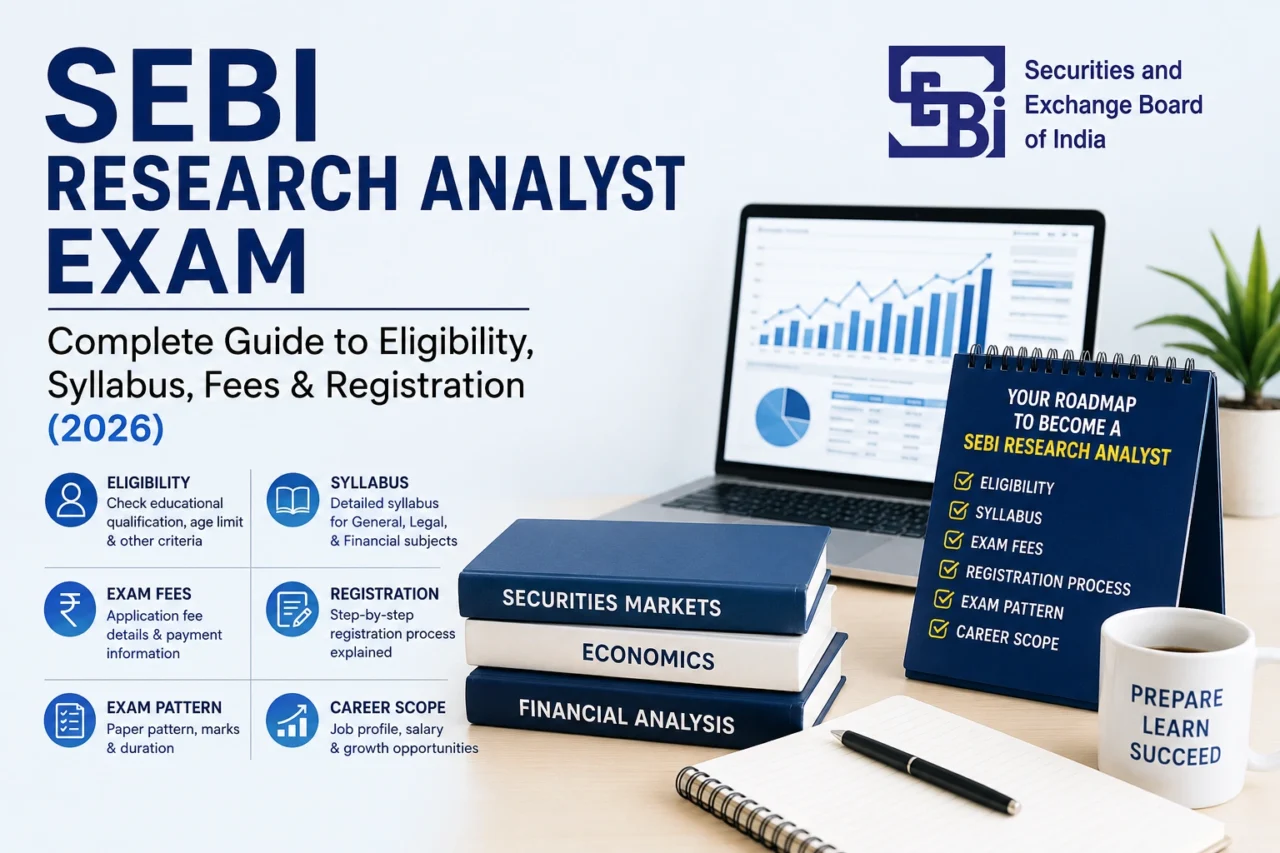
If you want to publish equity research, issue stock recommendations, or work as an analyst in India’s capital markets, there’s one exam standing between you and that career: the SEBI Research Analyst Exam, officially known as the NISM-Series-XV: Research Analyst Certification Examination.
This guide covers everything you need — eligibility, exam pattern, fees, syllabus with topic weights, registration steps (with the official NISM link), what we actually know about pass rates, how the SEBI RA credential compares to the CFA and FRM, a 10-question practice set, and the regulations you’ll be bound by once certified.
What Is the SEBI Research Analyst Exam?
The NISM Series XV exam isn’t a general finance qualification — it’s a regulatory gatekeeper. SEBI mandates it under the SEBI (Research Analysts) Regulations, 2014 for anyone who prepares or publishes research reports on listed or soon-to-be-listed securities, regardless of their job title.
The exam exists to protect investors from unregulated “tip sellers” and unauthorised research schemes. Once you’re certified and registered, clients can verify your credentials directly with SEBI — which is the whole point of the exercise.
It serves two groups:
Individuals who want to legally offer investment opinions and publish research
Firms and companies that want to operate as registered research entities
Who Needs to Take The SEBI Research Analyst Exam ?
You need NISM Series XV if you are:
Registering as an individual Research Analyst with SEBI
A partner or employee at a research analyst firm who is engaged in preparing or publishing research
Part of an entity applying for RA registration (at least one person at the entity must hold the certification)
Note: there is no formal educational bar to sit the exam itself — anyone can register and attempt it. The educational and experience requirements below apply specifically to SEBI RA registration, which is the step after you clear the exam.
Eligibility for SEBI research analyst exam
Educational Qualification
A postgraduate degree in finance, commerce, accounting, business, or management — or a professional qualification such as CA or CFA.
Professional Experience
A minimum of five years of relevant experience in the finance industry.
For Entities
If you’re registering as a firm rather than an individual, at least one principal officer or partner at the entity must meet the above educational and experience criteria.
Capital Adequacy (Net Worth)
Individuals: minimum net worth of ₹1 lakh
Entities: minimum net worth of ₹5 lakh
NISM Series XV Exam Pattern (Revised, Effective January 20, 2026)
SEBI and NISM revised the exam structure with effect from January 20, 2026. If you’ve seen older articles quoting 92 questions or two case studies, that information is outdated — here’s the current format, confirmed directly from NISM’s official exam page:
| Component | Details |
|---|---|
| Multiple choice questions | 80 questions × 1 mark = 80 marks |
| Case-based questions | 5 cases × 4 questions × 1 mark = 20 marks |
| Total marks | 100 |
| Duration | 2 hours (120 minutes) |
| Passing score | 60% (60 marks) |
| Negative marking | 25% of the marks assigned to each wrong answer |
| Certificate validity | 3 years |
| Exam fee | ₹1,500 + applicable taxes and payment gateway charges |
A quarter of the paper now comes from applied case studies rather than pure recall — so rote memorisation of the workbook alone won’t get you across the line. You need to be able to apply concepts like valuation, ratio analysis, and risk categorisation to a scenario.
Exam Dates: How Scheduling Actually Works
This trips up a lot of first-time candidates, so let me correct it directly: NISM Series XV is not a fixed-date exam like the CFA or FRM, which run on set testing windows a few times a year. It’s a computer-based test (CBT) offered on a rolling basis — once you complete registration on the NISM Certification Portal, you pick your own test centre, date, and time slot from the currently available options, which are typically open on a continuous basis throughout the year.
In practical terms: there is no single “2026 exam date” to wait for. You can register and sit the exam within days of deciding to, subject to seat availability at your chosen centre. The one date that does matter is January 20, 2026 — that’s when the revised syllabus and case-study format (the one detailed above) came into effect. Any exam booked from that date onward uses the current pattern; if you’re studying from an older workbook or a prep site still describing the pre-2026 format, discard it.
To check live seat availability and book your slot, go to the official exam centre locator on NISM’s site rather than relying on a third-party prep platform’s calendar, since availability changes centre by centre.
SEBI Research Analyst Exam Syllabus: What SEBI Wants You to Know (With Official Topic Weights)
NISM publishes an official weightage table for the exam (Annexure I to the exam circular), and it’s worth studying by the numbers rather than treating every chapter as equally important. Two chapters — Technical Analysis and Financial Analysis — account for over a quarter of the paper between them.
| Chapter | Topic | Weightage (marks out of 100) |
|---|---|---|
| 1 | Introduction to Research Analyst Profession | 1 |
| 2 | Introduction to Securities Market | 2 |
| 3 | Terminology in Equity and Debt Markets | 2 |
| 4 | Fundamentals of Research | 5 |
| 5 | Economic Analysis | 5 |
| 6 | Industry Analysis | 8 |
| 7 | Company Analysis — Business and Governance | 6 |
| 8 | Company Analysis — Financial Analysis | 12 |
| 9 | Corporate Actions | 5 |
| 10 | Valuation Principles | 12 |
| 11 | Fundamental Analysis of Commodities | 5 |
| 12 | Fundamentals of Risk and Return | 7 |
| 13 | Qualities of a Good Research Report | 5 |
| 14 | Legal and Regulatory Environment | 10 |
| 15 | Technical Analysis | 15 |
What this tells you about where to spend your prep time: Technical Analysis (15 marks) and Financial Analysis (12 marks) are the single biggest chapters, and together with Valuation Principles (12 marks) and Legal and Regulatory Environment (10 marks), these four chapters alone make up 49% of the paper. If your prep time is limited, that’s where it should go first — not because the smaller chapters don’t matter, but because the marginal return on studying them is lower.
Note that Technical Analysis and Fundamental Analysis of Commodities are relatively new full chapters in the revised syllabus — earlier versions of this exam barely touched either topic, so if you studied from pre-2026 material, these two chapters (20 marks combined) are where you have the biggest gap.
Broadly, across these chapters, the exam tests your ability to:
Understand the basics of Indian securities markets and key terminology used in equity and debt markets
Apply top-down and bottom-up approaches to fundamental research
Grasp micro and macroeconomic analysis principles, information sources, and the macro variables that move markets
Identify key industry drivers and sources of industry information
Analyse companies on both qualitative (business and governance) and quantitative (financial) dimensions
Apply risk and return fundamentals and valuation principles
Read and interpret basic technical analysis tools and chart patterns
Understand the philosophy behind various corporate actions
Recognise the qualities of a credible, well-supported research report
What’s the Actual Pass Rate?
Here’s the honest answer: NISM does not publish exam-wise pass rate statistics publicly for the Research Analyst certification, and neither its exam page nor its published annual reports break out a specific pass percentage for Series XV. Any number you see quoted as “the NISM XV pass rate” on a coaching site or prep platform is an estimate, not an official figure — treat it accordingly.
What we can say with more confidence: NISM’s certification exams as a category are commonly cited in the test-prep industry as averaging somewhere around a 45-55% pass rate, and the Research Analyst exam is generally considered to sit in that range or slightly tougher than average, given the case-study component and the addition of Technical Analysis and Commodities to the revised syllabus. Candidates who fail typically aren’t failing because the material is conceptually hard — they’re failing because they under-prepared for the two heaviest chapters (Technical Analysis and Financial Analysis) or underestimated the case-based section, which requires applying multiple concepts to one scenario rather than recalling a single fact.
If you want a genuinely reliable benchmark, treat the 60% passing threshold as your real target, and don’t rely on secondhand pass-rate claims to calibrate how much you need to study.
Where to Get Study Material
NISM provides the official workbook free of cost. Create an account on the NISM certification portal, and you can download the current study material directly — no need to pay for third-party material to get started.
How to Register and Take the SEBI Research Analyst Exam
Create an account on the official NISM Certification Portal — this is the direct registration link from NISM’s own Research Analyst exam page, so use it instead of a third-party redirect
Activate your account via the email link and log in
Go to Enrolment → Enroll for Examination and select NISM-Series-XV
Choose your preferred exam city, test centre, and date from the available slots
Pay the exam fee and download your admit card
Appear for the computer-based test at your chosen centre
Passing certificates are issued only to candidates who have updated their PAN details in their NISM registration — so make sure that’s in order before you sit the exam.
After You Pass: SEBI RA Registration
Clearing NISM Series XV is the qualifying step, not the finish line. To actually operate as a Research Analyst, you still need to complete SEBI registration:
SEBI scrutinises your application and supporting documents
Once approved, you pay the registration fee — ₹5 lakh for entities, ₹10,000 for individuals and partnership firms
You receive your SEBI RA registration number, which you’re required to quote in any public appearance as an analyst research analyst exam (NISM Series XV) vs CFA vs FRM: How They Actually Compare
This is a question I get constantly, and the short answer is: these three aren’t really competing for the same job. SEBI RA is a legal license to operate in India; CFA and FRM are voluntary global credentials that make you a stronger candidate. Confusing the three — thinking a CFA charter exempts you from NISM registration, for instance — is a genuine and fairly common mistake.
| SEBI RA (NISM Series XV) | CFA (Chartered Financial Analyst) | FRM (Financial Risk Manager) | |
|---|---|---|---|
| Governing body | SEBI / NISM (India-specific) | CFA Institute (global) | GARP (global) |
| What it actually is | A regulatory license — legally required to publish research in India | A voluntary professional credential in investment management | A voluntary professional credential in risk management |
| Number of levels | 1 exam | 3 levels | 2 parts |
| Typical time to complete | Days to weeks of prep; book and sit whenever ready | 2.5–4 years (self-paced, most candidates need ~300 hrs per level) | 1–2 years typically |
| Approx. total cost | ₹1,500 + GST (exam fee only) | ~₹3.5–4.5 lakh for all three levels (excludes coaching); see our CFA fees breakdown | ~₹1.3–1.7 lakh for both parts (excludes coaching) |
| Passing standard | 60% fixed threshold | Minimum Passing Score (MPS), set per exam administration, not a fixed % | Fixed thresholds, pass rates historically ~45-55% (Part 1) and ~55-60% (Part 2) |
| Certificate/charter validity | 3 years, renewable via NISM Series XV-B | Lifetime (subject to active membership) | Lifetime (subject to active membership) |
| Is it mandatory in India? | Yes — legally required to prepare/publish research reports | No — not a legal requirement anywhere | No — not a legal requirement anywhere |
| Where it matters most | Any role where you publish research (sell-side, buy-side, KPO) | Buy-side, portfolio management, senior equity research | Risk, treasury, credit, derivatives — less central to equity research |
| Can it substitute for the others? | No — even CFA charterholders must clear NISM XV to publish research in India | No — CFA does not exempt you from SEBI RA registration | No — FRM doesn’t touch equity research content in any depth |
The practical takeaway: if your career goal is equity research in India, NISM Series XV isn’t optional regardless of what other letters you’re pursuing after your name — it’s the baseline. CFA is what you add on top of it to be competitive for buy-side and senior sell-side roles. FRM is worth considering only if you’re pivoting toward risk management rather than research and stock-picking — it’s not a natural complement to an equity research career the way CFA is.
Regulations Every Registered Research Analyst Must Follow
Certification and registration come with ongoing obligations under SEBI’s regulatory framework:
Trading restrictions. If you’ve published a research report, you cannot trade in that stock for 30 days if it relates to an IPO, and there are cooling-off restrictions in other cases as well — always check the latest SEBI circular for the current window, as these periods have been revised over time.
No mixing with investment banking. Research analysts are barred from brokerage-adjacent activities like client solicitation, and cannot publish research in the presence of investment banking personnel from the same organisation — the idea being to keep research independent of deal-making incentives.
Documentary backing. Every published research report needs to be supported by evidence and analysis you can produce if SEBI or a client asks.
Disclosure in public appearances. Any time you appear publicly as a registered analyst — TV, webinars, social media — you’re required to disclose your SEBI registration details.
SEBI’s Code of Conduct for Research Analysts
All registered RAs are bound by a code of conduct built around:
Acting with honesty and good faith
Disclosing conflicts of interest transparently
Maintaining client confidentiality
Complying with regulatory standards on an ongoing basis
10 Practice Questions (NISM Series XV)-sebi research analyst exam
These are illustrative practice questions built around the official syllabus weightage above — weighted toward Technical Analysis, Financial Analysis, Valuation, and Legal/Regulatory, since those four chapters carry the most marks. They’re meant to test whether you can apply a concept, not just recall a definition, in line with how the actual exam’s case-based section works.
1. Under the SEBI (Research Analysts) Regulations, 2014, what is the minimum net worth requirement for an individual applying for RA registration? A) ₹50,000 B) ₹1 lakh C) ₹5 lakh D) ₹10 lakh Answer: B) ₹1 lakh — entities require ₹5 lakh; individuals require ₹1 lakh.
2. A stock trades at a P/E of 18x while its five-year historical average P/E is 24x, and sector peers trade at 22x. Which of the following is the most defensible conclusion from a research analyst’s perspective? A) The stock is automatically undervalued and should be bought B) The lower multiple may reflect fundamental deterioration and needs to be investigated before drawing a valuation conclusion C) P/E comparisons across peers are never useful D) The stock should be valued only using book value Answer: B — a below-average multiple relative to history and peers is a starting observation, not a conclusion; a research analyst must establish why before calling it cheap.
3. In a discounted cash flow (DCF) valuation, an increase in the discount rate (WACC), holding all cash flows constant, will: A) Increase the present value of the company B) Have no impact on valuation C) Decrease the present value of the company D) Only affect the terminal value, not the explicit forecast period Answer: C — a higher discount rate reduces the present value of every future cash flow, including the terminal value.
4. Which of the following is classified as a leverage ratio rather than a profitability ratio? A) Net profit margin B) Return on equity C) Debt-to-equity ratio D) Operating margin Answer: C) Debt-to-equity ratio — it measures capital structure and financial risk, not profitability.
5. In technical analysis, a “death cross” refers to: A) A short-term moving average crossing above a long-term moving average B) A long-term moving average crossing above a short-term moving average C) A short-term moving average crossing below a long-term moving average D) A stock hitting a 52-week low Answer: C — a death cross is typically the 50-day moving average crossing below the 200-day moving average, considered a bearish signal.
6. Under SEBI’s cooling-off framework, if a research analyst has published a report recommending a stock connected to an IPO, what is the standard restriction on the analyst’s own trading in that stock? A) No restriction applies B) A 30-day restriction from the date of the report C) A permanent ban on ever trading that stock D) Restriction applies only to the analyst’s family members, not the analyst Answer: B — a 30-day cooling-off period applies for IPO-related research; always verify against the current SEBI circular, as these windows have been revised over time.
7. Which of the following would NOT typically be considered a source of information for industry analysis? A) Industry association reports and government publications B) Company annual reports of peer firms C) An analyst’s personal opinion without supporting data D) Trade journals and sector-specific news Answer: C — a good research process is built on verifiable sources; unsupported opinion is explicitly what the “qualities of a good research report” chapter warns against.
8. A company announces a 1:1 bonus issue. All else equal, what happens to its earnings per share (EPS) immediately after the bonus issue? A) EPS remains unchanged B) EPS roughly halves, since the number of shares outstanding doubles C) EPS doubles D) EPS becomes negative Answer: B — a 1:1 bonus doubles the share count with no change to net profit, so EPS is roughly halved; the company’s total market value is broadly unaffected.
9. Which macroeconomic variable would a research analyst most directly use to assess the near-term outlook for a bank’s net interest margin (NIM)? A) Consumer Price Index (CPI) alone B) The prevailing repo rate and interest rate trajectory set by the RBI C) The country’s current account deficit D) Foreign exchange reserves Answer: B — repo rate movements directly influence banks’ cost of funds and lending rates, making it the most relevant variable for NIM analysis, more so than the other options listed.
10. Under SEBI regulations, a research analyst is restricted from being present during which of the following? A) Client meetings to discuss published research B) Internal research team meetings C) Situations involving investment banking personnel from the same organisation discussing a covered company D) Meetings with the company’s investor relations team Answer: C — the regulatory intent is to firewall research from investment banking/deal-making influence, which is why analysts cannot publish or discuss research in the presence of IB personnel from the same firm.
These are illustrative practice questions written to reflect the syllabus weightage and case-based format — not official NISM questions. Use them to sanity-check your conceptual grasp, not as a substitute for the official workbook.
Frequently Asked Questions:SEBI Research Analyst Exam
What is the passing score for the NISM Series XV exam? 60% (60 out of 100 marks).
What does the exam actually test? Your understanding of securities market fundamentals, sources of research information, the qualities of a strong research report, and the quantitative side of valuation and financial analysis — including applied case studies, not just recall. Since the 2026 revision, it also tests Technical Analysis and Fundamental Analysis of Commodities in dedicated chapters.
What are the SEBI Research Analyst Regulations, 2014? These are the rules registered RAs must operate under. Non-compliance can lead to penalties or a ban from participating in Indian capital markets.
What is the exam fee? ₹1,500 plus applicable taxes, charged by NISM (payment gateway charges are extra).
How long is the certificate valid? 3 years, after which you’ll need to clear the NISM Series XV-B renewal examination to continue operating.
Is there a fixed 2026 exam date I need to register for? No. NISM Series XV runs on a rolling, on-demand testing calendar — you register on the NISM Certification Portal and then book any available date and centre. The one fixed date that matters is January 20, 2026, when the revised syllabus and case-study format took effect.
Does clearing CFA or FRM exempt me from NISM Series XV? No. Neither the CFA charter nor the FRM certification substitutes for SEBI RA registration. If your role involves preparing or publishing research reports in India, NISM Series XV is mandatory regardless of what other qualifications you hold.
The Bottom Line
SEBI’s push toward mandatory certification is a genuine step toward cleaning up unregulated stock advice in India — though investor awareness of what “SEBI-registered” actually means still lags behind. For anyone serious about a career in equity research, IB operations, or portfolio analysis, clearing NISM Series XV isn’t optional — it’s the entry ticket, and it sits alongside (not instead of) credentials like the CFA if you’re aiming for buy-side or senior research roles.
Looking to build the practical skills behind the research — financial modeling, valuation, and analyst-grade Excel work? Explore MentorMeCareers’ Financial Modeling and Investment Banking Operations programs, or see our full equity research analyst salary and career guide for what comes after certification.

A CFA charterholder with hands-on experience across investment analysis and finance education. At MentorMeCareers, he writes and reviews content on CFA, financial modeling, and investment banking careers — grounded in real market data rather than generic advice, and shaped by what actually helps candidates and professionals succeed.