
Last updated on November 4th, 2026 at 11:38 am

The shutdown point is the short-run threshold at which a firm is indifferent between producing and stopping in the standard price-taking model. It occurs at the minimum average variable cost. Below that price, producing cannot cover variable costs at any output. A temporary shutdown is different from a permanent exit from the market.
Shutdown point formula and assumptions
For a perfectly competitive firm, the shutdown price is min AVC. AVC means total variable cost divided by output. Under the usual smooth cost curves, marginal cost intersects average variable cost at AVC’s minimum. Output choice also requires the relevant profit-maximising conditions; finding an intersection alone is not a complete decision rule.
This model assumes a price-taking firm and fixed costs that are unavoidable in the short run. The firm compares operating with shutting down while still bearing those fixed costs. It does not assume every real business can instantly stop without additional consequences.
OpenStax’s microeconomics treatment explains this distinction between covering variable costs, covering total costs and choosing short-run output. Apply the model before extending it to a business case.
Why a loss-making firm might keep producing
A firm can make an accounting loss while still covering all variable costs and part of unavoidable fixed costs. Shutting down would remove revenue and variable costs but leave those fixed costs. Continuing can therefore produce a smaller short-run loss.
This does not mean any loss-making business should continue indefinitely. The calculation depends on which costs are avoidable, the price available and feasible output choices. Long-run viability is a separate question.
| Price relative to costs | Short-run interpretation in the standard model |
|---|---|
| P > ATC at the chosen output | Revenue exceeds total cost |
| AVC < P < ATC | Operating can cover variable cost and contribute to fixed cost |
| P = minimum AVC | Indifferent at the shutdown threshold in the simple model |
| P < minimum AVC | Shutdown avoids variable costs that revenue cannot cover |
ATC means average total cost. The breakeven threshold, based on minimum ATC in this model, is different from the shutdown threshold based on minimum AVC.
Worked example: operate or stop?
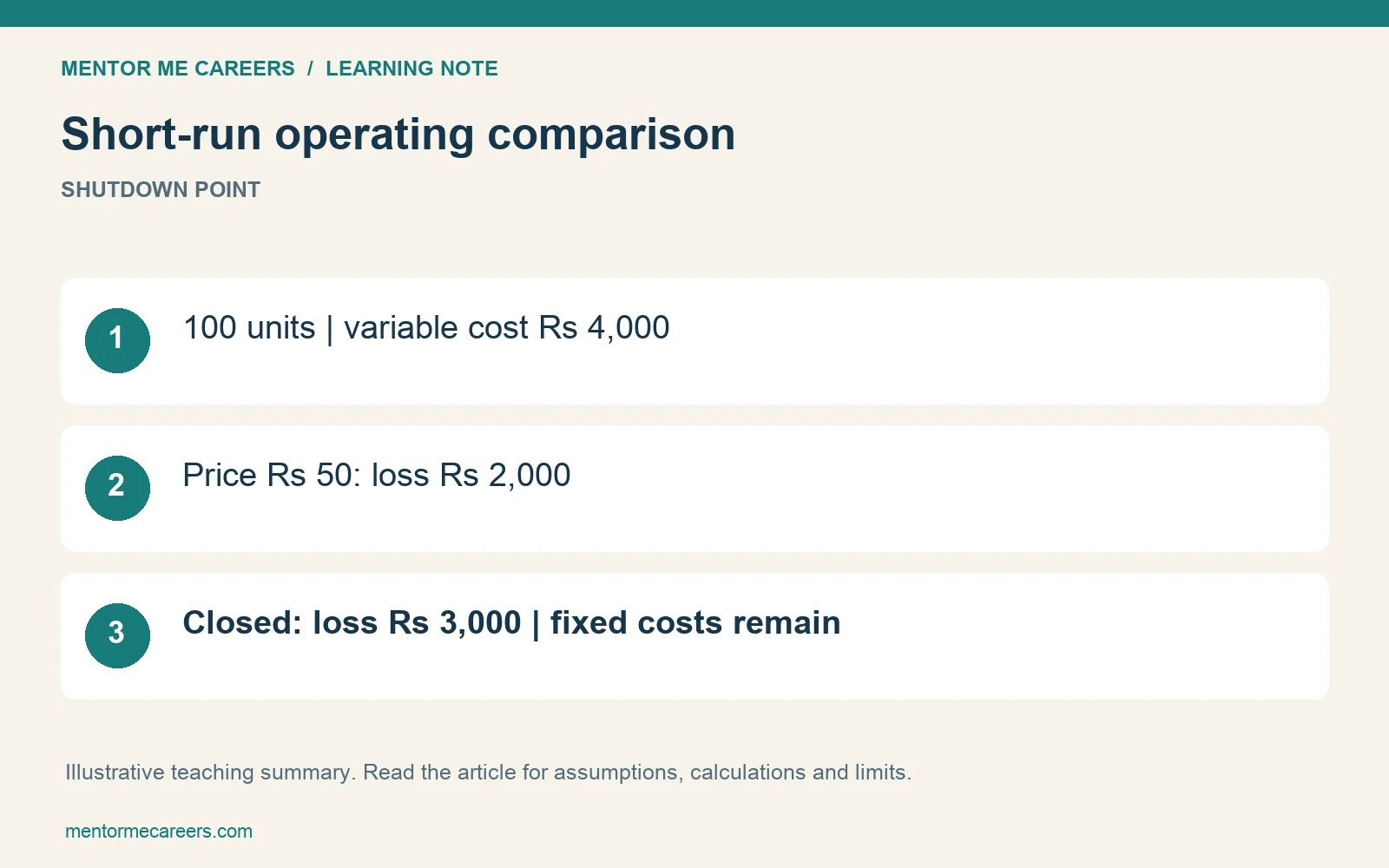
Consider a fictional plant with a specified production option of 100 units. That option has ₹4,000 variable cost and ₹3,000 unavoidable short-run fixed cost. If the plant stops, assume variable cost falls to zero but the ₹3,000 fixed cost remains.
At a price of ₹50, revenue is ₹5,000. Operating profit is ₹5,000 − ₹4,000 − ₹3,000 = −₹2,000. Shutting down gives a ₹3,000 loss. Producing the specified output is better by ₹1,000 because it contributes that amount towards fixed costs.
At a price of ₹30, revenue is ₹3,000. Operating loss becomes ₹4,000, versus ₹3,000 if closed. Operating the specified option is worse by ₹1,000.
| Price | Revenue at 100 units | Operating result | Shutdown result |
|---|---|---|---|
| ₹50 | ₹5,000 | −₹2,000 | −₹3,000 |
| ₹40 | ₹4,000 | −₹3,000 | −₹3,000 |
| ₹30 | ₹3,000 | −₹4,000 | −₹3,000 |
This table compares one operating option with closure. It does not establish that ₹40 is the plant’s global shutdown price unless ₹40 is the minimum AVC across all feasible outputs. That distinction prevents a common error: mistaking one observed average cost for the minimum of the entire curve.
A cost curve that gives an exact shutdown point
For a separate fictional continuous-output model, let AVC(q) = 20 + (q − 50)²/100 for positive q. Its minimum is 20 at q = 50. Therefore, the model’s shutdown price is 20 currency units per unit of output.
Variable cost equals q × AVC(q). Marginal cost is the derivative of that total variable cost. At q = 50, the slope of AVC is zero, so MC equals AVC at 20. This illustrates why the standard curves intersect at the minimum.
The equation is deliberately constructed for teaching. It is not an estimate of an actual factory’s costs. A real analyst needs production and cost evidence before applying the result.
Shutdown, breakeven and exit are different decisions
Shutdown concerns whether to produce in the short run. Breakeven concerns covering total costs. Exit concerns leaving the market in the long run, when more costs can be avoided or changed.
Real decisions can include restart costs, maintenance, employee obligations, customer contracts, capacity constraints and uncertain future demand. A cost labelled “fixed” in an accounting report is not automatically unavoidable over every decision horizon.
Use the same discipline in corporate finance decisions: identify incremental cash flows and the time horizon. For a related demand-side concept, see the substitution effect. Keep model assumptions explicit rather than turning a classroom threshold into a universal business instruction.
Frequently asked questions
Is the shutdown point where profit is zero?
No. In the standard competitive model, shutdown relates to minimum average variable cost. Zero economic profit at the breakeven point relates to average total cost.
Should a firm stop whenever price is below ATC?
Not necessarily in the short run. If revenue covers variable cost and contributes to unavoidable fixed cost, continuing may reduce the loss.
Can I use AVC at any output as the shutdown price?
No. The standard threshold is minimum AVC across feasible output. One output observation does not establish the minimum.
Sources and further reading
Reviewed 3 November 2026. Worked cases are fictional teaching examples unless a named primary source is given.

A CFA charterholder with hands-on experience across investment analysis and finance education. At MentorMeCareers, he writes and reviews content on CFA, financial modeling, and investment banking careers — grounded in real market data rather than generic advice, and shaped by what actually helps candidates and professionals succeed.