

The main types of anti money laundering controls are customer due diligence, risk assessment, enhanced checks, screening, transaction monitoring, suspicious transaction reporting, record keeping and independent testing. Each answers a different question: who is the customer, does the activity make sense, and what should the institution do when it does not?
Do not confuse these controls with placement, layering and integration. Those are stages used to explain money laundering. A useful AML analysis connects the stage or pattern to the evidence an analyst should examine. This guide does that through fictional banking cases, worked figures and example investigation notes.
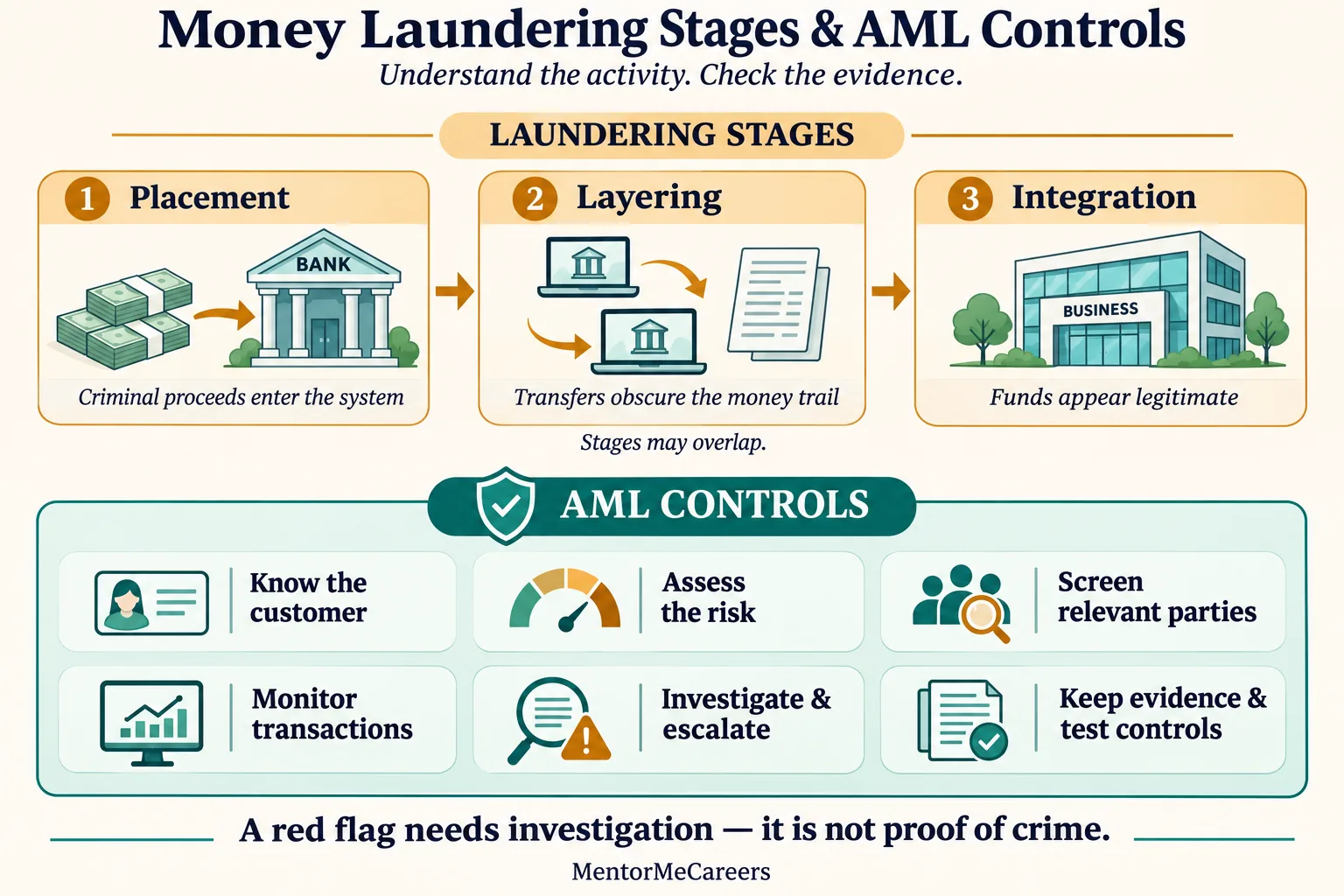
Types of anti money laundering controls versus laundering stages
Money laundering disguises the origin of criminal proceeds. AML describes the safeguards used to identify and respond to that risk. A typology is a recurring pattern, such as misuse of trade payments. Therefore, “trade-based laundering” and “customer due diligence” belong in different categories.
| Category | What it explains | Example |
|---|---|---|
| Laundering stage | How proceeds enter, move through or appear legitimate in the economy | Layering through transfers with no clear business purpose |
| Laundering typology | A pattern of abuse | Invoices that do not match the goods supplied |
| AML control | How an institution addresses the risk | Compare the invoice, shipment and payment parties |
There is no universal legal list called “the ten types of AML”. The categories below are a teaching framework. The duties that apply depend on the institution, product and jurisdiction. For the Indian legal meaning of proceeds of crime, consult FIU-IND’s explanation.
The three stages of money laundering, with examples
The FATF explanation uses placement, layering and integration. These stages help explain a scheme; they do not form a checklist that every case must follow in a neat order.
Placement: introducing criminal proceeds
Fictional example: a retail business reports cash takings far above what its stock purchases and trading hours appear to support. The analyst sees a possible gap between recorded sales and the business’s capacity to make those sales.
First, compare deposits with the customer’s stated activity and available sales records. Then examine whether a festival, new outlet or other supported change explains the rise. However, cash use alone does not prove laundering. The concern is the unexplained mismatch, not the fact that the business accepts cash.
Layering: making the money trail harder to follow
Fictional example: a company receives funds and sends most of them to several firms described as consultants. The contracts do not explain the services, and the payment parties differ from those named on the invoices.
Here, the analyst maps the flow of funds and the relationships between parties. Ask what each payment bought, who benefited and whether the records support the answer. However, a complex group structure or cross-border payment is not automatically suspicious. Real businesses also use both.
Integration: presenting proceeds as legitimate wealth
Fictional example: funds return to a business as an apparent investor loan. The loan agreement exists, but the available evidence does not explain how the lender obtained the funds.
Therefore, a signed agreement does not settle the source-of-funds question. Review the lender’s identity, relationship, financial capacity and evidence for the transfer. Therefore, the useful lesson is to follow the economic substance rather than accept a document’s label as the answer.
Eight types of anti money laundering controls in practice
1. Preventive AML controls: customer due diligence
CDD should give the institution a sound basis for understanding the relationship. For example, identity checks matter, but the file also needs a clear account of the customer’s business, purpose and relevant ownership. Otherwise, the monitoring team has little against which to compare later activity.
Fictional example: Meridian Supplies says it sells office stationery. Its account file describes domestic sales to small businesses. Later, large receipts arrive from overseas entities with no obvious link to stationery. Therefore, the analyst should compare the payments with that profile and request evidence through the approved process.
Useful output: a profile that explains expected activity and the evidence supporting it. “KYC completed” is too vague to explain why a transaction fits the relationship. See our guide to the objectives of KYC and AML procedures.
2. Risk-based AML controls and enhanced due diligence
A risk assessment helps decide the depth of checks. EDD means examining higher-risk circumstances more closely; it does not mean collecting a fixed bundle of extra documents for every customer.
| Question | CDD foundation | Possible enhanced enquiry |
|---|---|---|
| Who controls the business? | Establish relevant ownership and control | Resolve an unclear chain or conflicting ownership evidence |
| Why is the account needed? | Understand the purpose of the relationship | Test a complex purpose against contracts and economic activity |
| Where does the money come from? | Understand expected funding | Obtain and assess evidence for a higher-risk funding explanation |
Fictional example: a customer says a large transfer comes from selling a business. A useful review links the sale agreement, seller, buyer, amount and bank trail. However, merely saving the agreement does not establish that this particular payment came from that sale.
Also distinguish source of funds, the origin of money used in a transaction, from source of wealth, how the person built their overall wealth. An NRI, wealthy customer or virtual-asset user is not a criminal category. Assess the actual circumstances and applicable rules.
3. Screening AML controls: investigate the sanctions match
Screening identifies possible matches against relevant sanctions information. However, a similar name is a starting point for review, not a confirmed identity match. OFAC’s match-assessment guidance stresses checking which list or programme generated the alert and following the organisation’s procedures.
Fictional example: an alert links a customer named Arun Kumar to a listed person with a similar name. Compare available identifiers such as date of birth, nationality and address. Record what matches, what differs and what remains unknown. Do not clear a case just because one field differs, or confirm it just because the name matches.
Useful output: an evidence-based match decision or escalation. Therefore, the response to a possible or confirmed match follows the relevant sanctions regime and authorised process. Do not treat OFAC, UN sanctions, FATF country statements and FIU-IND as interchangeable lists.
4. PEP and adverse-media checks
A politically exposed person check asks about a relevant public function and associated risk. By comparison, an adverse-media review asks whether credible reporting raises concerns about the customer. These are separate from asking whether the person is subject to sanctions.
Fictional example: a news search finds a fraud allegation against someone with the customer’s name. First, establish whether the story concerns the same person. Then assess the source, date, allegation, case status and later developments. Therefore, a name-only news hit is weak evidence.
Similarly, an allegation is not a conviction. Keep that distinction in the case note. Therefore, the analyst’s task is to explain the risk and the evidence, rather than repeat an accusation as a proven fact.
5. Monitoring AML controls: test activity against the profile
Monitoring asks whether activity makes sense given what the institution knows. For example, a rule or model may generate an alert; an analyst then assesses the facts. AUSTRAC’s banking indicators provide examples of patterns to examine, rather than automatic findings of crime.
Fictional example: a small wholesaler normally receives payments from retailers. It suddenly receives many personal transfers and quickly pays one new beneficiary. Review the change in payer mix, purpose, destination and supporting records together. A larger turnover figure alone tells only part of the story.
Useful output: a clear explanation of why the activity fits the profile, needs further work or warrants escalation. However, closing an alert because “documents received” does not explain what those documents established.
6. Suspicious transaction reporting
An alert and an STR are different. The alert starts a review; the reporting decision follows the applicable standard and the institution’s authorised process. Therefore, an analyst should document unresolved concerns and escalate them promptly, rather than claim to have proved the underlying crime.
The FIU-IND web text of Rule 8(2) requires the Principal Officer, on being satisfied that the transaction is suspicious, to furnish the information promptly. Do not treat a remembered deadline from older training material as an allowance to delay a case. Follow the current applicable rules, escalation process and confidentiality requirements. See the PML Rules published by FIU-IND.
Fictional example: an invoice does not resolve a payment concern because it names a different supplier and omits the goods description. The analyst records those gaps and refers the case for the required decision. Therefore, the existence of an invoice neither forces closure nor proves an offence.
7. Supporting AML controls: records and KYC updates
Across these types of anti money laundering controls, the institution needs records that allow another authorised reviewer to reconstruct the decision. In a teaching exercise, that means keeping the relevant facts, document references, reasoning, approvals and unresolved questions together.
The RBI KYC Direction PDF linked below, updated 14 August 2025, states periodic KYC update intervals of at least every two years for high-risk customers, eight for medium-risk and ten for low-risk. Changes in risk may need earlier attention. Check subsequent amendments and the applicable institutional policy before using those intervals operationally.
Fictional example: a customer changes from a local service business to an international trading activity. A distant periodic-review date is not a reason to ignore that change. Update the profile and assess the new activity through the approved process.
8. Testing AML controls: training, quality checks and review
These types of anti money laundering controls help identify weaknesses in the process itself. Training addresses what staff need to do. Quality checks examine case handling. Independent testing examines whether the control framework works as intended.
Fictional example: a sample of closed alerts shows that analysts repeatedly accepted invoices without comparing the payment beneficiary. A useful response addresses that specific gap: revise the review steps, train staff and test a later sample. However, more training hours alone do not show that the problem has improved.
Measure the quality of decisions as well as workload. For example, a team can close more alerts while leaving the same evidence gaps in every file.
How AML controls address common laundering patterns
Money-mule accounts and rapid pass-through activity
A money mule receives or moves funds for others; the account need not be fictitious. For example, the holder may have been recruited, deceived or knowingly involved. Therefore, an authentic identity document does not settle how the account is being used.
Fictional example: a personal account receives transfers from many unrelated people and sends most of the money onwards. Review the customer’s explanation, payment relationships and available fraud information. Also consider whether the holder could be a victim. Escalate the evidence without assuming the person’s knowledge or intent.
Trade-based money laundering
FATF’s trade-based laundering report explains how trade can disguise movements of value, including misrepresentation of goods’ price, quantity or quality.
Fictional example: an invoice values 100 standard components at ₹20 lakh, while a relevant benchmark suggests ₹5 lakh. The ₹15 lakh gap is a question to investigate, not a proven illicit transfer. Check specifications, delivery terms, freight, insurance and the benchmark’s quality. For example, a customised component or bundled service could make a simple price comparison misleading.
Then compare the contract, invoice, shipment evidence and payment recipient. If the payer sends money to a third party, establish why. This exercise teaches document consistency and commercial reasoning, rather than treating every price difference as a crime.
Correspondent banking and cross-border relationships
Correspondent banking allows one bank to provide services to another. For example, its AML questions can involve the respondent institution, its business and the payment information available across the chain. It is a banking context for applying controls, not a separate stage of laundering.
Fictional example: a payment description is too vague to explain the underlying purpose. The reviewer seeks clarification through authorised channels and documents the limits of available information. “International transfer” alone is not an adequate reason either to escalate or to clear the payment.
Virtual assets and digital payments
Digital channels change the evidence available, but the core questions remain: who is involved, where did the value come from and does the activity have a credible purpose? FATF’s virtual-asset indicators cover patterns involving profiles, geography, transaction behaviour and source of funds.
Fictional example: a customer says a bank credit is a withdrawal from an exchange. Compare the exchange record, account ownership, dates and amounts. If the records show an earlier crypto transfer, identify what evidence is available for that part of the explanation. A wallet label or a blockchain-analytics score is an input, not a complete case conclusion.
Worked case: applying types of anti money laundering controls
All names and figures in this case are fictional. Cedar Office Supplies normally receives about ₹8 lakh a month from business customers. In the review month, it receives ₹42 lakh, including ₹30 lakh from personal accounts. It transfers ₹36 lakh to one new beneficiary, described as an equipment supplier.
| Observation | Calculation or question | What it establishes |
|---|---|---|
| Receipts rise from ₹8 lakh to ₹42 lakh | 42 ÷ 8 = 5.25 times the normal monthly level | A large change that needs context |
| ₹30 lakh comes from personal accounts | 30 ÷ 42 = about 71.4% of receipts | A change in payer mix, not proof that payers are unrelated |
| ₹36 lakh goes to the new beneficiary | 36 ÷ 42 = about 85.7% of receipts | A concentration of outgoing funds requiring an explanation |
Step 1: establish the business explanation
First, compare the activity with the account profile. Ask whether Cedar added a retail channel, won a new contract or changed its business. Then obtain the evidence required by the institution’s process. However, the prior monthly figure is a comparison point, not a regulatory threshold.
Step 2: reconcile the documents with the payments
Suppose Cedar provides an equipment invoice for ₹36 lakh. The named supplier differs from the beneficiary, and the invoice has no model numbers. Those are specific gaps. Check for an agency arrangement, payment instruction or other evidence that could explain them.
Step 3: distinguish two possible outcomes
Supported explanation: Cedar documents a new retail contract, and verified records reconcile the customer receipts and authorised supplier payment. The analyst explains how the evidence resolves each concern, subject to the required approval.
Unresolved explanation: the payer relationships remain unclear, and the supplier cannot be linked to the payment beneficiary. The analyst records the gaps and escalates for further action. Therefore, the case may require a reporting decision, but these exercise facts alone do not establish a conviction or a mandatory account freeze.
Step 4: write a useful investigation note
Receipts of ₹42 lakh are 5.25 times the stated normal monthly level. Personal-account credits represent about 71.4% of receipts. The ₹36 lakh invoice matches the outgoing amount, but names a different supplier and does not identify the equipment. The current records do not explain the payer relationships or beneficiary difference. Refer for further review under the approved escalation process.
This note separates facts, calculations and unresolved questions. In contrast, “customer is laundering money” makes a claim the evidence has not established. “Invoice received, no concern” ignores the mismatch. Therefore, good analysis explains the gap between those two extremes.
Types of anti money laundering controls: interview questions
What is the difference between KYC and AML?
KYC helps establish who the customer is and understand the relationship. AML is broader and includes monitoring, escalation, reporting and other controls. Therefore, valid identity documents do not establish that every transaction is legitimate.
Are placement, layering and integration types of AML?
No. They describe laundering activity. CDD, monitoring and reporting describe controls used to address it. In an interview, give one example of each and explain what evidence an analyst would need.
Does a red flag always require an STR?
A red flag requires assessment in context. An STR decision follows the applicable suspicion standard and authorised process. However, the analyst should not delay escalation until they can prove a criminal offence.
Can AI replace the AML analyst?
A tool can help identify patterns or organise information, but its output still needs validation and accountable decisions. For example, a high-risk score does not explain whether an invoice matches a payment. Examine the underlying evidence and the model’s limitations.
How should a fresher prepare for AML work?
Practise turning an alert into a short evidence-based note. Identify the customer profile, calculate the change, test the explanation and state what remains unresolved. Then review our AML/KYC interview questions and AML analyst skills guide. For structured learning, see the AML/KYC certification course.
Primary sources and scope
The cases, names, calculations and sample notes above are original fictional teaching exercises. They illustrate reasoning, not universal operating procedures. The regulatory discussion identifies its jurisdiction; check later amendments before operational use.
- FATF: money laundering and its stages
- RBI KYC Master Direction: linked consolidation updated 14 August 2025
- FIU-IND: PML Maintenance of Records Rules
- OFAC: assessing potential name matches
- FATF: trade-based money laundering
- FATF: virtual-asset red flags
- AUSTRAC: banking-sector indicators

A CFA charterholder with hands-on experience across investment analysis and finance education. At MentorMeCareers, he writes and reviews content on CFA, financial modeling, and investment banking careers — grounded in real market data rather than generic advice, and shaped by what actually helps candidates and professionals succeed.