
The main difference between cash flow and fund flow is the balance each explains. Cash flow tracks changes in cash and cash equivalents. A traditional fund flow statement explains changes in net working capital: current assets less current liabilities. Cash can rise while net working capital stays the same.
By Allen Aravindan, CFA
That last point matters. A short-term bank loan can put money into the bank without adding net working capital. A company can also build working capital through unpaid sales while receiving no cash. Let us test the distinction with entries and a linked example.
Cash flow versus fund flow: comparison table
| Basis | Cash flow | Traditional fund flow |
|---|---|---|
| Balance explained | Cash and cash equivalents | Net working capital |
| Main question | Why did the cash balance change? | Which sources and uses changed working capital? |
| Typical presentation | Operating, investing and financing cash flows | Sources of funds, applications of funds and a working-capital schedule |
| Credit sale with no receipt | No immediate cash inflow | Can affect funds from operations and working capital |
| Cash used to buy inventory | Cash falls | Total working capital may remain unchanged at the purchase date |
| Non-cash long-term transaction | Excluded from cash flows and disclosed separately where required | May also need separate treatment; do not force it into cash |
| Reporting role | A core financial statement under applicable reporting rules | A traditional analysis tool, not a replacement for the cash flow statement |
Here, “fund” means net working capital. In other contexts, people use “funds” to mean cash, investment capital or an investment scheme. To explain the difference between cash flow and fund flow, define the term before doing any calculation. Otherwise, two people can use the same word and discuss different things.
What is cash flow?
Cash flow is the movement of cash and cash equivalents into and out of a business. A cash flow statement reconciles the opening and closing balance. It separates cash generated or used in operations from investing and financing activities.
For example, collecting ₹50,000 from a customer brings in cash. Paying ₹20,000 for a machine uses cash. Receiving a loan also brings in cash, but it does not count as a customer receipt or prove that trading performance improved.
Cash equivalents are a defined reporting category, not every investment that looks easy to sell. Check the applicable policy and standard. The IFRS Foundation’s IAS 7 overview explains the framework.
What is fund flow?
In the traditional working-capital approach, fund flow explains the sources and applications that change net working capital between two balance-sheet dates. Sources can include long-term borrowing and funds from operations. Applications can include buying non-current assets and repaying long-term debt.
Net working capital = current assets − current liabilities.
A rise in a current asset raises working capital if nothing else changes. A rise in a current liability reduces it. But many transactions change both sides at once. Always trace the complete entry.
For example, buying inventory for cash increases one current asset and reduces another by the same amount. It changes the cash balance but not total working capital at that moment. Later sales, expenses or write-downs can change the picture.
Difference between cash flow and fund flow: four transactions
Assume all amounts below are ₹10,000. The examples ignore tax and fees. Treat the short-term loan as a current liability and the long-term loan as a non-current liability. Cash in these cases is not subject to any special restriction.
| Transaction | Effect on cash | Effect on net working capital | Reason |
|---|---|---|---|
| Collect an existing trade receivable | Up ₹10,000 | No change | Cash rises and receivables fall equally |
| Buy inventory with cash | Down ₹10,000 | No change | Inventory rises and cash falls equally |
| Receive a short-term loan | Up ₹10,000 | No change | Cash and a current liability rise equally |
| Receive a long-term loan | Up ₹10,000 | Up ₹10,000 | Cash rises, but the liability is non-current |
This table makes the difference between cash flow and fund flow clear. The cash receipt alone is not enough. You also need the classification of the other account.
Worked example: difference between cash flow and fund flow
Consider a fictional business with the following opening balances, in ₹ lakh. It has no cash equivalents beyond the stated cash balance. The example is deliberately simple so you can trace each movement.
| Opening current item | ₹ lakh |
|---|---|
| Cash | 2 |
| Trade receivables | 3 |
| Inventory | 5 |
| Total current assets | 10 |
| Trade payables: the only current liability | 4 |
| Opening net working capital | 6 |
During the year, it completes five transactions. There are no other transactions, taxes, interest, depreciation or reclassifications in this exercise. This is a teaching model, not a full commercial year.
- Receives a ₹4 lakh long-term loan.
- Buys equipment for ₹3 lakh in cash.
- Collects ₹2 lakh of opening receivables.
- Buys ₹1 lakh of inventory for cash.
- Performs services on credit for ₹2 lakh, with no related costs in this simplified case. The customer has not yet paid.
Step 1: calculate the change in cash
Cash starts at ₹2 lakh. Add the ₹4 lakh loan and ₹2 lakh receivable collection. Subtract ₹3 lakh for equipment and ₹1 lakh for inventory. Closing cash is ₹4 lakh, a rise of ₹2 lakh. The credit service revenue has not yet created a cash receipt.
Closing cash = 2 + 4 − 3 + 2 − 1 = ₹4 lakh.
| Cash flow section | ₹ lakh | Explanation |
|---|---|---|
| Operating | +1 | ₹2 lakh collected less ₹1 lakh paid for inventory |
| Investing | −3 | Cash paid for equipment |
| Financing | +4 | Long-term loan proceeds |
| Net increase in cash | +2 | 1 − 3 + 4 |
| Closing cash | 4 | Opening cash 2 + increase 2 |
Step 2: calculate closing working capital
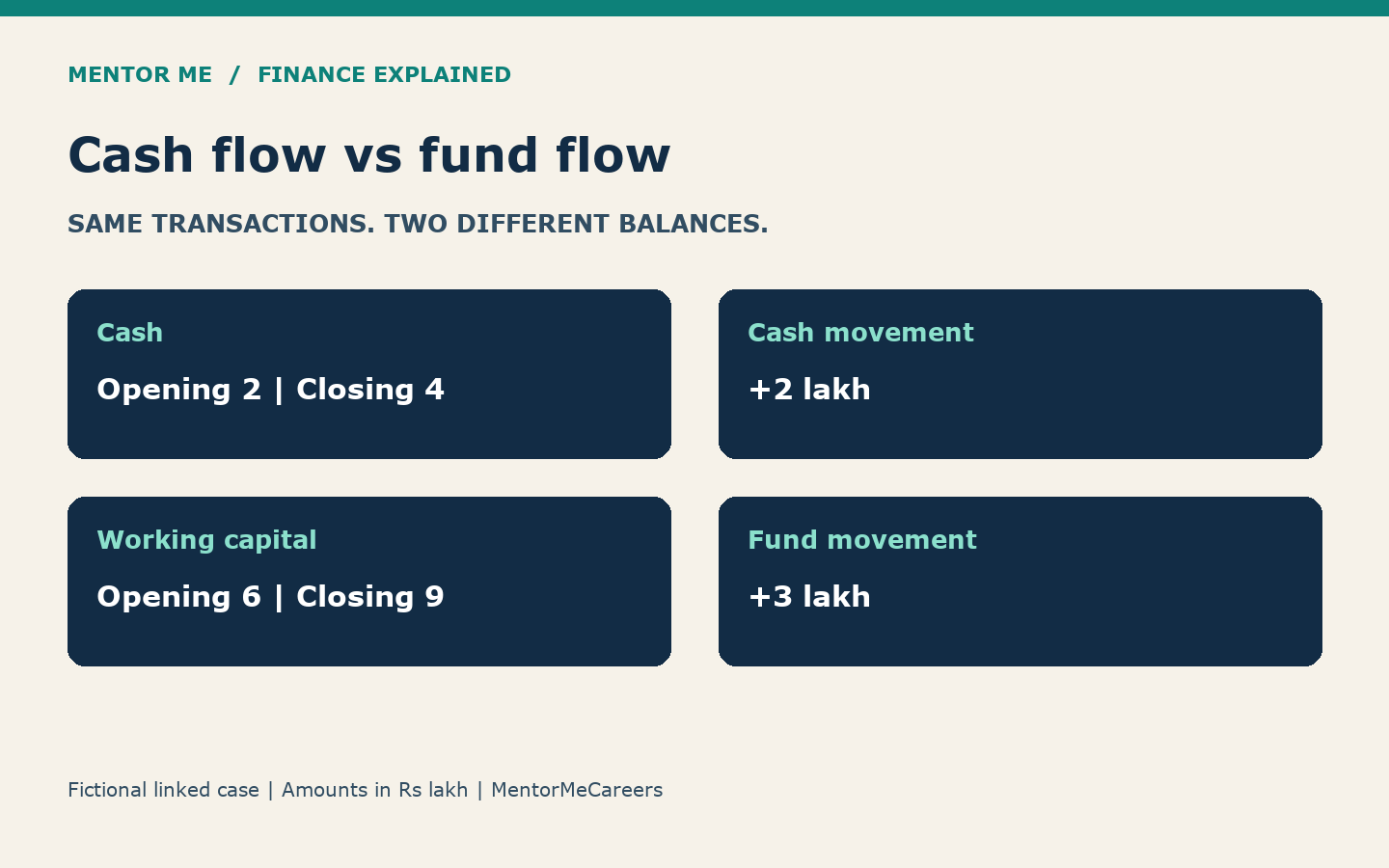
Receivables start at ₹3 lakh. Collecting ₹2 lakh reduces them, while the new credit service revenue adds ₹2 lakh. Therefore, they close at ₹3 lakh. Inventory rises from ₹5 lakh to ₹6 lakh. Trade payables remain ₹4 lakh.
| Current item | Opening | Closing | Change |
|---|---|---|---|
| Cash | 2 | 4 | +2 |
| Trade receivables | 3 | 3 | 0 |
| Inventory | 5 | 6 | +1 |
| Total current assets | 10 | 13 | +3 |
| Trade payables | 4 | 4 | 0 |
| Net working capital | 6 | 9 | +3 |
Working capital rises by ₹3 lakh, while cash rises by ₹2 lakh. The difference is the ₹1 lakh increase in inventory. These closing balances show the difference between cash flow and fund flow in numbers. Both statements reconcile without treating profit as cash.
Step 3: explain the sources and uses of funds
The long-term loan supplies ₹4 lakh of funds. The services generate ₹2 lakh of profit and funds from operations under the exercise assumptions, even though payment is still due. Buying equipment uses ₹3 lakh. The net source is ₹3 lakh, matching the increase in working capital.
Increase in working capital = 4 + 2 − 3 = ₹3 lakh.
In a traditional sources-and-applications statement, you can show the ₹3 lakh increase in working capital as the balancing application. Do not add it to sources as well. That would double count the movement.
Why profit and operating cash flow differ here
Profit is ₹2 lakh because the business earned credit service revenue and incurred no costs under the stated assumptions. Operating cash flow is ₹1 lakh because it collected ₹2 lakh and spent ₹1 lakh on inventory. Buying inventory does not itself create an expense in this exercise; the stock remains on hand.
Under an indirect bridge, start with profit of ₹2 lakh and subtract the ₹1 lakh increase in inventory. Net receivables did not change. This produces operating cash flow of ₹1 lakh. In a real company, you would also check depreciation, tax, payables and other adjustments.
For a broader review, apply the tools of financial statement analysis. Then link the schedules using our guide to building a financial model.
Difference between cash flow and fund flow: errors to avoid
- “Cash flow only measures operations.” It also includes investing and financing cash flows.
- “Fund flow measures only long-term transactions.” It can include funds from operations and explains the net working-capital movement.
- “A cash inflow always improves working capital.” A current loan raises cash and current liabilities together.
- “Positive working capital means the firm can pay today.” Slow debtors and unsold stock may delay cash.
- “Depreciation creates cash.” Adding it back removes a non-cash expense from an indirect calculation; it is not a cash receipt.
- “Higher working capital always means better performance.” Excess stock or late customer payments can tie up resources.
Questions about the difference between cash flow and fund flow
What is the main difference between cash flow and fund flow?
Cash flow explains movements in cash and cash equivalents. Traditional fund flow explains movements in net working capital. The worked case shows a ₹2 lakh cash increase and a ₹3 lakh working-capital increase from the same transactions.
Can cash increase without an increase in working capital?
Yes. Collecting an existing receivable increases cash and reduces receivables equally. A current loan can also raise cash while raising current liabilities by the same amount. Neither transaction necessarily increases total working capital.
Is a fund flow statement a substitute for a cash flow statement?
No. It answers a different question. Follow the cash flow reporting requirements that apply to the entity. Use a traditional fund flow statement as an added analysis tool when it helps explain financing and working capital.
What is the difference between funds from operations and cash from operations?
Traditional funds from operations adjusts profit for relevant non-fund and non-operating items. Cash from operations also reflects operating working-capital changes and other adjustments under the applicable reporting method. State the framework before comparing the two.
Which statement helps assess immediate liquidity?
Cash flow analysis is closer to cash availability, but a historical statement alone is not a short-term cash forecast. Check due dates, restricted balances, credit lines and expected receipts before judging whether the business can meet its next payment.
What are the three types of cash flow?
The cash flow statement groups cash flows into operating, investing and financing activities. Customer receipts commonly relate to operations, equipment purchases to investing, and loan proceeds to financing. Classification details depend on the applicable reporting framework.
Is cash flow the same as profit and loss?
No. Profit and loss includes revenue and expenses under accrual accounting. Cash flow records cash movements. Credit sales, depreciation and inventory changes can create differences. In the worked case, profit is ₹2 lakh while operating cash flow is ₹1 lakh.
A quick test before you finish
Change the example’s ₹4 lakh loan from long-term to current. Cash still closes at ₹4 lakh. However, current liabilities rise to ₹8 lakh, and working capital closes at ₹5 lakh. That is a ₹1 lakh decline from the opening balance. The cash result did not change, but the funding structure did.
That is the habit I want you to build: trace both accounts, check the classification and reconcile the answer. To practise linked statements and forecasts, explore our Financial Modelling course.
Sources and further reading
Framework references: IFRS Foundation, IAS 7; IGNOU, Statement of Changes in Financial Position; and Bharathidasan University, Corporate Accounting. The linked case and transaction tests above use original fictional numbers.

A CFA charterholder with hands-on experience across investment analysis and finance education. At MentorMeCareers, he writes and reviews content on CFA, financial modeling, and investment banking careers — grounded in real market data rather than generic advice, and shaped by what actually helps candidates and professionals succeed.