
Last updated on November 3rd, 2026 at 04:29 pm

The scope of corporate finance covers how a business invests money, raises funds, manages short-term liquidity and returns surplus capital to its owners. Finance teams use forecasts, valuation and risk analysis to support these decisions. As a result, their work connects a business plan with cash, funding constraints and the value of the firm.
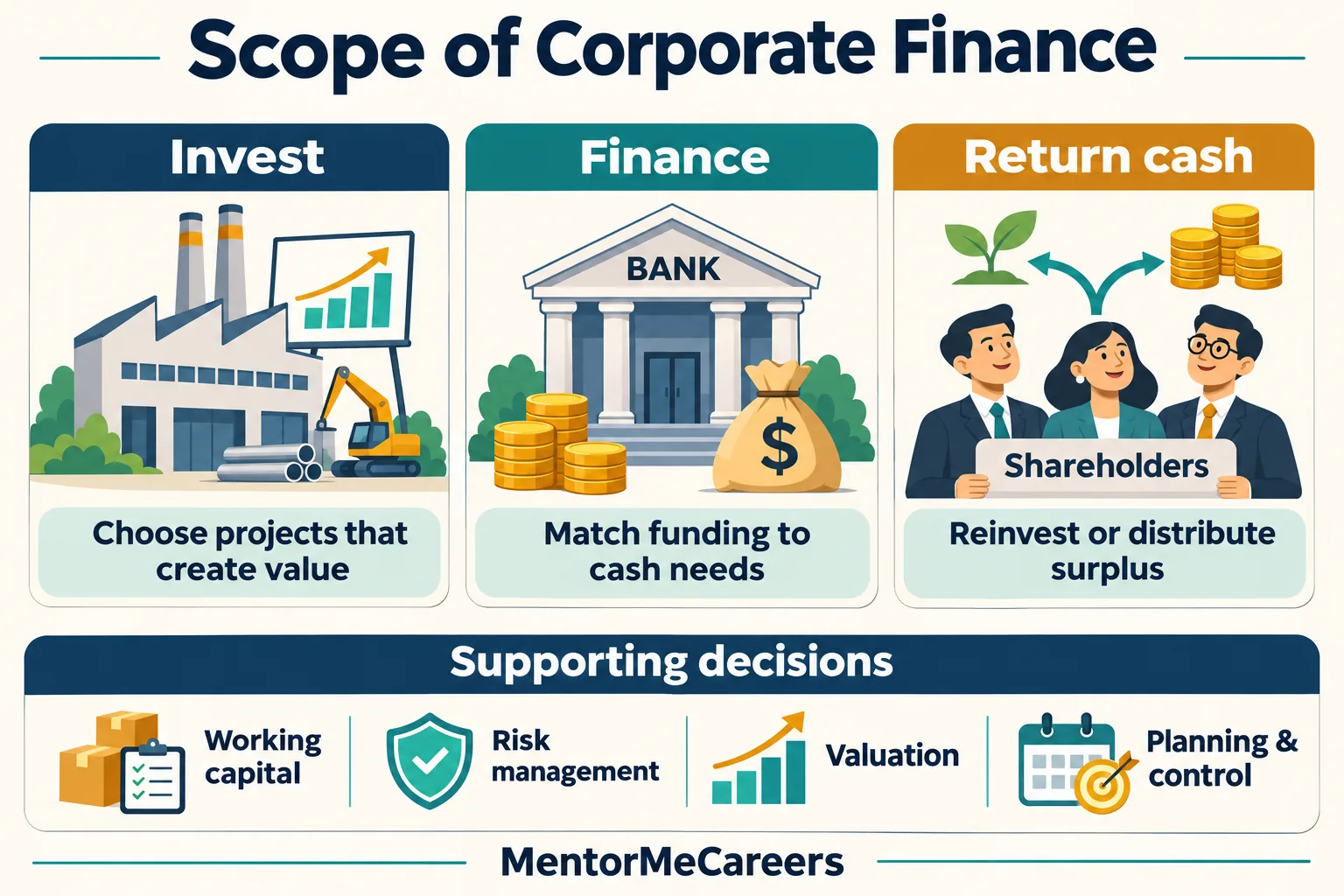
Seven areas within the scope of corporate finance
| Area | Decision | Typical analyst output |
|---|---|---|
| Investment and capital budgeting | Which projects should receive capital? | Corporate finance forecast, NPV, IRR and sensitivity analysis. |
| Financing and capital structure | How should the company fund its assets? | Corporate finance funding plan, debt capacity and cost-of-capital analysis. |
| Working capital and liquidity | Can the business fund day-to-day operations? | Cash forecast, receivables/inventory analysis and funding gap. |
| Payout policy | How much cash should be retained or returned? | Dividend/buyback capacity and reinvestment assessment. |
| Financial risk management | Which exposures could disrupt the plan? | Interest-rate, currency and scenario analysis. |
| Valuation, acquisitions and restructuring | What is an asset or business worth, and how could a transaction affect value? | Corporate finance valuation range, due-diligence inputs and deal scenarios. |
| Planning, analysis and governance | Is performance consistent with the plan and approved constraints? | Budget, forecast, variance analysis and decision reporting. |
Investment decisions: a worked project example
First, assume a fictional project costs ₹80 million today. For example, it produces cash inflows of ₹20m, ₹25m, ₹30m, ₹30m and ₹25m at the ends of years 1–5. In this case, the appropriate annual discount rate is assumed to be 12%. Also, the case excludes any additional terminal value and treats the supplied figures as the relevant incremental project cash flows.
| Year | Cash flow, ₹m | Present value at 12%, ₹m |
|---|---|---|
| 0 | −80 | −80.0000 |
| 1 | 20 | 17.8571 |
| 2 | 25 | 19.9298 |
| 3 | 30 | 21.3534 |
| 4 | 30 | 19.0655 |
| 5 | 25 | 14.1857 |
For this example of the scope of corporate finance, NPV = −80 + 20/1.12 + 25/1.12² + 30/1.12³ + 30/1.12⁴ + 25/1.12⁵ = ₹12.3916 million. In addition, the IRR, which makes NPV zero, is approximately 17.77%.
Therefore, the positive NPV supports acceptance under the stated assumptions. However, the analyst still needs to test demand, costs, timing, working capital and execution risk. In corporate finance, an attractive base case is not a guarantee.
For the corporate finance team, undiscounted cumulative inflows reach ₹75m after year 3. For example, if the year-four inflow arrives uniformly, the remaining ₹5m takes 5/30 of a year, giving a simple payback of 3.17 years. In contrast, if cash arrives only at each year end, recovery occurs at the end of year 4. Also, payback ignores later cash flows and, in this simple form, the time value of money.
How should the business fund the project?
Within the scope of corporate finance, a project may be economically attractive yet difficult to fund. Therefore, compare borrowing, equity and retained cash while considering repayment obligations, dilution, covenants and flexibility. However, a lower headline interest rate does not automatically mean lower total risk. Also, finance teams should keep financing assumptions consistent with the valuation method.
What does an analyst do?
Corporate finance work varies by role. For example, an FP&A analyst may forecast revenue and explain budget variances. In contrast, a treasury analyst may monitor cash and funding exposures. In addition, a corporate-development analyst may support valuation and acquisition analysis. Across the scope of corporate finance, accounting knowledge, spreadsheet skills and clear communication help across these roles, but a single qualification does not guarantee an offer.
Common questions about the field
Is corporate finance the same as accounting?
In practice, the fields overlap. For example, accounting records and reports financial activity; corporate finance uses financial information to assess investments, funding and value. Therefore, reliable accounting inputs are essential to a useful financial model.
What is the scope of business finance?
In general, business finance broadly covers obtaining and managing funds in a business. Similarly, corporate finance applies these decisions to companies, including capital structure, investment and distributions to owners.
Is corporate finance a good career?
For example, this field can suit people who enjoy financial analysis, business decisions and explaining uncertain outcomes. First, compare the actual responsibilities and requirements of FP&A, treasury, valuation and corporate-development roles before choosing a path.
Which qualifications are required?
For corporate finance roles, requirements depend on the role and employer. Commerce or finance study, CA, CFA programme study, an MBA and practical modelling skills can be relevant in different situations. Therefore, check the employer’s stated requirements; do not assume every opportunity requires a Tier-1 MBA.
Finally, for the reasons these decisions matter, read the separate importance of corporate finance guide. For a closer look at investment appraisal, see capital budgeting.
How to use these decisions together
In practice, the scope of corporate finance extends across linked decisions. For example, a growth plan can increase sales and still create a cash shortfall. Therefore, the team checks both the project return and the cash needed to run it. Similarly, a funding choice can change risk even when the project forecast stays the same. Finally, compare the plan with actual results and explain why they differ.
The scope of corporate finance: seven decisions in one business
A scope list becomes more useful when you can see the decisions interact. Consider a fictional manufacturer planning a new production line. The investment case may look attractive, yet the company can still run short of cash if customers pay slowly or the funding matures too soon.
Corporate finance investment decisions: what deserves capital?
First, define the alternatives: build the line now, delay it, outsource production or reject it. Compare incremental cash flows rather than allocate existing costs to make a preferred option look better. For example, an old research bill already paid is not a new cash outflow caused by accepting the project.
The analyst’s output should explain the choice, assumptions and risks. A single NPV cell without a supporting forecast is not a complete recommendation. Therefore, show what happens if demand or unit margins fall.
Corporate finance funding decisions: match the obligation to the asset
A five-year asset funded with borrowing due next month creates a refinancing question. That does not prove the funding is wrong, but it does need an answer. Compare repayment timing with expected cash generation, security requirements and the terms that constrain the business.
Similarly, equity avoids scheduled loan repayments but changes ownership claims. Retained cash also has an opportunity cost. Therefore, “debt is cheaper” does not settle the financing choice by itself.
Working capital: fund the gap between buying and collecting
Suppose the project requires ₹6 million of inventory and ₹4 million of customer receivables, supported by ₹3 million of supplier credit. The simplified net operating working-capital requirement is ₹7 million. If these balances are new, this is cash tied up in operations, not an extra ₹7 million profit expense.
However, do not automatically add this amount to the project case above: that case already treats its supplied cash flows as the relevant incremental project figures. First establish what those figures include. This prevents counting the same cash requirement twice.
Payouts: decide whether surplus cash is truly available
A bank balance can look comfortable while the company faces a near-term tax bill, debt maturity or planned investment. Therefore, test the cash forecast before recommending a payout. A company also needs to follow the legal and contractual constraints that apply to it.
In a simplified teaching case, assume ₹15 million remains after operating needs and all binding commitments. If a justified project requires ₹9 million, ₹6 million remains before other reserves or choices. The calculation frames the decision; it does not prove that ₹6 million must be paid out.
Corporate finance risk analysis: test the plan
For example, an exporter may earn foreign currency while paying costs in rupees. A currency move can change the margin even if sales volume meets the plan. The analyst identifies the exposure, models scenarios and supports the approved risk response.
Distinguish a sensitivity from a scenario. A sensitivity changes one input to show its effect. A scenario changes a coherent set of assumptions, such as weaker demand and slower collection together. Neither removes uncertainty, but both can improve the decision.
Valuation and transactions: connect price with cash flows
A proposed acquisition needs more than the seller’s price and a headline earnings multiple. Check what the buyer receives, the relevant debt and cash, expected cash generation, transaction costs and the evidence for any claimed synergies.
For example, a benefit requiring integration spending should include that spending in the analysis. Otherwise, the model presents the upside while omitting part of its cost. Corporate finance teams make those assumptions visible rather than treat the deal price as the value.
Planning and governance: explain what changed
After approval, compare actual performance with the forecast. A shortfall may come from lower prices, fewer units, delayed collections or costs. Separate these drivers instead of writing “sales missed budget” as the whole explanation.
Finally, record who owns the follow-up action and when the decision needs review. This connects the scope of corporate finance with day-to-day management rather than ending the exercise at project approval.
Check the project example in Excel
Put year-zero cash flow of −80 in B2 and the five annual cash inflows in B3:B7, all in millions of rupees. Then use =NPV(12%,B3:B7)+B2. The result is about 12.3916. The initial investment is outside NPV because it occurs today, while the five inflows occur at year ends.
Next, use =IRR(B2:B7), including the initial outflow. Format the answer as a percentage: about 17.77%. However, do not compare the unformatted decimal 0.1777 with a percentage such as 12 without checking the units.
If cash flows occur on irregular dates, use a date-aware method such as XNPV or XIRR with matching dates. Also, some cash-flow patterns can produce more than one IRR or no useful IRR. The conventional one-outflow-then-inflows example here avoids that complication.
What does a useful analyst recommendation look like?
The base case adds about ₹12.39 million of present value at the assumed 12% discount rate. The annual cash flows and initial outlay produce an IRR of about 17.77%. Acceptance remains conditional on the demand, cost and funding assumptions. Before committing, test the downside case and confirm that the financing plan covers the expected cash needs.
This recommendation separates the calculated result from the assumptions behind it. In contrast, “IRR exceeds 12%, so the project is safe” claims more than the model establishes. A strong corporate finance answer makes the limits clear.
How is corporate finance different from investment banking?
Corporate finance is the company’s decision field. Investment bankers may advise on raising capital, mergers or other transactions, while company teams remain responsible for their own plans and decisions. Roles overlap in their use of forecasts, valuation and financial statements, but their employers and day-to-day work can differ.
To explore the skills behind these examples, practise building a cash-flow model, checking assumptions and explaining a recommendation. Our financial modelling course covers structured learning options. Check the current curriculum against the particular skill you want to develop.
Sources
Utkal University corporate-finance module; Aswath Damodaran, NYU: corporate finance first principles; Microsoft: NPV and IRR cash-flow timing.

A CFA charterholder with hands-on experience across investment analysis and finance education. At MentorMeCareers, he writes and reviews content on CFA, financial modeling, and investment banking careers — grounded in real market data rather than generic advice, and shaped by what actually helps candidates and professionals succeed.