
Last updated on November 4th, 2026 at 11:38 am

The substitution effect is the change in consumption caused by a change in relative prices after compensating for the change in purchasing power under a stated method. It is different from the income effect. A price increase can change both what is relatively attractive and what the consumer can afford, even when money income stays the same.
Why unchanged income does not isolate substitution
Suppose a meal becomes more expensive while your monthly food budget stays fixed. You may switch to another meal because the first is now relatively dearer. You may also cut spending because the same budget buys less overall. Those are different channels.
The substitution effect concerns the relative-price channel. The income effect concerns the change in real purchasing power. Observing one before-and-after purchase does not, by itself, identify the size of each effect. An economic model and a compensation method are needed.
OpenStax distinguishes these channels in consumer choice. The important starting point is that a fixed nominal income is not the same as fixed purchasing power.
Substitution effect vs income effect
| Feature | Substitution effect | Income effect |
|---|---|---|
| Driver | A change in relative prices | A change in real purchasing power |
| What is held constant | A specified compensated benchmark | The comparison follows the chosen decomposition |
| Normal good after own-price rise | Works towards less of the relatively dearer good | Lower purchasing power also reduces demand |
| Inferior good after own-price rise | Still works away from the relatively dearer good under standard assumptions | Can work in the opposite direction |
“Inferior” describes a demand response to income, not poor quality. A Giffen case requires an opposing income effect large enough to outweigh the substitution effect. Not every inferior good is a Giffen good.
Substitution effect example: a compensated budget
Consider two fictional meals, A and B. Initially, A costs ₹100 and B costs ₹50. A consumer has ₹600 and chooses four A meals plus four B meals. Spending is 4 × ₹100 + 4 × ₹50 = ₹600.
Now A rises to ₹150 while B stays at ₹50. A used to cost the same as two B meals; it now costs the same as three. At the new prices, the old bundle would cost 4 × ₹150 + 4 × ₹50 = ₹800.
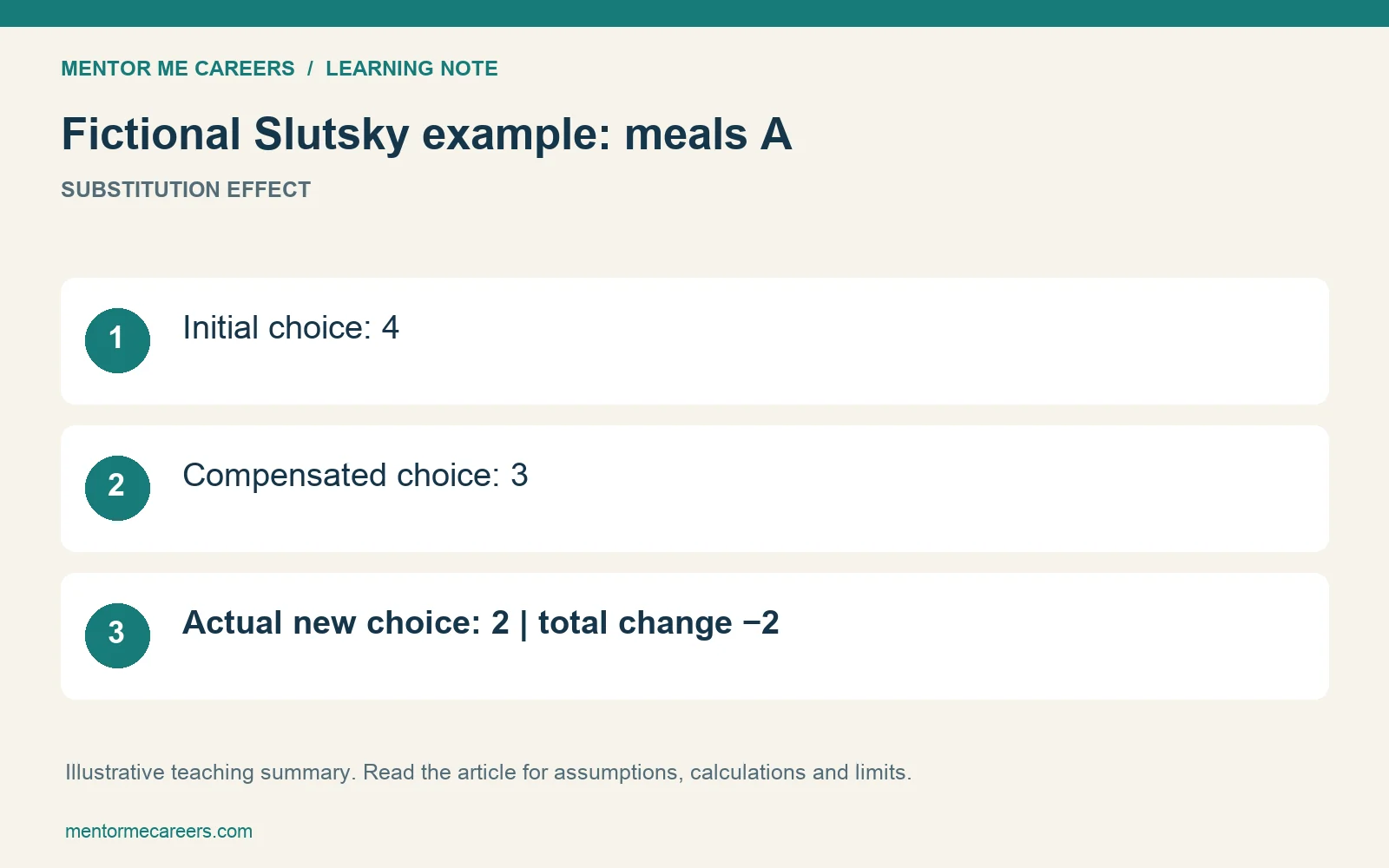
For a Slutsky-style compensation, raise the hypothetical budget to ₹800 so the old bundle remains affordable. Assume, for illustration, that the consumer chooses three A and seven B with that compensated budget. Spending is 3 × ₹150 + 7 × ₹50 = ₹800. Finally, at the actual ₹600 budget and new prices, assume the chosen bundle is two A and six B, costing ₹600.
| Stage | Price A / B | Budget | Assumed chosen A / B |
|---|---|---|---|
| Initial | ₹100 / ₹50 | ₹600 | 4 / 4 |
| Compensated at new prices | ₹150 / ₹50 | ₹800 | 3 / 7 |
| Actual new-price choice | ₹150 / ₹50 | ₹600 | 2 / 6 |
For A, the substitution component is 3 − 4 = −1 meal. The income component is 2 − 3 = −1 meal. The total price effect is 2 − 4 = −2 meals. The components add correctly: −1 + −1 = −2.
These chosen bundles are explicit assumptions, not predictions derived from prices alone. Different preferences can produce different quantities. The example demonstrates the decomposition and arithmetic, not an estimated consumer response.
Substitution effect: Hicks and Slutsky compensation
Hicksian compensation holds the consumer at the original utility level while prices change. Slutsky compensation makes the original bundle affordable at the new prices. For a finite price change, these can produce different compensated choices.
The example above uses the affordability approach. It does not claim that the compensated bundle gives exactly the original utility. Calling both methods simply “income stays unchanged” would hide the key distinction.
In either approach, be explicit about the benchmark and assumptions. If an exercise provides a utility function, solve the relevant consumer problem rather than choosing quantities that merely fit the budget.
What businesses can and cannot infer
A retailer may observe customers moving from one product to another after a price change. That observation is consistent with substitution, but promotions, stock availability, income changes and seasonality may also affect sales. A before-and-after chart alone does not establish causation.
For a useful analysis, define the products, period, units, prices actually paid and relevant customer group. Distinguish a switch between brands from a change in total category spending. A revenue increase can coexist with fewer units sold if the price rises sufficiently.
The supply-side shutdown-point example explains a different decision: whether production covers avoidable costs. Our regression guide also highlights why relationships and predictions require careful interpretation. Do not replace consumer evidence with a neat diagram.
Frequently asked questions
Can substitution occur when income is unchanged?
Yes. But unchanged money income does not isolate the pure substitution effect because a price change also alters purchasing power.
Does the substitution effect always mean buying the cheapest product?
No. It concerns relative prices and preferences under a compensated comparison. Quality, tastes and other product characteristics still matter.
Is the income effect the same for normal and inferior goods?
No. Their responses to a change in real income differ. The direction and size must be assessed under the specified model.
Sources and further reading
Reviewed 3 November 2026. Worked cases are fictional teaching examples unless a named primary source is given.

A CFA charterholder with hands-on experience across investment analysis and finance education. At MentorMeCareers, he writes and reviews content on CFA, financial modeling, and investment banking careers — grounded in real market data rather than generic advice, and shaped by what actually helps candidates and professionals succeed.