
Last updated on November 16th, 2026 at 06:31 pm
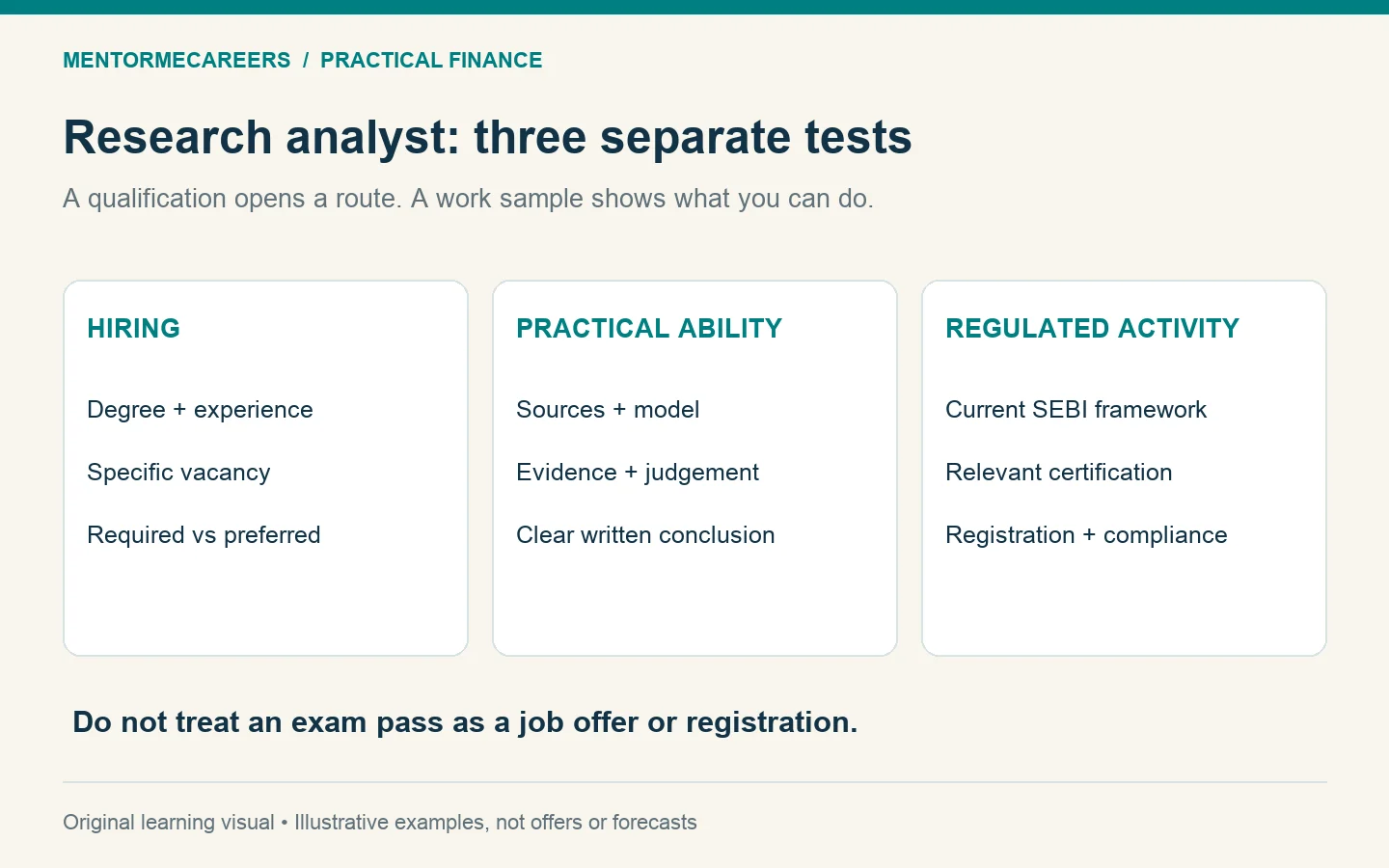
Research analyst qualifications depend on the role you want: an employer’s hiring criteria, the skills needed to produce useful analysis, and any applicable regulatory requirements are separate tests. Research analyst qualifications may help you enter the hiring process. It does not, by itself, show that you can analyse a company or authorise you to run a regulated research service.
Start with the work, not the title. An equity analyst, a credit researcher and a market-research analyst can all collect information and write reports, but they investigate different problems. This guide focuses on financial research in India and shows how to turn qualifications into evidence an employer can inspect.
Research analyst qualifications: three questions to answer first
| Question | What to check | What it does not establish |
|---|---|---|
| Can I apply for this job? | The exact degree, experience, location and skill requirements in its advertisement. | That every employer uses the same criteria. |
| Can I do the work? | Accounting, modelling, research, source checking and written judgement. | That passing an exam replaces practical ability. |
| Can I provide the proposed regulated service? | The current SEBI framework, relevant certification and registration/compliance route. | That an NISM pass is itself SEBI registration. |
First, read job advertisements in two columns: required and preferred. For example, a preferred qualification can strengthen an application without being an absolute gate. Conversely, a mandatory requirement should not be ignored because a training provider says a course is enough.
What a financial research analyst actually does
The central task is to turn incomplete information into a defensible view. In equity research, that may mean forecasting earnings and judging valuation. In credit research, it may mean testing debt-servicing capacity and identifying downside risks. A research-support team may maintain models, track disclosures and draft sections for senior analysts.
| Role | Typical analytical question | A useful work sample |
|---|---|---|
| Equity research | What drives earnings, and what assumptions justify the valuation? | A sourced company model and a concise investment note. |
| Credit research | Can the borrower meet obligations under a weaker cash-flow scenario? | A debt schedule, coverage analysis and downside case. |
| Investment research support | Has new information changed the existing forecast or thesis? | An earnings update showing the old estimate, new estimate and reason. |
| Market or consumer research | What does evidence say about customers, demand or competitors? | A survey/industry analysis with a clear method and limitations. |
Buy-side teams use research to support investment decisions. Sell-side research supports clients and the firm’s research offering. However, the distinction affects the audience and workflow, but neither label excuses weak evidence. Therefore, a strong report makes its sources, assumptions and uncertainty visible.
What actual employer descriptions ask for
BlackRock’s investment-research graduate function page describes company analysis, recommendations to portfolio managers and concise communication. It is a global function description, not proof of a current Indian vacancy. The useful lesson is the combination of analytical work and communication.
A J.P. Morgan Global Research Center Mumbai advertisement, job ID 210791098, observed during this review, separately listed analytical/data capabilities and preferred research experience, finance credentials and education. That is one role’s specification, not a universal entry rule. It also shows why “analyst” is too broad a search term: sector knowledge, automation and the work product matter. Check the employer’s current vacancy page because individual listings can close.
When reviewing vacancies, record the employer, job ID, date, required skills, preferred credentials and experience band. Compare several genuinely similar roles before choosing a course. Do not count a data-operations or sales role as equity research just because the title contains “research”.
Degrees, CFA, CA and MBA: what each can and cannot prove
A finance or commerce degree can supply an accounting foundation. Economics can strengthen economic reasoning; quantitative or technical study may support data-heavy work. In practice, the right starting point depends on the specific vacancy and your existing skills. There is no defensible rule that every research employer requires an MBA.
| Route | Potential contribution | Gap to test in a work sample |
|---|---|---|
| Commerce/finance degree | Accounting and business foundations. | Can you turn statements into a consistent forecast? |
| CFA Program | Investment analysis and valuation study. | Can you apply the concepts to a sourced company case? |
| CA or accounting route | Financial reporting and accounting judgement. | Can you connect accounting detail to business drivers and valuation? |
| MBA or postgraduate study | Structured learning, projects and possibly recruitment access. | Are the relevant placement outcomes and costs evidenced? |
| Technical/data background | Coding, statistics and data handling. | Can you explain the economics and accounting behind the numbers? |
Above all, describe your status accurately. Passing a CFA exam level is not the CFA charter. Likewise, attending a valuation course is not professional registration. Our CFA explanation and CFA versus financial modelling comparison help separate broad investment study from applied modelling practice.
SEBI research analyst qualifications: the current framework
For regulated research services, consult SEBI’s Research Analysts Regulations, amended through 10 October 2026. Regulation 7 currently provides a recognised graduate/equivalent qualification or CFA Charter together with the relevant NISM/accredited certification route, or the specified NISM postgraduate-programme route. Renewal requirements and the individual’s function also matter.
This is narrower than saying “any research analyst needs an MBA” and broader than saying “pass NISM and start selling recommendations”. Qualification, certification, registration and ongoing compliance are distinct. Before offering a service, establish how the current rules apply to the activity and entity rather than relying on a job title or an older summary.
NISM’s current Series XV page says the revised exam took effect on 20 January 2026: 80 standalone questions plus five cases with four questions each, 100 marks in two hours, a 60% pass mark and 25% negative marking for a wrong answer. A case-based exam is another reason to understand the analysis rather than memorise isolated definitions. Our SEBI research analyst exam guide covers that route separately.
A worked research example: growth is not the same as quality
Consider a fictional distributor. Revenue rises from ₹100 crore to ₹120 crore. Operating profit rises from ₹12 crore to ₹12.6 crore, while receivables rise from ₹15 crore to ₹24 crore. These are teaching inputs, not the results of a real company.
| Measure | Calculation | Interpretation |
|---|---|---|
| Revenue growth | 120/100 − 1 = 20% | Sales increased strongly. |
| Operating margin, old | 12/100 = 12% | Starting profitability. |
| Operating margin, new | 12.6/120 = 10.5% | Margin fell by 1.5 percentage points. |
| Receivables as a share of sales | 15% → 20% | More of the reported sales remain tied up in receivables. |
By contrast, a weak note repeats “revenue grew 20%”. A useful note asks whether price, volume or acquisitions drove growth; why margin fell; whether receivables reflect seasonality, longer terms or collection issues; and what the cash-flow statement shows. The figures are prompts for investigation, not proof of misconduct.
Build the next step in Excel: link revenue to volume and price, separate operating costs, reconcile working capital and show the effect on cash. Document each source and avoid plugging an unexplained balancing number. The financial statement analysis guide offers a wider set of checks.
Build a portfolio that demonstrates research ability
- One source pack: annual reports, exchange filings and dated industry evidence, with page references.
- One clean model: historical statements, explicit drivers, forecast assumptions and error checks.
- One short note: the question, thesis, supporting evidence, risks and what would change your view.
- One update: revise the model after a new result and explain the difference.
Use public information and respect copyright. A practice note should be labelled educational and should not pretend to be regulated client advice. If you use AI to summarise a filing, verify every material number against the original. A fluent paragraph is not an audit trail.
A practical preparation sequence
Start by choosing a target such as equity research support or credit analysis. In the first two weeks, diagnose your accounting and Excel gaps and read actual role descriptions. Over the next month, build one company case with a documented model. Then practise explaining it aloud and tailor applications to roles that fit. This is a suggested workflow, not a guaranteed hiring timeline.
For interviews, prepare to explain one assumption you changed, one source you rejected and one risk that could invalidate your conclusion. Use our equity research interview questions and equity research firms guide for further study. If modelling is your immediate gap, review the financial modelling course against the specific skills you need.
Research analyst salary: compare the job, not just the title
There is no single salary for this title. A research-support role, an experienced sector analyst and a market-research position are not the same job. Compare current offers or disclosed pay for the same city, experience band, employer type and responsibilities. Separate fixed pay, variable pay and benefits; a self-reported average is not a guaranteed package.
Finally, before paying for a credential, model your own budget: exam/training costs, preparation time and the income you may forgo. Ask for documented role-level outcomes rather than using the highest placement as the expected result. Our research-associate salary discussion is a related starting point, not a substitute for a current offer.
Research analyst qualifications: frequently asked questions
How do you become a research analyst?
Choose the type of research, check matching vacancies, build the necessary accounting/data/writing skills and prepare an evidence-based work sample. Follow the applicable regulatory route if the activity falls within regulated research services.
Is a research analyst an IT job?
Sometimes the role is data-heavy, but financial research is defined by the analytical problem and output. Coding can support the work; it does not replace understanding a business, security or credit exposure.
Which course is best for a research analyst?
Choose from the gap between your current ability and the intended role. Investment study, accounting, modelling and data analysis solve different problems. Compare curriculum, assessment and practical output rather than choosing solely from a certificate name.
Can a fresher become a research analyst?
Some employers recruit graduates or interns, while others require experience. Apply to the appropriate band and show what you can produce. A qualification can support an application; it does not override a vacancy’s requirements.

A CFA charterholder with hands-on experience across investment analysis and finance education. At MentorMeCareers, he writes and reviews content on CFA, financial modeling, and investment banking careers — grounded in real market data rather than generic advice, and shaped by what actually helps candidates and professionals succeed.