
Last updated on January 12th, 2026 at 05:45 pm

What is Financial Modelling?
Financial modelling is the process and skill of creating a structured Excel-based representation of a company’s financial performance to analyze decisions, forecast future outcomes, and evaluate business, investment, or valuation scenarios.

Here is a how a real; Financial model looks like:
What is Financial Modelling?
Financial modeling encompasses a wide range of techniques and approaches that require a robust understanding of accounting principles. Whether you aim to build a financial model for investment analysis, budgeting, or strategic planning, a deep grasp of accounting fundamentals is essential. This understanding includes the effective management of working capital the funds available for day-to-day operations and its impact on a company’s financial health.
For instance, when evaluating a company’s liquidity and operational efficiency, models often include projections of working capital requirements, which can significantly affect cash flow and profitability. In order for you to understand what is financial modeling, at the contextual level. You first need to understand various use cases. Let me illustrate some real life scenarios, where you would end up using financial modeling.
Why is Financial Modelling Important?
Financial Modelling enables you to make informed decisions, strategic analysis regarding financials. Analyzing the financial data and representing with proper framework is a very important skill in finance sector. Financial Modelling exactly provides you this. Framework and conclusions represented by you as Financial Analyst helps stakeholders value the company. This helps in making future decisions for the company. Financial Analyst are the pillar of any financial Institutions. Financial Modelling is the core basic skill needed for you to enter into the finance world.
For investors and lenders, financial models provide transparency. They show how a business generates cash, manages costs, and sustains growth over time. This builds trust and supports informed investment decisions.
Financial modeling also aligns stakeholders. Management, investors, and advisors work from the same assumptions and projections. This creates consistency in planning, valuation, and long-term strategy.
Why Financial Modelling should be preferred by Freshers?
Degree and the syllabus provided by the institutions is not enough for you to get a job in Finance Industry. Modelling is the basic skill needed. Learning it will help you step into the Industry. It bridges the gap between theory and practical world. This is the perfect opportunity for students to crack it. Also it boost your career growth and makes you more employable by increasing you your analytical skills.
Tool used for Financial Modelling
Excel
Honestly speaking, excel is the only skill you need to master to be a financial analyst. Through excel learn how to make models in Excel.
- Layout and Functions
- Logical Operators
- Data visualization Techniques
- Advanced Functions
- Macros and VBA programming
Learning these step by step will make you Job ready in the finance industry.
Expanding Financial Modeling Knowledge: From Basics to Advanced Applications
In more advanced financial modeling scenarios, such as those employed by a private equity firm, the scope extends to evaluating investments, mergers, and acquisitions. Private equity models, in particular, focus on assessing leveraged buyouts (LBOs) and other strategic transactions, often requiring complex forecasting and sensitivity analyses.
These models help investors understand how different capital structures and operational strategies will impact the financial outcomes of their investments. By incorporating a comprehensive understanding of accounting and operational dynamics, financial modeling supports informed decision-making and strategic planning in a variety of business contexts.
What is financial modelling used for?
Financial modeling is used to support key business and investment decisions where clarity, forecasting, and valuation are critical.
1. Investment decisions: Analyze potential returns, risks, and cash flows before committing capital.
2.Business valuation: Estimate a company’s intrinsic value for fundraising, buying, or selling purposes.
3.Mergers and acquisitions (M&A): Analyze deal impact, synergies, and accretion or dilution outcomes.
4.Budgeting and forecasting: Plan future revenues, costs, and cash needs with structured financial projections.
5.Strategic planning: Test different growth scenarios and assess long-term business sustainability.
6.Capital raising: Support equity or debt fundraising with clear financial projections and assumptions.
Use cases of financial modeling and Valuation
In case of the above question, you are using financial modeling to take a decision between two industry choices. One of your friends, is confused between opening a hospital versus the business model of a pharmaceutical labs. Pharmaceutical labs are less complicated and better margins compared to hospitals. So gives you insights on the delicate complications and details of a business.
You are trying to decide between two stocks: Let say TCS versus Infosys. Both look good and reputed but which one will give you more higher returns?
We know that both these companies are great but what will matter is which of these is reasonably priced. Which means valuation.
What is the Process of Creating a Financial Model
Learn the Complete step by step process on How to build a financial model
The financial modeling process follows a structured approach to convert financial data into actionable insights.
- Define the objective: Identify the purpose of the model, such as valuation, budgeting, or deal analysis.
- Collect financial data: Gather historical financial statements, assumptions, and relevant market information.
- Build assumptions: Set clear drivers for revenue, costs, growth, and capital structure.
- Develop the model: Create linked financial statements or projections using structured formulas.
- Analyze scenarios: Test different assumptions to understand risks and outcomes.
- Review and validate: Check accuracy, logic, and consistency before sharing with stakeholders.
Brief History of Financial Modeling
This can be insightful how this skill became such an important requirement today, and it happened with a small case study thrown at MBA Students at Harvard. Dan Bricklin also known popularly as the god father of spreadsheet, was precisely that student who made this happen. Yea that’s right! An MBA student in a business school ! Making the long story short. Bricklin was attending his finance lecture at Harvard, in the spring of 1978 presented with an assignment to create a ledger sheet (Paper based) financial model for a merger. During those times creating spreadsheet, wasn’t exactly the job of a finance manager, it used to be done by data processors team using mainframe computers.
Who should learn financial modelling?
Financial modeling is a valuable skill for anyone involved in financial analysis, business decision-making, or strategic planning.
1.Students and fresh graduates who want strong practical skills for finance, consulting, or corporate roles.
2.Working professionals in finance, accounting, strategy, or operations who want to improve analytical decision-making.
3.Career switchers moving into finance, investment banking, or corporate finance roles.
4.Entrepreneurs and business owners who need to understand financial performance and future projections.
Types of Financial Model
By now you should have understood its importance and why this is such an important skill. You would be very uncomfortable if you didn’t have a financial model in situations where some serious money was at stake. It just simplifies the decision making process and gives you a road map for the future. So the basic types of financial model.
Three statement Model
The most common- Basically creating three future financial statements of the company. Including income statement balance sheet, cash flow statement.
Merger Model ( M&A Model)
In this type we are trying to see the effect of A+ B = C or A+ B =A. Meaning either merger or acquisition respectively and checking its effect on the future financial performance
DCF Model (Discounted Cashflow analysis)
In this model we try to forecast the future free cashflows of the business and find the net present value of these cashflows. Its majorly used for valuation purposes.
Sum of Parts Model
Used when we deal with a large conglomerate. For eg TATA. Tata is a large company with different types of businesses, so it will be very difficult to model the entire business in one go. So we break the business into various parts and forecast them separately
LBO (Leveraged Buy Out) Model
This is a classic model, in order to understand LBO, consider a real estate purchase done using home loan. You take loan to purchase the house and use the rents generated to pay off the debt and eventually reducing the debt in the house. Apply this exactly like it is to a private equity company purchasing a business using debt.
Comparable Company Analysis
In this type of model, we try to value a business using competitors and how the market is pricing the business. It is very useful when you have a company which has negative cashflows, hence you can’t actually forecast future cashflows.
IPO Model
Very similar to a valuation model using DCF. The only difference is you are creating this model to take a private company public. Also in the process raising capital.
Option Pricing Models
Very similar to a valuation model using DCF. The only difference is you are creating this model to take a private company public. Also in the process raising capital.
Algo Trading Models
Algo trading is done not basis financial statements but price data and statistics and signals to buy or sell, how to position your trade, risk management etc. This is an advance application of financial modeling.
Private Equity Models
the types of business’s which invest to private investors in private companies. These models are usually made by investment banks called as private equity firm.
Roles that use financial modelling
Financial modeling is used across multiple finance and business roles where forecasting, valuation, and decision analysis are required.
- Investment banking analysts and associates for valuation, deal analysis, and client advisory.
- Equity research professionals to evaluate companies and support investment recommendations.
- Corporate finance teams for budgeting, forecasting, and strategic planning.
- Private equity and venture capital professionals to assess investments and portfolio performance.
- Management consultants to model business scenarios and strategic outcomes.
Entrepreneurs and business leaders to plan growth, funding, and cash flow management.
Banking and Finance Roles which require financial modelling certification
Finance is the answer, any finance roles or business roles that you wish to be in would require you to have this skill under your belt . Not every role is going to ask you to put this in your resume but I can’t imagine being a CFO/ Product manager/ Treasury manager without knowing how to take decisions. Still for putting this in black and white here is the list. You can also check the deep dive analysis of financial modelling salary
The best way to learn financial Modeling- Complete Recommended list
There are many ways to learn it from doing it by yourself or watching YouTube videos all the way up to joining a financial modelling course but that depends on your previous understanding of finance, excel and also your preference of interaction and mentoring. Here is my top list on how to learning financial modelling
What is financial modelling best practices
Book: Simon Benninga: (Recommended for Advance Students)
This is the best option if you are already well versed with financial terminologies and can manage without a mentor or trainer. Read here.
Financial Modeling Online Full Course: (Recommended for Most).
There are many out there but I think all of them lack the common fundamental which is comprehensiveness and interactive.
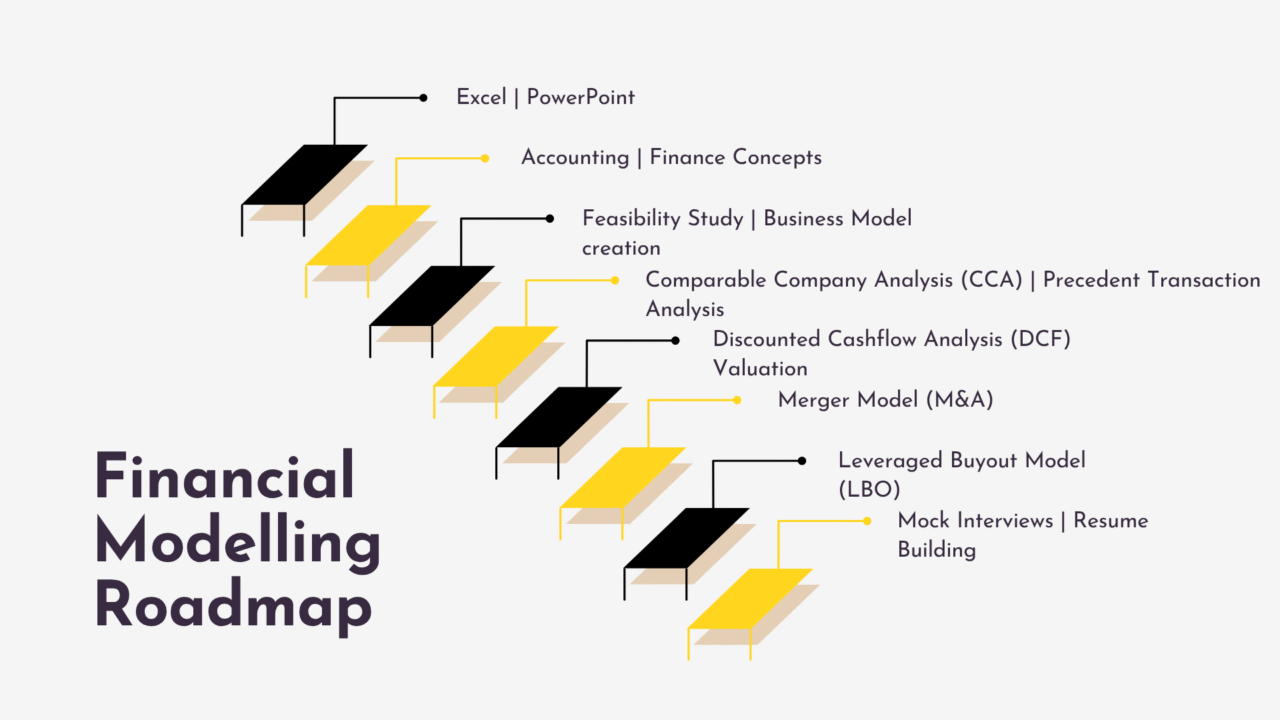
If you’re looking to apply financial modeling in a career-oriented program with placement support, explore the complete program here in Mentor me careers
FAQ
Financial modelling skill increase your analytical skills, critical thinking and decision making. In technical part financial modelling teaches you how to make models based on the data. All this leads towards getting a Job as a fresher.
By aquiring the skills demanded by the industry. In a competitive market having demanded skill is important hence financial modelling
Common types of financial models are used to analyze performance, value businesses, and support strategic decisions.
1.Three-statement model: Projects income statement, balance sheet, and cash flow together.
2.Discounted Cash Flow (DCF) model: Estimates a company’s intrinsic value using future cash flows.
3.M&A model: Evaluates the financial impact of mergers and acquisitions.
4.Budgeting and forecasting model: Plans revenues, expenses, and cash flows.
5.Sensitivity and scenario model: Tests outcomes under different assumptions.
Microsoft Excel is the best and most widely used tool for financial modelling.
It offers flexibility, powerful formulas, scenario analysis, and industry-wide acceptance across investment banking, corporate finance, and consulting.
Financial modelling requires a mix of technical, analytical, and business skills.
Accounting fundamentals to understand financial statements.
Excel proficiency for building accurate and efficient models.
Financial analysis and valuation knowledge to interpret results.
Logical thinking and attention to detail to avoid errors.
Business understanding to link numbers with strategy.