
Last updated on November 3rd, 2026 at 05:29 pm

A stock and sales statement reports how inventory moves during a defined period. It normally shows opening stock, receipts, sales, returns, other movements and closing stock by product. For example, use it to reconcile quantities and investigate differences. Keep inventory cost separate from sales revenue.
What is a stock and sales statement used for?
A distributor, retailer or manufacturer can use the report to understand what arrived, what left and what remains. As a result, a manager can compare the recorded closing balance with a physical count and inspect unusual movements.
For example, a product can show strong sales but still carry excessive slow-moving stock. In contrast, another item can have a negative balance because a receipt was posted late. Therefore, the stock and sales statement helps locate these questions; it does not answer them without transaction evidence.
This article explains the report and its preparation. It is not a login page for a pharmaceutical company’s stock-and-sales portal. Therefore, if your principal or lender requests a particular submission, use its own current format and instructions.
Stock and sales statement format: useful columns
| Column | What to record | Control to apply |
|---|---|---|
| Product/SKU and unit | A unique item code and a consistent unit | Do not mix boxes, strips and individual pieces |
| Opening stock | Balance at the beginning of the period | Agree it to the previous closing balance |
| Receipts | Goods received into this location | Use the appropriate receipt date and document |
| Gross sales quantity | Units leaving through sales before returns | Reconcile with the sales records |
| Sales returns | Returned units accepted back into saleable stock | Keep damaged returns separate |
| Supplier returns | Units returned out to suppliers | Match approved return documents |
| Other movements | Transfers, damage, expiry and approved adjustments | Show the movement type and evidence |
| Closing stock | Calculated ending book quantity | Reconcile with the stock ledger |
| Physical count and variance | Counted units and difference from book quantity | Investigate before approving an adjustment |
Also, add the reporting period, location and preparation date. For example, for batch-controlled products, include batch and expiry details where needed. For a multi-location business, show transfers in and out separately rather than hiding them in purchases or sales.
Software can produce product-wise stock-and-sales reports, but the setup still matters. For example, Marg’s product documentation describes its reporting configuration. That is a vendor workflow, not a universal report standard.
Stock and sales statement formula
For a simple single-location case with no transfers:
Book closing quantity = Opening + Receipts + Saleable sales returns − Gross sales − Supplier returns − Write-offs
Then calculate:
Count variance = Physical quantity − Book closing quantity
In this stock and sales statement, a negative variance means that the physical count is lower than the book balance. However, it is a shortage to investigate, not permission to change sales until the two figures agree.
In particular, be consistent about returns. If the sales figure is already net of sales returns, do not add those same returns again. Likewise, the formula above assumes receipts have not already been reduced by supplier returns.
Stock and sales statement example: reconcile 52 units to 50
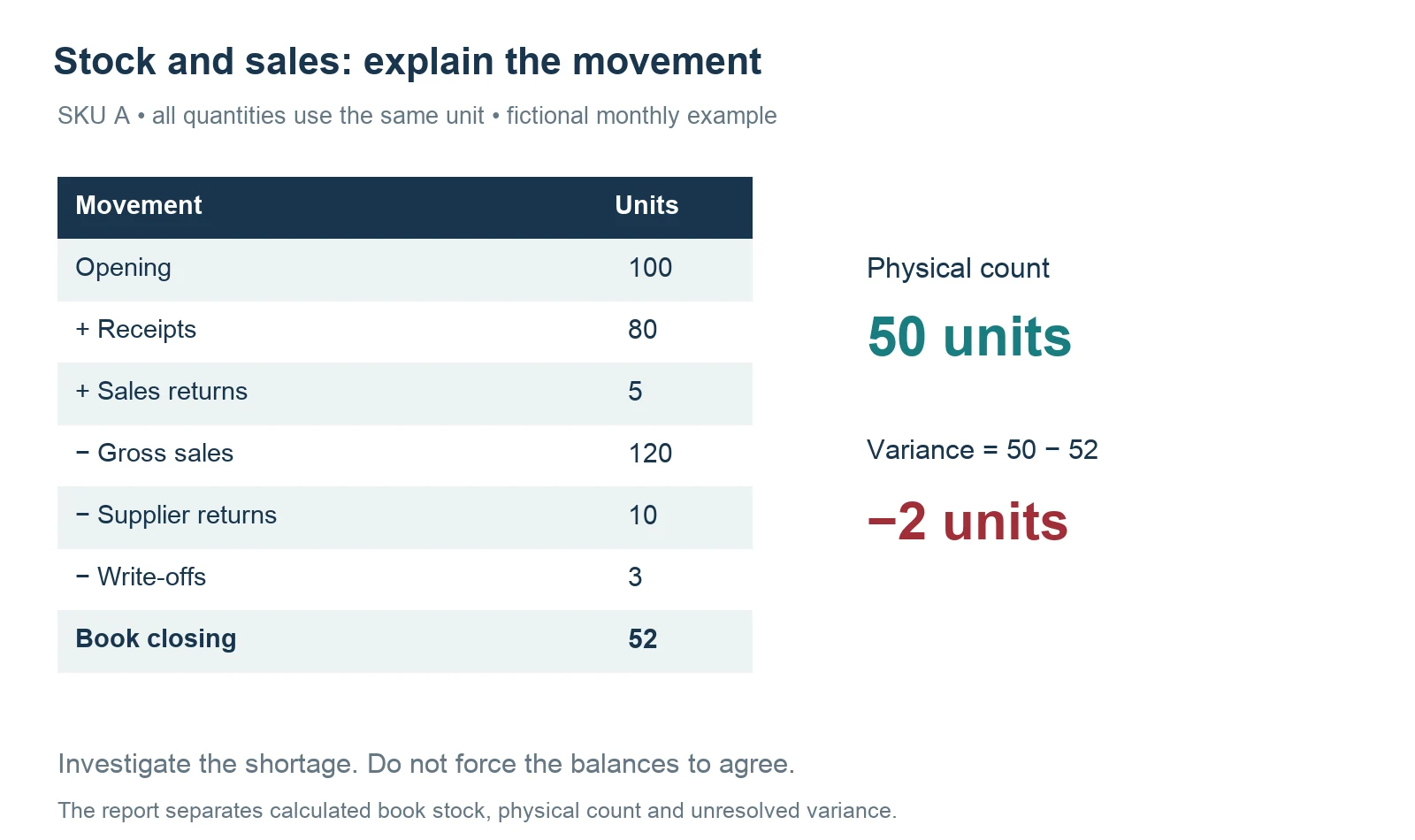
For example, consider a fictional distributor preparing its monthly report for SKU A. All quantities below are individual units. Receipts and sales are gross; the separately listed returns have not already been netted off.
| Movement | Quantity | Effect on stock |
|---|---|---|
| Opening balance | 100 | Starting balance |
| Receipts | 80 | Add |
| Saleable sales returns | 5 | Add |
| Gross sales | 120 | Subtract |
| Supplier returns | 10 | Subtract |
| Approved write-offs | 3 | Subtract |
Book closing = 100 + 80 + 5 − 120 − 10 − 3 = 52 units.
Next, the team counts 50 units at the same cut-off. Therefore, variance = 50 − 52 = −2 units. As a result, the stock and sales statement should show 52 as the calculated book balance, 50 as the count and −2 as the unresolved difference.
What should the analyst investigate?
- Check whether the count used the same location, SKU and unit.
- Review the two-unit difference against receipts, dispatches, returns and transfers around the cut-off.
- Inspect the count sheets and recount where appropriate.
- Check whether a transaction was duplicated, omitted or posted in the wrong period.
- Document the conclusion and obtain the required approval for any correction.
Suppose the team finds an unposted two-unit dispatch supported by the correct documents. Therefore, that evidence may explain the difference. If it cannot find a cause, keep the item open under the business’s investigation process. However, do not invent a dispatch just because it makes the arithmetic work.
Download the stock and sales statement Excel template
Download the stock and sales reconciliation template (.xlsx). It contains three fictional products, editable amber inputs and formula-driven closing balances, variances and illustrative book values.
In the template, the quantity inputs run from C to H. For row 6:
- Book closing in I6:
=C6+D6+E6-F6-G6-H6 - Variance in K6:
=J6-I6 - Illustrative book value in M6:
=I6*L6
For a quick check, change SKU A’s receipts from 80 to 81. The closing balance should rise from 52 to 53; with the physical count still 50, the variance should become −3. Restore 80 before comparing your answer with this article.
However, the template is deliberately simple. It excludes GST, discounts, freight, transfers, batch splits and net-realisable-value adjustments. Therefore, adapt the structure only after defining the movements your own business needs.
Inventory value is different from sales revenue
In contrast to a revenue report, a stock and sales statement does not tell you revenue or profit without prices and cost information. Therefore, keep these measures in separate columns and label their basis.
In the fictional SKU A case, assume a constant unit cost of ₹50. The 52-unit book balance has an illustrative cost of ₹2,600. In comparison, the physical count of 50 units corresponds to ₹2,500 at that same cost. As a result, the two-unit gap is ₹100 on this simplified cost basis.
Now assume a selling price of ₹80 per unit, with no discounts or tax in the example. Gross sales of 120 units equal ₹9,600. Five sales returns equal ₹400, so net sales revenue is ₹9,200. In contrast, that revenue is not the value of the 52 units still held.
However, for actual accounting, use the applicable framework and cost method. Under IAS 2, inventory measurement considers cost and net realisable value; a quantity report alone cannot establish the carrying amount. See the IFRS Foundation’s IAS 2 overview. Indian entities should apply their applicable Indian reporting requirements rather than assume every IFRS rule directly governs them.
How to prepare and validate a stock and sales statement
- Define scope. State the period, location, products, unit and movement cut-off.
- Bring forward opening balances. Reconcile them with the prior report and ledger.
- Collect movement records. Use receipts, dispatches, credit notes, supplier returns and approved write-offs.
- Classify consistently. Separate saleable returns from damaged goods and internal transfers.
- Calculate closing stock. Use formulas rather than typed totals that hide the logic.
- Reconcile. Compare the calculated result with the ledger and appropriate physical-count evidence.
- Review exceptions. Investigate unusual or negative balances and document approved corrections.
Finally, inspect products with high closing stock, low sales, frequent returns or repeated count differences. However, a spreadsheet flag identifies a question. It does not prove fraud, obsolescence or a particular employee’s fault.
You can practise related financial interpretation in our ratio-analysis problems with solutions. Inventory turnover requires an appropriate cost-of-sales figure and average inventory; do not substitute sales revenue into that ratio without understanding the definition.
Stock and sales statement: common errors
- Mixing units: one carton is not one piece. Use a documented conversion.
- Double counting returns: choose gross-plus-separate-returns or a consistent net basis.
- Wrong dates: do not combine one period’s receipts with another period’s dispatches.
- Omitted locations: a transfer can look like a loss if only one side is recorded.
- Confusing value and quantity: never add rupees to units in a closing-stock formula.
- Overstating automation: software cannot correct inaccurate source records on its own.
- Forcing agreement: preserve the original variance until evidence supports a correction.
For a wider learning path that connects spreadsheet checks with financial statements, review the financial modelling course curriculum. Choose training around the skills you need rather than treating one report as the whole analyst role.
Frequently asked questions
Is a stock and sales statement the same as a stock register?
They overlap, but a register can record individual movements while a statement summarises a chosen period. Therefore, reconcile the summary back to the underlying records.
How often should I prepare it?
Use the frequency needed by the business or requesting party. For example, daily monitoring and monthly reporting serve different needs. However, there is no single universal deadline established by the name of the report.
Is it the same as a bank stock statement?
Not necessarily. A lender may require additional values, eligibility details or other fields for its assessment. Therefore, follow that lender’s current format and sanction terms; do not assume this teaching template meets them.
What if closing stock is negative?
Investigate missing receipts, timing, wrong units, duplicates and location errors. In particular, a negative balance is a control exception. Do not overwrite the formula with zero to hide it.
Can Excel handle the report?
Yes, a controlled workbook can support a simple report. As transaction volume and locations grow, assess access controls, audit trails, integrations and reconciliation needs before choosing a system.

A CFA charterholder with hands-on experience across investment analysis and finance education. At MentorMeCareers, he writes and reviews content on CFA, financial modeling, and investment banking careers — grounded in real market data rather than generic advice, and shaped by what actually helps candidates and professionals succeed.