
Last updated on November 4th, 2026 at 11:41 am

The sampling error formula for a sample mean is sample mean minus population mean: x̄ − μ. This is different from standard error, which measures the variability of an estimator across samples, and margin of error, which combines a standard error with a critical value. Confusing these three quantities leads to incorrect confidence intervals.
Sampling error formula vs standard error and margin of error
| Quantity | Formula for a mean | What it tells you |
|---|---|---|
| Actual signed sampling error | x̄ − μ | How far this sample estimate is from the known population mean |
| Standard error, population SD known | σ / √n | Spread of sample means under the sampling assumptions |
| Estimated standard error | s / √n | Estimated spread when population SD is unknown |
| Margin of error | Critical value × standard error | Half-width of the stated confidence interval |
Here, n is sample size, σ is population standard deviation and s is sample standard deviation. The population mean μ is generally unknown when a sample is collected to estimate it. Therefore, we usually cannot observe that sample’s exact error. We estimate uncertainty instead.
Penn State’s statistics materials distinguish sampling distributions, standard errors and confidence intervals. Those distinctions are more useful than memorising z × σ / √n and calling it every kind of sampling error.
Sampling error formula example: actual signed error
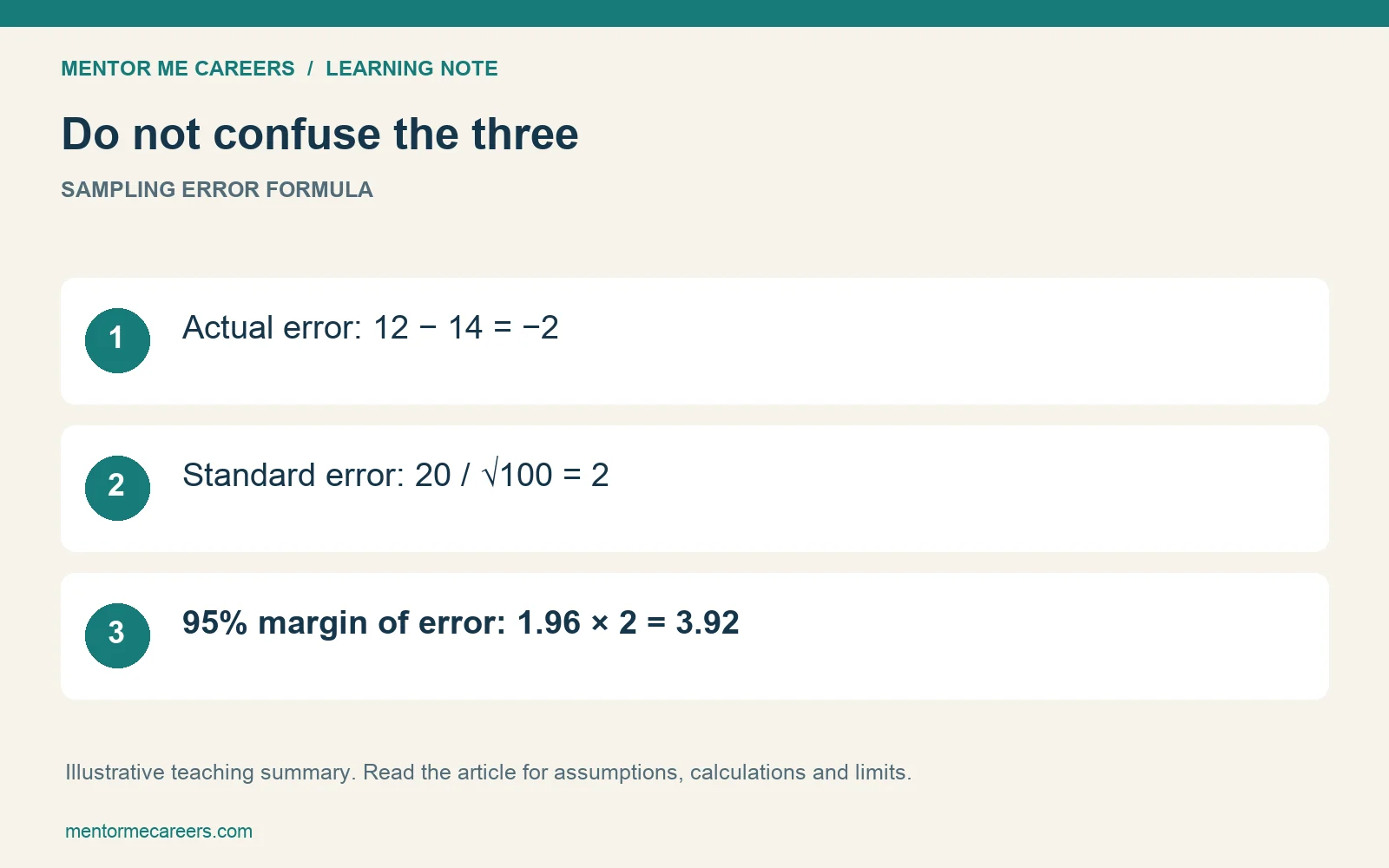
To apply the sampling error formula, take a small fictional population with values 10, 12, 14, 16 and 18. Its mean is 14. A sample containing 10, 12 and 14 has mean 12. The signed sampling error is 12 − 14 = −2. The sample mean is two units below the population mean; its absolute error is 2.
This is an arithmetic illustration with a known population, not evidence that the selected sample is representative. In a real survey, the population mean is often precisely what you are trying to discover. You cannot simply look it up to calculate the realised error.
Example 2: standard error and a 95% margin of error
Assume independent observations from a population where σ = 20, and suppose the conditions for a normal-based interval are appropriate. With n = 100, the standard error is 20 / √100 = 2. If the observed sample mean is 250, a 95% normal interval uses a critical value of about 1.96.
Margin of error = 1.96 × 2 = 3.92. The interval is 250 ± 3.92, or 246.08 to 253.92. The value 3.92 is not the observed error of the sample mean. It is the interval’s half-width under the stated method and assumptions.
| Sample size | Standard error with σ = 20 | 95% margin of error |
|---|---|---|
| 100 | 2.00 | 3.92 |
| 400 | 1.00 | 1.96 |
| 1,600 | 0.50 | 0.98 |
Quadrupling sample size halves this standard error and margin of error. Doubling the sample does not halve them because sample size appears inside a square root.
When to use a t-based interval
If the population standard deviation is unknown, the common one-sample t procedure uses s / √n and a t critical value with n − 1 degrees of freedom. Its suitability depends on the sampling design and distributional conditions. A small, highly skewed sample with outliers may require more careful analysis.
Do not substitute a z value merely because a spreadsheet offers a convenient normal function. State whether σ is known or estimated and why the chosen method is appropriate. The interval should follow the study design, not a memorised template.
For simple random sampling without replacement from a finite population, an appropriate finite-population adjustment may also matter when a substantial fraction of the population is sampled. Clustered, stratified or weighted surveys can require different standard-error calculations. The elementary σ / √n expression is not universal.
Sampling error formula in Excel: calculate the example
For raw data, calculate the sample mean with AVERAGE and the sample standard deviation with STDEV.S. The estimated standard error is STDEV.S(range)/SQRT(COUNT(range)), provided the range represents the intended numeric sample.
For the known-σ example, enter =20/SQRT(100) to obtain 2. Then use =NORM.S.INV(0.975)*2 for the 95% normal margin of error. For an appropriate two-sided t interval, the multiplier is =T.INV.2T(0.05,n-1), applied to s/√n.
Use consistent units throughout. If observations are measured in rupees, the mean, standard error and margin of error are in rupees. Variance is in squared units, so do not put variance directly where the formula requires standard deviation.
What a smaller margin of error does not solve
Before using the sampling error formula, define the population and sample. A larger sample reduces random sampling variability under the model. It does not automatically fix selection bias, misleading questions, missing groups or measurement error. A huge convenience sample can give a very precise answer about the wrong population.
A 95% confidence procedure describes long-run interval coverage under its assumptions. Avoid saying that 95% of individual observations lie inside the mean’s confidence interval. That is a different question.
For related quantitative practice, use our regression worked example and harmonic mean guide. Choose the statistic and method that match the question before calculating an impressive-looking number.
Frequently asked questions
Is sampling error the same as standard error?
No. Actual sampling error compares a particular estimate with the population parameter. Standard error describes variability of the estimator across possible samples under the method.
Is 1.96 × σ / √n the sampling error formula?
It is a common 95% normal margin-of-error expression for a mean under appropriate assumptions. It does not reveal the realised error of a particular sample.
Can sampling error be negative?
A signed error can be negative when the estimate is below the population value. Standard errors and margin-of-error magnitudes are non-negative.
How do I calculate sampling error in Excel?
If the population mean is known, subtract it from AVERAGE(sample_range) to obtain the signed error of the sample mean. If it is unknown, you cannot observe that exact error; estimate uncertainty using an appropriate standard error and interval method. Do not label a margin of error as the realised sample error.
Sources and further reading
Reviewed 3 November 2026. Worked cases are fictional teaching examples unless a named primary source is given.

A CFA charterholder with hands-on experience across investment analysis and finance education. At MentorMeCareers, he writes and reviews content on CFA, financial modeling, and investment banking careers — grounded in real market data rather than generic advice, and shaped by what actually helps candidates and professionals succeed.