
Last updated on October 3rd, 2026 at 03:57 pm

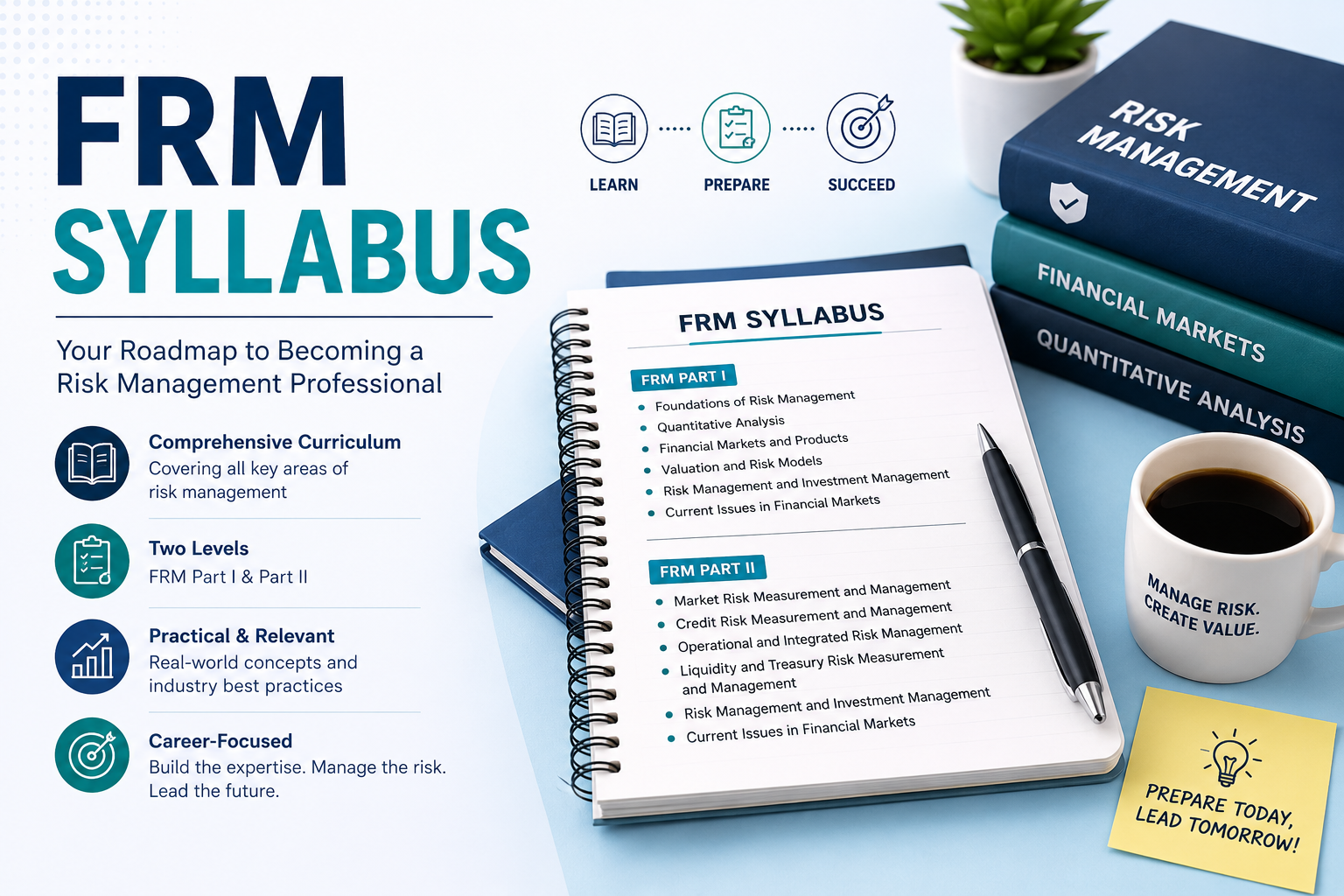
The Financial Risk Manager (FRM) qualification from GARP is one of the fastest-growing professional certifications in finance.In this article, I will take you through the detailed FRM Syllabus and walkthrough for optimum preparation. Planning to become a global risk management professional? Understanding the FRM syllabus is the first and most important step. The Financial Risk Manager (FRM) certification offered by GARP is one of the world’s most respected qualifications in banking, credit risk, market risk, and financial analytics. The exam is divided into Part I and Part II, each testing a different layer of skills: Part I focuses on the core foundations of risk, quantitative tools, financial markets and basic valuation models, whereas Part II applies these concepts to real-world risk management, covering market, credit, operational, investment, liquidity, and emerging risks.
In this detailed guide, I break down the official FRM syllabus, topic weightage, learning objectives, and how much time to allocate to each module along with a practical study plan to help you prepare effectively. By the end, you’ll know exactly what to study, how to structure your preparation, and which areas matter most in the exam.
FRM Syllabus Overview
Below I have shown the broader classification of subjects across 4 areas. More or less in my experience, and understanding of the syllabus the FRM level 1 is majorly foundational. As you can see from the FRM Course syllabus below, that higher weightage is towards topics like financial markets.
The FRM subjects in part 1 include;
- Foundations of risk management
- Quantitative analysis
- Financial Markets and Products
- Valuation and Risk models.
FRM Syllabus Part I 2026: Topic Weightage
| Topic | Weight | Questions (approx.) | Key subtopics |
|---|---|---|---|
| Foundations of Risk Management | 20% | 20 | Risk governance, enterprise risk management, CAPM and factor models, financial disasters, GARP Code of Conduct |
| Quantitative Analysis | 20% | 20 | Probability and distributions, hypothesis testing, linear regression, time series, simulation, machine learning methods |
| Financial Markets and Products | 30% | 30 | Forwards, futures, swaps, options, bonds and interest rates, foreign exchange, central clearing |
| Valuation and Risk Models | 30% | 30 | Value at Risk, expected shortfall, duration and convexity, binomial trees, Black-Scholes-Merton, the Greeks, stress testing |
Financial Markets & Products and Valuation & Risk Models together account for 60% of Part I — these are also the most calculation-heavy sections, covering derivatives pricing, VaR, and fixed-income valuation. Foundations of Risk Management is frequently underestimated: it’s conceptual rather than quantitative, but the governance and ethics questions here trip up candidates who spend all their prep time on the numbers.
FRM Syllabus Part II 2026: Topic Weightage
| opic | Weight | Questions (approx.) | Key subtopics |
|---|---|---|---|
| Market Risk Measurement and Management | 20% | 16 | VaR and expected shortfall estimation, backtesting, VaR mapping, FRTB, term structure models, volatility smiles |
| Credit Risk Measurement and Management | 20% | 16 | Default probability, Merton model, credit VaR, counterparty risk and CVA, credit derivatives, securitisation |
| Operational Risk and Resilience | 20% | 16 | Operational risk frameworks, cyber risk, third-party risk, model risk, Basel capital rules, stress testing |
| Liquidity and Treasury Risk Measurement and Management | 15% | 12 | LCR, NSFR, funding and intraday liquidity, asset-liability management, contingency funding |
| Risk Management and Investment Management | 15% | 12 | Factor investing, portfolio construction, risk budgeting, performance measurement, hedge funds, private markets |
| Current Issues in Financial Markets | 10% | 8 | AI in finance, geopolitical risk, government debt, crypto and tokenisation, digital resilience |
What’s New in the FRM 2026 Syllabus
GARP updates the curriculum every year, and I make it a point to flag exactly what’s changed rather than let candidates study from an outdated edition. If you’re using older prep material, check this table first.
| Area | 2026 change |
|---|---|
| Part I | No major structural change. Topic weights unchanged. |
| Part II reading count | Up from 104 to 107 readings. |
| Risk Management and Investment Management | The biggest change: expanded from 11 to 17 readings, with new material on private markets. |
| Liquidity and Treasury Risk | Trimmed from 19 to 17 readings. |
| Current Issues | Eight readings, five of them new. Themes include AI, geopolitical risk, government debt, crypto and tokenisation, and digital resilience. |
| Market, Credit and Operational Risk | Largely unchanged. |
Practical takeaway: if you’re studying Part I with 2026 material, you’re largely fine. If you’re studying Part II with anything older than the current 2026 Study Guide, download GARP’s updated Learning Objectives before you go further — The Investment Management and Current Issues sections in particular have changed.
Part II is where the syllabus turns to applied risk management: market risk, credit risk, operational risk, and liquidity.
FRM Exam Format 2026
| Detail | Part I | Part II |
|---|---|---|
| Number of questions | 100 MCQs | 80 MCQs |
| Duration | 4 hours | 4 hours |
| Time per question (avg.) | ~2 min 24 sec | ~3 minutes |
| Format | Computer-based, PSI test centres | Computer-based, PSI test centres |
| Negative marking | None | None |
| Passing score | Not fixed — set per sitting via GARP’s standard-setting process | Not fixed — set per sitting via GARP’s standard-setting process |
| Next exam windows: Part I 14–20 November 2026, Part II 21–25 November 2026. Early registration for May 2027 opens 1 December 2026. | May, August, November | May, August, November |
Detailed FRM Syllabus (2026)
As a CFA charterholder who teaches the overlapping quant, fixed income and derivatives material, I have seen one thing hold true. candidates who map their study time to GARP’s actual exam weightage pass on the first attempt far more often than those who study by gut feel. This guide breaks down the official, GARP-published 2026 FRM syllabus — Part I and Part II — with the exact topic weightages, question counts, and a study plan that’s proportional to what’s actually tested, not just what’s easiest to study.
Last updated: 2026 exam cycle. The 2026 syllabus applies to all three FRM exam windows this year — May, August, and November — so whichever window you’re targeting, the topics, weights, and learning objectives below are identical.
FRM Syllabus 2026: Quick Answer
Readings rose from 104 to 107. Risk Management and Investment Management expanded the most, with new private markets material, and Current Issues was refreshed with five new readings.
| Question | Answer |
|---|---|
| What does the FRM Part I syllabus cover? | Foundations of Risk Management, Quantitative Analysis, Financial Markets & Products, and Valuation & Risk Models — 4 topics, 100 MCQs, 4 hours. |
| What does the FRM Part II syllabus cover? | Market Risk, Credit Risk, Operational Risk & Resilience, Liquidity & Treasury Risk, Risk Management & Investment Management, and Current Issues in Financial Markets — 6 topics, 80 MCQs, 4 hours. |
| Which FRM Part I topics carry the most weight? | Financial Markets & Products and Valuation & Risk Models together make up 60% of Part I. |
| How is the FRM Part I exam structured? | 100 equally weighted multiple-choice questions, 4 hours, computer-based, no negative marking. |
| How is the FRM Part II exam structured? | 80 equally weighted multiple-choice questions, 4 hours, computer-based, no negative marking. |
| Does the FRM syllabus change every year? | Yes. GARP republishes the Study Guide and Learning Objectives annually. Part I is largely stable year to year; Part II typically sees more content updates. |
| What changed in the FRM Part II syllabus for 2026? | Expanded reading list with new material on AI/ML in risk management, private credit, geopolitical risk, and crypto/tokenization, plus a revised Current Issues section. |
FRM Pass Rates: What the Data Actually Shows
GARP doesn’t publish a single fixed pass rate — it varies by sitting, since the pass/fail threshold is set after each exam based on question difficulty and candidate performance. Treat the figures below as a planning benchmark, not a guarantee.
| Exam | Typical Pass Rate Range |
|---|---|
| FRM Part I | Roughly 40–47%, with recent windows trending toward the higher end (November 2025 came in at 47%, per GARP) |
| FRM Part II | Generally somewhat higher than Part I, typically in the low-to-mid 50s |
A near-50% pass rate can look discouraging until you consider the candidate pool: FRM candidates are already numerate finance professionals who’ve committed real study time, and roughly half still don’t clear it on a given sitting. That tells you the exam rewards depth of preparation over raw aptitude — it isn’t a quota-based cutoff working against you.
FRM level 1 Syllabus- 5 Tips on Preparation
Here is how each FRM Part 1 subject stacks up on weightage and difficulty, based on GARP’s 2026 FRM Learning Objectives.
| FRM Part I Topic | Weightage | Estimated Questions (out of 100) | Difficulty |
|---|---|---|---|
| Foundations of Risk Management (FIRM) | 20% | 18–22 | 3 (Moderate) |
| Quantitative Analysis (QA) | 20% | 18–22 | 5 (High) |
| Financial Markets & Products (FMP) | 30% | 28–34 | 4 (Moderately High) |
| Valuation & Risk Models (VRM) | 30% | 28–34 | 5 (High) |
How Many Hours Should You Study?
| Metric | Recommendation |
|---|---|
| Minimum study hours per part | 200 hours |
| Average reported by candidates (GARP survey) | ~240 hours |
| Realistic timeline | 3–6 months, depending on background and pace with quantitative material |
The single biggest mistake I see candidates make is studying every topic equally when the exam doesn’t weight them equally. Since Financial Markets & Products and Valuation & Risk Models together carry 60% of Part I, your study-time allocation should broadly track that — not split evenly across four topics.
| Topic | Exam Weight | Recommended Study-Time Share |
|---|---|---|
| Financial Markets & Products + Valuation & Risk Models | 60% | ~55–60% |
| Quantitative Analysis | 20% | ~20–25% |
| Foundations of Risk Management | 20% | ~15–20% |
Note this replaces the “40-30-30” split some FRM guides recommend — that formula actually under-allocates time to the two topics carrying 60% of the exam. Foundations often needs slightly less raw time per point than the quant-heavy sections, since it’s conceptual rather than calculation-based, which is the only reason its recommended share sits a little below its exam weight.
High-Yield Topics by Part
| Part I | Part II |
|---|---|
| Duration & Convexity | FRTB (market risk capital) |
| VaR (all methods) | Credit VaR + Merton Model |
| Regression & Time-Series | Loss Distribution Approach (Operational Risk) |
| Derivatives Pricing (forwards, futures, swaps) | Liquidity Risk (LCR & NSFR) |
| GARP Code of Conduct | AI in risk management and private markets (new for 2026) |
FRM Study Planner
Plan for about 240 hours over three to six months. The 12-week plan below uses 228 hours, weighted to the exam.
| Weeks | Topic | Hours |
|---|---|---|
| 1–2 | Foundations of Risk Management | 38 |
| 3–4 | Quantitative Analysis | 38 |
| 5–7 | Financial Markets and Products | 57 |
| 8–10 | Valuation and Risk Models | 57 |
| 11–12 | Full mocks and revision | 38 |
Your FRM Part I Prep, Mapped Out Week by Week
Reading a syllabus is one thing. Actually turning it into a schedule you’ll stick to for the next three months is a different problem entirely — and it’s the one that trips up more candidates than the material itself does.
So instead of just telling you what to study, we built a 12-week FRM Part I study planner that does the math for you. It takes GARP’s actual exam weightage — not a guess, the real 20/20/30/30 split — and turns it into a week-by-week schedule: what to study, how many hours to put in, what “done” looks like for that week, and when your mock exams should happen.
A few things that make this different from a generic study calendar:
It’s weighted to the real exam, not split evenly. Financial Markets & Products and Valuation & Risk Models carry 60% of Part I between them. Most study plans still give all four topics equal time. This one doesn’t — the heavier-weighted, more calculation-intensive sections get proportionally more weeks and more hours.
It tracks your actual progress, not just your intentions. Every week has a status you can update — Not Started, In Progress, Complete — plus a spot to log the hours you actually put in. That gets rolled up into a running completion percentage and a hours-planned-vs-hours-logged comparison, so you know by week 6 whether you’re on track or quietly falling behind.
It’s built around checkpoints, not just topics. Each week has a specific “you should be able to do this by now” milestone — solve 10 duration/convexity problems in under 30 minutes, score 65%+ on a Quant practice set, price a forward contract unaided — rather than a vague “study Chapter 4” instruction that doesn’t tell you whether you’ve actually learned it.
Weeks 11 and 12 are protected for mocks, not crammed in as an afterthought. A full-length timed mock in week 11, review and targeted revision in week 12. If you’re still learning new material in the final week before your exam window, something upstream went wrong — this plan is built so that doesn’t happen.
Use it as-is, or treat the weekly hours and topic weeks as adjustable — if you’ve already got a strong quant background from a CFA or engineering degree, you can shift hours toward Financial Markets & Products and Valuation & Risk Models instead, which is exactly where the heavier lift actually is.
If you’d rather not build this schedule alone, our FRM Certification Program is structured around the same weighted approach — case studies, practice questions, and instructor feedback mapped to the same high-yield sections this planner prioritizes.
Create Your Personalised FRM Study Plan
Select your FRM exam part, target exam date and weekly study availability to generate a realistic preparation schedule.
FRM Level 2 Syllabus: Weightage and Difficulty by Subject
So, again let me dive into sub basics of FRM level 2 subjects, which will give you an insight on the expectation.
| FRM Part II Topic | Weightage | Estimated Questions (out of 80) | Difficulty |
|---|---|---|---|
| Market Risk Measurement & Management | 20% | 15–18 | 5 (High) |
| Credit Risk Measurement & Management | 20% | 15–18 | 5 (High) |
| Operational Risk & Resilience | 20% | 15–18 | 4 (Moderately High) |
| Liquidity and Treasury Risk Measurement and Management | 15% | 11–13 | 4 (Moderate to High) |
| Risk Management & Investment Management | 15% | 11–13 | 3 (Moderate) |
| Current Issues in Financial Markets | 10% | 7–9 | 2 (Low to Moderate) |
FRM Part II Exam Strategy: Where to Put Your Time
Part II rewards different instincts than Part I. It’s less about raw calculation speed and more about connecting concepts across risk types — market risk feeding into credit exposure, liquidity strain amplifying operational risk, and so on. Here’s how I’d allocate study time against the actual 2026 weightage.
1. Market & Credit Risk (40% combined)
The most heavily weighted and technical block. Focus areas:
- Merton model and structural credit models
- Credit VaR and KMV
- Market risk frameworks, including FRTB
- Backtesting and stress testing methodology
2. Operational Risk + Liquidity Risk (35% combined)
Theory-heavy but genuinely scoring if you put in the reps:
- Loss Distribution Approach (LDA) for operational risk
- Scenario analysis
- LCR, NSFR, and liquidity stress metrics
3. Risk Management & Investment Management (15%)
Directly relevant to real-world portfolio work:
- Active vs. passive investment risk
- Performance attribution
- Hedge fund and alternative investment risk
- Private markets (expanded for 2026)
4. Current Issues in Financial Markets (10%)
This section got a real overhaul for 2026 — it’s no longer the “quick win, just skim the summaries” section it used to be. It now includes:
- AI in risk management, geopolitical risk, rising government debt, crypto-assets and tokenisation, and digital resilience.
Given the expansion, I’d budget more deliberate reading time here than older Part II guides suggest — treating it as an afterthought is the single most outdated piece of advice still circulating for this exam.
5. Overall Strategy to Clear Part II
Part II case-study questions are built around exactly these connections” to “Part II questions often test these connections
Common Mistakes & How to Avoid Them
| # | Mistake | How to Avoid It |
|---|---|---|
| 1 | Studying blindly from coaching notes without checking the current GARP Learning Objectives | Download the latest FRM Learning Objectives directly from GARP and map your study plan to them before relying on any third-party material |
| 2 | Spending too much time on low-weight chapters or easy theory | Prioritize FMP + VRM for Part I and Market + Credit Risk for Part II — a 60/40 time split toward high-weight areas is a reasonable default |
| 3 | Memorizing formulas without understanding why they work | Focus on the logic behind each formula, then apply it to practical scenarios — not just multiple-choice recall |
| 4 | Avoiding lengthy numerical problems in Part I | Practice VaR, duration/convexity, derivatives pricing, and regression daily; get fluent with calculator shortcuts (BA II Plus / HP 12C) |
| 5 | Only studying theory, never testing under exam conditions | Take 5–7 full-length mocks per part; analyze every wrong answer, not just your score |
| 6 | Starting late or studying without a structured plan | Follow a defined 3-, 4-, or 6-month plan with weekly targets for chapters, revision, and mocks |
| 7 | Skipping revision in favor of last-minute cramming | Reserve 3–4 weeks purely for revision — formulas, key frameworks, Basel rules, VaR types, credit models |
| 8 | Switching between 4–5 different study resources | Stick to one primary resource (GARP books, Schweser, or similar), and supplement only with question banks and mocks |
| 9 | Reading end-of-chapter questions without actually solving them | Solve every end-of-chapter question and track your accuracy over time as your real progress metric |
| 10 | Avoiding difficult topics like regression, VaR, or credit risk | Identify weak areas early and deliberately over-allocate time to them rather than polishing what you’re already good at |
Most FRM candidates who don’t clear the exam on their first attempt share the same pattern: uneven time allocation relative to weightage, too little numerical practice, and not enough full-length mocks under real time pressure. Structuring your prep against the GARP Learning Objectives directly, rather than against someone else’s summary of them, is the single highest-leverage change I’d recommend.
FRM exam fees and exam windows
New candidates pay a one-time USD 400 enrolment fee, plus USD 600 per part with early registration or USD 800 at the standard rate. GARP holds both parts in May, August and November. The next window is 14–20 November 2026 for Part I and 21–25 November for Part II. Early registration for May 2027 runs from 1 December 2026 to 31 January 2027.”
The fee figures are third-party reports of GARP’s 2026 schedule, which I couldn’t read on GARP’s own page, and the dates are from GARP. Confirm the fees before publishing, since 2027 pricing may differ.
Conclusion
The FRM syllabus is designed to build deep, practical expertise in financial risk management covering everything from quantitative foundations and financial markets to advanced topics like market, credit, operational, and liquidity risk. With clearly defined Learning Objectives updated regularly by GARP, the curriculum stays aligned with real-world industry trends, regulatory changes, and global best practices.
Whether you are preparing for Part I or Part II, understanding the syllabus structure helps you prioritize high-weightage topics, plan your study hours effectively, and focus on the analytical and conceptual skills the exam demands. With the right strategy, consistent practice, and a strong grasp of the core subjects, clearing the FRM exam becomes a realistic and rewarding goal.
By mastering the FRM syllabus, candidates not only pass the exam but also strengthen their career prospects in banking, fintech, consulting, trading, and global risk management roles making the FRM designation a powerful investment in long-term professional growth.
Frequently Asked Questions
There is no universal answer because the two exams test somewhat different areas. FRM is more specialised in financial risk management, quantitative analysis, financial markets, valuation and risk models, while CFA covers a broader investment-management curriculum. Your background can therefore strongly influence which exam feels harder. For a detailed comparison, read our FRM vs CFA comparison.
FRM Part I should not generally be considered an easy exam. Candidates with previous exposure to finance, statistics, derivatives or CFA topics may find parts of the curriculum more familiar. For complete beginners, the quantitative concepts and specialised risk-management material can require considerably more preparation. You can learn more about the qualification in our Financial Risk Manager (FRM) guide.
Yes, six months can be sufficient for FRM Part I for many candidates if they study consistently. GARP reports that candidates devote about 240 hours on average to exam preparation. Spread across six months, this works out to roughly 9–10 hours per week. Candidates who are new to quantitative finance may need additional time.
FRM Part I pass rates vary by exam administration and should not be treated as a fixed percentage. Recent pass rates have generally been in the mid-40% range. Candidates should check GARP’s latest published pass-rate information for the most recent exam administration.
FRM Part I focuses on the fundamental concepts and tools used in financial risk management:
1. Foundations of Risk Management
2. Quantitative Analysis
3. Financial Markets and Products
4. Valuation and Risk Models
For a more detailed breakdown of the curriculum and preparation approach, see our FRM syllabus and study plan.
FRM Part II applies risk-management concepts to major areas of professional practice:
1. Market Risk Measurement and Management
2. Credit Risk Measurement and Management
3. Operational Risk and Resilience
4. Liquidity and Treasury Risk Measurement and Management
5. Risk Management and Investment Management
6. Current Issues in Financial Markets
The exact curriculum and learning objectives can change, so candidates should use the current GARP curriculum for their exam year.
FRM Part I consists of 100 equally weighted multiple-choice questions and has a four-hour examination period. FRM Part II consists of 80 equally weighted multiple-choice questions and also has a four-hour examination period.
GARP offers FRM examinations during multiple testing windows during the year. The available windows can differ between Part I and Part II, so candidates should always confirm the current examination dates, scheduling deadlines and registration deadlines directly with GARP before planning their attempt.
GARP reports that candidates spend about 240 hours studying on average. However, the amount of preparation required varies according to a candidate’s academic background, professional experience and familiarity with quantitative subjects. A structured preparation period of approximately three to six months is common.
Yes. FRM Part I and Part II are administered as computer-based tests (CBT) at designated testing centres. Candidates should review GARP’s current exam-day policies and testing requirements before their scheduled examination.
GARP does not publish a predetermined passing score for the FRM examination. Candidates therefore should not rely on unofficial claims that a particular percentage automatically guarantees a pass. A better preparation strategy is to develop strong coverage across the curriculum and use practice questions and mock examinations to identify weak areas.
Yes. The FRM curriculum and Learning Objectives are reviewed and updated periodically. Candidates should always use the Learning Objectives and study materials applicable to their specific examination year rather than relying on material prepared for an older exam cycle.
Yes, the FRM exam can be challenging, particularly for candidates without a strong background in quantitative finance. Part I requires candidates to understand areas such as probability, statistics, derivatives, fixed income, valuation and risk models rather than simply memorising definitions. Part II then applies many of these concepts to areas such as market, credit, operational and liquidity risk. A structured study plan and regular question practice can make the curriculum considerably more manageable. See our guide to risk management roles in finance for more context on the field.
Yes, it is possible to prepare for and clear an FRM part within six months. Using GARP’s reported average of approximately 240 study hours, a six-month preparation period would require roughly 9–10 hours of study per week. Candidates with weaker foundations in statistics, derivatives or financial markets may need more time. Our FRM syllabus and study plan can help you structure the preparation period.
FRM and CA are difficult to compare directly because they have different structures and objectives. FRM is a specialised financial risk-management qualification with two examination parts, whereas the Indian Chartered Accountancy pathway covers a much broader accounting, auditing, taxation, law and finance curriculum across multiple stages, along with practical training requirements. A candidate strong in quantitative finance may find FRM more familiar, while someone with an accounting background may find CA subjects more familiar. For additional context on CA difficulty, see our guide on how tough the CA course is.
There is no single fixed “FRM salary.” Compensation depends on the actual job role, experience, employer, location and technical skills rather than the FRM qualification alone. FRM candidates and certified professionals commonly pursue roles in market risk, credit risk, operational risk, treasury, model risk, quantitative risk and related areas. Salaries can therefore vary significantly between an entry-level risk analyst and an experienced risk manager. You can explore the types of roles available in our risk management careers guide.
Related Articles

A CFA charterholder with hands-on experience across investment analysis and finance education. At MentorMeCareers, he writes and reviews content on CFA, financial modeling, and investment banking careers — grounded in real market data rather than generic advice, and shaped by what actually helps candidates and professionals succeed.