
Last updated on October 10th, 2026 at 02:33 pm

The equity research analyst salary in India (2026) generally starts at ₹4–7 LPA for freshers, depending on the firm type and location. Entry-level roles at boutique brokerages or research KPOs tend to be at the lower end, while global banks and large domestic brokerages pay closer to the upper range. As analysts gain experience and build sector expertise, salaries rise steadily, mid-level analysts (3–6 years) often earn ₹10–18 LPA, and senior or lead analysts at top firms can cross ₹25–40 LPA+, including bonuses.
Salary growth in equity research depends more on skill depth and performance than tenure alone. Analysts who master financial modeling, valuation, and industry coverage progress faster and earn more. Higher pay is common in finance hubs like Mumbai and Bengaluru, and in roles serving institutional clients or the buy-side. Other factors that influence pay include accuracy of research calls, client impact, certifications (CFA, MBA), firm type (sell-side vs buy-side), and bonus structures tied to performance.
From city-wise salary differences to sector-specific pay and long-term career growth including buy-side moves into hedge funds, asset management, and private equity this is your complete roadmap to understanding the real earning potential in equity research today.
Equity research analyst salary in India
On average, an equity research analyst salary can expect ₹6–10 LPA, but growth to ₹15–20 LPA+ in 4–6 years is common for those who perform well. Experienced analysts at leading firms can cross ₹25–30 LPA+ (base + bonus), especially if they handle lead-research reports or sector coverage, with increasing financial market activity and demand for equity research across mutual funds, broking houses, and institutional investors, equity research remains a strong career path with steady salary growth.
| Experience / Role Level | Typical Salary Range (Annual, INR) | Notes |
| Entry / Junior Analyst (0–1 yr) | ₹4 L – ₹6 L | Often from smaller brokerages, boutique firms or as interns. |
| Early-Career (1–3 yrs) | ₹6 L – ₹10 L | Much variation depending on location, firm size, and skillset. |
| Mid-Level Analyst (3–5 yrs) | ₹10 L – ₹16 L | Includes base salary + performance bonus; skill in financial modelling/valuation raises pay. |
| Senior Analyst / Associate (5–8 yrs) | ₹14 L – ₹22 L | Seniority, research report quality & industry coverage drive higher pay. |
| Top Equity Research Analyst / Lead (8+ yrs) | ₹20 L – ₹30 L+ (top 90th percentile: ₹25–30 L or more) | Senior roles in major brokerages or buy-side funds, includes bonuses, perhaps profit sharing. |
Equity research analyst salary by experience level
In India, equity research salary in 2025 begin at approximately ₹4–6 LPA for entry-level positions, increase to between ₹10–25 LPA for senior and VP roles, and can surpass ₹1.5 Cr (total compensation) at the MD or buy-side leader level. The main drivers for significant pay increases are bonuses and profit-sharing (variable compensation), meaning that possessing strong technical skills (such as modeling and valuation), having solid coverage, and generating revenue are effective pathways to higher earnings.
| Level | Typical Base (₹/yr) | Typical Bonus Range (% of base) | Median Total Comp (₹/yr) | 25th / 75th Percentile Total (₹/yr) |
| Entry / Junior Analyst (0–1 yr) | ₹4LPA – ₹6LPA | 0% – 20% | ₹5.5LPA | ₹4.4Lakh / ₹6.6Lakh |
| Associate (1–3 yrs) | ₹6LPA – ₹10LPA | 5% – 35% | ₹9.6LPA | ₹7.2 Lakh / ₹12 Lakh |
| Senior Associate (3–5 yrs) | ₹10LPA – ₹16LPA | 15% – 50% | ₹16.9LPA | ₹12.5Lakh / ₹20.8Lakh |
| VP / Principal (5–8 yrs) | ₹14LPA – ₹25LPA | 30% – 100% | ₹31.2LPA | ₹22Lakh / ₹40Lakh |
| Director / Head of Research (8–12 yrs) | ₹25LPA – ₹45LPA | 50% – 150% | ₹70.LPA | ₹50 Lakh / ₹1.2 Cr |
| MD / Senior Fund/Buy-Side Lead (12+ yrs) | ₹40LPA – ₹80LPA | 80% – 300% | ₹1.5Cr | ₹1 Cr / ₹2.5 Cr |
Check in detailed the Equity Research Firms In India
Equity research analyst salary by city & sector (India)
Equity research salaries in India (2025) vary widely: entry roles typically ₹3–6 LPA, mid-level ₹9–16 LPA, and senior/lead roles ₹20–40 LPA+ with top MDs far higher. Location (Mumbai/Bengaluru), firm type (buy-side vs sell-side), and performance bonuses drive the biggest differences. Goldman Sachs typically pays above sell-side averages, with significant bonus upside for strong performers.
City / Sector | Entry (0–2 yrs) | Mid (2–5 yrs) | Senior (5+ yrs) | Typical Employers |
| Mumbai- Broking / Sell-side | ₹5–8L | ₹8–15L | ₹15–30L+ | Large brokerages, bulge-bracket research houses |
| Mumbai- Buy-side / AM / PMS | ₹6–10L | ₹12–25L | ₹25–50L+ | Mutual funds, AMCs, PMS firms |
| Bengaluru- Tech / TMT coverage | ₹5–8L | ₹9–16L | ₹15–30L | Research boutiques, tech-focused funds |
| Delhi NCR- Generalist / Mid-caps | ₹4–7L | ₹7–12L | ₹12–22L | Regional brokerages, small funds |
| Hyderabad / Pune | ₹4–6L | ₹7–12L | ₹12–20L | Mid-sized brokers, corporate research |
| Smaller cities / regional | ₹3.5–5.5L | ₹6–9L | ₹8–14L | Local brokerages, research service firms |
| Sectors that pay premium | — | — | — | Buy-side / Hedge funds > Investment banks > Large broking houses > Boutiques > Retail research |
| High-pay sectors (specialties) | Quant/Prop trading | Quant/prop & algo: ₹12–30L+ | Senior quant leads: ₹30–100L+ | Proprietary trading firms, quant funds |
Equity research analyst salary provided by top companies in India
Lets discover options in India, the salary provided so you will have a clear idea what to expect from the companies and next step would be to look after what exactly the companies expect from you!
| Company | Typical Base Range (INR/yr) | Typical Bonus / Variable | Typical Total (median range) |
| Goldman Sachs | ₹3.5L – ₹12L | 0–50% (varies by level) | ₹4L – ₹18L (median ₹7L) |
| J.P. Morgan | ₹4L – ₹13L | 5–60% | ₹5L – ₹18L (median ₹7.4L) |
| Morgan Stanley | ₹4L – ₹8L (entry) → higher at senior levels | 10–60%+ | ₹5L – ₹20L (depending on level) |
| Citi | ₹4L – ₹13L | 5–50% | ₹5L – ₹16L (median ₹7.2L) |
| ICICI Securities | ₹4L – ₹13L | 5–40% | ₹5L – ₹16L (median ₹7.4L) |
| Motilal Oswal | ₹4L – ₹18L (wide spread by seniority) | 10–60% (performance linked) | ₹5L – ₹20L+ |
| Edelweiss | ₹4L – ₹13L | 5–50% | ₹5L – ₹16L |
| Nomura | ₹4L – ₹15L (varies) | 5–50% | ₹5L – ₹18L |
| Axis / Axis Capital | ₹4L – ₹20L (role dependent) | 10–80% | ₹6L – ₹25L |
Equity Research Salary Trends in India
India Inc salary growth is projected around 9%–9.1% in 2026, and NBFC/financial services compensation is expected to remain among the stronger sectors. Equity research candidates with financial modeling, valuation, accounting, Excel, report writing, and sector understanding should command better salary growth than candidates who only know theory.
| year | Fresher (0–2 Years) | Mid-Level (3–6 Years) | Senior (7+ Years) | Market Trend |
|---|---|---|---|---|
| 2018 | ₹2.8–4.5 LPA | ₹6–10 LPA | ₹12–18 LPA | Traditional brokerages dominated hiring. |
| 2019 | ₹3–5 LPA | ₹6.5–11 LPA | ₹13–20 LPA | Increased demand from domestic brokerages and research firms. |
| 2020 | ₹3–5 LPA | ₹6–10 LPA | ₹12–18 LPA | Hiring slowed temporarily during COVID-19. |
| 2021 | ₹3.5–5.5 LPA | ₹7–12 LPA | ₹14–22 LPA | Capital market recovery boosted research hiring. |
| 2022 | ₹3.8–6 LPA | ₹8–14 LPA | ₹15–25 LPA | Strong IPO activity increased demand for analysts. |
| 2023 | ₹4–6 LPA | ₹9–15 LPA | ₹16–28 LPA | Buy-side firms and GCCs expanded research teams. |
| 2024 | ₹4–6.5 LPA | ₹9–17 LPA | ₹18–30 LPA | Higher demand for financial modeling and sector specialists. |
| 2025 | ₹4–6.5 LPA | ₹10–18 LPA | ₹20–35 LPA | AI tools improved productivity, but deep research skills commanded premium salaries. |
| 2026 | ₹4–7 LPA | ₹10–20 LPA | ₹20–40+ LPA | Strong demand from investment banks, brokerages, PMS, AIFs, and Global Capability Centres (GCCs). |
Salary figures are indicative market ranges compiled from multiple industry salary platforms, recruiter insights, and publicly reported compensation data. Actual salaries vary depending on employer type, city, educational background, technical skills, and bonus structure.
Factors that influence Equity research analyst pay
1. Technical financial skills (modeling & valuation)
Mastery of DCF, LBO, comps, Equity Research Analyst Course, forecasting and Excel/VBA directly increases market value, firms pay a premium for analysts who can build robust models and produce actionable valuations.
2. Sector / Coverage specialization
Coverage matters: niche sectors (pharma, tech, infra, NBFCs) or high-growth themes often pay more because domain expertise drives tradeable investment calls and client demand. Deep sector knowledge = higher billable value.
3. Credentials & formal qualifications (CFA, MBA, CA)
Certifications like the CFA and top-tier MBA remain strong signals of technical credibility and improve pay prospects, especially for buy-side or senior roles. Recruiters frequently shortlist charterholders for mid/senior roles.
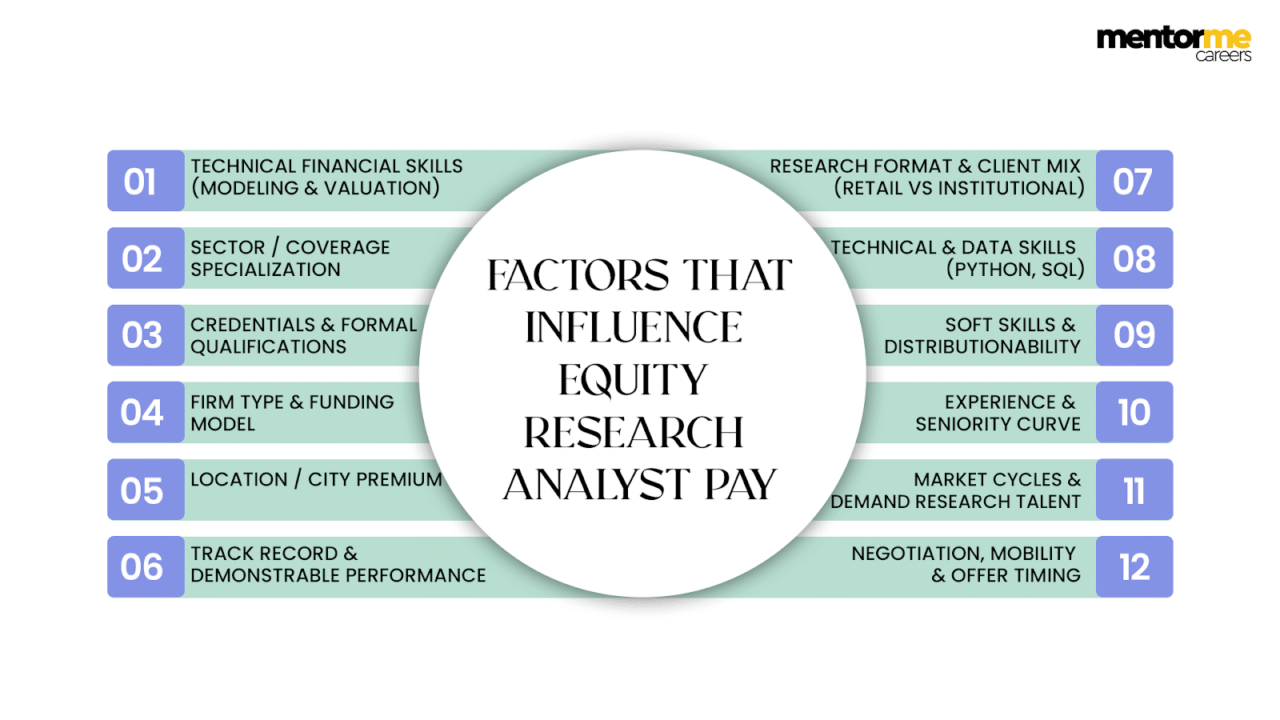
4. Firm type & funding model (sell-side vs buy-side vs boutique)
Buy-side funds, HF/asset managers and large bulge-bracket firms generally offer higher base + bonus packages than small brokerages or regional boutiques. Compensation at global banks may also include stock/RSUs.
Financial hubs (Mumbai, Bengaluru) pay noticeably more due to concentration of HQs, AMCs and brokerages, city premium influences base and bonus potential.
6. Track record & demonstrable performance
Past accuracy of calls, quality of reports, and tangible revenue/asset flows driven by your research directly influence bonuses and promotion speed. Performance metrics are often decisive for large bonus pools.
7. Research format & client mix (retail vs institutional)
Analysts covering institutional accounts, large buy-side clients or producing sell-side flagship research garner higher compensation than those focused on small retail reports.
8. Technical & data skills (Python, SQL, alternative data)
Ability to use Python/R, query large datasets, build alpha signals or work with alternative data (web scraping, satellite, sentiment) is increasingly rewarded, especially for quant-oriented research roles.
9. Soft skills & distribution ability
Communication, institutional sales support, investor presentations and media visibility help monetize research, the better you can distribute and defend ideas, the higher your pay upside.
10. Experience & seniority curve
As usual: junior → associate → senior → lead → head. Each promotion step typically brings significant base and bonus uplift, 4–7 years of strong performance often moves analysts into high-pay bands.
11. Market cycles & demand for research talent
Bull markets, IPO waves, and rising AUM increase demand (and pay) for quality analysts; downturns compress bonus pools and hiring. The macro environment affects short-term compensation swings.
12. Negotiation, mobility & offer timing
Smart job moves (timed after a strong result) and negotiation of bonus structure, sign-on and RSU components can materially affect total comp.
Equity research analyst career ladder
Entry / Junior Analyst (0–2 years)
Focus: modeling, data collection, writing notes.
Timeline: 12–24 months before first promotion.
Associate / Senior Analyst (2–4 years)
Focus: lead models, draft reports, client calls; begin coverage responsibility.
Timeline: promoted after consistent delivery & coverage ownership (usually 2–3 years).
Vice-President / Research Lead (4–7 years)
Focus: manage junior team, client relationships, larger reports, mentoring.
Timeline: 3–4 years in senior role before moving to VP-level responsibilities.
Director / Head of Research (7–12 years)
Focus: strategy, major client sales, overall research quality, deal origination.
Timeline: typically 7–10+ years from entry.
Managing Director / Partner (10+ years)
Focus: firm leadership, business development, large client mandates, P&L.
Timeline: 10–15 years to reach senior leadership in large firms.
Optimal window: 2–6 years (post-associate to early-VP) is the most common window for lateral moves into buy-side (asset managers, long/short funds) or PE/VC.
Why that window? Candidates then have strong modelling/valuation experience, sector expertise, and analyst track record (research notes, calls).
Comp delta: Moving to buy-side/PE typically yields higher base + larger performance compensation (20–100%+ uplift depending on fund size and role). PE/HF roles pay best but are most selective.
Equity Research analyst Salary forecast 2026-30
Baseline (Market) scenario: 9% annual growth (Aon outlook + normal market inflation)
Conservative scenario: 6% annual growth (soft market / slower hiring)
Optimistic scenario: 12% annual growth (strong hiring, buoyant markets, buy-side demand)
Projections show base pay only (excludes large bonuses, sign-on, or ESOPs). City premiums (Mumbai/Bengaluru) add 10–25% to the base shown below.
| Year | Conservative (6% CAGR) | Baseline (9% CAGR) | Optimistic (12% CAGR) |
| 2025 (baseline) | ₹5.5lakh (actual) | ₹5.5 lakh (actual) | ₹5.5 lakh (actual) |
| 2026 | ₹5.83 lakh | ₹5,99,500 lakh | ₹6.16 lakh |
| 2027 | ₹6,18,980 lakh | ₹6,53,455 lakh | ₹6,899,000 lakh |
| 2028 | ₹6,55,119 lakh | ₹7,12,266 lakh | ₹7,726,880 lakh |
| 2029 | ₹6,94,416 lakh | ₹7,76,370 lakh | ₹8,658,145 lakh |
| 2030 | ₹7,35,081 lakh | ₹8,45,744 lakh | ₹9,701,122 lakh |
How to Become an Equity Research Analyst: A Step-by-Step Roadmap
Equity research is one of those roles that looks straightforward from the outside — read reports, build models, recommend stocks — but the actual path in is more structured than most aspirants expect. Here’s a realistic sequence, not the idealized version.
Step 1: Build the academic foundation
Most equity research analysts come from a commerce, finance, economics, or engineering background, with an MBA (Finance) or CFA charter layered on top. Neither is strictly mandatory to enter the field, but both signal to hiring managers that you can actually read a financial statement and build a valuation model without hand-holding — which matters, because ER teams are typically lean and don’t have time to train someone from zero.
Step 2: Get fluent in financial statement analysis and valuation
Before you touch a stock pitch, you need to be comfortable pulling apart a balance sheet, income statement, and cash flow statement, and connecting them to a working three-statement model. From there, the core valuation toolkit — DCF, comparable company analysis, precedent transactions — is non-negotiable. This is the single biggest gap we see in candidates who “know the theory” but freeze the moment they’re asked to actually build a model live.
Learners in Pune looking to practise these skills can explore our financial analyst course in Pune, which covers financial analysis, modelling and valuation.
Step 3: Specialize in a sector
Generalist equity research analysts exist, but most junior roles are sector-specific — IT, pharma, BFSI, FMCG, and so on. Picking a sector early and going deep (tracking 15-20 companies closely, reading their quarterly commentary, understanding sector-specific metrics) gives you something concrete to talk about in interviews, rather than generic “I like the stock market” enthusiasm.
Step 4: Build a stock pitch — and actually defend it
Every serious ER interview eventually asks for a stock pitch: a company, your thesis, your target price, and your reasoning. This is where most candidates fall short, not because the pitch is wrong, but because they can’t defend it under follow-up questioning — what happens if margins compress, what’s your downside case, why hasn’t the market already priced this in. Building and stress-testing 2-3 pitches before you start interviewing is worth more than any amount of additional reading.
Step 5: Get certified and get the reps in
This is where structured training earns its place — not as a replacement for the work above, but as a way to compress the timeline and get feedback on your models and pitches before an interviewer does. MentorMeCareers’ Equity Research Analyst Course is built around exactly this gap: real modeling practice, sector-specific case studies, and pitch-building with actual feedback, rather than passive video lectures.
Step 6: Target the right entry points
Most freshers don’t start at large buy-side funds — they enter through sell-side research desks, KPOs offering outsourced research support to global institutions, or boutique advisory firms, and move up from there. Being realistic about this first step (rather than holding out for a marquee buy-side name straight out of college) is usually what determines whether someone breaks into the field within a year or spends two years applying with no traction.
Equity research rewards genuine preparation more than most finance roles — the interview format is designed to expose gaps quickly, so the roadmap above is less about ticking boxes and more about making sure each step actually holds up under questioning.
Conclusion
What truly sets high earners apart is not just the firm they join, but their ability to build accurate models, produce actionable insights, develop sector depth, and add measurable value to clients and fund managers. With increasing demand across sell-side, buy-side, AMCs, PMS firms, and quant-driven strategies, the long-term outlook for equity research careers remains exceptionally strong.
Whether you’re a fresher exploring finance or a professional aiming for a switch, this guide has shown you the complete earning roadmap from base salaries to bonuses, city-wise pay, firm-level differences, and lifetime career progression.
If you want to accelerate your journey whether through resume support, interview prep, or personalised salary benchmarking feel free to explore our advanced resources and career coaching modules designed specifically for research analysts.
Want to break into equity research? Take a look at our financial modelling course which provides you placement opportunities
FAQ
Typical equity research analyst pay in India ranges ₹4–10 LPA for junior/early-career roles, ₹10–20 LPA for mid-level analysts, and ₹20–30 LPA+ for senior leads, total comp varies widely with bonuses and firm type.
At Goldman Sachs (India) compensation is above sell-side averages: entry-level total comp ≈ ₹4–8 LPA, mid-level ₹8–25 LPA, and senior/lead roles ₹20–80 LPA+ depending on bonus, stock/RSU and level.
Globally (US/UK/SG), top firms pay substantially more, entry US roles ~$60k–$120k, mid/senior roles $120k–$300k+ (base + bonus/stock), with buy-side/hedge funds often paying the most.
Yes, equity research is one of the better-paying careers in Indian finance — but how high depends heavily on which side of the market you work on, your seniority, and your firm.
At the entry level, equity research analyst salaries in India start at ₹4–7 LPA for freshers at boutique brokerages or research KPOs, and ₹6–10 LPA at larger domestic brokerages and global banks. That is a solid starting point but not exceptional compared to, say, investment banking front office.
Where equity research genuinely becomes high paying is in the mid-to-senior bracket. Analysts with 3–6 years of strong sector coverage and a track record of accurate calls typically earn ₹10–20 LPA. Senior analysts and lead researchers at top-tier firms in Mumbai earn ₹25–40 LPA including bonuses. At the VP or Director level on the buy-side — managing money rather than just covering stocks — total compensation can cross ₹50 LPA and beyond.
The distinction between sell-side and buy-side matters enormously here. Sell-side equity research (working at a brokerage writing reports for institutional clients) pays well but has a lower ceiling. Buy-side equity research (working at a mutual fund, hedge fund, or asset manager making actual investment decisions) pays significantly more at every level of seniority, because your research directly drives returns.
The other major variable is bonus. Base salaries in equity research are reasonable; total compensation is where the job becomes genuinely high paying, and bonuses in this field are tied to market conditions, your firm’s performance, and the quality of your investment calls. In a bull market with strong AUM inflows, bonuses at top firms can match or exceed base salary.
So: yes, equity research pays well — especially from year four or five onwards, on the buy-side, in Mumbai. It is not the highest-paying entry point in finance, but it has a strong long-term earnings trajectory for analysts who build deep sector expertise.
You do not strictly need the CFA to get into equity research — but it materially improves your chances, your starting salary, and your long-term ceiling in the field. Here is the honest picture:
At the entry level, equity research roles — particularly equity research associate positions — are accessible without the CFA. Employers look for strong financial modeling skills, sector knowledge, and analytical ability. A finance graduate with good Excel and valuation skills and a compelling interview can land a research associate role without having cleared a single CFA exam.
However, CFA Level I on your CV does act as a screener-pass at many firms. It signals that you have a structured understanding of financial analysis, equity valuation, and ethics — the core of what equity research demands. Several research desks at Indian brokerages and global banks explicitly prefer CFA Level I or above for analyst roles, and some state it as a requirement for mid-level positions.
Where the CFA becomes genuinely important — arguably essential — is in two situations. First, if you are transitioning into equity research from a non-finance background (engineering, technology, non-finance commerce). Here, the CFA provides credible proof of finance knowledge that your degree does not. Second, for buy-side equity research roles at mutual funds and asset managers in India, the CFA charter is a near-standard requirement at the senior analyst level. Portfolio managers at most major Indian AMCs either hold the CFA charter or are actively pursuing it.
The practical reality in India’s equity research market is this: CFA Level I opens doors at the entry level, Level II signals serious commitment and gets you into better mid-level roles, and the full charter is effectively the industry standard credential for senior buy-side research and portfolio management positions.
Beyond the credential itself, the CFA curriculum directly teaches what equity research analysts use every day — financial statement analysis, equity valuation, fixed income, portfolio management, and ethics. Candidates who have gone through even the Level I curriculum are faster to train and quicker to contribute on a research desk, which is why employers value it.
The short answer: you do not need it to start, but you will want it to grow — and the sooner you begin, the more of your CFA journey overlaps with your early career rather than running alongside a senior one.
Freshers typically start at ₹4–6 LPA (base), total first-year compensation including small bonuses may be ₹4–8 LPA, higher at boutique or buy-side internships→offers.
An equity research analyst studies publicly listed companies and financial markets to produce investment recommendations — typically buy, sell, or hold — for institutional investors, portfolio managers, or internal fund managers.
The day-to-day work breaks down into a few core activities:
Building and maintaining financial models. An equity research analyst spends a significant portion of their time in Excel, constructing detailed financial models — income statements, balance sheets, cash flow statements, and valuation models (DCF, comparable company analysis, sum-of-the-parts). These models are used to forecast a company’s future earnings and estimate what the stock is worth.
Reading and analysing corporate filings. Annual reports, quarterly earnings results, investor presentations, regulatory filings — an analyst reads these in detail, looking for changes in revenue drivers, margin trends, management commentary, and risks that the market may not have priced in yet.
Tracking sector news and macro developments. Equity research is sector-specialised. An analyst covering pharmaceuticals reads drug approval news, clinical trial data, and pricing policy changes. One covering banking reads RBI circulars, NPA disclosures, and credit growth data. Staying current on your sector is a daily requirement.
Writing research reports and notes. The outputs of equity research are written documents — initiation reports (when you start covering a new company), earnings preview and review notes, sector thematic reports, and quick updates when something material happens. These are distributed to institutional clients, internal portfolio managers, or both.
Interacting with company management and clients. Senior analysts regularly attend earnings calls, investor days, and management meetings. On the sell-side, analysts also field questions from institutional clients and participate in investor conferences.
The split between sell-side and buy-side shapes what the job looks like in practice. Sell-side analysts at brokerages and investment banks write reports that are distributed to external clients — their job includes a client-servicing and marketing dimension alongside the research itself. Buy-side analysts at mutual funds, hedge funds, and asset managers produce research for internal use — their recommendations directly feed into portfolio decisions, which means the accountability is higher and the work is more focused.
JP Morgan is one of the highest-paying firms for equity research roles in India, significantly above the market average.
The average JP Morgan equity research analyst salary in India is approximately ₹15.9 LPA, which is around 175% above the national average for this role. Indeed
Glassdoor data based on 50 salary submissions puts the typical range between ₹4.5 LPA at the 25th percentile and ₹14.25 LPA at the 75th percentile, with top earners at the 90th percentile reaching approximately ₹26.8 LPA. Glassdoor
A few important things to understand about these numbers:
JP Morgan’s equity research operations in India are largely based in Mumbai and support the firm’s global research division. Analysts here work on coverage that feeds into JP Morgan’s institutional research distributed globally — which means the work is high-calibre and the compensation reflects that.
The range is wide because “equity research analyst” at JP Morgan spans multiple levels. A junior analyst or research associate supporting a senior analyst will be at the lower end. A mid-level analyst with sector ownership and client interaction will be in the ₹15–20 LPA range. A senior analyst or VP-level research professional at JP Morgan in India can earn ₹25 LPA and above, with bonuses on top.
For context: JP Morgan, Goldman Sachs, Morgan Stanley, and Deutsche Bank consistently pay a significant premium over domestic brokerages for equivalent roles. If your goal is equity research at a global firm in India, these firms set the compensation benchmark — and the CFA designation is one of the credentials they screen for most consistently.
Related Articles
- Equity Research Analyst Jobs in Mumbai
- Equity Research Analyst Interview Questions
- Equity Research Analyst Internships in India
- Equity Research Companies in India
- CFA Salary in India
- CFA + MBA Salary in India
- Research Associate Salary in India
- Quantitative Analyst Salary in India
- Investment Banker Salary in India
- Financial Modelling Salary in India
- Financial Modelling Salary in Pune
- Private Equity Salary in India
- Private Equity Firms in Mumbai for Jobs
- Private Equity Firms in Bangalore for Jobs

A CFA charterholder with hands-on experience across investment analysis and finance education. At MentorMeCareers, he writes and reviews content on CFA, financial modeling, and investment banking careers — grounded in real market data rather than generic advice, and shaped by what actually helps candidates and professionals succeed.