
Last updated on November 4th, 2026 at 11:41 am

A capital injection is new funding put into a business or institution. It may support expansion, replace depleted capital or help a business through financial stress. Always specify the instrument: an equity contribution, a loan and an emergency liquidity facility have different effects on ownership, repayment and the balance sheet.
How a capital injection changes a business
The first effect is usually more cash or another contributed asset. What changes on the other side of the balance sheet depends on the funding agreement. An equity subscription increases equity. A loan creates a liability. Neither is ordinary sales revenue merely because cash enters the bank account.
A growing company may need funds to build a factory before customers start paying. A distressed company may need funds after losses have weakened its capital base. Those are different problems. The same phrase—capital injection—does not tell an analyst whether the underlying business is healthy.
Ask three questions: what instrument provides the money, what purpose it serves and what obligations or rights it creates. Then connect the funding to the operating plan.
Equity injection vs debt funding
| Feature | New equity | New loan |
|---|---|---|
| Balance-sheet entry | Cash and equity increase | Cash and liabilities increase |
| Ownership | New shares may dilute existing holders | Ordinarily no ownership change unless conversion or other rights apply |
| Cash commitments | Dividends depend on relevant decisions and legal constraints | Interest and principal follow agreed terms |
| Key review | Valuation, voting rights and shareholder terms | Repayment capacity, security and covenants |
Labels can be misleading. A convertible instrument may begin as debt and later convert into shares. Preference shares can carry terms that differ substantially from ordinary equity. Read the agreement before deciding how to model the funding.
Capital injection example: ownership dilution
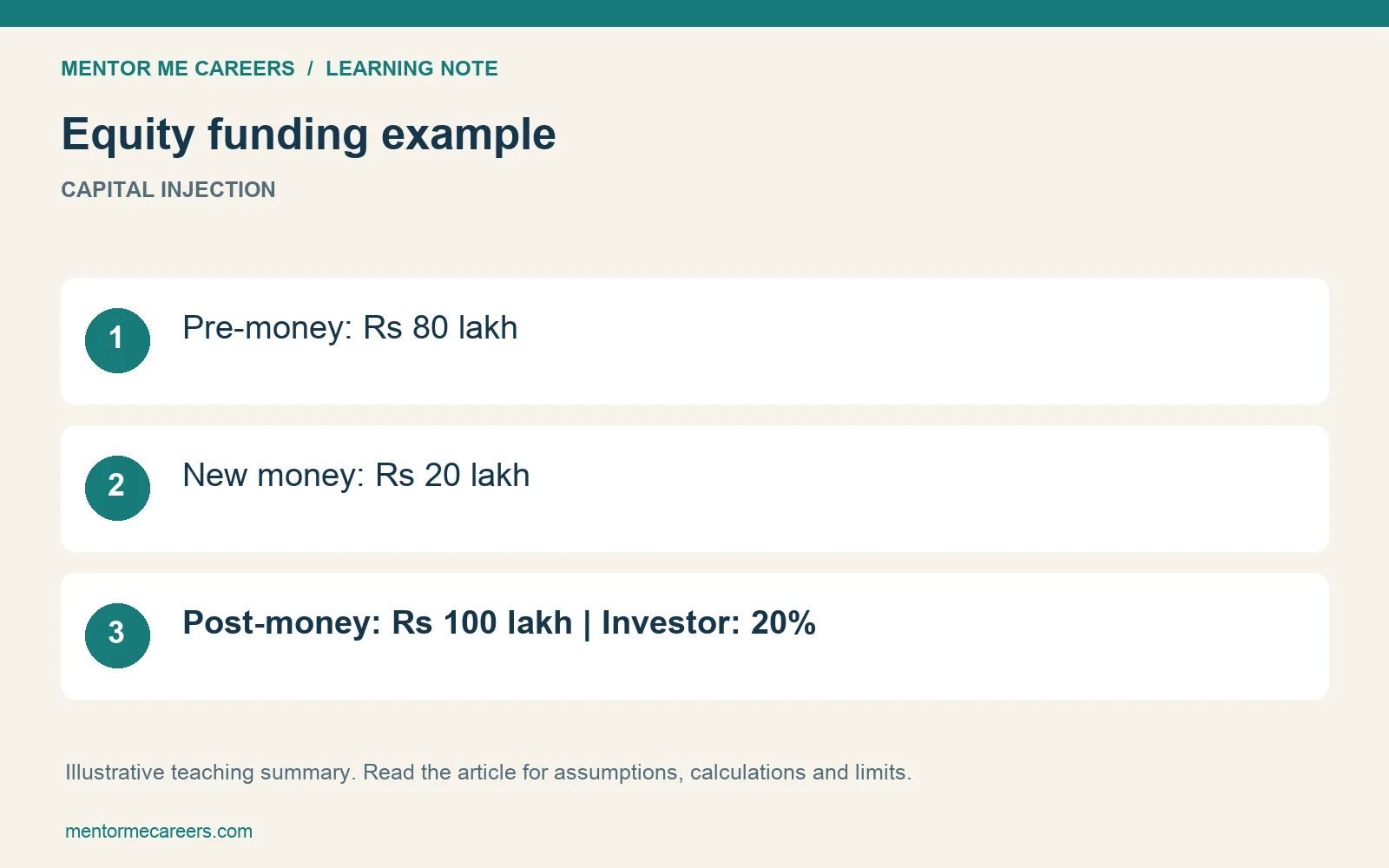
Assume a fictional company has a pre-money equity value of ₹80 lakh. A new investor contributes ₹20 lakh for newly issued ordinary shares. Assume all shares have identical economic rights and there are no options, fees or other securities.
Post-money value = ₹80 lakh + ₹20 lakh = ₹100 lakh. The new investor’s share is ₹20 lakh ÷ ₹100 lakh = 20%. Existing holders collectively retain 80%. Do not divide the investment by the pre-money value and call the result the final ownership percentage.
In this capital injection, the company receives ₹20 lakh because these are newly issued shares. If the investor instead buys shares from an existing owner, the seller receives the proceeds. That secondary transaction does not itself inject cash into the company.
| Item | Before | After new equity contribution |
|---|---|---|
| Cash | ₹10 lakh | ₹30 lakh |
| Other assets | ₹70 lakh | ₹70 lakh |
| Liabilities | ₹30 lakh | ₹30 lakh |
| Book equity | ₹50 lakh | ₹70 lakh |
The table shows book values, not the investment valuation. The ₹80 lakh pre-money valuation need not equal ₹50 lakh book equity. A valuation reflects negotiated expectations and rights; accounting equity reflects recorded assets less liabilities.
How a capital injection affects cash runway
Suppose the company has ₹30 lakh of cash after the investment and expects a net cash outflow of ₹5 lakh a month. A simple runway calculation gives six months. This assumes the outflow stays constant and the cash is available for that purpose.
Now suppose ₹10 lakh must immediately buy equipment. Available cash falls to ₹20 lakh, giving four months at the same net burn. Separate one-off spending from ongoing burn, and identify restricted balances. Otherwise, the headline funding amount can overstate the time available.
A capital injection can buy time to improve operations. It does not make a loss-making sale profitable. Test pricing, variable costs, collections and realistic demand separately. Use a base case and a downside case rather than assuming the next funding round will arrive.
Real example: Spain’s bank recapitalisation
The European Stability Mechanism explains that Spain requested assistance of up to €100 billion for its banking sector, while actual ESM assistance totalled €41.33 billion. The approved ceiling and the amount disbursed are different figures. Describing the full €100 billion as money actually injected would overstate the programme.
This example illustrates a wider reporting rule: distinguish announced funding, committed funding, cash received and money finally deployed. The differences can matter as much as the headline number.
What an analyst should check
Review the cap table, the signed instrument, cash restrictions, the use-of-funds schedule and the repayment or distribution terms. Next, reconcile the cash movement to the balance sheet and financing cash flows. Finally, test whether the operating forecast still requires further funding.
Our corporate finance guide places funding alongside investment and working-capital decisions. For a practical next step, use ratio analysis examples to examine how new funding changes leverage and liquidity without confusing those changes with improved operating performance.
Frequently asked questions
Is a capital injection revenue?
An owner contribution or borrowing is financing, not sales revenue. The accounting depends on the instrument and applicable standards.
Does a capital injection always dilute ownership?
New ordinary shares can dilute existing holders. A loan normally does not, although convertible instruments and negotiated rights need separate analysis.
Is capital the same as liquidity?
No. Liquidity concerns the ability to meet cash needs. Capital concerns the funding structure and loss-absorbing resources in the relevant context. A cash facility can improve liquidity without increasing ordinary equity.
Sources and further reading
Reviewed 3 November 2026. Worked cases are fictional teaching examples unless a named primary source is given.

A CFA charterholder with hands-on experience across investment analysis and finance education. At MentorMeCareers, he writes and reviews content on CFA, financial modeling, and investment banking careers — grounded in real market data rather than generic advice, and shaped by what actually helps candidates and professionals succeed.