

Last updated on November 4th, 2026 at 11:41 am

Agency by necessity concerns action taken to protect another person’s interests in an emergency when the agent cannot obtain ordinary instructions in time. In India, section 189 of the Indian Contract Act deals specifically with an agent’s emergency authority. It is a limited principle, not a general permission to act for someone whenever an action seems helpful.
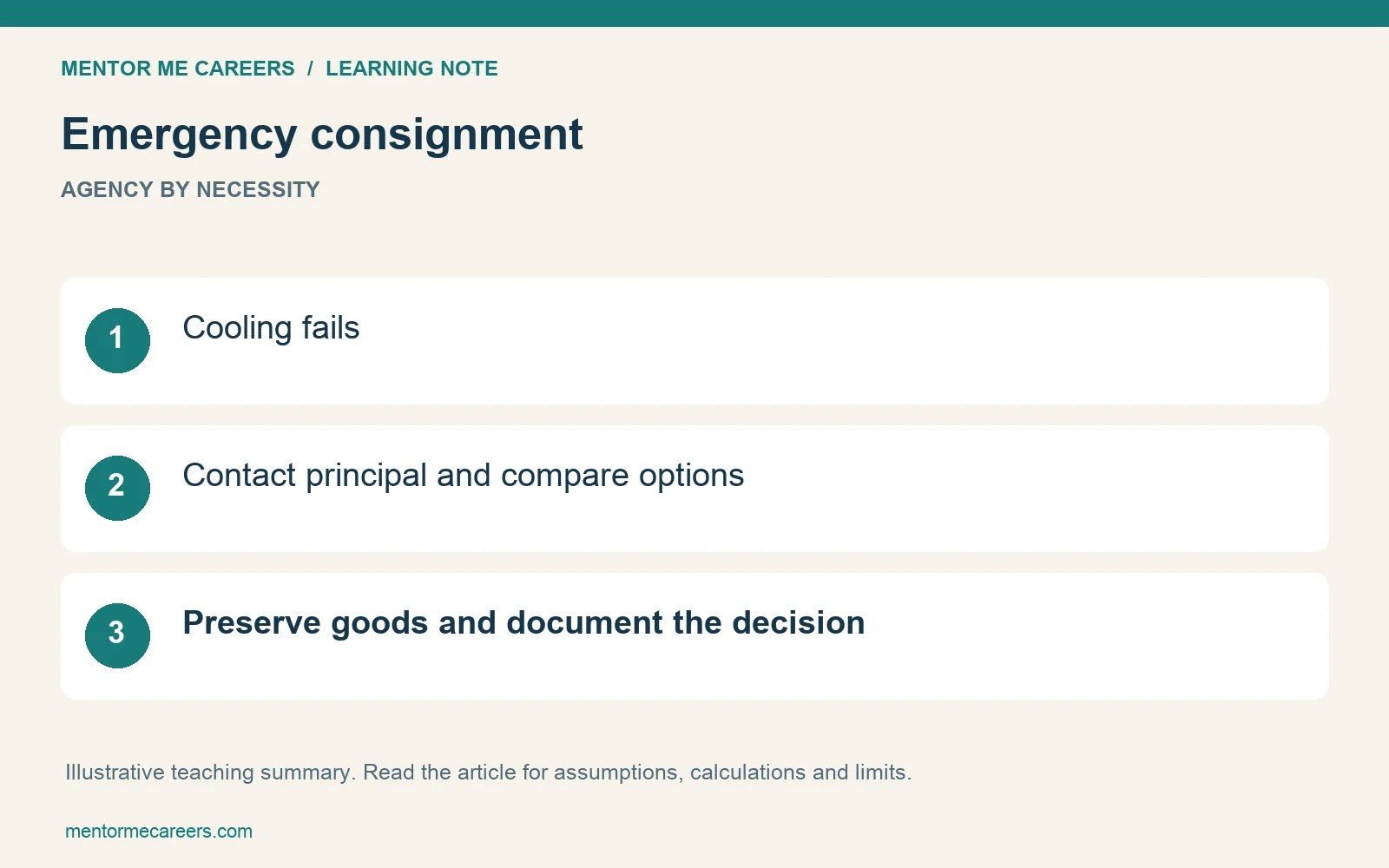
Agency by necessity under Indian law
Start with the relationship and the emergency. Section 189 concerns an agent acting to protect the principal from loss. The standard is what a person of ordinary prudence would do in their own case under similar circumstances. Read it alongside the agent’s usual authority and duties, not as a substitute for them.
For example, a transport agent may face a sudden delay while holding perishable goods. Waiting for routine instructions could destroy their value. Taking reasonable preservation measures can raise a genuine emergency-authority question. Buying an unrelated investment because it might make the principal richer is a very different situation.
The relevant facts include the goods’ condition, the available time, attempts to contact the principal, feasible alternatives and the scale of the expense. A successful outcome does not by itself prove authority. Equally, a loss does not by itself prove that a reasonable emergency decision was improper.
| Check | Evidence to retain | Why it matters |
|---|---|---|
| An agency relationship and relevant responsibility | Mandate, transport instructions or engagement | Identify whose interests the agent is responsible for protecting |
| A real risk of loss | Condition reports, timing and expert input where needed | Distinguish an emergency from ordinary convenience |
| The agent cannot obtain instructions in time | Calls, messages and the decision deadline | Explain why the normal approval process was insufficient |
| A prudent and proportionate response | Alternatives, costs and reasons | Show why the chosen action reasonably addressed the risk |
| Prompt reporting and accounting | Receipts, quantities and communication | Allow the principal to understand what happened |
This is a practical review checklist, not a legal formula that guarantees recovery of expenses. The contract, the facts and applicable law still matter.
Agency by necessity example: a refrigerated shipment
A fictional agent transports 1,000 boxes of produce. A road closure delays delivery by 18 hours. The vehicle’s cooling unit also fails. The agent cannot reach the principal despite repeated calls, and the produce may spoil before the route reopens.
Two options are available: hire replacement refrigerated storage for ₹15,000 or leave the goods in a warm vehicle. The agent checks capacity, records the condition of the goods, stores them safely and sends the principal the receipts and an explanation. The analysis focuses on protecting the consignment from loss using a proportionate response.
Now change the facts. A perfectly adequate storage option costs ₹15,000, but the agent hires a luxury facility for ₹90,000 without a reason related to preservation. The existence of an emergency does not automatically justify that extra expense. Reasonableness concerns the action taken, not just the presence of a problem.
Finally, suppose the principal answers the phone and gives lawful, workable instructions in time. The agent should not ignore those instructions merely because another course feels preferable. Emergency authority should not become a routine workaround for an inconvenient approval process.
| Concept | Main question | Example |
|---|---|---|
| Express authority | What did the principal specifically authorise? | Written permission to hire storage up to a stated amount |
| Implied authority | What authority follows from the role and circumstances? | Routine steps incidental to an authorised transport task |
| Emergency authority | What prudent action was needed to protect against loss? | Urgent preservation of a consignment during an unexpected breakdown |
| Ratification | Did the principal later adopt an otherwise unauthorised act? | Subsequent approval, subject to the legal conditions for ratification |
These concepts may arise in the same dispute, but they are not identical. Later approval is a different question from whether emergency authority existed at the time.
Examples that should not be assumed to qualify
A broker closing a position may be acting under a client agreement, exchange rules or risk controls. A mutual fund restricting redemptions may be acting under its governing documents and regulatory framework. Neither should automatically be labelled agency by necessity.
Similarly, helping a neighbour during a fire does not automatically establish the legal agency relationship needed for every claim. First identify the applicable legal framework. Then assess the facts against it.
In finance operations, this distinction encourages a useful habit: separate urgent action, contractual authority and subsequent approval in the incident record. Related protections such as an advance payment guarantee also depend on their own terms; they do not arise simply because a transaction has become risky.
Frequently asked questions
What is a simple example of agency by necessity?
An agent arranging reasonable emergency cold storage to prevent a consignment from spoiling can illustrate the issue, especially when the agent cannot reach the principal in time. Whether the principle applies depends on the actual relationship and facts.
Can an agent do anything that avoids a loss?
No. The response must stay within the applicable legal framework and be prudent in the circumstances. An emergency does not create unlimited authority.
Is ratification the same as necessity?
No. Ratification concerns later adoption of an act. Necessity concerns the basis for emergency action when the decision was made.
Sources and further reading
Reviewed 3 November 2026. Worked cases are fictional teaching examples unless a named primary source is given.

A CFA charterholder with hands-on experience across investment analysis and finance education. At MentorMeCareers, he writes and reviews content on CFA, financial modeling, and investment banking careers — grounded in real market data rather than generic advice, and shaped by what actually helps candidates and professionals succeed.