
Last updated on November 4th, 2026 at 11:38 am

An advance payment guarantee protects a buyer or employer against the specified risk that the applicant fails to repay or apply an advance as the contract requires. For example, a bank or other permitted guarantor issues the undertaking on stated terms. It is not a promise that the project cannot fail, and it is not automatically insurance against every kind of loss.
Parties and payment flow
First, identify the beneficiary: usually the buyer or employer. The supplier or contractor is usually the applicant that requests the guarantee. The guarantor issues the instrument for the beneficiary’s benefit, subject to its terms. The underlying commercial contract explains why the buyer pays the advance.
For example, a contractor may need funds to purchase materials before completing work. The employer may agree to pay an advance only after receiving an acceptable guarantee. That arrangement supports the funding flow while addressing a defined repayment risk.
Keep the documents distinct. The commercial contract governs performance and payment obligations. The guarantee sets out the guarantor’s undertaking. An invoice, a purchase order and a guarantee are not substitutes for one another.
What an advance payment guarantee does and does not cover
Next, the instrument should identify the advance, covered obligation, amount and claim requirements. It may require specified documents or a statement concerning the applicant’s breach. Whether it is a demand guarantee or a conditional undertaking depends on the wording and applicable framework—not merely its title.
ICC’s URDG 758 rules apply where the guarantee or counter-guarantee expressly makes itself subject to them. Do not assume every guarantee in every country follows URDG. If they apply, read the instrument alongside those rules, including presentation, examination and expiry provisions.
A guarantee does not eliminate fraud, delivery problems, disputes or bank risk. Nor should the beneficiary assume that a demand can be made by any convenient method after expiry. The protection is useful only if the beneficiary can meet the relevant requirements.
Worked example: advance recovery and remaining exposure
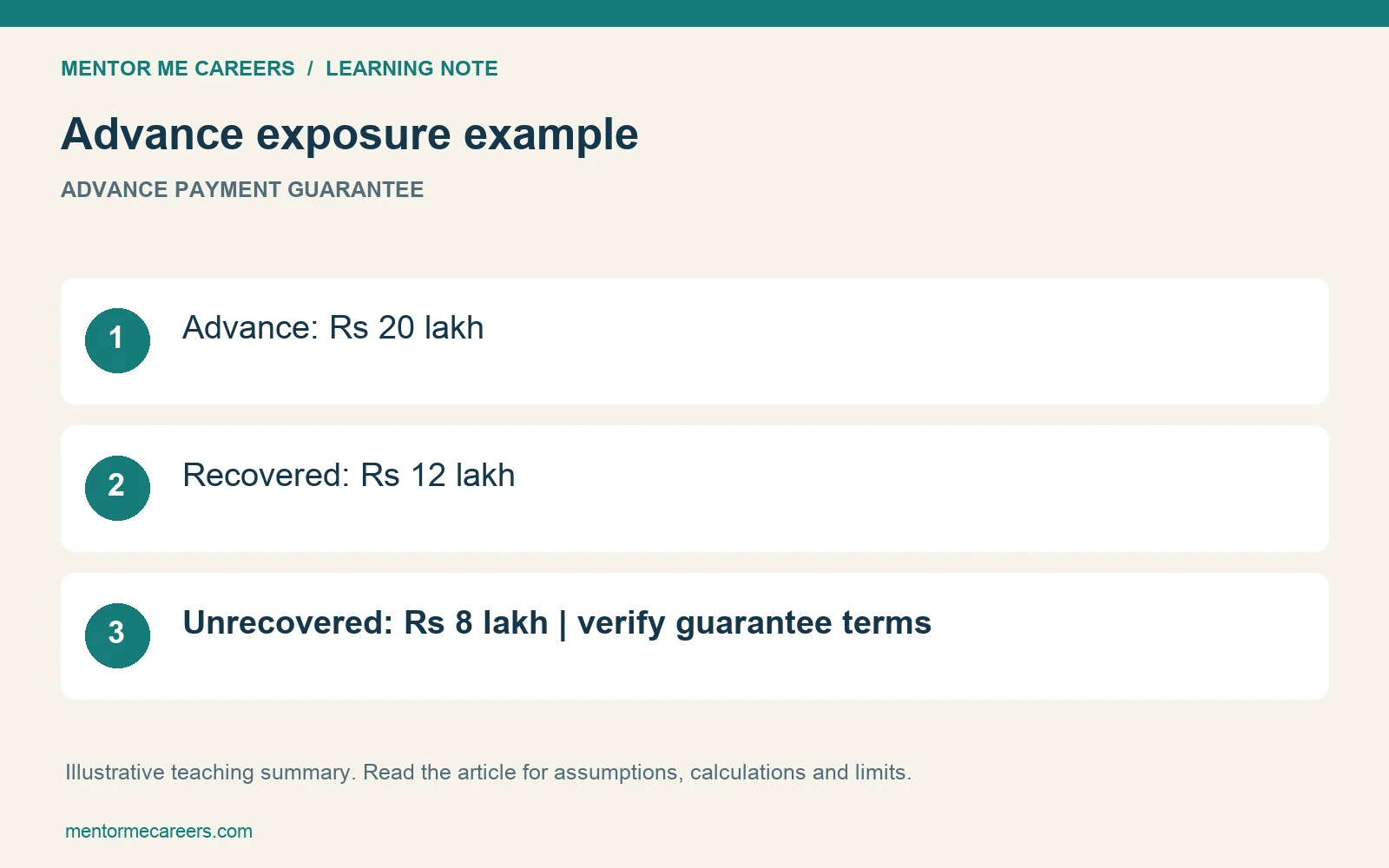
Assume a fictional ₹1 crore project contract provides for a ₹20 lakh advance. The contractor arranges a guarantee initially covering ₹20 lakh. Later, certified contract payments recover ₹12 lakh of the advance, leaving ₹8 lakh economically unrecovered.
The remaining advance exposure is ₹20 lakh − ₹12 lakh = ₹8 lakh. However, the guarantee’s amount reduces only in the manner provided by its terms. A recovery entry in the employer’s spreadsheet does not automatically amend a bank’s undertaking.
| Item | Amount | Interpretation |
|---|---|---|
| Total contract value | ₹1 crore | Not automatically the guarantee amount |
| Advance paid | ₹20 lakh | Initial advance exposure |
| Advance recovered through payments | ₹12 lakh | Reduces the unrecovered advance in this example |
| Unrecovered advance | ₹8 lakh | Economic balance, subject to reconciliation |
| Guarantee amount after reduction | Check the instrument | May require specified evidence or an amendment |
If the contractor defaults, do not assume the employer can claim the entire contract value. Assess the covered obligation, applicable cap, reduction mechanism and claim documents. Then confirm whether the beneficiary can make a compliant presentation before the relevant expiry deadline.
Advance payment guarantee vs performance guarantee
| Feature | Advance payment guarantee | Performance guarantee |
|---|---|---|
| Main purpose | Protection concerning the advance payment | Protection concerning specified performance obligations |
| Amount | Often linked to the advance and agreed reductions | Set by the contract and instrument |
| Trigger and documents | Defined in the guarantee | Defined in the guarantee |
| What not to assume | It covers every project loss | It automatically refunds every advance |
Both instruments may exist for the same contract. Their amounts, expiry dates and claim conditions can differ. A performance guarantee is not automatically a complete replacement for advance-payment protection.
What to check before accepting or requesting one
Confirm legal names, contract reference, currency and amount first. Then check the operative date, expiry event or date, place and method of presentation, required documents and any reduction provisions. Identify the applicable law, jurisdiction and incorporated rules.
Meanwhile, the applicant should understand the issuing bank’s charges, collateral requirements and reimbursement obligations. The beneficiary should check authenticity through an appropriate verified banking channel, not merely trust an emailed PDF.
Create a diary of expiry and renewal deadlines with a named owner. Reconcile advance recoveries to certificates and the guarantee schedule. Where an extension is needed, start early enough to follow the actual contractual process.
For related learning, compare a corporate guarantee and the role of an advising bank. An advising role does not by itself mean the advising bank guarantees payment. Seek qualified advice for the terms of a real instrument.
Frequently asked questions
Does an advance payment guarantee cover the whole contract?
Not automatically. It addresses the undertaking stated in the instrument, often connected to the advance, with its own cap and conditions.
Does the guarantee reduce when the advance is recovered?
Only as its reduction mechanism provides. Reconcile the commercial recovery balance with the operative guarantee amount rather than assuming they always match.
Is URDG 758 compulsory for every guarantee?
No. ICC states that URDG applies to a guarantee or counter-guarantee that expressly indicates it is subject to those rules.
Sources and further reading
Reviewed 3 November 2026. Worked cases are fictional teaching examples unless a named primary source is given.

A CFA charterholder with hands-on experience across investment analysis and finance education. At MentorMeCareers, he writes and reviews content on CFA, financial modeling, and investment banking careers — grounded in real market data rather than generic advice, and shaped by what actually helps candidates and professionals succeed.