
Last updated on November 3rd, 2026 at 05:29 pm

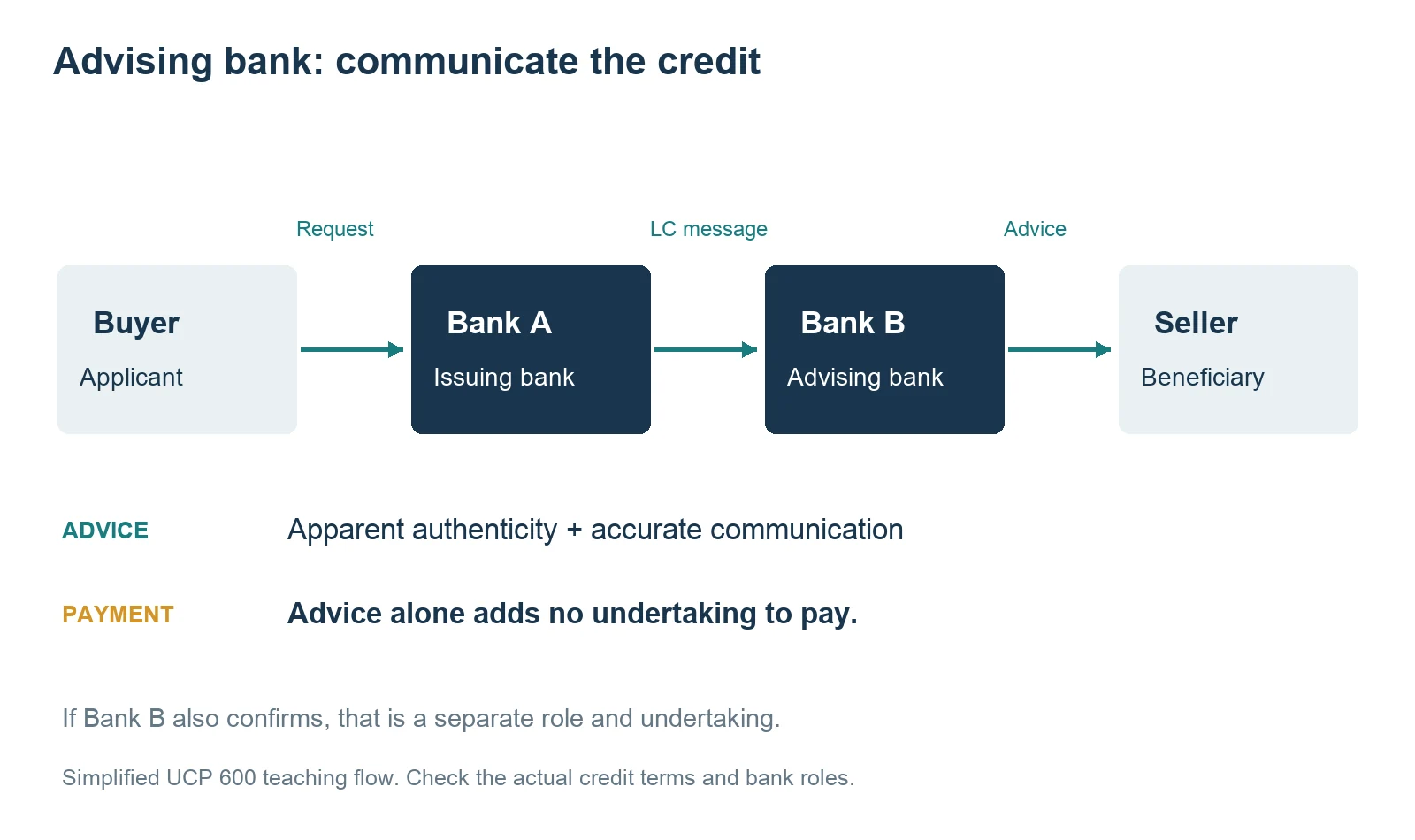
An advising bank communicates a letter of credit to its beneficiary at the issuing bank’s request. When it advises under UCP 600, it checks the credit’s apparent authenticity and conveys its terms accurately. Advising alone does not add a promise to pay. A bank that also confirms the credit takes on a separate undertaking.
What is an advising bank in a letter of credit?
A letter of credit, or LC, sets out a bank’s undertaking tied to a complying presentation of documents. The applicant usually asks its bank to issue it in favour of the beneficiary. Another bank then communicates the credit through an established banking channel.
The bank performing that communication role is the adviser. It helps the beneficiary receive the terms through a bank rather than treating an unauthenticated email or forwarded PDF as sufficient evidence of a credit.
The ICC’s UCP 600 rules, especially Articles 1, 2 and 9, distinguish advice from confirmation. These rules apply when the credit incorporates them, subject to any stated modifications. They are not automatically the terms of every bank message or trade contract.
What does the advising bank actually do?
For a UCP 600 credit, distinguish two checks from a payment commitment:
- Apparent authenticity: the bank satisfies itself about the apparent authenticity of the message it advises.
- Accurate advice: it conveys the terms as received, rather than replacing them with a salesperson’s summary.
- Clear role: the beneficiary must determine whether the advice also contains confirmation or another separate undertaking.
However, these checks do not certify that the underlying goods are satisfactory. Nor does an advice mean that the seller has met every documentary condition. Therefore, the exporter still needs to read the LC, plan its presentation and resolve unworkable terms before relying on them.
Bank services can include notifications, document handling or other work under separate arrangements. For example, DBS describes its own LC receipt notifications and separate pricing guide. Those are that bank’s service details, rather than a universal tariff. Check the actual service, instructions and credit wording. Do not assume that every activity offered by the same bank belongs to its advising role.
Advising bank example: a $50,000 machinery export
Consider a fictional Indian exporter selling machinery to an overseas buyer for US$50,000. The sales agreement calls for payment under an LC. The following sequence illustrates roles; it is not a live transaction or a bank-specific procedure.
| Stage | Action in this example | What the exporter should check |
|---|---|---|
| 1. Issue | The buyer asks Bank A to issue the LC in the exporter’s favour. | Does the issued credit match the agreed commercial terms? |
| 2. Advise | Bank A sends the credit to Bank B to advise. | Has Bank B advised the message through its normal channel? |
| 3. Review | The exporter reads the advice before arranging shipment. | Can it meet the amount, dates, document list and presentation terms? |
| 4. Amend if needed | The exporter requests correction of an unworkable term through the appropriate parties. | Has the required amendment been issued and accepted? |
| 5. Present | The exporter presents the required documents under the credit. | Does the presentation comply with the credit and applicable rules? |
In this example, Bank B is the advising bank. It does not owe US$50,000 simply because it delivered the advice. You must read the credit and any confirmation to identify which bank has undertaken to honour or negotiate a complying presentation.
A practical document-date problem
Suppose the fictional LC requires a shipment date that the exporter cannot meet. The buyer says by email, “The later date is fine.” That email alone does not rewrite the issued credit. The exporter should arrange the required amendment and review the resulting bank advice before acting on the changed date.
The adviser should communicate the amendment it receives; it should not silently edit the shipment date to match the buyer’s email. This distinction is why an operations analyst needs both document accuracy and a clear escalation process.
Advising bank vs issuing bank vs confirming bank
| Role | Main function | Payment undertaking |
|---|---|---|
| Issuing bank | Issues the credit | Its undertaking relates to a complying presentation under the credit |
| Advising bank | Advises the credit and relevant amendments | Advice alone adds no undertaking to honour or negotiate |
| Confirming bank | Adds confirmation on the issuing bank’s authority or request | Adds its own undertaking for a complying presentation |
| Nominated bank | The bank with which the credit is available, or a bank under an any-bank credit | Nomination alone should not be read as confirmation |
One institution can perform more than one role. For example, an adviser may also add confirmation when properly authorised and willing to do so. Ask what capacity it has accepted in the actual transaction. Its name, branch location or presence on an advice is not sufficient evidence of confirmation.
The US International Trade Administration’s Trade Finance Guide provides exporter-focused context on documentary payment methods. Compare the terms and risks before selecting a method; no short role definition settles a real transaction’s entire risk.
Does an advising bank guarantee payment?
No: not by advising alone. This is the most important distinction for an interview or a transaction review. If the same bank adds confirmation, identify that separate commitment and its conditions.
Consider two advice notices from fictional Bank B:
- Notice A: communicates Bank A’s credit without adding confirmation. The communication does not make Bank B an additional payment guarantor.
- Notice B: also states that Bank B adds its confirmation. That changes Bank B’s role and undertaking; the beneficiary must still make a complying presentation.
Do not infer Notice B from a marketing phrase such as “secure export payment.” Read the actual bank wording. For a live transaction, resolve unclear obligations with the bank and appropriate professional advisers.
Amendments, authenticity concerns and a second adviser
Article 9 of UCP 600 also addresses the communication chain. A bank can decline to advise and must notify the requesting bank without delay. If it cannot establish apparent authenticity, it must flag that concern; if it nevertheless advises, it must make the concern clear to the recipient.
A second advising bank may sit between the first adviser and the beneficiary. In particular, keep the chain clear: identify the source of each message and use the appropriate channel for amendments. Do not describe two advisers as two payment guarantees.
Amendment acceptance is a separate matter from message delivery. Under the applicable UCP framework, a bank’s transmission does not mean every required party has consented to the proposed change. Check the amendment’s status before updating the transaction record.
What should an operations analyst check in the advice?
- Identity and references: beneficiary, applicant, issuing bank and credit reference.
- Commercial details: currency, amount and the permitted description of the transaction.
- Dates: shipment, expiry, presentation period and place of presentation.
- Documents: what the credit requires and whether those requirements are workable.
- Bank roles: who issues, advises, confirms if applicable, and receives the presentation.
- Changes and exceptions: amendments, unresolved authenticity concerns and the required follow-up owner.
This is a learning checklist, not a substitute for a bank’s operating procedures. Record the source document and unresolved questions. Never fill a missing reference or date with a guess simply to complete the system fields.
How to explain an advising bank in an interview
An advising bank communicates the LC to the beneficiary at the issuing bank’s request. Under UCP 600, its advice addresses apparent authenticity and accurate communication. Advice alone adds no payment undertaking. If it also confirms, that is a separate role tied to a complying presentation.
Then apply the distinction to the US$50,000 example. Explain who issued the credit, who advised it and what evidence would show confirmation. This demonstrates understanding beyond memorising a definition.
For further practice, our capital-market interview questions cover a different banking knowledge area. Keep documentary trade finance separate from securities settlement when comparing operations roles.
Frequently asked questions
Is the advising bank always in the exporter’s country?
It often serves the beneficiary through a convenient banking relationship, but geography does not define the role. The actual instructions and credit determine which bank advises.
Is the negotiating bank the same as the advising bank?
Not necessarily. Advice communicates the credit. Negotiation concerns purchasing drafts or documents under the credit by advancing, or agreeing to advance, funds under the applicable rules. The same bank may act in both capacities, but advice alone does not establish that it will negotiate.
Who pays advising bank charges?
Check the credit, tariff and agreed charging arrangement. There is no single fee amount or payer that this definition can establish for every transaction. Ask the bank for the applicable schedule before committing.
Can the adviser change an LC amount or shipment date?
It should communicate the issued terms and amendments accurately. It cannot replace the amendment process by editing the terms to suit a buyer’s informal request.
Are UCP 600 credits revocable?
UCP 600 defines a credit as irrevocable. An older explanation of freely revocable documentary credits should not be presented as the current UCP 600 position.
Is advising the same as checking all presented documents?
No. Advice communicates the credit. Later document examination or negotiation may involve the same institution in another capacity. Establish its role and instructions at each stage.