
Last updated on November 20th, 2025 at 05:01 pm

Graduation degrees only dip their toes into the water of the ocean to a certain point. But in order to learn more and develop more specialized skills in any given field, students constantly want to delve deeper and explore new topics. In this article we discuss, if pursuing ACCA after graduation actually makes sense for a better career or not.
Introduction to ACCA after Graduation

The world in which we live is a reflection of and centred on technological prowess. In today’s society, specialized knowledge and skills are in high demand, while general knowledge and skills have limited room for advancement. Candidates can look into a number of specialization courses in the accounting field. Having an expert on hand in this number-crunching field will be beneficial to them. One of the top professional organizations for accountants in the world is called ACCA, or the Association of Chartered Certified Accountants.
The prestigious organization provides the ACCA qualification, which enables students to obtain both ACCA membership and Certified Chartered Accountant Status. Students who join ACCA have the opportunity to learn useful accounting techniques and connect with esteemed accounting industry experts. Students who pursue ACCA can enhance their professional skill set and gain advantageous career benefits.ACCA helps students advance their careers. However, it necessitates a commitment of time, money, and effort. Therefore, students should only enroll in this course after determining their need for it or the potential value of ACCA to their career path.
Should you pursue ACCA after Graduation?
The ability and foresight of the student to pursue a specific graduate degree is the key to the answer to the mentioned question. With their degree, students can enroll in professional courses like ACCA if they have the aptitude and willingness to do multiple things.
In India, students interested in accounting pursue a Bachelor of Commerce degree (B.Com). Students will learn about the complexities of this dynamic field in this course. The chance for students to take additional professional courses while pursuing their degrees is tremendous. Because B.Com requires less effort and energy than other graduation courses, students have the excellent opportunity to pursue other professional programs concurrently.
ACCA after graduation in India
ACCA can be pursued in addition to graduate degrees other than B.Com because there are no prerequisites for it. Students can review the benefits and drawbacks of pursuing an ACCA course before or after earning a degree to provide a more thorough response to this question. Certainly, pursuing ACCA after completing your graduation is a good option, and it remains one of the most sought-after pathways for graduates in commerce and finance in India. Actually, obtaining an ACCA qualification post-B.Com, BBA, BMS, BAF, or MBA can be quite beneficial, as graduates may qualify for various exam exemptions due to their academic background. This advantage allows you to bypass several foundational exams (typically between 4 and 9 papers), enabling you to expedite the qualification process and potentially start at the Applied Skills or even Strategic Professional level, depending on your qualifications.
The ACCA qualification is recognized worldwide, esteemed in over 180 countries, which makes it an excellent option for graduates seeking international career paths in areas like accounting, auditing, taxation, financial reporting, and corporate finance. Its adaptable exam format allows for study alongside employment, making it particularly suitable for new graduates entering the job market. With quarterly exam sessions, online learning alternatives, and requirements for practical experience, you can develop substantial real-world skills while advancing toward membership.
Benefits of ACCA AFTER Graduation
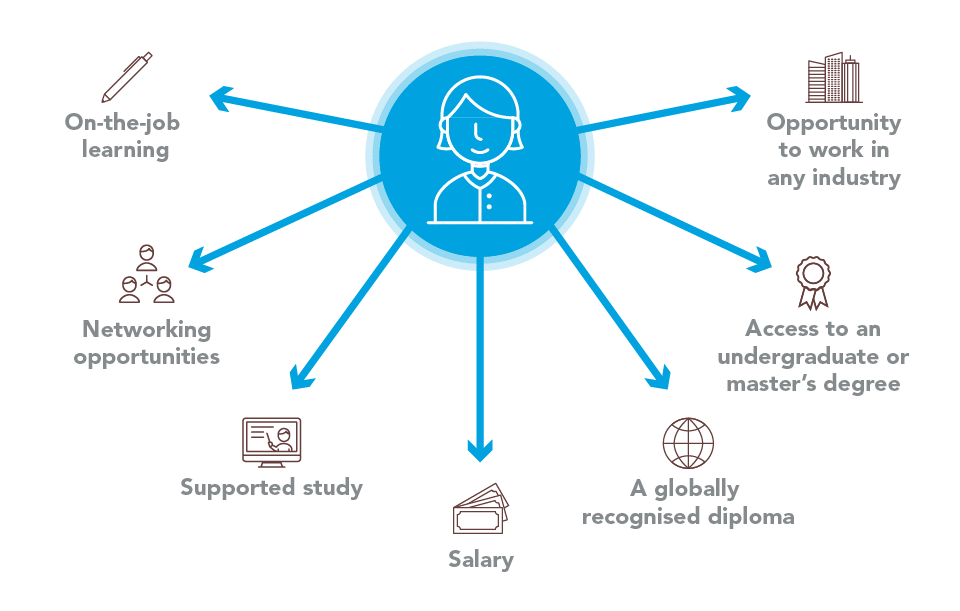
The reasons listed below are why students ought to think about pursuing ACCA with a degree:
- The typical ACCA course lasts 4 to 5 years, but if students pursue it alongside their degree, they can finish it in 1 to 2 years after receiving their diploma. Saving the students some important time in the process.
- Students can determine whether or not the ACCA program will suit their career path by participating in it during their graduation. With plenty of time left over, they can quickly withdraw from the course.
- The candidate may be able to obtain an exemption from a few ACCA papers by pursuing a B.Com at a reputable university.
- Numerous colleges and universities offer focused ACCA classes to aid students in getting ready for the course.
- Students have more opportunities to find employment because employers can entice them with lucrative offers. After completing their ACCA, they can also hold senior positions within that organization.
Benefits of Continuing Your Education in ACCA After Graduation
The benefits of continuing your ACCA studies after graduation are as follows:
- After graduation, students who want to concentrate and meet the requirements for their graduate degree may choose to pursue ACCA subjects.
- It allows students the time they need to consider and research different career options, freeing them from the pressure to move quickly.
- If necessary, students can apply for a job and then continue with the course. It provides them with a variety of flexible options.
ACCA exemptions explained
ACCA exemptions enable qualified students to bypass certain exams based on their educational background. This allows graduates and CA students to complete their ACCA sooner and lower overall expenses. Exemptions are primarily granted for the Applied Knowledge and Applied Skills levels, as ACCA acknowledges that individuals with backgrounds in accounting, finance, or commerce have already covered similar subjects.
For instance:
1.BCom / BBA / MCom graduates typically receive 4–5 exemptions.
2.CA Inter students qualify for 6 exemptions.
3.CA Qualified professionals can obtain as many as 9 exemptions, allowing them to finish the ACCA program much more quickly.
It is essential to verify exemptions using the official ACCA Exemption Calculator, and students must pay a fee for each exempted paper. Exemptions are not granted automatically; students must submit academic transcripts, mark sheets, and certificates for consideration. In summary, ACCA exemptions can help streamline your path, lessen the workload, and facilitate a quicker achievement of the ACCA qualification, particularly if you have a background in commerce, accounting, or CA.
Typical exemption scenarios
| Qualification | Common Exemptions | Papers You Usually Skip | Start From |
| B.Com (General) | 4–5 exemptions | BT, MA, FA, LW (sometimes) | Applied Skills Level |
| B.Com (Accounting / Finance Specialization) | 6–9 exemptions | All Knowledge Level + some Skills Level (FR / TX / PM) | Applied Skills or Strategic Professional |
| BBA / BMS (Finance) | 4–6 exemptions | BT, MA, FA, LW, PM | Applied Skills Level |
| MBA (Finance) | 6–9 exemptions | Knowledge Level + selected Skills (FR/TX/FM based on curriculum) | Applied Skills or Professional Level |
| CA Inter (India) | 6–8 exemptions | Majority of Knowledge + Skills Level | Applied Skills / Strategic Professional |
| CA Qualified (India) | Up to 9 exemptions (maximum) | All Knowledge + most Skills (varies by year) | Strategic Professional Level |
| M.Com | 5–7 exemptions | BT, MA, FA + 2–3 Skills papers | Applied Skills Level |
How to claim exemptions
If you’ve completed a B.Com, BBA, BMS, or a finance/accounting-related degree, you may be eligible for ACCA exemptions, allowing you to skip certain papers and complete the qualification faster. Claiming exemptions is simple, but it must be done correctly to avoid delays or additional fees. Here’s a step-by-step guide for graduates!
1.Check Your Exemption Eligibility Online
Start by visiting the ACCA Exemption Calculator on the official ACCA website.
Enter your:
- Country
- University name
- Degree/course
It will instantly show how many exemptions you qualify for (often 4–9 papers for commerce graduates).
2. Create Your ACCA Account & Begin Registration
Sign up on the ACCA website and start the registration process.
During sign-up, you will be asked about your education history.
This is where ACCA determines whether you can receive exemptions.
3. Upload Required Academic Documents
To verify your qualification, ACCA requires clear copies of:
- Degree certificate (provisional or final)
- Marksheet/Transcripts of all semesters
- Identification document (Aadhaar/Passport)
Ensure the documents are scanned clearly and uploaded in PDF/JPG format.
4. ACCA Reviews Your Documents
Once submitted:
- ACCA verifies your university and course
- Confirms your exemptions
- Updates your myACCA dashboard
This review usually takes 7–15 business days.
5. Pay the Exemption Fees
Exemptions are not free.
You have to pay the standard exemption fee, equal to the exam fee for each paper you skip.
After payment, your exemptions get activated and you can proceed to book the next eligible exam.
6. Start from Your First Non-Exempt Paper
Once the exemptions appear on your ACCA portal, you can schedule exams for the next level (usually Applied Skills or Strategic Professional, depending on how many papers you skip).
The structure of the ACCA examination is divided into three tiers: Applied Knowledge, Applied Skills, and Strategic Professional, each designed to enhance expertise in accounting, finance, auditing, and reporting. The level of difficulty increases with each tier: the Knowledge Level caters to beginners and is well-suited for recent graduates, the Skills Level incorporates advanced problem-solving and practical situations, while the Professional Level analyzes strategic decision-making through intricate case studies.
Overall, the ACCA qualification is viewed as moderately challenging, with the most difficult subjects appearing at the Strategic Professional level. Achieving success in regular practice, a solid grasp of concepts, and proficiency in solving exam-style questions. With exemptions available for commerce graduates and examinations offered quarterly, ACCA is recognized as one of the most flexible and globally esteemed accounting qualifications.
ACCA exam structure & difficulty
| Exam Level | Papers Included | Exam Format | Difficulty Level | What Makes It Hard / Easy? |
| Applied Knowledge | BT (Business & Technology), MA (Management Accounting), FA (Financial Accounting) | On-demand computer-based exams (Objective questions) | 1 Easy – Beginner Level | Basic concepts; good for freshers; high pass rates |
| Applied Skills | LW, PM, TX, FR, AA, FM | Quarterly CBEs (Mix of MCQs + constructed response) | 2 Moderate | Deeper calculations, scenario-based questions, practical application |
| Strategic Professional (Essentials + Options) | SBL, SBR (Essentials) + 2 of AFM, APM, ATX, AAA | Quarterly CBEs (Case-study format) | 3 Hard – Professional Level | Complex case studies, judgment-based questions, real-world scenarios |
The structure of the ACCA examination is organized into three tiers: Applied Knowledge, Applied Skills, and Strategic Professional, each designed to progressively enhance expertise in accounting, finance, auditing, and reporting. The level of difficulty escalates with each tier: the Knowledge Level caters to beginners and is well-suited for recent graduates, the Skills Level incorporates advanced problem-solving and practical situations, while the Professional Level evaluates strategic decision-making through intricate case studies.
Overall, the ACCA qualification is viewed as moderately challenging, with the most difficult subjects appearing at the Strategic Professional level. Achieving success hinges on regular practice, a solid grasp of concepts, and proficiency in solving exam-style questions. With exemptions available for commerce graduates and examinations offered quarterly, ACCA is recognized as one of the most flexible and globally esteemed accounting qualifications.
Pros & cons ACCA after graduation
Depending on some of these factors, some students will find the ACCA harder than others:
| Pros of ACCA | Cons of ACCA |
| Globally Recognised in 180+ countries | Not mandatory for core accounting roles in India (CA still preferred) |
| Flexible exam structure (on-demand + quarterly exams) | Lengthy qualification timeline (2–3 years for most students) |
| Multiple exemptions for BCom, MCom, CA Inter, CA | Exemption fees increase total cost |
| Opens international career opportunities | International roles may need relocation or work visas |
| Strong demand in Big 4, MNCs, financial services | Job roles for freshers may start at lower salary until full qualification |
| Focused on practical finance, audit, taxation & reporting | Requires consistent self-study discipline |
| Affordable compared to MBA or international courses | Annual subscription & exam retake fees add up |
| Suitable for working professionals | Technical subjects can be difficult without strong accounting basics |
The ACCA qualification offers distinct benefits, such as international recognition, flexible examination timings, strong demand from major firms and multinational corporations, as well as various exemptions for graduates and CA students. It is particularly advantageous for individuals pursuing global opportunities or careers in finance, auditing, reporting, and consulting.
Nevertheless, candidates should also weigh the drawbacks: obtaining the qualification takes about 2 to 3 years, entails ongoing costs, and entry-level professionals might begin with relatively low salaries until they achieve full certification. In India, while ACCA is held in high regard, it does not yet fully serve as a substitute for the CA designation in conventional audit or statutory positions.
The subject matter will be more familiar to you if you have a Bachelor’s or Master’s degree in finance and accounting or a closely related field. But that doesn’t necessarily mean it will be simpler, especially if you use exemptions and don’t go into enough detail about earlier material.
ACCA After Graduation- Jobs
ACCA (the Association of Chartered Certified Accountants) is a global professional accounting qualification that provides students with a comprehensive understanding of accounting and business principles. Completing ACCA can open up a wide range of job opportunities in various sectors and industries. Here are a few examples of jobs that may be available to those who have completed ACCA:
- Financial Analyst: Financial analysts use financial data to evaluate the performance of companies, industries, and economies. They use their knowledge of accounting and financial analysis to develop financial models, make investment recommendations, and provide strategic financial advice.
- Audit Senior: An Audit Senior is responsible for planning, executing, and finalizing financial audits and reviews. They assess the internal control systems of the organization and ensure that all financial information is accurate and complete.
- Tax Manager: Tax Managers are responsible for ensuring that an organization is compliant with tax laws and regulations. They work with financial data to prepare and file tax returns and identify tax planning opportunities.
- Financial Controller: Financial Controllers are responsible for the financial operations of an organization. They oversee the preparation of financial statements, develop financial strategies, and ensure that the organization’s financial activities are in compliance with laws and regulations.
- Management Accountant: Management accountants provide financial information to managers and other decision-makers within an organization. They use financial analysis to help managers make better decisions, improve operations, and identify new business opportunities.
Major roles
- Financial Advisor: Financial Advisors help individuals and organizations plan their financial futures by providing advice on investments, insurance, taxes, and retirement planning.
- Investment Banker: Investment bankers help companies and governments raise money by underwriting and issuing securities, and by acting as intermediaries in the buying and selling of securities.
- Risk Manager: Risk Managers assess and manage the financial risks associated with an organization’s operations. They use financial analysis to identify potential risks and develop strategies to mitigate those risks.
These are just a few examples of the many career opportunities that may be available to those who have completed ACCA. The specific job opportunities will depend on the skills, experience, and interests of the individual and the job market
ACCA vs MBA vs CFA vs CFP for graduates
Association of chartered certified accountants is a global qualification offered by the Association of Chartered Certified Accountants. It is widely recognized in many countries around the world, including the UK, Europe, and Asia. The ACCA qualification covers a broad range of accounting and finance topics, including financial reporting, audit, and tax. It is designed for individuals who want to become professional accountants and work in a variety of industries.
CPA, on the other hand, is a professional certification offered by the American Institute of Certified Public Accountants (AICPA) and is recognized in the United States and other countries. The CPA exam covers a wide range of accounting and finance topics, including financial reporting, audit, and tax. It is intended for individuals who want to become licensed public accountants and work in the accounting profession.
| Qualification | Best For | Core Focus | Duration | Global Scope |
| ACCA | Accounting, audit, tax careers | Financial reporting, audit, compliance | 2–3 yrs (with exemptions) | Very high (180+ countries) |
| MBA | Management, leadership, corporate roles | Strategy, management, specialization (Finance/Marketing/Analytics/HR) | 1–2 yrs | High (depends on college) |
| CFA | Investment & portfolio careers | Equity research, valuation, asset management | 2–4 yrs | Very high (investment industry) |
| CFP | Wealth advisory & financial planning | Personal finance, retirement, insurance planning | 6–18 months | High (planning & advisory roles) |
- Choose ACCA if you want a stable global career in accounting, audit, controllership, tax, and corporate finance roles.
- Choose MBA if you want leadership roles, consulting, product management, corporate strategy, or business management across industries.
- Choose CFA if you want to work in equity research, portfolio management, investment banking, asset management, or risk roles.
- Choose CFP if you want a client-facing career in wealth management, financial planning, advisory, and retail investment services.
Conclusion
Studying ACCA can give students an edge over their peers because it is a professionally recognized course that is offered all over the world. Students should consider their suitability, ability, and requirements before deciding whether to pursue it alongside or after receiving a degree and only then should they move forward. The pressure to pursue ACCA shouldn’t affect how well a student performs on their graduation exam. They should therefore weigh all options before moving forward with pursuing ACCA.
FAQ
Yes, you can start ACCA immediately after graduation. In fact, graduates especially from commerce, finance, business, or accounting backgrounds often get exemptions and can complete ACCA faster.
How many ACCA exemptions do graduates get?
Graduates from B.Com, BBA, BMS, or accounting-related degrees typically receive up to 9 exemptions out of 13 papers, depending on their university and course curriculum.
Can I work while doing ACCA after graduation?
Yes. ACCA is highly flexible, allowing you to study and work simultaneously. Many students take one exam every quarter while gaining practical experience, which also counts towards ACCA’s PER requirement.
Does ACCA help get jobs abroad?
Absolutely. ACCA is globally recognized in 180+ countries, giving graduates opportunities in the UK, UAE, Canada, Singapore, Australia, and more. It is especially valued in accounting, audit, and finance roles.
ACCA pass rates vary by paper, but most exams have an average pass rate of 40%–55%, making it challenging but achievable with consistent preparation.
Related Articles

A CFA charterholder with hands-on experience across investment analysis and finance education. At MentorMeCareers, he writes and reviews content on CFA, financial modeling, and investment banking careers — grounded in real market data rather than generic advice, and shaped by what actually helps candidates and professionals succeed.