
Last updated on September 24th, 2026 at 07:36 pm

The CFA Institute (USA) provides the globally recognized CFA program, which is aimed at professions in wealth administration, corporate funding, equity investigation, investment appraisal, and portfolio oversight. Due to its challenging syllabus, high sector applicability, and moral guidelines, it is viewed as one of the most esteemed finance qualifications globally. The three examination tiers (Level I, Level II, and Level III) of the CFA Program evaluate analytical competencies, valuation techniques, and mastery of portfolio oversight. Lets dive deep into CFA course details.
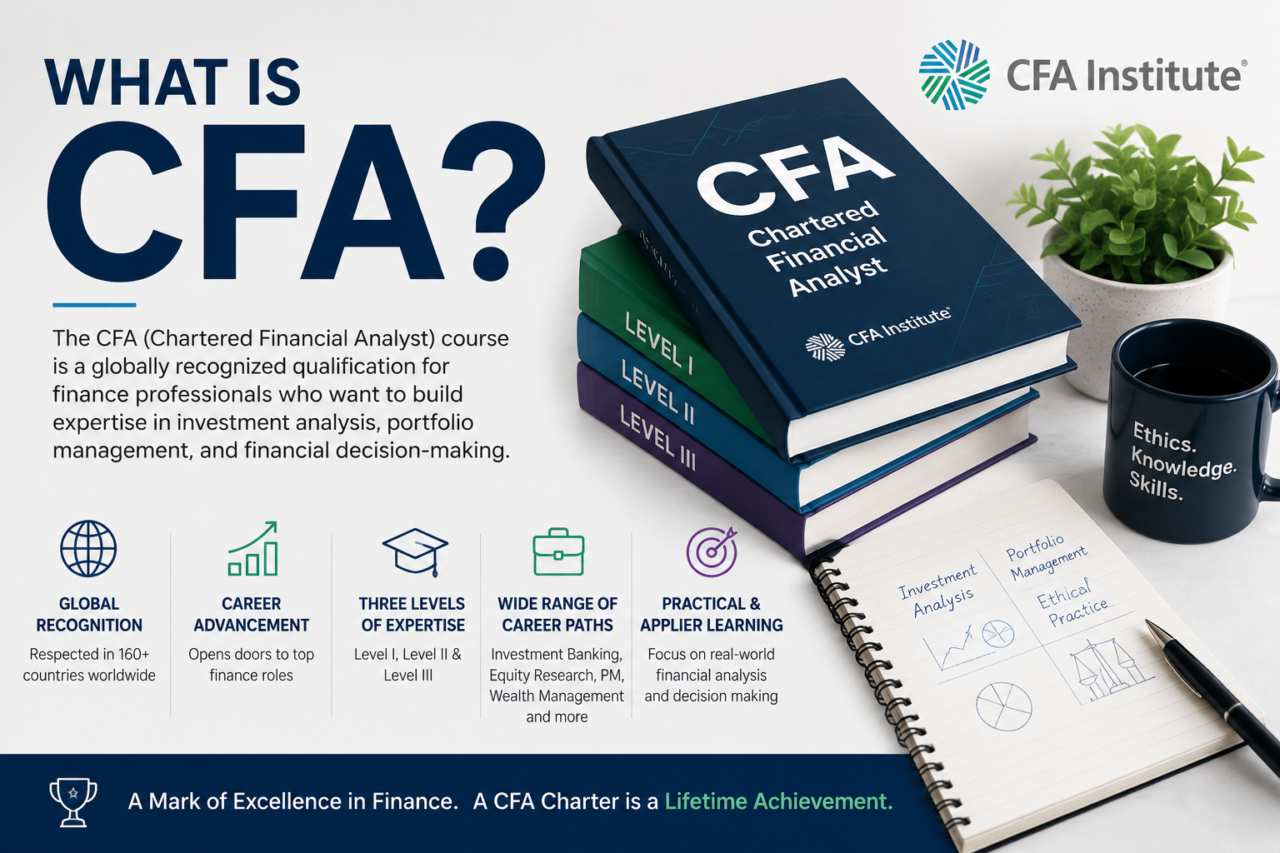
What the CFA Course Includes:
1.Three levels of exams (Level I → Level II → Level III)
2.Subjects like ethics, financial reporting, valuation, derivatives, and portfolio management
3.Practical Skills Modules (PSMs) like financial modeling & Python
4.Global recognition across investment banks, asset managers, and consulting firms
5.Suitable for graduates, final-year students, and professionals seeking an international finance credential
What is CFA Course?
The CFA (Chartered Financial Analyst) course is a globally recognised professional certification in investment management and financial analysis, awarded by the CFA Institute, USA. It’s structured across three levels — Level I, II, and III — each testing progressively deeper knowledge of areas like equity valuation, fixed income, portfolio management, financial reporting, ethics, and corporate finance.
Unlike an MBA or a university degree, the CFA is a self-study, exam-driven credential: there’s no mandatory classroom requirement, which is exactly why the pass rates stay tough and why most candidates who try to wing it without structured guidance end up repeating levels. In India specifically, the CFA charter has become the go-to qualification for candidates targeting roles in equity research, portfolio management, investment banking, and asset management — largely because it signals a rigorous, standardised body of knowledge that recruiters across BFSI trust without needing to second-guess it. I’ll be upfront: it’s not a quick certificate you add to your resume in a few months. Between the three levels, most candidates take 2.5 to 4 years to finish, on top of the 4,000 hours of relevant work experience needed for the actual charter (not just the exams). If you’re serious about a career in finance and willing to put in the study hours, it’s worth it — but it’s not a shortcut, and anyone selling it to you as one isn’t being straight with you.
by Allen Aravindan, CFA
What Does the CFA Program Cover?
The CFA Program covers the full spectrum of investment analysis and portfolio management, building a foundation for careers in equity research, asset management, investment banking, wealth management, and risk analysis. The curriculum is structured to move progressively — from foundational financial concepts through advanced valuation techniques, portfolio construction, and wealth planning — so candidates come out with both the theory and the practical judgment the job actually demands.
Build the fundamental knowledge required to understand investment analysis and financial markets.
Go deeper into individual asset classes and learn to apply financial concepts rather than simply recall them.
Apply knowledge from Levels I and II to portfolio decisions and real-world investor circumstances.
Who Can Take the CFA Course?
The CFA course is accessible to students and employed professionals seeking to develop a career in investment analysis, equity research, portfolio administration, wealth management, or financial strategy. The CFA Institute has made the curriculum adaptable so that applicants from various academic and professional backgrounds can register provided they satisfy the minimum educational or employment prerequisites.
To qualify for the CFA Program in 2026 & 2027, you must fulfil one of these conditions:
You can register through one of CFA Institute’s education or professional work experience pathways.
- Bachelor’s degree completed; OR
- Your Level I exam window is within 23 months of your graduation month; OR
- A combination of 4,000 hours of professional work experience and/or higher education, acquired over at least 3 sequential years.
University students can progress to Level II subject to CFA Institute’s education requirements.
- Must have passed the CFA Level I exam.
- If still an undergraduate, you must be within 11 months of graduation to sit for Level II.
- You must continue to meet CFA Program enrollment requirements.
Additional education or professional experience requirements apply before sitting for Level III.
- Must have passed the CFA Level II exam.
- Must have completed a bachelor’s degree or accrued 4,000 hours of professional work experience.
- You must continue to meet CFA Program enrollment requirements.
Exam eligibility should not be confused with eligibility for the CFA charter. To become a CFA charterholder, candidates must pass all three exam levels and separately satisfy CFA Institute’s qualifying work experience and membership requirements.
CFA Course Duration, Structure & Timeline
The CFA exam is organized into three examination tiers Level I, Level II, and Level III each formulated to enhance your proficiency in financial analysis, valuation, and asset management. The majority of candidates require 2.5 to 4 years to finish the entire process, contingent upon study duration, examination intervals, and professional obligations. Since CFA tests occur multiple times annually, you may devise an adaptable study timetable fitting your agenda.
Every tier necessitates 300–400 hours of preparation, and you are permitted to take the subsequent tier immediately upon passing the former one. Professional practical experience (4,000 hours) may be acquired before, throughout, or after the tests, so participants frequently study concurrently with their financial careers.
Read More: CFA Pass percentage | CFA exam Pattern
Timeline
| Stage | Duration | Key Milestones |
| Start: Register for CFA Level I | 1–3 months before prep | Pay fees, access Learning Ecosystem, plan schedule |
| Level I Preparation | 4–6 months | Foundations: ethics, quant, FSA, economics |
| Level II Preparation | 6–9 months | Deep valuation: equity, fixed income, derivatives, analysis |
| Level III Preparation | 6–9 months | Portfolio management, wealth planning, essay-style questions |
| Work Experience Requirement | Parallel or post-exams | 4,000 hours of relevant experience |
| Apply for CFA Charter | 1–2 months | Membership approval + references |
| Become a CFA Charterholder | — | Earn global professional designation |
Total Time to Complete CFA:
Most candidates finish in:
2.5–4 years (average)
Fast-track candidates may finish in ~18–24 months, though this is uncommon.Check our structured CFA course and training program, for CFA Level 1 preparation.
What is the Cost of CFA Course in India?
CFA fees vary based on enrollment period and exam level. In India, the cost of the CFA course is
One-time Enrollment Fee: USD 350
Exam Registration Fee per Level:
1.Early: USD 940
2.Standard: USD 1,250
Total Cost in India:
Approx ₹2.5 – ₹3.2 lakh for all three levels (excluding coaching, materials & travel).
Additional Costs:
1.Third-party prep (optional): ₹10,000–₹60,000
2.Books / mock tests
3.Exam-day travel costs
You can apply for CFA scholarship if u are eligible.
Career Scope After CFA in India
CFA is rapidly gaining prominence in India due to the growth of investment banking, wealth management, and the asset management industry. CFA charterholders work across leading banks, consulting firms, hedge funds, PMS/AMCs, and Big 4s.
Popular Job Roles:
1.Equity Research Analyst
2.Portfolio Manager
3.Wealth Manager / Private Banker
4.Financial Analyst
5.Risk Analyst
6.Investment Banking Analyst
7.Valuation Consultant
Salary Snapshot (India):
1.Freshers: ₹6–10 LPA
2.Mid-level analysts: ₹12–25 LPA
3.Senior professionals: ₹20–50 LPA+
CFA vs Other Courses (CA, MBA, FRM)
| Feature | CFA | CA | MBA | FRM |
| Focus | Investments & portfolio mgmt | Tax, audit, accounting | Management & business | Risk management |
| Exam Difficulty | Moderate–High | High | Varies by college | Moderate–High |
| Duration | 2.5–4 yrs | 4–5 yrs | 2 yrs | 1–2 yrs |
| Best For | Finance careers & markets | Compliance & accounting | Leadership/management | Risk & quantitative roles |
1.Choose CFA if you love valuation, markets and investment careers.
2.Choose CA if you want technical accounting, audit, tax and an India-focused finance leadership path.
3.Choose MBA if you aim for management, product, consulting, or a career switch with networking benefits.
4.Choose FRM if you want to specialise in market/credit/liquidity/operational risk.
Conclusion
The CFA Program is one of the most prestigious finance qualifications globally, but it requires commitment, consistent study, and genuine interest in financial markets. If you aspire to build a career in equity research, investment banking, portfolio management, valuation, or risk, the CFA charter can dramatically accelerate your growth and credibility.
Decision Checklist:
1.Do you want a global finance career?
2.Are you comfortable with analytical work & valuation?
3.Can you commit 300–400 hours per level?
4.Do you want higher salary potential in investment roles?
If yes, CFA is an excellent fit for your long-term career goals.
FAQ
The CFA (Chartered Financial Analyst) course is a globally recognized professional program in investment and financial analysis offered by the CFA Institute.
The CFA program has three levels:
Level I: Investment tools and basic concepts
Level II: Asset valuation and analysis
Level III: Portfolio management and wealth planning
The CFA course typically takes 3–4 years to complete all three levels and meet the required 4,000 hours of work experience. Duration varies based on study pace and exam scheduling.
To enroll, you must have:
1.A bachelor’s degree (or be in the final year), or
2.4,000 hours of professional work experience in any field over 3 years
There is no age limit, and candidates from any stream are eligible.
The total cost ranges between ₹1.2 to ₹2.1 lakhs, depending on early or standard registration. Fees are paid in USD (typically $900–$1,200 per level), and rates vary with exchange fluctuations.
CFA charterholders typically work as:
1.Investment Analyst
2.Portfolio Manager
3.Equity Research Associate
4.Risk Analyst
5.Financial Advisor
Related Articles
- FRM vs CFA
- CFA Full Form
- CFA Classes in Mumbai
- CFA Level 1 Free Resources
- Is CFA harder than CA?
- CFA vs CPA
- CFA after CA
- Best CFA courses online

A CFA charterholder with hands-on experience across investment analysis and finance education. At MentorMeCareers, he writes and reviews content on CFA, financial modeling, and investment banking careers — grounded in real market data rather than generic advice, and shaped by what actually helps candidates and professionals succeed.