
Last updated on November 19th, 2026 at 06:32 pm
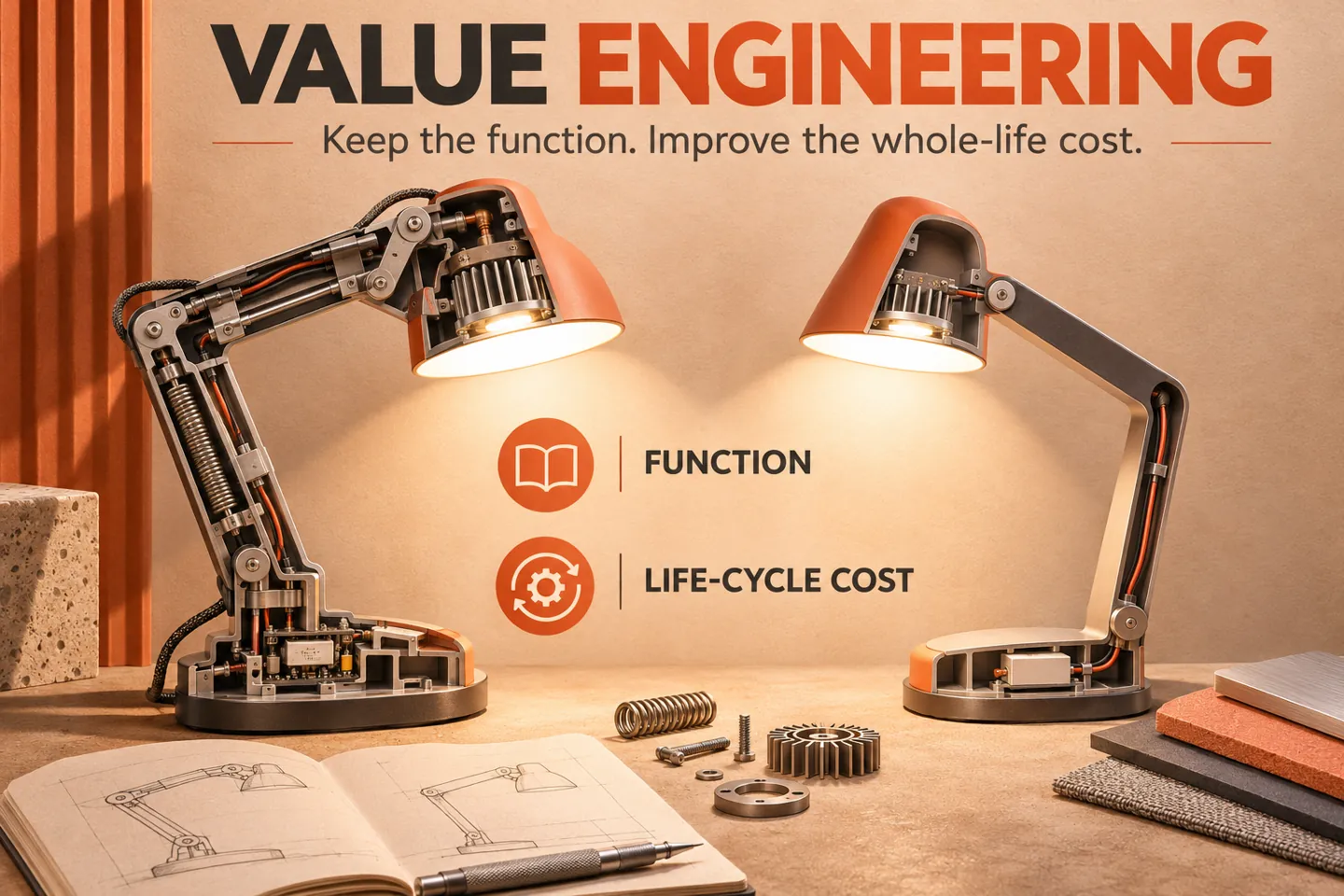
Value engineering is a structured way to improve the value of a product, service or project by examining the function it must perform and the cost of delivering that function. A cheaper design is an improvement only when it still meets the agreed needs for performance, safety, quality and life. The aim is better value, rather than a lower purchase price at any cost.
For example, consider a lamp that must light a desk. Removing its glare shield may save money but make the lamp unsuitable. A simpler joint that passes the same strength and adjustment tests could be a sound alternative. Start with the job the customer needs done, then assess different ways to do it.
Value engineering meaning: function comes before the component
A design describes a chosen solution. A function describes the result that solution must achieve. This distinction creates room for useful alternatives. If the team begins with “buy a cheaper metal bracket”, it has already narrowed the answer. “Support the load” invites a review of shape, material, joining method and even whether a separate bracket is needed.
The function still needs a measurable standard. How much load, for how long, in what environment and with what tolerance? Without those conditions, an apparent saving can simply move a cost to a customer, a maintenance team or a later reporting period. The person who approves the change must understand that trade-off.
Meanwhile, a finance analyst contributes cost evidence and cash-flow analysis. Designers, operations staff, procurement and quality specialists test whether an alternative can actually work. A spreadsheet cannot establish that a component meets a safety standard. Equally, a successful prototype does not prove that a supplier can produce it reliably at the quoted scale.
The function-to-cost relationship
The familiar expression Value = Function / Cost is a useful organising idea. It is not a universal accounting ratio with a standard rupee numerator. Teams must define how they judge function and which costs belong in the comparison. A score without clear criteria can give a weak option a misleading appearance of precision.
| Change | Possible effect on value | What must be checked |
|---|---|---|
| Same required function, lower relevant cost | Value may improve. | Durability, maintenance, quality and transition cost remain acceptable. |
| Better useful function, similar cost | Value may improve. | The improvement matters to the user and is demonstrated. |
| Lower upfront cost, shorter useful life | Value may worsen. | Replacement, downtime and disposal can exceed the initial saving. |
| More features, higher cost | Not automatically better value. | The customer needs the added capability enough to justify its cost. |
Therefore, use the same scope and service period for all options. Otherwise, comparing a five-year part with a two-year part on purchase price alone is unfair. Distinguish a cost reduction from a change in specification. Both may be legitimate business decisions, but they are not the same decision.
A value engineering job plan that leads to a decision
A study needs a disciplined sequence, not just an open meeting about cheaper materials. The Federal Highway Administration job plan includes project selection, investigation, function analysis, creative work, evaluation, development, presentation and close-out. The table translates those phases into practical work products; it is not a claim that every organisation uses identical labels.
| Stage | Practical work product |
|---|---|
| Select and investigate | An agreed scope, baseline cost and user requirement. |
| Analyse functions | A short function statement and measurable acceptance criteria. |
| Generate alternatives | Several ways to meet the requirement before choosing a favourite. |
| Evaluate | A screened list with quality, safety, delivery and cost evidence. |
| Develop | A tested proposal, whole-life cost estimate and implementation plan. |
| Present | A recommendation showing assumptions, owners and trade-offs. |
| Close out | Approval, implementation and a comparison of actual outcomes with the plan. |
Separate idea generation from final approval. Early criticism can suppress a good idea before it is developed. However, enthusiasm is not a substitute for evidence at the approval stage. Keep rejected options and their reasons so that the next team does not repeat the same work.
Where possible, run the review while major design choices are still open. Once equipment is ordered or construction has begun, a change can create delay, rework and contract costs. Value engineering is not restricted to a final round of cuts after a project has exceeded its budget.
Worked value engineering example: a protective shipping insert
The following is a fictional teaching case, not a claimed saving from a real company. A manufacturer ships 10,000 instruments a year. Each pack must protect the instrument under an agreed drop and vibration test, fit the current box and allow safe unpacking. The existing foam insert costs ₹80 per unit. A folded-fibre design is quoted at ₹55 and requires ₹50,000 of one-time tooling and validation.
| Measure | Existing insert | Proposed insert |
|---|---|---|
| Annual quantity | 10,000 | 10,000 |
| Cost per insert | ₹80 | ₹55 |
| Annual insert cost | ₹8,00,000 | ₹5,50,000 |
| One-time change cost | None in this comparison | ₹50,000 |
| First-year relevant cost | ₹8,00,000 | ₹6,00,000 |
| First-year saving before other effects | Baseline | ₹2,00,000 |
The gross unit saving is ₹25. At 10,000 units, that gives ₹2,50,000 a year before the one-time cost. The first-year net saving is therefore ₹2,00,000. With a steady flow of units, the simple payback on ₹50,000 is 2,000 units, or 0.2 years at the assumed volume. This ignores tax, financing and the exact timing of payments.
Now test the proposal rather than stopping at the saving. Suppose damage rises by 0.5 percentage points: that would mean 50 extra damaged shipments at 10,000 units. At a fictional replacement and service cost of ₹4,000 each, the added cost is ₹2,00,000. It consumes the entire first-year saving. More importantly, failed protection may breach the non-negotiable requirement, so the option could be rejected even if a spreadsheet still showed a small gain.
Before approval, the team should verify pack time, storage, moisture resistance, supplier capacity and the test results. A limited pilot can help expose practical problems. Only then should finance turn the accepted design into a forecast and record who owns each assumption. Our target costing guide explains how a permitted product cost differs from a proposal to reduce one component’s cost.
Life-cycle cost: the cheapest asset can be the expensive choice
Consider two fictional machines that meet the same output and quality requirement over five years. Machine A costs ₹5,00,000 and needs ₹1,50,000 of annual operating and maintenance cash outflow. Machine B costs ₹6,00,000 and needs ₹1,10,000 a year. Assume year-end operating payments, an 8% annual discount rate and no residual value or other differences.
The five-year annuity factor is (1-(1+8%)^-5)/8% = 3.99271. A’s present cost is ₹5,00,000 + ₹1,50,000 × 3.99271 = about ₹10,98,907. B’s is ₹6,00,000 + ₹1,10,000 × 3.99271 = about ₹10,39,198. On these assumptions, B has the lower present cost by about ₹59,708 despite its higher purchase price.
In addition, a proper case would test output, uptime, energy prices, repairs, resale value and the working capital needed to operate each machine. The discount rate here is an assumption, not a recommended rate for every project. A small change in service life or annual cost can reverse a close decision. The purpose of discounting is a fair timing comparison, not a more impressive-looking answer.
Value engineering, value analysis and cost cutting
| Term | Useful distinction | Practical caution |
|---|---|---|
| Value engineering | Often associated with developing or changing a design. | Check required function and whole-life implications. |
| Value analysis | Often used for a product or process already in use. | The terminology overlaps across organisations. |
| Cost cutting | A broad attempt to reduce spending. | It may remove required capability or defer costs. |
| Target costing | Starts with a market price and required profit to derive an allowable cost. | A target is not proof that a proposed design can achieve it. |
These labels should help a decision, not become an argument about vocabulary. The FHWA FAQ acknowledges overlapping terminology. A review that never examines function is missing a central part of value methodology, whatever the meeting is called.
How a finance analyst should test the saving
- Reconcile the baseline to the actual volume, bill of materials and process cost. A budget standard may differ from current spend.
- Separate recurring cash savings from accounting allocations that will remain. Lower assigned overhead is not always a cash release.
- Include transition costs: tests, tooling, training, downtime, scrap and supplier changes.
- Test lower volumes, shorter life and higher failure rates. Record which assumption changes the recommendation.
- Agree an owner and measurement period for benefits. Compare actual results with the approved case after implementation.
For example, eliminating five minutes from a task may free capacity without reducing payroll. That capacity has value if the business can use it, but it is not automatically a cash salary saving. Similarly, a cheaper input may increase inventory buffers. Link the operating change to the cash-flow line that actually moves.
A practical model should keep the baseline, alternative and sensitivity assumptions separate. The financial model building guide develops that workflow. Learners can also review the Financial Modelling course for structured instruction in forecasting and evaluating business decisions.
Frequently asked questions
Is value engineering just cost cutting?
No. A sound study tests how to deliver a required function more effectively. Cutting cost by breaching safety, quality or agreed service requirements is not an equivalent improvement.
What is a simple value engineering example?
Changing a shipping insert from foam to folded fibre can be an example if the new design passes the same protection requirements and lowers the relevant whole-life cost. The worked case shows why damage costs and testing matter.
Can value engineering increase the initial cost?
Yes. A higher purchase cost can be justified by lower operating cost, longer life or a useful performance improvement. Compare equivalent service and cash-flow timing rather than only the invoice price.
Does it apply outside construction?
Yes. Product design, packaging and service processes can all be reviewed by function and cost. The team and acceptance tests must fit the work; an accounting analyst should not substitute for a qualified technical reviewer.