
If you search for fraud prevention analyst jobs in India, you will notice something odd: almost no Indian employer posts a job under that exact title. Yet the work behind it (spotting deception, monitoring transactions and protecting customers) is one of the fastest-growing hiring areas in Indian banking, NBFCs and fintech.
In this guide, based on the research behind our latest YouTube video, I will explain why these roles are multiplying, what the job is actually called in India, how it differs from AML and KYC work, whether you need an expensive certification, and the exact route I would take depending on where you are starting from.
Why Fraud Roles Are Booming in India: The RBI 2024 Master Directions
On 15 July 2024, the Reserve Bank of India issued revised Master Directions on Fraud Risk Management. There are three separate sets of directions covering commercial banks (including regional rural banks) and all-India financial institutions, cooperative banks, and NBFCs (including housing finance companies). Together they replaced 36 older circulars.
Surprisingly few people talk about what this means for jobs. The directions make it mandatory for regulated entities to:
- Set up data analytics and market intelligence units that continuously monitor financial transactions.
- Strengthen Early Warning Signal (EWS) and Red Flagged Account (RFA) frameworks, with EWS integrated into core banking and operational systems.
- Extend early warning systems to non-credit transactions, not just loans.
- Put the Board at the centre of fraud risk oversight through an approved Fraud Risk Management Policy.
This is not a suggestion. It is a regulatory requirement, and every one of those units needs people who can monitor alerts, investigate them and escalate them properly. That is the structural reason fraud-related hiring has arrived in such a large wave.
Is “Fraud Prevention Analyst” a Real Job Title in India?
Not really. “Fraud prevention analyst” is largely a US umbrella term. Indian banks, global capability centres and fintechs hire for this work under different titles, and when you open those job descriptions you often find the day-to-day work is not labelled “prevention” at all.
When we searched LinkedIn India for our video, this is what the numbers looked like:
| Job title searched on LinkedIn India | Openings found |
| Fraud Analyst | 629 |
| KYC Analyst | 197 |
| AML Analyst | 127 |
| Fraud Prevention Analyst | Not a meaningful standalone category |
Note: these are point-in-time LinkedIn search results from our research and will change daily. Use them to understand the relative size of each market, not as exact figures.
Three different titles, three different numbers, and “fraud prevention analyst” is not one of them. That is where the confusion starts. If you only search the US title, you will miss most of the real openings. Search these instead:
- Fraud Analyst / Fraud Operations Analyst
- Transaction Monitoring Analyst
- Fraud Investigation Analyst
- Financial Crime Operations Analyst
- KYC Analyst and AML Analyst
Read the Job Description, Not the Title: The Wise Example
Titles in this field are often broad. Take Wise, the global fintech that many aspiring AML professionals want to join. It advertised a role called Financial Crime Operations Senior Analyst. The title sounds like one job, but the description says the analyst escalates suspicious activity to the AML team and the fraud team, which are two separate downstream functions.
So even when a company uses an umbrella title, the actual work splits into two distinct streams. Before you apply anywhere, read the responsibilities section and ask: am I being hired to catch money laundering, to catch deception, or to triage for both?
Fraud Analyst vs AML Analyst vs Financial Crime Analyst
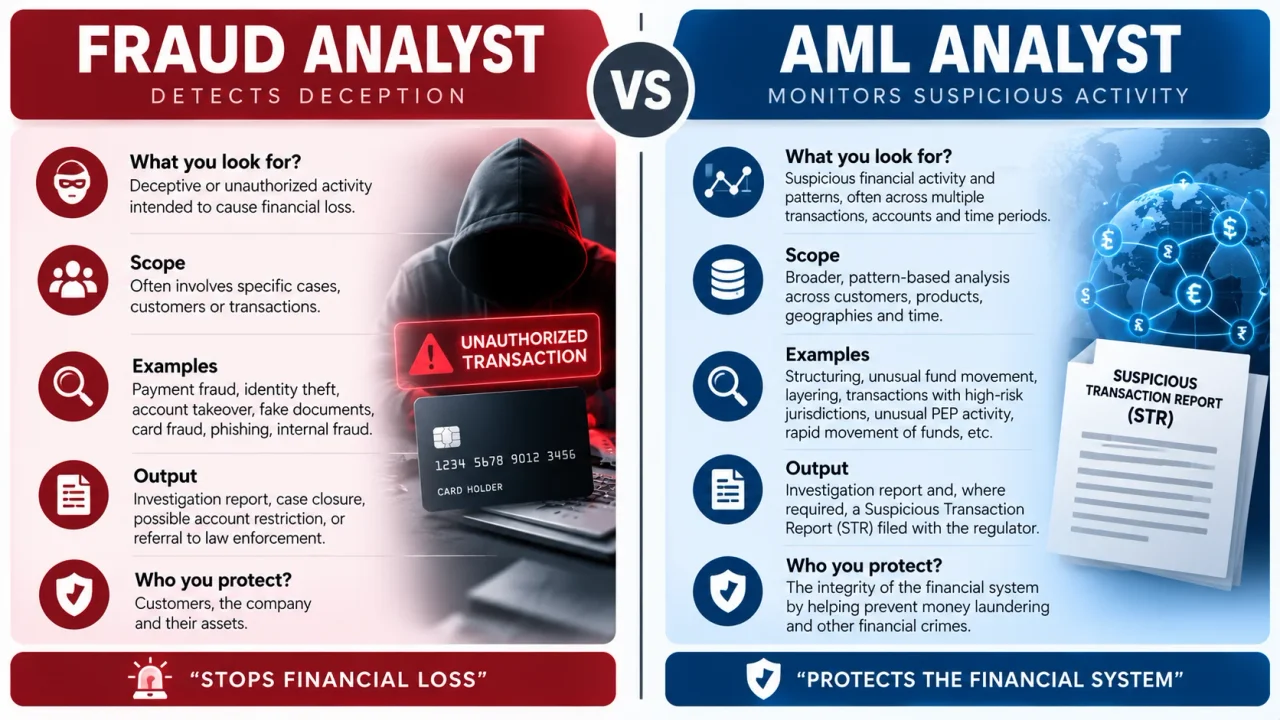
AML analyst. Your job is to filter transactions and identify those that look suspicious from a money-laundering or terrorist-financing perspective. The key output is a Suspicious Transaction Report (STR), which in India is filed with FIU-IND. The purpose is to protect the integrity of the financial system itself. We have covered this role in depth in our guide to the AML analyst role, skills and career path.
Fraud analyst. The scope is narrower but more varied. You are looking for deception, which may involve account transactions but may equally involve the customer’s identity (impersonation, synthetic identities, account takeover) or internal fraud by employees. The purpose is to protect the customer and the institution from loss. A useful mental model here is the fraud triangle of pressure, opportunity and rationalisation, which explains why fraud happens and where controls should sit.
Financial crime analyst. This is not really a separate entry-level role. It is a progression role. Senior profiles typically cover both fraud and AML, and that combined remit is what the market calls a financial crime analyst.
| AML Analyst | Fraud Analyst | Financial Crime Analyst | |
| Core question | Is this money being laundered? | Is someone being deceived? | Both, at a senior level |
| Main output | Suspicious Transaction Report (STR) | Fraud case, blocked transaction, loss prevention | Escalations and investigations across both |
| Protects | Integrity of the financial system | The customer and the institution | Both |
| Typical entry | KYC/AML operations | Fraud ops; open to varied backgrounds | Progression after 3+ years |
Skills You Need to Get Hired
Entry-level fraud and AML roles are operations roles first. Recruiters look for:
- Pattern recognition: spotting unusual transactions, velocity changes and mismatches between a customer’s profile and behaviour.
- KYC and due diligence basics: CDD, EDD, beneficial ownership, PEP and sanctions screening.
- Clear written documentation: your case notes and escalations are what reviewers and regulators read.
- Regulatory awareness: the RBI directions above, PMLA and the basic reporting obligations.
- Working comfort with Excel and case-management tools, plus the attention to detail to clear alert queues accurately under time pressure.
Do You Need CFE or CAMS to Become a Fraud Analyst?
Most people assume there is a certification gate: CFE for fraud, CAMS for AML. These certifications are not cheap, so it is worth checking the facts before you pay for one.
CFE (Certified Fraud Examiner). According to the ACFE’s own website, the CFE exam application fee is US$480, which covers your first attempt at each exam section. ACFE membership is also required and is charged separately. That is very different from the ₹1–2 lakh figures some Indian training providers quote, which usually bundle in their own coaching fees.
CAMS. We have already published an honest breakdown of what CAMS is, who it is for, what it actually costs and whether freshers should take it. Read our CAMS certification guide before you decide.
What working professionals actually hold. To test the assumption, we reviewed 23 real LinkedIn profiles of people with three to four years’ experience at Genpact, Wipro, TCS, Concentrix, Paytm, Revolut and Wise. Not one of them held CFE or CAMS. Where these certifications do appear consistently is among professionals with ten or more years in AML and fraud.
The conclusion is simple: certification is not the gate through which people enter this field. Relevant operational experience is.
Fraud Analyst Salary in India: Fraud vs AML
Fraud roles have more openings and are more open to candidates from different backgrounds. Even people coming from sales have moved into fraud operations. The trade-off is that entry-level fraud roles, particularly for candidates without relevant experience, can start lower than comparable AML roles.
Over time, however, the gap closes and fraud investigation can pay well. As one example, a Wise listing for Investigator, Financial Crimes showed a salary of roughly ₹9–10 lakh per annum. For freshers entering KYC/AML operations, a realistic starting CTC is around ₹3.5–4 lakh per annum.
Which Route Should You Take? My Recommendation by Profile
If you are a fresher
Do not chase “fraud analyst” or “AML analyst” titles on day one. Aim for any entry role in KYC/AML operations, even if the CTC is ₹3.5–4 lakh. That first year of relevant experience is what qualifies you for the premium fraud, AML and financial crime roles later.
If you have six months to a year of banking experience
Target fraud analyst roles. Many AML openings are restrictive about what counts as relevant experience, and candidates with only domestic branch or retail banking experience are often filtered out quickly. Fraud teams are generally more open to that background.
If you are one to two years into the field
Now CFE or CAMS can start to pay off. But be clear about why you are doing it, because neither is cheap. Ask yourself whether the certification or simply more experience will do more for your next move, and choose accordingly.
How MentorMe Careers Prepares You for These Roles
These entry routes (KYC operations, AML operations and fraud operations) are exactly what our AML/KYC Certification Course is built around. The programme covers KYC and due diligence, transaction monitoring, STR drafting, sanctions screening and interview preparation, and multiple students from the programme have already been placed in these roles.
Frequently Asked Questions
Is fraud prevention analyst a real job title in India?
Rarely. It is mainly a US umbrella term. In India the same work is usually advertised as Fraud Analyst, Fraud Operations Analyst, Transaction Monitoring Analyst, Financial Crime Operations Analyst, or AML/KYC Analyst.
What is the salary of a fraud analyst in India?
Entry-level KYC/AML and fraud operations roles typically start around ₹3.5–4 lakh per annum. Experienced investigators at global fintechs can earn more; one Wise Investigator, Financial Crimes listing showed around ₹9–10 lakh per annum.
Can a fresher become a fraud analyst?
Yes, but the most reliable route for a fresher is an entry role in KYC/AML operations first, followed by a move into fraud or AML analyst roles once you have relevant experience.
Do I need CFE or CAMS to get a fraud analyst job?
No. In our review of 23 professionals with three to four years’ experience, none held CFE or CAMS. These certifications are more common among professionals with ten or more years’ experience and make more sense once you are one to two years into the field.
What is the difference between a fraud analyst and an AML analyst?
An AML analyst identifies suspicious transactions linked to money laundering and prepares Suspicious Transaction Reports, protecting the financial system. A fraud analyst detects deception, including identity fraud, account takeover and internal fraud, protecting customers and the institution.
Why are banks and NBFCs hiring more fraud analysts?
The RBI’s July 2024 Master Directions on Fraud Risk Management made data analytics and market intelligence units and strengthened early warning systems mandatory for banks, cooperative banks and NBFCs, creating ongoing demand for monitoring and investigation staff.
Related Articles
- Anti-Money Laundering Careers in India
- Top AML/KYC Certifications
- AML/KYC Interview Questions
- AML/KYC Jobs in Mumbai
- What Is AML in Banking?
- Stages of Money Laundering: Placement, Layering and Integration
About the author: Allen Aravindan, CFA, is the founder of MentorMe Careers, a BFSI-focused training and placement institute with centres in Pune and Mumbai. He designs the institute’s AML/KYC, financial modelling and investment banking operations programmes

A CFA charterholder with hands-on experience across investment analysis and finance education. At MentorMeCareers, he writes and reviews content on CFA, financial modeling, and investment banking careers — grounded in real market data rather than generic advice, and shaped by what actually helps candidates and professionals succeed.