
Search “ACCA course fees in India” and you’ll see the same range everywhere: ₹2.8 lakh to ₹5.5 lakh. That range is technically correct and practically useless. A ₹2.7 lakh gap is not a budget — it’s a shrug.
The range is wide because three very different things get lumped together: the fees you pay ACCA (fixed, charged in pounds, identical for every student in India), the fees you pay a coaching institute (optional and wildly variable), and the costs you create yourself through late entries and resits (almost entirely avoidable).
In this guide I’ve pulled those three apart. Every ACCA figure below comes from ACCA’s own India fee schedule, converted at ₹128 to the pound. Then I’ve built three realistic total-cost scenarios — after 12th, after B.Com and after CA — so you can find your own number instead of quoting someone else’s range. If you’re still deciding whether ACCA is the right qualification at all, start with our ACCA full form and course overview.
| Quick answerACCA’s own fees — registration, annual subscriptions, exam entry, exemptions and the Ethics module — come to roughly ₹2.75 lakh to ₹3.45 lakh for most Indian students in 2026. Coaching adds ₹60,000 to ₹3 lakh on top if you choose it. Your exact number depends on three things: how many exemptions you get, how many years you stay registered, and whether you clear each paper first time at standard entry. |
ACCA Course Fees in India 2026 at a Glance
Here is every fee ACCA charges a student in India, in pounds and in rupees. These are the non-negotiable costs — no institute can reduce the exam fees themselves.
| Fee component | ACCA fee (GBP) | Approx. ₹ (at ₹128/£) | When you pay |
| Initial registration | £30 (reduced) / £89 standard | ₹3,840 / ₹11,392 | Once |
| Annual subscription (2026) | £140 | ₹17,920 | Every year you are a student |
| Applied Knowledge exams (BT, MA, FA) | Set by CBE centre | ~₹11,000–₹15,000 (est.) | Per paper |
| Corporate and Business Law (LW) | Set by CBE centre | ~₹11,000–₹15,000 (est.) | Per paper |
| Applied Skills (PM, TX, FR, AA, FM) | £151 | ₹19,328 | Per paper, standard entry |
| Strategic Business Reporting (SBR) | £191 | ₹24,448 | Per paper, standard entry |
| Options (any 2 of AFM, APM, ATX, AAA) | £191 | ₹24,448 | Per paper, standard entry |
| Strategic Business Leader (SBL) | £268 | ₹34,304 | Per paper, standard entry |
| Ethics and Professional Skills Module | £83 | ₹10,624 | Once |
| Exemption fee – Applied Knowledge | £84 | ₹10,752 | Per exemption |
| Exemption fee – Applied Skills | £111 | ₹14,208 | Per exemption |
Source: ACCA Global, Fees and charges – India (December 2026 standard-entry rates). Rupee values are indicative and move with the exchange rate.
Why ACCA Fees Are in Pounds — and Why That Matters to You
ACCA is a UK body, so it bills every student in GBP. You pay through your myACCA account with a card, and your bank converts the pounds to rupees on the day you pay. That has two consequences most fee guides skip over.
First, your rupee cost is not fixed. Over the last twelve months the pound has moved from roughly ₹117 to over ₹130. On ₹3 lakh of ACCA fees, a five-rupee move in the exchange rate changes your bill by around ₹12,000. You can’t control the rate, but you can stop treating any rupee figure — including mine — as final.
Second, your bank takes a cut. Regular debit and credit cards typically add a 2–3.5% foreign-currency markup on each payment. Across the whole qualification that’s another ₹6,000–₹10,000 for nothing. A zero-markup forex card fixes this in ten minutes.
The good news is structural: ACCA is pay-as-you-go. You never pay ₹3 lakh at once. You pay a paper at a time, spread over two to four years, which makes ACCA far easier to fund from a salary or family budget than a lump-sum programme.
ACCA Registration Fees in India
The initial registration fee is £89 at the standard rate. ACCA’s India fee page currently shows a reduced registration of £30 (about ₹3,840). Some learning partners also arrange registration waivers for students who sign up through them — ask before you pay it yourself.
Registration is the small number. The one that quietly adds up is the annual subscription of £140 (about ₹17,920), due every January for as long as you remain a student. Four years of subscriptions is ₹71,680 — more than a third of what you’ll spend on all your Applied Skills exams combined.
Miss a subscription payment and ACCA removes you from the student register. Getting back on costs a re-registration fee of £89 (about ₹11,392) plus whatever you owed. It’s an entirely avoidable ₹11,000.
ACCA Exam Fees Per Paper: Structure and Fees
ACCA has 13 exams across three levels, plus the Ethics and Professional Skills Module. How you sit each paper also decides who sets the fee.
| Level | Papers | How you sit it | Fee per paper (standard) |
| Applied Knowledge | BT, MA, FA | On-demand CBE at a centre, any time of year | Centre-set (~₹11,000–₹15,000) |
| Applied Skills | LW | On-demand CBE at a centre | Centre-set (~₹11,000–₹15,000) |
| Applied Skills | PM, TX, FR, AA, FM | Session exam (Mar, Jun, Sep, Dec) | £151 (₹19,328) |
| Strategic Professional – Essentials | SBR | Session exam | £191 (₹24,448) |
| Strategic Professional – Essentials | SBL | Session exam | £268 (₹34,304) |
| Strategic Professional – Options | 2 of AFM, APM, ATX, AAA | Session exam | £191 each (₹24,448) |
Because the four on-demand papers are priced by the computer-based exam centre rather than ACCA, the exact fee varies by city and centre. Our guide to ACCA exam centres in India lists where you can sit them — call two or three before booking and compare.
Standard vs Late Entry: The Most Expensive Mistake in ACCA
Every session exam has a standard entry deadline and a late entry deadline. The exam is identical. The price is not.
| Paper | Standard entry | Late entry | Extra you pay |
| Applied Skills (PM, TX, FR, AA, FM) | £151 (₹19,328) | £387 (₹49,536) | ₹30,208 |
| SBR / Options | £191 (₹24,448) | £430 (₹55,040) | ₹30,592 |
| SBL | £268 (₹34,304) | £430 (₹55,040) | ₹20,736 |
For the December 2026 session, standard entry closes on 2 November 2026 and late entry on 9 November 2026 (23:59 GMT). Miss the standard deadline on two papers and you’ve spent ₹60,000 extra — more than some complete online coaching packages. Put every standard-entry deadline in your calendar the day you register.
ACCA Exemption Fees: They Save Time, Not Much Money
If your degree or qualification covers ACCA’s syllabus, you can be exempted from some papers — but ACCA still charges a fee for each exemption: £84 (about ₹10,752) per Applied Knowledge paper and £111 (about ₹14,208) per Applied Skills paper. There are no exemptions at Strategic Professional level.
Here’s the part most counsellors won’t say out loud. An Applied Knowledge exemption costs roughly the same as simply sitting that exam at a CBE centre. An Applied Skills exemption saves you around ₹5,000 against the ₹19,328 exam fee. So exemptions are not a big money saver on their own.
What exemptions really buy you is time. Fewer papers means fewer years on the register, which means fewer ₹17,920 subscriptions and an earlier start to your career. That’s where the saving shows up.
How many exemptions you get depends on your specific university and programme, not just your degree name. Check yours on ACCA’s exemptions page before you plan anything. We’ve covered the details for B.Com students, for graduates more broadly, and for chartered accountants moving to ACCA.
One practical tip: some higher-tier ACCA Approved Learning Partners run promotional exemption-fee offers for students who register through them. If you qualify for many exemptions — especially as a CA — this can matter more than the coaching price itself. Ask directly.
ACCA Total Fees in India: Three Realistic Scenarios
Ranges don’t help you plan. Scenarios do. Here’s what ACCA itself will charge you across three common starting points.
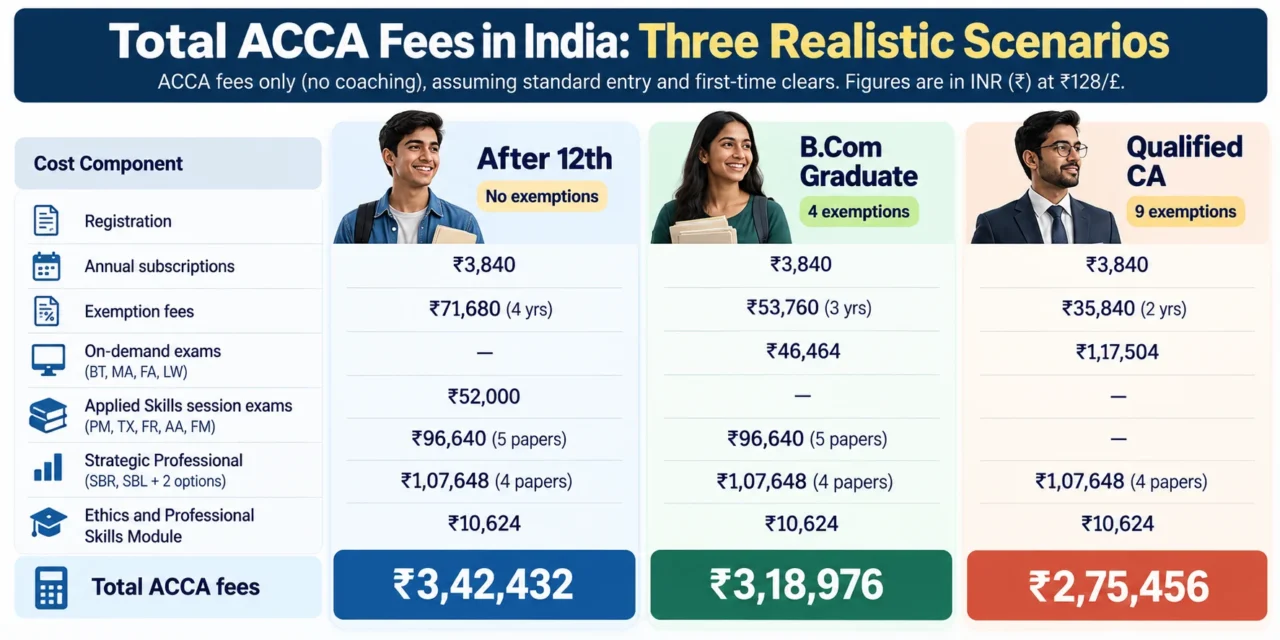
Assumptions: ₹128/£; standard entry; every paper cleared first time; reduced £30 registration; on-demand papers budgeted at ₹13,000 each; ACCA fees only — no coaching, books or forex markup.
| Cost component | After 12th (no exemptions) | B.Com graduate (4 exemptions) | Qualified CA (9 exemptions) |
| Registration | ₹3,840 | ₹3,840 | ₹3,840 |
| Annual subscriptions | ₹71,680 (4 yrs) | ₹53,760 (3 yrs) | ₹35,840 (2 yrs) |
| Exemption fees | — | ₹46,464 | ₹1,17,504 |
| On-demand exams (BT, MA, FA, LW) | ₹52,000 | — | — |
| Applied Skills session exams (5) | ₹96,640 | ₹96,640 | — |
| Strategic Professional (SBR, SBL + 2 options) | ₹1,07,648 | ₹1,07,648 | ₹1,07,648 |
| Ethics and Professional Skills Module | ₹10,624 | ₹10,624 | ₹10,624 |
| Total ACCA fees | ₹3,42,432 | ₹3,18,976 | ₹2,75,456 |
Three things stand out from this table.
- The B.Com saving is small. A graduate with four exemptions pays only about ₹23,000 less than a 12th-pass student — and most of that is one fewer year of subscription, not cheaper exams.
- A CA’s biggest line item is exemptions. At ₹1.17 lakh, exemption fees cost more than all four Strategic Professional exams. This is exactly where a partner’s exemption-fee offer earns its keep.
- Strategic Professional costs the same for everyone. Roughly ₹1.08 lakh plus the Ethics module — no route avoids it.
Now the honest adjustment: very few students clear all their papers first time. A failed Applied Skills paper costs another ₹19,328; a failed SBL costs ₹34,304; and every resit that pushes you into another calendar year adds ₹17,920 in subscription. Strategic Professional in particular is where many students stumble — our take on how hard ACCA really isexplains why. I’d build a ₹40,000–₹60,000 resit buffer into any serious plan.
ACCA Course Fees in India Without Coaching
Self-study is genuinely possible, particularly at Applied Knowledge level. ACCA itself offers free and low-cost online courses through ACCA-X for the early papers, and past papers and examiner reports are available free through ACCA’s study resources.
Your main extra cost is study material. Books and question banks from ACCA’s approved content providers typically add ₹10,000–₹25,000 depending on how many you buy new. That puts a self-study ACCA at roughly ₹3 lakh to ₹3.7 lakh all-in, depending on your scenario above.
My view: self-study is sensible for BT, MA and FA. Where it gets expensive is the Applied Skills papers like FR, AA and FM, and all of Strategic Professional. One failed SBL plus an extra subscription year costs over ₹50,000 — often more than paper-wise coaching for that paper would have. Be selective rather than all-or-nothing.
ACCA Coaching and Online Course Fees in India
Coaching is where the ₹2.8–₹5.5 lakh range really comes from. In 2026, ACCA coaching in India runs from roughly₹60,000 to ₹3 lakh, and the spread is driven by a few factors:
- Full qualification vs paper-wise pricing. Full-programme bundles look cheaper per paper but lock you in; paper-wise lets you pay only where you need help.
- Online vs classroom. Live online batches are usually cheaper than classroom programmes, which carry city overheads.
- Partner status. ACCA Approved Learning Partners (Silver, Gold, Platinum) often charge more — but may bundle registration waivers, exemption offers or official mock exams.
- What’s bundled. Books, mocks, exemption processing and “placement assistance” are sometimes included and sometimes sold separately.
City doesn’t change what ACCA charges — only what institutes charge. If you want a city-specific view, we’ve reviewed options for ACCA classes in Mumbai, ACCA institutes in Chennai and ACCA courses in Ahmedabad.
Before paying any institute, ask these five questions:
- Are you listed in ACCA’s Approved Learning Partner directory, and at what tier?
- Do you offer registration waivers or exemption-fee discounts, and are they in writing?
- Can I pay paper-wise instead of for the full qualification?
- What is your pass rate for the specific papers I’m taking — not an “overall” figure?
- What happens if I fail: is the repeat batch free or charged again?
Hidden ACCA Costs Most Fee Guides Miss
- Forex markup: 2–3.5% on every card payment unless you use a zero-markup card.
- Re-registration: £89 (about ₹11,392) plus arrears if you miss a January subscription.
- Late entry premium: ₹20,000–₹30,000 extra per session paper.
- Resits: a full exam fee each time, plus potentially another subscription year.
- Membership after you qualify: ACCA’s admission fee is £326 (currently shown at a reduced £163), and the annual membership subscription is £326 — about ₹41,700 every year once you’re a member. Budget for this; it doesn’t stop.
ACCA Course Duration and How It Drives Your Cost
Most students take two to four years to clear the exams. To become a full member, you also need 36 months of relevant practical experience, which you can build alongside your exams rather than after them.
Duration matters for fees because of that annual subscription: every extra year on the register is another ₹17,920. Session exams run four times a year — March, June, September and December — so the faster you can sensibly progress, the less you pay.
Realistically: a qualified CA with nine exemptions has four papers plus the Ethics module left and can finish in 12–18 months. A student starting after 12th with all 13 papers should plan for three to three-and-a-half years. Two years from scratch is possible on paper, but it means sitting multiple papers almost every session — and one bad result breaks the plan.
Is ACCA Costlier Than CA?
In fees, yes — by a wide margin. CA’s ICAI fees are charged in rupees and total roughly ₹70,000–₹80,000 across Foundation, Intermediate (including the mandatory IT and orientation training) and Final, before coaching. ACCA’s own fees are about four times that.
But fees are the wrong place to end the comparison. CA involves three years of articleship at a small stipend; ACCA offers exemptions, flexible scheduling and international portability. And CA freshers generally earn more in India. We’ve laid out the full trade-off in ACCA vs CA: the hard truth.
Is ACCA Worth the Fees? My Honest Take
I’ll be direct, because a ₹3–4 lakh decision deserves it. Our own research on ACCA salaries in India shows freshers commonly starting around ₹3–5 LPA — below what ICAI chartered accountants typically command. ACCA’s value is much stronger in markets that recognise it closely, such as the UK and the Gulf, and in Big 4 and shared-services roles built around IFRS reporting.
So the fee is worth it if you’re targeting international accounting, IFRS-heavy roles or an eventual move abroad. If your goal is statutory audit or signing authority in India, CA is the cheaper and stronger route. And if you’re weighing ACCA against a management degree, read our ACCA vs MBA comparison before committing either sum.
How to Reduce Your ACCA Fees: Six Practical Moves
- Always book at standard entry. It’s the single biggest saving you control — up to ₹30,000 per paper.
- Claim exemptions for time, not money — and ask partners about exemption-fee offers, especially if you’re a CA.
- Use the reduced registration window or a partner waiver rather than paying the £89 standard rate.
- Pay with a zero-markup forex card to avoid 2–3.5% on every payment.
- Compress your timeline. Each year you save is ₹17,920 in subscription you don’t pay.
- Self-study the early papers; pay for help where failure is expensive — Applied Skills and Strategic Professional.
Frequently Asked Questions
What are the total ACCA course fees in India?
ACCA’s own fees come to roughly ₹2.75 lakh to ₹3.45 lakh in 2026, depending on your exemptions and years of registration. With coaching and study material, most students spend between ₹3.5 lakh and ₹6 lakh all-in.
What is the ACCA registration fee in India?
The standard initial registration is £89, and ACCA’s India page currently shows a reduced £30 (about ₹3,840). On top of that you pay an annual subscription of £140 (about ₹17,920) every year you remain a student.
What are ACCA exam fees per paper?
At standard entry: Applied Skills papers are £151 (about ₹19,328), SBR and the options are £191 (about ₹24,448), and SBL is £268 (about ₹34,304). BT, MA, FA and LW are priced by the CBE centre, typically around ₹11,000–₹15,000.
What are the ACCA course fees in India after 12th?
A student starting after 12th with no exemptions will pay about ₹3.4 lakh in ACCA fees if every paper is cleared first time at standard entry, before coaching and books.
Is ACCA costlier than CA?
Yes. ACCA’s fees total around ₹3 lakh; CA’s ICAI fees are roughly ₹70,000–₹80,000 before coaching. The right choice depends on where you want to work, not just the fee.
Can I get ACCA for free?
Not entirely. ACCA’s registration, subscription and exam fees must be paid. What can be close to free is the tuition: ACCA-X courses, free past papers and self-study cover the early papers well. Registration waivers and exemption-fee offers through learning partners can also cut the bill.
Can I complete ACCA in 2 years?
With significant exemptions — for example as a qualified CA — yes, comfortably. From 12th with all 13 papers, two years is possible but very aggressive. Plan for three to three-and-a-half years, and remember membership also needs 36 months of practical experience.
What is an ACCA salary in India?
Freshers in India commonly start around ₹3–5 LPA, with stronger pay in Big 4, IFRS reporting roles and overseas markets. See our detailed ACCA salary in India analysis.
Do ACCA fees differ by city in India?
No. ACCA charges the same GBP fees across India. Only coaching fees — and the centre-set fees for on-demand papers — vary by city.
Planning Your ACCA Budget?
The right ACCA budget starts with two questions: how many exemptions you’ll actually get, and which papers genuinely need coaching. If you’d like help mapping both before you spend anything, speak to our ACCA counsellors — we’ll walk through your scenario with real numbers, not a range.
Sources
- ACCA Global – Fees and charges, India (December 2026 standard and late entry rates; registration, subscription, exemption, EPSM and membership fees).
- ACCA Global – Applying for exemptions.
- GBP/INR mid-market rate, mid-September 2026 (approximately ₹128 per £1).

A CFA charterholder with hands-on experience across investment analysis and finance education. At MentorMeCareers, he writes and reviews content on CFA, financial modeling, and investment banking careers — grounded in real market data rather than generic advice, and shaped by what actually helps candidates and professionals succeed.