


Estimated reading time: 13 minutes
Over the last few years, I’ve personally worked with hundreds of students who wanted to become an Investment Banking Analyst. Almost all of them came in with the same belief:
If I do some qualification or degrees and maybe do CFA, I should be able to become an Investment banking analyst.
My Next question to them usually would be, what do you think an investment banking analyst does? As you might have guessed it, the response has a long pause or some gibberish answers.
Investment banking career hiring—especially in India—is not just driven by degrees. It is driven by specific sets of traits or interests which when combined with the right skills makes you eligible and thrive in this industry.
Some of the very common way to identify someone who won’t make it in the industry won’t be able to
- Build a clean Financial model in Excel
- Explain assumptions logically
- Handle time-bound case studies
- Cannot think like an analyst
So in this guide, I’m not going to give bore you with the details which everyone else can tell you, but at the end of this article you should be able to understand
- 👉 What the role actually looks like
- 👉 What companies really test
- 👉 How most candidates fail
- 👉 And how you can realistically break in
Key Takeaways
- The role of an investment banking analyst involves high-stakes financial analysis that influences capital allocation.
- Successful candidates excel in financial modeling, valuation methods, and can handle time-bound case studies.
- Entry-level salaries for investment banking analysts in India vary: ₹10–20 LPA in top-tier firms and ₹3–6 LPA for freshers.
- To prepare, focus on building strong fundamentals, mastering financial modeling and valuation, and practicing case studies.
- Choosing a program that prioritizes practical skills and placements is essential for breaking into the investment banking analyst role.
Who is an Investment Banking Analyst?
An Investment Banking Analyst sits at the core of high-stakes financial decisions, even though they are rarely visible in the final deal. For Example; when a company decides to raise capital, acquire another business, or sell itself, the outcome is not determined in the boardroom—it is determined much earlier through detailed financial analysis.
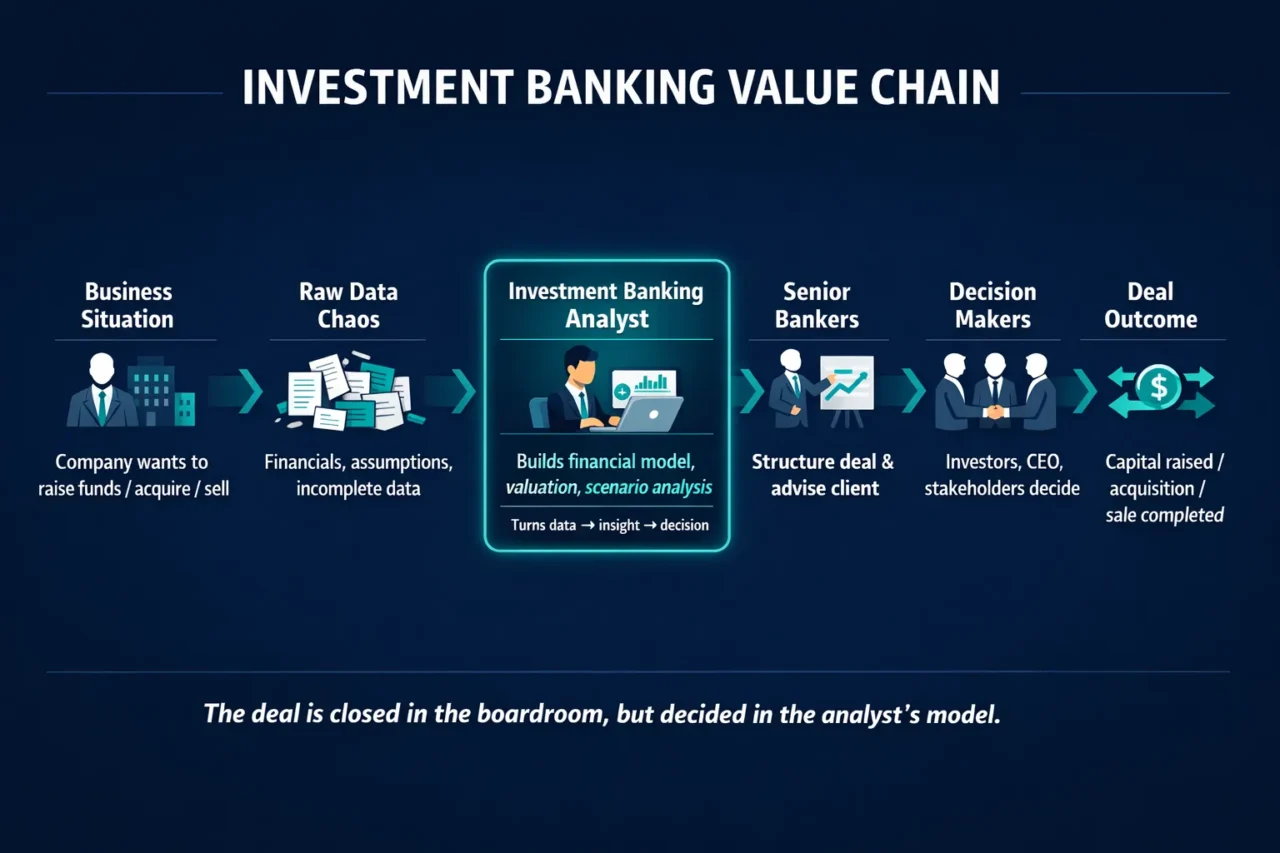
The analyst takes raw, unstructured data and converts it into a structured financial model, tests multiple scenarios, and derives a valuation that ultimately guides decision-making.
Senior bankers may lead negotiations and clients may sign the deal, but the entire process is built on the analytical foundation created by the analyst. In essence, an investment banking analyst operates at the critical intersection of data, insight, and decision—quietly influencing how capital is allocated across businesses and industries.
What Does An Investment Banking Analyst Do? Real Interviews
Instead of relying only on job descriptions, it helps to hear how analysts and candidates describe the work, the interviews, and the pressure in their own words. The patterns below reveal what the role really demands.
What surprised you most about working as an Investment Banking Analyst?
The glamour sits at the surface, but the real work is built on repetition, precision, revisions, and execution quality. This is an operator’s role before it becomes a strategist’s role.
What do recruiters actually expect from candidates?
Technical preparation gets you through the door, but differentiation comes from depth, communication, and credibility. Recruiters want evidence that you can think through real work, not just recite memorized answers.
What part of the hiring process is usually the toughest?
The most difficult stage is usually where theory meets pressure: valuation logic, accounting linkages, case-study thinking, and time-bound execution. This is where preparation quality becomes visible.
What do candidates underestimate in interviews?
Candidates often over-focus on technicals and underprepare their narrative. Firms are also testing commitment, maturity, and whether your motivation for the role is real, specific, and sustainable.
How should candidates prepare effectively?
Real understanding shows up in simplicity. If you cannot explain DCF, dilution, or working capital without jargon, you probably do not understand the concept deeply enough for a demanding interview.
What is the work culture like in investment banking?
The upside is high, but so is the demand on your time and attention. The role rewards ownership, stamina, responsiveness, and the ability to stay sharp even when the pressure compounds.
The Pattern Is Hard to Ignore
Across all six interviews, the same themes keep surfacing: execution, technical sharpness, communication, fit, and pressure handling. That is exactly why anyone targeting this role has to prepare beyond textbook finance. The industry does not just reward knowledge. It rewards the ability to apply it cleanly, explain it clearly, and deliver it under pressure.
Investment Banking Analyst Job Description
An Investment Banking Analyst supports capital raising, mergers and acquisitions, valuation, financial modeling, and transaction execution. The role combines Excel-based analysis, business research, valuation work, and presentation building to help companies make high-stakes financial decisions.
What Does an Investment Banking Analyst Do?
An Investment Banking Analyst works on live transactions and strategic assignments involving mergers, acquisitions, fundraising, debt, equity, and business valuation. In practical terms, the analyst turns raw financial data into structured models, decision-ready analysis, and client-facing presentations.
Key Responsibilities
- Build and maintain financial models including 3-statement models, DCF models, and valuation comparables.
- Support M&A, private equity, debt, and equity fundraising transactions.
- Prepare pitch books, investor presentations, information memorandums, and management presentations.
- Conduct company, industry, and market research to support live deals and strategic recommendations.
- Analyze historical financial statements, operating drivers, margins, and business performance trends.
- Assist senior bankers in transaction execution, client communication support, and due diligence preparation.
- Prepare sensitivity analysis, scenario analysis, trading comps, and precedent transaction analysis.
- Organize data rooms, transaction materials, and internal deal documentation.
Why This Role Matters
Investment Banking Analysts sit near the center of the decision-making chain. Their analysis helps determine valuation, pricing, deal feasibility, investor messaging, and financial strategy. Although they are rarely the visible face of the transaction, much of the deal logic is built on their work.
Investment Banking Analyst Salary in India
The Investment Banking Analyst salary in India varies widely depending on the type of firm, location, and the candidate’s skill level. At top-tier global investment banks, entry-level analysts can earn between ₹10–20 LPA, while mid-market firms and boutique investment banks typically offer salaries in the range of ₹6–12 LPA. For freshers entering through KPOs or support roles, the starting salary may range from ₹3–6 LPA. However, compensation grows rapidly with experience and performance, often doubling within 2–3 years as analysts gain deal exposure and technical expertise. In addition to base salary, many roles also include performance bonuses linked to transaction activity. Overall, investment banking remains one of the highest-paying finance careers in India, especially for candidates with strong financial modeling, valuation, and execution skills.
Entry-Level Salary (India)
- Tier 1 IB Firms: ₹10 – ₹20 LPA
- Mid-sized firms / KPOs: ₹5 – ₹10 LPA
- Entry-level roles: ₹3 – ₹6 LPA
Growth Potential
- 2–3 years: ₹12 – ₹25 LPA
- Associate level: ₹20 – ₹40 LPA
The key driver of salary is skills and deal exposure, not just your degree.
Essential Investment Banking Analyst Skills
Investment Banking Analyst skills include a combination of technical expertise, analytical thinking, and clear communication. Analysts are expected to be proficient in financial modeling, valuation methods such as discounted cash flow (DCF) and comparable company analysis, and have a strong understanding of accounting and financial statements. Advanced Excel skills are critical, as much of the role involves building structured models to support real-world transactions. In addition, strong problem-solving ability, attention to detail, and the capacity to work under tight deadlines are essential for handling deal execution. Equally important is the ability to present insights clearly through pitch decks and explain financial concepts in simple terms during interviews and client discussions. According to practical training frameworks followed by institutes like MentorMeCareers, candidates who combine technical accuracy with real case study exposure and interview readiness are significantly more likely to succeed in investment banking roles.
A strong investment banking analyst combines technical capability, analytical judgment, and communication precision. The three skill areas below form the foundation of success in valuation, deal execution, and client-facing work.
Technical Skills
Technical skills form the execution backbone of an investment banking analyst’s role and are essential for building models, valuing businesses, and interpreting financial performance accurately.
- Financial Modeling
- Valuation (DCF, comps, transactions)
- Accounting fundamentals
- Excel proficiency
Analytical Skills
Beyond technical knowledge, analysts need the ability to interpret numbers, understand how businesses operate, and solve financial problems in a structured, logical way.
- Data interpretation
- Business understanding
- Problem-solving
Communication Skills
Since analysts support client materials and senior bankers, communication skills matter just as much as technical ability. Clear presentation and concise explanation help turn analysis into action.
- Presentation skills
- PowerPoint structuring
- Client communication
Investment banking Analyst Requirements: Education
The education requirements for an Investment Banking Analyst typically include a strong foundation in finance, accounting, or economics. Most candidates come from backgrounds such as B.Com, BBA, BA Economics, or pursue advanced qualifications like CA, CFA, or an MBA in Finance. However, while formal education provides theoretical knowledge, recruiters place increasing emphasis on practical skills such as financial modeling, valuation, and real-world case study experience. Candidates with internships in investment banking, equity research, corporate finance, or related fields have a clear advantage. In today’s hiring landscape, a combination of academic qualifications and hands-on training is considered ideal, as firms look for candidates who can apply concepts effectively rather than just understand them.
Investment Banking Career Path Step By Step
Here’s a realistic roadmap for an investment banking career you can follow in India.
Step 1: Build Strong Fundamentals (2–3 weeks)
- Accounting basics
- Financial statements
Step 2: Learn Financial Modeling (4–6 weeks)
- 3-statement models
- Forecasting
Step 3: Master Valuation (2–3 weeks)
- DCF
- Comparable analysis
Step 4: Practice Case Studies (2–3 weeks)
- Real company analysis
- Time-bound Excel tests
Step 5: Interview Preparation (2 weeks)
- Technical questions
- Mock interviews
You can become job-ready in 60–90 days with focused effort.
Investment Banking Analyst vs Other Finance Roles
| Role | Focus Area | Skill Requirement | Salary Growth |
|---|---|---|---|
| Investment Banking Analyst | Deals & valuation | Very high | Very high |
| Equity Research Analyst | Stock analysis | High | High |
| FP&A Analyst | Budgeting & planning | Moderate | Moderate |
Investment Banking is the most demanding, but also the most rewarding.
Investment Banking Analyst FAQs
These answers cover the most common questions about the Investment Banking Analyst role, including career scope, salary, qualifications, skills, and job readiness.
Is investment banking a good career in India?
Yes, investment banking is considered one of the most rewarding finance careers in India, both in terms of compensation and long-term growth. It offers exposure to mergers and acquisitions, capital markets, and high-impact business decisions. Professionals in this field often experience faster salary growth compared to other finance roles and gain opportunities to transition into private equity, venture capital, or corporate strategy. However, it is also a demanding career with long working hours and high performance expectations, so it is best suited for individuals who are comfortable working under pressure and handling complex financial work.
Can a fresher become an Investment Banking Analyst?
Yes, a fresher can become an Investment Banking Analyst, but it is not purely degree-driven. Recruiters typically look for candidates who have strong practical skills such as financial modeling, valuation, and Excel proficiency. Freshers who have completed internships, worked on real case studies, or undergone structured training programs have a significantly higher chance of getting shortlisted. In most cases, freshers enter through mid-sized firms, boutique investment banks, or KPOs before moving to larger roles as they gain experience.
Is CFA required for investment banking?
No, the CFA qualification is not mandatory for investment banking roles. However, it can add value by strengthening your understanding of finance, valuation, and investment concepts. Recruiters usually prioritize practical skills such as financial modeling, deal understanding, and interview performance over certifications. Many successful candidates enter investment banking without CFA but with strong technical preparation and relevant experience.
How difficult is investment banking as a career?
Investment banking is challenging, both in terms of skill requirements and work environment. The role demands strong technical knowledge, attention to detail, and the ability to work long hours under tight deadlines. Analysts are expected to deliver high-quality work with minimal errors, often under pressure. However, with structured preparation focused on financial modeling, valuation, case studies, and interview practice, the role becomes achievable even for freshers. The difficulty lies not only in the concepts, but in the level of execution expected.
What is the starting salary of an Investment Banking Analyst in India?
The starting salary of an Investment Banking Analyst in India varies based on the type of firm and the candidate’s skill level. Entry-level roles in KPOs or smaller firms typically offer ₹3–6 LPA, while mid-sized investment banks and boutique firms offer ₹6–12 LPA. Top-tier global investment banks can offer ₹10–20 LPA or higher for highly skilled candidates. In addition to base pay, performance-based bonuses can significantly increase total compensation in deal-heavy environments.
What skills are most important for getting hired in investment banking?
The most important skills include financial modeling, valuation techniques such as DCF and comparable company analysis, accounting fundamentals, and advanced Excel proficiency. In addition, candidates must have strong analytical thinking, attention to detail, and the ability to explain financial concepts clearly. Communication skills are equally important because analysts are involved in preparing presentations and supporting client discussions. Recruiters consistently prioritize candidates who can demonstrate practical application of these skills through case studies, internships, or relevant project work.
How long does it take to become job-ready for investment banking?
With focused preparation, a candidate can become job-ready for investment banking in around 2–3 months. This usually involves learning financial modeling, valuation, practicing real company case studies, and preparing for technical and fit interviews. The timeline depends on consistency, the depth of practice, and the quality of training. Candidates who actively build models and simulate interview scenarios tend to become job-ready much faster than those relying only on theory.
What are the exit opportunities after working as an Investment Banking Analyst?
Investment banking opens doors to several high-growth career paths. Common exit opportunities include private equity, venture capital, hedge funds, corporate finance, and strategy roles. Many professionals also move into leadership positions within finance over time. Because of the technical training, transaction exposure, and business understanding it provides, investment banking is considered one of the strongest starting points for long-term careers in finance.
Conclusion
Becoming an Investment Banking Analyst is not about having the perfect degree — it’s about having the right skills.
If you focus on:
- Financial modeling
- Valuation
- Case studies
- Interview preparation
You can break into this field even as a fresher.
The finance industry rewards those who are practically skilled and job-ready — and that’s exactly what you should aim for.
Next Step
If you’re serious about becoming an Investment Banking Analyst:
- Learn the right skills
- Practice consistently
- Prepare for interviews
And most importantly — choose a program that focuses on placements, not just theory.
Related Articles

A CFA charterholder with hands-on experience across investment analysis and finance education. At MentorMeCareers, he writes and reviews content on CFA, financial modeling, and investment banking careers — grounded in real market data rather than generic advice, and shaped by what actually helps candidates and professionals succeed.