
Last updated on November 16th, 2026 at 02:11 pm
The difference between factoring and bill discounting is the financing structure and service—not simply when an invoice becomes due. Factoring involves assignment of receivables and can include collection or ledger services. Bill discounting generally advances money against a bill or eligible trade receivable before maturity. The contract determines recourse, charges and collection duties.
A sale can create revenue today and cash several weeks later. Meanwhile, the supplier must buy stock, pay staff and meet other obligations. Both arrangements can bridge that working-capital gap, but the cash received upfront, responsibilities and remaining risks may differ. Compare the actual agreement rather than relying on the product label.
Difference between factoring and bill discounting: comparison table
| Point to compare | Factoring | Bill discounting |
|---|---|---|
| Core arrangement | Acquisition or financing against assigned receivables under the agreement | Finance against an eligible bill or trade receivable, typically before its due date |
| Additional services | May include collections, ledger administration and credit-management support | Usually focuses on the financing transaction; verify any servicing duties |
| Scope | Can cover selected receivables or a broader portfolio | Often relates to identified bills or invoices |
| Buyer notification | Depends on the structure; do not assume every facility is confidential | Depends on the instrument, platform and contractual process |
| Who bears non-payment risk? | Can be with or without recourse; exclusions matter | Check the terms; conventional recourse assumptions do not describe every platform arrangement |
| How cost is quoted | May separate finance charges, service fees and other charges | May deduct a discount and add processing or other charges |
| Decision that matters | Which receivables, services and risks are transferred? | What is financed, when is cash received, and who must pay if settlement fails? |
This table is a framework, not a claim that every provider offers the same product. In India, the Factoring Regulation Act defines the assignment framework. Product marketing may use overlapping terms, so the legal documents and applicable rules take precedence over a two-column slogan.
What is factoring?
A business assigns eligible receivables to a factor under an agreement. The factor may advance funds, collect from the debtor and settle any remaining balance after agreed charges. The exact package can include services beyond financing. It need not mean that the factor buys every invoice the business has issued.
The assignor is the business transferring the receivable, the assignee is the factor receiving it, and the debtor is the buyer who owes the payment. Keep those roles separate from the movement of cash. Assignment changes rights under the arrangement; the amount and timing of the advance are commercial terms to inspect.
Recourse versus non-recourse factoring
With recourse, the seller may have to reimburse or repurchase a receivable when the buyer does not pay under the contract’s conditions. Without recourse, the factor assumes the specified credit risk. That phrase does not remove every possible seller obligation: disputes, fraud, documentation breaches or ineligible invoices can be treated separately.
Ask a precise question: “If this named buyer fails to pay this eligible invoice for this reason, who bears the loss under which clause?” A salesperson saying “risk transferred” is not a substitute for reading the risk definition and exclusions. RBI’s guidance on factoring services by banks recognises the distinction between recourse and without-recourse structures.
What is bill discounting?
In a conventional bill-discounting arrangement, a financier provides funds before the bill’s due date and deducts an agreed discount. The bill, acceptance, trade documents and facility terms matter. Invoice-based digital arrangements may use different operational terminology; do not assume the existence of a physical bill in every case.
For a simplified example, a ₹1,00,000 bill is payable in 60 days. If a hypothetical financier applies a 12% annual simple discount on face value using a 365-day basis, the discount is ₹1,00,000 × 12% × 60 / 365 = ₹1,972.60. Before other charges, the seller receives ₹98,027.40 now. The example is not a current market quote.
A complete cash-flow example: factoring is not just an advance percentage
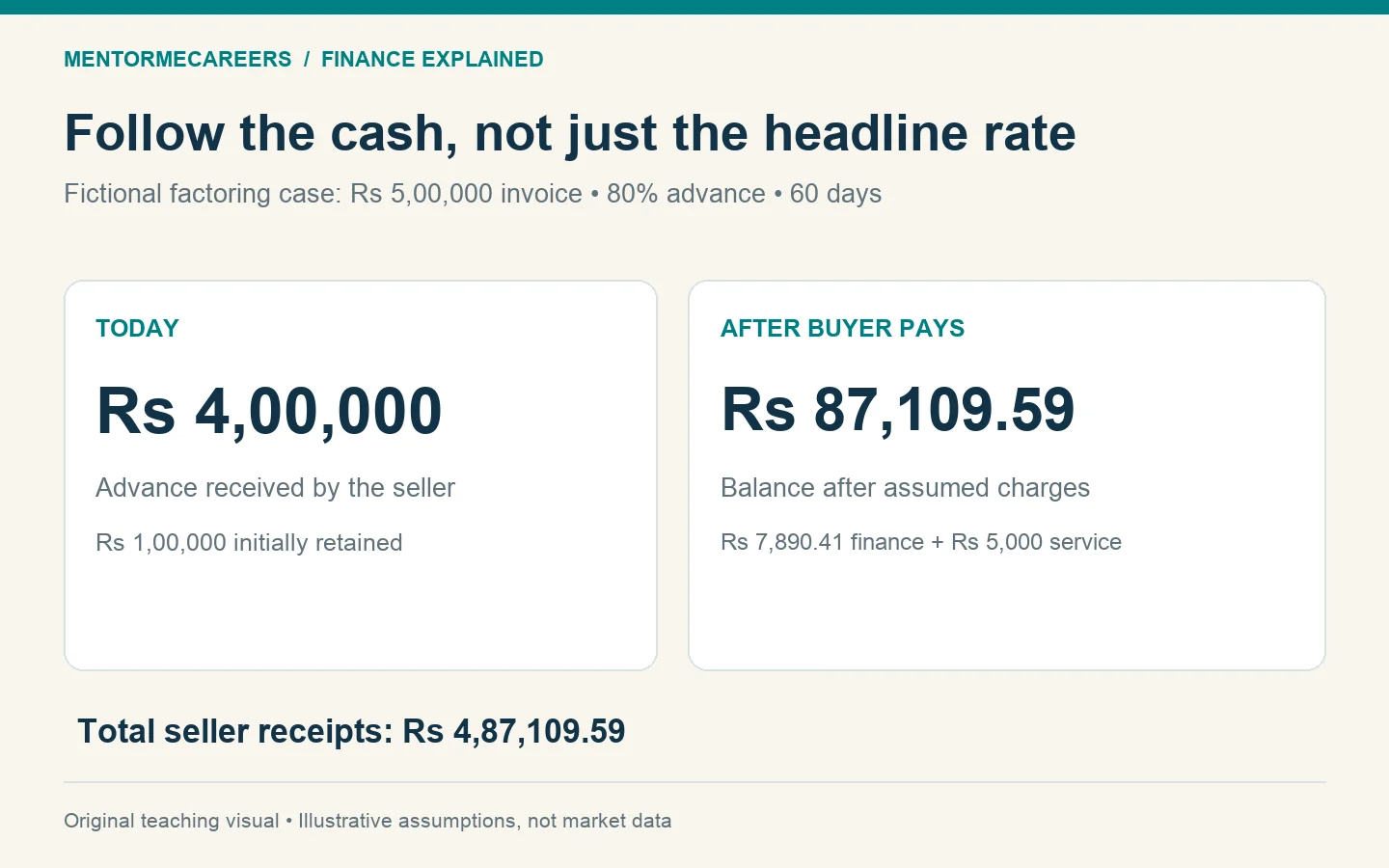
Consider a separate fictional ₹5,00,000 invoice due in 60 days. Assume a factor advances 80%, charges finance at 12% a year on that advance for the full 60 days using a 365-day basis, and deducts a service fee of 1% of invoice face value. Assume both charges are taken from the retained balance at final settlement. Ignore tax, extra fees and delays to isolate the mechanics.
| Item | Calculation | Amount |
|---|---|---|
| Invoice face value | Given | ₹5,00,000.00 |
| Cash advanced today | ₹5,00,000 × 80% | ₹4,00,000.00 |
| Retained balance before fees | ₹5,00,000 − ₹4,00,000 | ₹1,00,000.00 |
| Finance charge | ₹4,00,000 × 12% × 60 / 365 | ₹7,890.41 |
| Service charge | ₹5,00,000 × 1% | ₹5,000.00 |
| Final payment to seller after buyer pays | ₹1,00,000 − ₹7,890.41 − ₹5,000 | ₹87,109.59 |
| Total seller receipts | ₹4,00,000 + ₹87,109.59 | ₹4,87,109.59 |
The ₹1,00,000 holdback is not automatically a ₹1,00,000 fee. In this example, most of it returns after the buyer pays. Equally, the ₹4,00,000 advance is not the seller’s full economic proceeds. Trace both dates before comparing two offers.
Compare financing offers on the same basis
Suppose the same ₹5,00,000 face value were discounted for 60 days at a hypothetical 12% annual simple rate on face value. The discount would be ₹9,863.01 and initial proceeds ₹4,90,136.99, before other fees. That gives more cash immediately than the factoring example, but it is not an equivalent package: the financing amount, service scope, recourse and settlement structure differ.
For the small ₹1,00,000 bill above, the 60-day financing cost relative to cash received is ₹1,972.60 / ₹98,027.40 = 2.0123%. Simple annualisation gives about 12.24%, and repeated 60-day compounding would imply about 12.89%. These are analytical comparisons under the stated assumptions, not a regulatory APR disclosure or an offered return.
The difference between factoring and bill discounting becomes clearer in a dated cash-flow schedule. Compare the net cash received on each date, all charges, day-count basis, delayed-payment treatment and responsibilities. A lower headline rate applied to a larger base can cost more. A service fee may also cover collection work that another quote leaves with your team.
What affects factoring cost and eligibility?
An invoice’s face value is only the starting point. A financier also needs to assess whether the buyer will pay, whether the receivable is genuine and how long funds will remain outstanding. A quoted rate is therefore not an offer available to every business.
| Factor | What to examine | Why it matters |
|---|---|---|
| Buyer creditworthiness | Payment history, financial strength and concentration in one customer. | The expected ability to collect influences the financier’s risk assessment. |
| Payment tenor | Days until payment and charges if settlement is delayed. | At the same simple daily rate and financed amount, more days mean a higher finance charge. |
| Advance percentage | Cash released now, the retained balance and when that balance is released. | A lower advance means less usable cash; compare offers on the same cash-and-date basis. |
| Acceptance and disputes | Buyer acceptance, delivery evidence, credit notes and existing assignments. | Disputed or unverifiable receivables can delay or prevent funding. |
| Services and risk allocation | Collections, ledger work, recourse and exclusions. | A finance-only quote and a service-inclusive quote are not directly comparable. |
The British Business Bank’s invoice-finance guide explains the distinction between funding and collection services in the UK context. For Indian TReDS transactions, use the RBI directions for the local process: invoices or bills are uploaded, accepted and offered for financier bids, with checks on their genuineness. Meeting a platform’s onboarding requirements is not a guarantee that every invoice will receive funding.
Where TReDS fits in India
TReDS is a platform framework for financing MSME trade receivables through multiple financiers. It is not evidence that “factoring” and “discounting” are always mutually exclusive. The RBI’s Trade Receivables Discounting System Directions, 2026 define a factoring unit using an invoice or bill, and state that discounted units are without recourse to sellers. The platform itself does not take responsibility for buyer default.
This is why a blanket statement that all bill discounting is with recourse is unsafe. Distinguish a conventional bank facility from a transaction governed by TReDS rules. The actual acceptance, assignment, bidding and settlement process still matters. Never finance the same receivable twice or assume a platform eliminates operational and documentation risks.
Invoice discounting, reverse factoring and forfaiting
Invoice discounting commonly describes financing against invoices, sometimes with the seller continuing to manage collections. The term is not a universal guarantee of confidentiality or a single legal structure. Reverse factoring generally begins from the buyer side of an approved-payables arrangement. Check which party initiates the transaction and whose payment obligation is assessed.
Forfaiting is commonly associated with purchasing export receivables without recourse, often for a different tenor and documentation structure. It should not be treated as another name for every short-term domestic invoice facility. Compare the actual instrument, currency, risk cover and jurisdiction before extending a textbook definition to a transaction.
Risks an analyst should examine before recommending either route
- Genuine receivable: reconcile the invoice to delivery, acceptance and the customer ledger.
- Disputes and dilution: identify credit notes, returns, set-offs and amounts the buyer contests.
- Concentration: one large buyer can dominate the facility even if there are many invoices.
- Recourse triggers: distinguish credit default from breaches of warranties or documentation requirements.
- Cost under delay: ask what happens if settlement occurs 30 days later than expected.
- Existing security: check charges, assignments and required consents with the responsible professionals.
To apply the difference between factoring and bill discounting in practice, link the funding decision to the working-capital cycle. A company can report profit and still face a cash shortage. Our sources of working capital guide compares funding routes, while credit control explains how collection policy influences the cash gap.
A useful interview answer
“Both can release cash tied up in trade receivables. Factoring is an assignment-based arrangement that may include collections or ledger services, while bill discounting focuses on finance against an eligible bill or receivable. I would compare advance amount, charges, collection duties, recourse and settlement terms. I would also separate conventional facilities from TReDS rather than assume all discounting carries the same risk.”
To turn that answer into practical analysis, build a dated cash-flow schedule and reconcile invoice face value to total receipts and charges. That is a useful exercise alongside the financial modelling course. It develops an explainable decision rather than memorising a comparison table.
Factoring and bill discounting: frequently asked questions
What is the main difference between factoring and discounting bills?
Factoring combines assignment-based receivables financing with the services agreed in the contract. Bill discounting focuses on advancing cash against an eligible bill or receivable before maturity. Compare the documents, risk allocation and servicing duties; timing alone does not distinguish them.
What are the two types of factoring?
Recourse and non-recourse are two important categories based on the specified credit risk. Other distinctions include disclosed versus undisclosed and domestic versus cross-border arrangements. Those classifications answer different questions and should not be mixed.
What is bill discounting with an example?
Using fictional terms, a ₹1,00,000 bill due in 60 days discounted at 12% a year on a 365-day basis produces ₹98,027.40 before other charges. The buyer’s later payment and the seller’s remaining obligations depend on the facility terms.
Is factoring always more expensive?
No universal comparison is justified without quotes. Calculate the total charges for the same dates and cash available, then compare services and risk allocation. The cheapest headline percentage may not be the lowest economic cost.
Is bill discounting automatically off the balance sheet?
No. Accounting depends on the actual terms and the applicable financial-reporting framework, including the treatment of transferred risks and obligations. A product label alone does not determine derecognition. Obtain an assessment for the specific transaction.

A CFA charterholder with hands-on experience across investment analysis and finance education. At MentorMeCareers, he writes and reviews content on CFA, financial modeling, and investment banking careers — grounded in real market data rather than generic advice, and shaped by what actually helps candidates and professionals succeed.