

Last updated on November 5th, 2026 at 03:58 pm
An economic system is the set of rules, institutions and decisions through which a society produces goods, uses scarce resources and distributes output. It determines who owns productive assets, who makes choices and how people obtain what is produced. The main teaching models are traditional, command, market and mixed economies.
Start with the decisions, rather than memorising country labels. A private shop, a public hospital and a household all make economic choices. However, their objectives, budgets and decision rights differ. This guide uses one fictional town to show how those differences work.
What every economic system must decide
Scarcity means that available time, land, skills and capital cannot satisfy every competing use at once. Therefore, a society must choose what to produce, how to produce it and for whom to produce it. Investment also determines how much capacity will be available in the future.
| Decision | Practical question | Trade-off |
|---|---|---|
| What? | Use land for housing, farming or a school? | More of one use leaves less land for another. |
| How? | Use more machines or more labour? | Compare cost, output, skills and environmental effects. |
| For whom? | Allocate housing by price, need or an eligibility rule? | Different rules produce different access. |
| Future capacity | Consume today’s output or invest part of it? | Current consumption competes with future production. |
In a market economic system, a price can help coordinate a decision, but it does not answer every social question. For example, a household may need safe housing without having the income to buy it. Equally, a public allocation rule needs a workable budget, reliable information and a way to monitor delivery.
Economic system versus economic sector: start with the decision rule
An economic system describes how decisions are coordinated. An economic sector describes the activity being carried out. A market, command or mixed system can contain farms, factories and service businesses. This distinction prevents a common error: listing agriculture, manufacturing and services as three competing economic systems.
The NCERT introduction to microeconomics explains the central allocation questions and contrasts market coordination with planning. Use that framework to connect the four-model comparison to the capitalist, socialist and mixed classification often used in Indian syllabuses. These are teaching frameworks; ownership, planning and exchange do not always move together in practice.
| Dimension | Question to ask | Why it matters |
|---|---|---|
| Ownership | Who owns land, machines and businesses? | Ownership affects control and who receives returns. |
| Coordination | Are decisions driven by prices, instructions, contracts or custom? | The mechanism determines how information reaches decision-makers. |
| Distribution | Who can obtain the output, and on what terms? | Purchasing power, eligibility and customary rights produce different access. |
| Accountability | Who bears a loss or answers for poor delivery? | A decision rule needs feedback and a way to correct mistakes. |
For example, a publicly funded service can use a private contractor. Funding answers who pays; ownership answers who controls assets; delivery answers who performs the work. Calling all three “government activity” hides useful details. Equally, public regulation of a private company does not by itself turn that entire industry into a command economy.
A duopoly describes competition in a defined product market, not an alternative national economic system. Meanwhile, public finance examines government revenue, spending and borrowing. A machine can be a productive resource and a non-monetary accounting asset; those labels answer different questions.
Are there three or four types of economic systems?
Both lists are used in introductory teaching. The four-type list is traditional, command, market and mixed. A three-type comparison often focuses on market, centrally planned and mixed economies. Another common syllabus uses capitalist, socialist and mixed. State which classification you are using before comparing the models.
| Classification | What the labels emphasise | How to use it |
|---|---|---|
| Traditional / command / market / mixed | The main way decisions are coordinated: custom, instructions, prices or a combination. | Use this guide’s four-type comparison. |
| Capitalist / socialist / mixed | Ownership, economic goals and the role of public decisions. | Explain ownership and allocation separately; do not treat every label as an exact synonym. |
| Primary / secondary / tertiary | The kind of productive activity: extraction, manufacturing or services. | These are sectors, not economic systems. |
Capitalism places private ownership and profit-seeking enterprise at the centre. A market describes a way to exchange and coordinate decisions. They are closely linked in many teaching models, but they answer different questions. Likewise, social ownership is an ownership principle; central planning is a coordination mechanism. A short comparison should make its simplifying assumptions clear.
For the underlying distinctions, see OpenStax’s business-and-economics chapter and the IMF explanation of capitalism. These introductions use different groupings; a reader should compare the mechanism rather than assume that the longest list is the most accurate.
Four types of economic systems
1. Traditional: established practices guide choices
In a traditional system, customs and community arrangements strongly influence work, production and distribution. For instance, a community may allocate farming tasks through established family responsibilities. This model highlights continuity and local knowledge.
However, do not assume that every rural community uses the same rules or avoids technology. A farming household can follow inherited practices while selling produce in a market and using a bank loan. Traditional arrangements can exist inside a wider mixed economy.
How to reason through an example: imagine a fictional community that allocates access to an irrigation channel through inherited turns. The important rule is the customary right, not whether the household uses a modern pump or accepts cash for its crop. Ask who can change the turns, how newcomers gain access and how a drought changes the arrangement. This illustrates a customary mechanism; it is not a description of every rural or Indigenous community.
In a command model, a central authority makes major decisions about production and resource allocation. A plan may specify output targets, inputs and the intended users of goods. The key question is who has the authority to decide, rather than whether money exists.
Consider a fictional authority that assigns a factory to produce water pumps. It can prioritise a public need even when customers cannot pay the full cost. Yet it must still estimate demand, obtain inputs and check whether the pumps work. A target on paper is not the same as successful delivery.
What the planner must solve: suppose demand for pumps moves from one district to another. A national output total can still be met while the wrong models arrive in the wrong places. Planners need local information, transport and feedback from users. Therefore, judging only the number manufactured can reward output that does not solve the intended need. This is a fictional control problem, not a verdict on a named country.
3. Market: decentralised choices and prices coordinate activity
In a market model, households and businesses make many decisions independently. Buyers express demand through purchases, while producers respond to prices, costs and expected returns. Profit and loss provide feedback on those choices.
Markets still need rules for ownership, contracts and competition. The IMF’s explanation of capitalism describes private ownership and market pricing, while recognising different degrees of government involvement. It also notes that mixed capitalist economies predominate. Consequently, a pure textbook market model should not be treated as a literal description of an entire modern country.
What the price signal does: a pump seller sees demand rise and expects an extra unit to sell for more than its extra cost. That creates an incentive to expand. However, the decision can change if a rival enters, a spare part is unavailable or the buyer cannot obtain finance. The system coordinates choices through expected returns; it does not promise every producer a profit or every household affordable access.
4. Mixed: public decisions coexist with market choices
A mixed economy combines market activity with public ownership, regulation or provision of services. The balance can differ across sectors. For example, consumers may choose among private restaurants while a public authority funds sanitation.
The label alone does not tell you whether the balance works well. Instead, ask which service is being considered, who pays for it, who supplies it and how performance is assessed. Public funding and private delivery can also coexist in the same arrangement.
How a mixed arrangement can work: a public authority can specify a service standard and finance access while competing contractors bid to deliver it. The contract must then define price, quality checks and remedies for failure. Public funding does not remove the need for cost discipline, and private delivery does not remove public responsibility for the contract. This fictional arrangement shows why “who pays?” and “who supplies?” are separate questions.
Comparison of the four models
| Model | Main coordinating mechanism | Useful question | Risk to examine |
|---|---|---|---|
| Traditional | Custom and established relationships | Whose customary rights guide the decision? | Can people adapt or enter new activities? |
| Command | Central plans and instructions | Who sets the target and receives the output? | Are targets based on reliable information? |
| Market | Prices and independent choices | How do buyers and sellers respond to incentives? | Are competition, access and external costs addressed? |
| Mixed | A combination of mechanisms | Which decision belongs to which institution? | Are responsibilities clear and accountable? |
Price signals in an economic system: how they work and fail
For example, suppose a fictional town suddenly needs more water pumps. Buyers place more orders at the existing price. Suppliers with spare capacity may raise output; a higher price can attract investment or encourage buyers to conserve. The signal combines many decisions without one authority having to know every household’s plans.
However, that mechanism has conditions. A supplier must be able to enter or expand. In addition, buyers need usable information, and prices must reflect relevant costs. If one factory controls a critical component, supply may not respond quickly. If production pollutes a river without bearing the damage cost, the private selling price can understate the social cost.
By contrast, consider public planning. A town can reserve capacity for a clinic even if patients cannot finance it through individual purchases. Nevertheless, the authority still needs evidence about need, construction cost and delivery. A plan can fail through poor information, weak oversight or incentives to report targets as achieved. Markets and planning both need institutions; their information and accountability problems differ.
| Objective | Useful evidence | Trade-off to test |
|---|---|---|
| Efficiency | Cost and quality for the same output | Low private cost may exclude pollution or congestion. |
| Access and equity | Who receives the service and who is excluded | A low posted price does not ensure availability. |
| Resilience | Spare capacity, alternative suppliers and maintenance | The cheapest arrangement today may have little backup. |
| Adaptability | Time to respond to new needs or technology | A stable rule can become difficult to revise. |
Do not claim that a mixed system automatically combines the best features of every model. It can combine conflicting responsibilities as well. The analytical question is whether the chosen arrangement fits the problem and provides a credible way to learn from failure. The OpenStax discussion of economic organisation provides further context on markets and institutions.
Worked example: one town, three allocation choices
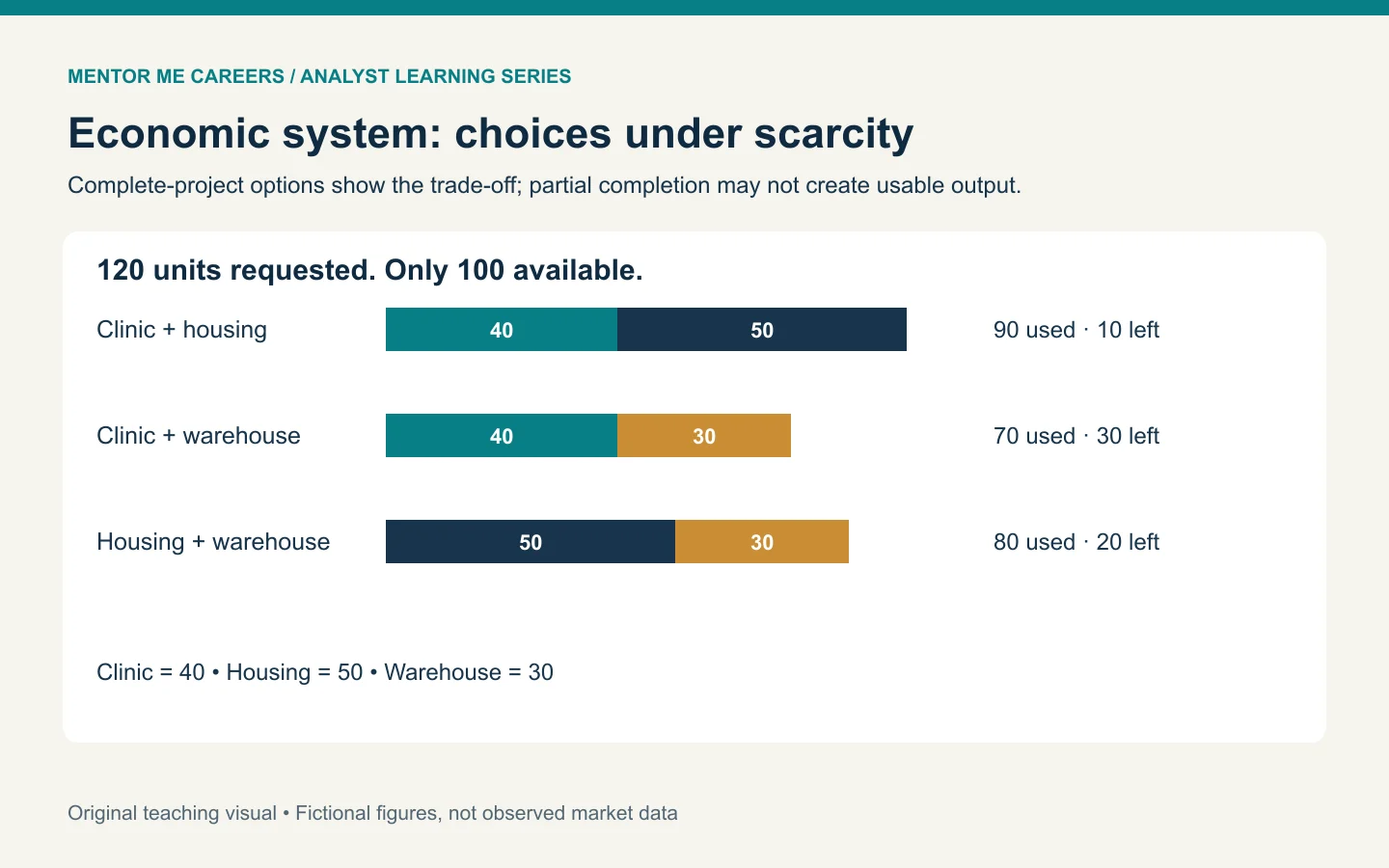
Imagine a town with 100 units of construction capacity for the year. A clinic needs 40 units, housing needs 50 and a commercial warehouse needs 30. Total requests equal 120 units, so all three cannot be completed within the available capacity. These are fictional teaching numbers.
Under a simplified market allocation, projects compete for labour and materials through bids. A warehouse may proceed if its backers can pay more. This shows willingness and ability to pay; it does not prove that the warehouse has the highest social value.
Under a central plan, the authority could allocate 40 units to the clinic, 40 to housing and 20 to the warehouse. The total is 100. However, two projects remain partly unfinished. Planners must explain the priority, the delivery sequence and the cost of delay.
Under a mixed arrangement, the town could reserve 40 units for the clinic and let private projects compete for the remaining 60. It could also set safety standards for all projects. The example shows a change in the decision rule, not a promise that one rule always creates the best outcome.
Extend the town example: indivisible projects and opportunity cost
In this economic system example, the first allocation assigns inputs; it does not establish how much usable output those inputs create. If partial stages are useful, explain what they deliver. If the clinic, housing project and warehouse each require full completion before use, an allocation of 40, 40 and 20 units can leave only the clinic operational. Therefore, count usable services, not just construction work completed.
| Complete-project combination | Capacity used | Capacity left | Immediate trade-off |
|---|---|---|---|
| Clinic + housing | 40 + 50 = 90 | 10 | No warehouse this year. |
| Clinic + warehouse | 40 + 30 = 70 | 30 | No completed housing project. |
| Housing + warehouse | 50 + 30 = 80 | 20 | No completed clinic. |
| All three | 120 | Shortfall of 20 | Infeasible without extra capacity or delay. |
However, unused capacity in this simplified table is not necessarily waste. It may be too small for another indivisible project, or it may support maintenance and preparation. First, estimate the value of each usable outcome, who benefits and whether unfinished work has any interim value. Thus, the arithmetic identifies feasible options; it does not supply the social judgement.
In any economic system, opportunity cost is the best alternative forgone, not the sum of every rejected request. If the town selects clinic plus housing, compare that choice with its next-best feasible package. Do not add the full cost of both other packages and call it the opportunity cost. State the objective and alternatives first.
Which economic system does India follow—and why is it called mixed?
India follows a mixed economic system. Private businesses and market exchange coexist with public enterprises, public services and government rules. “Mixed” does not mean an equal ownership split, nor does it mean that every industry uses the same balance of public and private decisions.
Banking provides a concrete example. The Department of Financial Services’ banking FAQs distinguish public-sector banks, private-sector banks and other categories, and identify the RBI as the regulator and supervisor. Thus, different ownership forms coexist within a regulated financial system. This supports the institutional example; it does not establish that every bank has identical legal rules, objectives or performance.
| Decision in the banking example | What to distinguish | Analytical question |
|---|---|---|
| Ownership | Public-sector and private-sector institutions are different categories. | Who owns and governs the institution? |
| Commercial activity | Institutions supply services to households and businesses. | What product, customer and revenue model are being examined? |
| Regulation | Commercial choices operate within a regulatory framework. | Which rule constrains the specific decision? |
| Access and public purpose | Policy goals and commercial activity can coexist. | Who pays for an obligation, and how is its delivery assessed? |
For an exam, explain coexistence and connect it to production and allocation. For a finance analysis, identify the institution and the actual rule or contract. A public-sector label alone does not tell you the price of every product; a private-sector label does not imply freedom from regulation. Consequently, neither label should be used as a substitute for researching the business.
Short answer: India is a mixed economy because both public and private activity contribute to economic decisions, alongside market exchange and government intervention. Use the banking example to explain the point; avoid inventing a percentage for how “capitalist” or “socialist” the whole country is.
Apply the idea in a financial model
Consider a fictional supplier whose selling price is fixed at ₹100 while unit input cost rises from ₹70 to ₹80. Unit contribution falls from ₹30 to ₹20, a decline of one-third. If volume stays at 10,000 units, contribution falls from ₹3,00,000 to ₹2,00,000 before fixed costs. The mechanism is the pricing constraint and cost shock—not the national economic-system label.
Then test the contract. Can prices reset? Is there a subsidy, and who receives it? Does payment arrive on delivery or after certification? In practice, these questions turn economics into explicit revenue, margin and working-capital assumptions. For practical modelling study, see our financial modelling course. This connects the concept to revenue, margin and cash-flow assumptions.
Takeaway: define the allocation mechanism, explain the trade-off and test the assumptions. A strong answer shows how decisions change; it does more than attach a country name to a textbook category.
Which economic system is best? Compare the problem, not the label
No single label settles the best arrangement for every decision. Start with the objective, then examine information, incentives, access and accountability. A price can reveal what paying customers want. A budget can prioritise a service that users cannot fund individually. Either mechanism still needs reliable information and a way to correct poor results.
| Problem | What a market mechanism can contribute | What needs separate attention |
|---|---|---|
| Changing demand | Prices and profit/loss can encourage suppliers to adapt. | Entry barriers, information and the ability to pay. |
| Pollution | A producer can compare private operating costs. | Costs imposed on other people may be absent from that calculation. |
| Essential access | Providers can respond to paying users. | People with urgent needs may lack purchasing power. |
| Large planned service | A public budget can reserve resources for a priority. | Procurement, delivery quality and accountability for failure. |
Return to the town case. Choosing the clinic over a warehouse is a priority decision. Completing the clinic within budget is a delivery question. Ensuring people can use it is an access question. Separating these questions makes the comparison more useful than claiming that one system always maximises efficiency, fairness and resilience at once.
Frequently asked questions
What is an economic system in simple words?
It is how a society organises production and decides how scarce resources and finished goods are used. It includes ownership rules, institutions and ways of coordinating decisions.
Is an economic system the same as the state of the economy?
No. An economic system describes the rules and institutions that organise decisions. The state of the economy describes conditions such as growth, inflation and employment during a stated period. A mixed economy can experience either strong growth or a slowdown without changing its basic classification. Use dated official data when discussing current conditions.
What should a short Class 12 answer include?
Define the system, identify what, how and for whom to produce, and compare ownership and decision-making. Add a brief example and distinguish the model from economic sectors.
Sources and examples: this guide uses NCERT and open university teaching material for core concepts, IMF material for capitalism, and the Department of Financial Services for the Indian banking illustration. Sources checked 5 November 2026. All town, pump and supplier figures are fictional teaching assumptions. They are not measurements of a named country or business.