
Last updated on November 10th, 2026 at 05:52 pm
You are finishing BCom, and the next question arrives before the final marksheet: should you do an MBA? Perhaps your friends are preparing for CAT. Perhaps the jobs you have seen look more operational than the finance career you imagined. An MBA can be a good next step, but the degree alone does not tell you whether the decision makes financial or career sense.
Yes, a BCom graduate can apply for an MBA, subject to the programme’s entry rules. The more useful question is which MBA, for which role, at what cost—and what you would do instead. I would work through those questions before comparing college logos or the highest package in a placement report.
What does an MBA add after BCom?
BCom gives you a foundation in subjects such as accounting, business law, economics and finance. An MBA can broaden that foundation into decisions about customers, people, operations and strategy. The value comes from the particular programme: its teaching, projects, peer group, internships and access to relevant recruitment.
For a finance-oriented student, the transition might be from preparing a set of accounts to using those accounts to recommend a budget or investment decision. For someone interested in marketing, it might be from learning business concepts to designing and testing a customer-acquisition plan. These are different ambitions. An MBA is most useful when you can name the work you want to become better at.
MBA after BCom eligibility: what to check first
Start with the current admission policy for the colleges you intend to apply to. As one concrete example, IIM Calcutta’s published domestic admission policy states bachelor’s-degree thresholds of 50%, or 45% for the specified SC, ST and PwD categories. Meeting a minimum is not the same as securing an interview or admission. Other programmes can have different requirements.
Check how your university converts grades, whether final-year applicants are eligible, which entrance results are accepted and when you must produce your degree documents. Full-time MBA, executive and online programmes should not be treated as one admissions category. Work-experience requirements and selection processes can differ.
Should you work first or go straight into an MBA?
This is often the real decision. A graduate with an offer from a suitable programme may reasonably want to continue studying. Another graduate may benefit from a year or two of work, both to understand the workplace and to build a more informed view of the role they want.
Work experience is useful when it gives you something concrete to learn: handling a customer problem, analysing a process, working with a budget or taking responsibility for a result. Simply waiting for an MBA application is not the same thing. Equally, enrolling in the first available college merely to avoid a gap can become an expensive way to postpone the career decision.
| Your situation | A useful next step |
|---|---|
| You have a suitable admission offer and a clear role goal. | Compare programme-specific outcomes, affordability and the alternative job path. |
| You have a credible job offer but only weakly matched college options. | Consider the job while preparing for a stronger application; build relevant achievements. |
| You are unsure which business function interests you. | Use internships, conversations and small work projects to test the options before committing. |
| The course requires debt your household cannot comfortably support. | Stress-test repayment and lower-pay outcomes. Compare lower-cost and work-compatible routes. |
Career paths after an MBA: look at the daily work
“Management” is too broad to be a career plan. An early-career role will involve specific tasks, targets and trade-offs. Read job descriptions and ask alumni what a normal week looks like. The title on a placement slide may not explain whether the work is analysis, sales, operations or client service.
| Specialisation / direction | Illustrative early-career roles | Work you should be able to discuss |
|---|---|---|
| Finance | Financial analyst, FP&A analyst, credit analyst, finance trainee. | Budgets, forecasts, statements, business drivers and risk. |
| Marketing and sales | Sales management trainee, account executive, category associate, market-research analyst. | Customers, distribution, conversion, pricing and commercial targets. |
| Operations | Operations analyst, procurement trainee, supply-chain analyst. | Capacity, service time, quality, stock and supplier trade-offs. |
| Business analytics | Reporting analyst, business operations analyst, business-intelligence associate. | Reliable data, SQL or analytical tools, clear measures and decision support. |
| Human resources | HR trainee, recruiting coordinator, HR operations associate. | Hiring processes, employee operations, communication and appropriate handling of data. |
Which MBA specialisation is best after BCom?
Finance is an obvious option, but it is not the only sensible one. If you enjoy interpreting accounts, forecasting and investigating why performance changed, a finance route may fit. For an interest in customers and commercial results, explore marketing and sales. If processes and resource decisions interest you, examine operations. For analytics, be honest about your interest in quantitative work and the time you will spend practising it.
Use one small exercise to test the preference. Build a forecast for a fictional business, analyse a customer funnel or map an inefficient process. Which task makes you want to investigate further? That answer is more useful than choosing a specialisation because one salary table places it first.
The MBA ROI calculation most people leave incomplete
Tuition is only part of the bill. Include additional living costs, relocation, applications, equipment and the earnings you give up while studying. Then compare the post-MBA outcome with the career you could have pursued without it. A salary after graduation is not all incremental benefit.
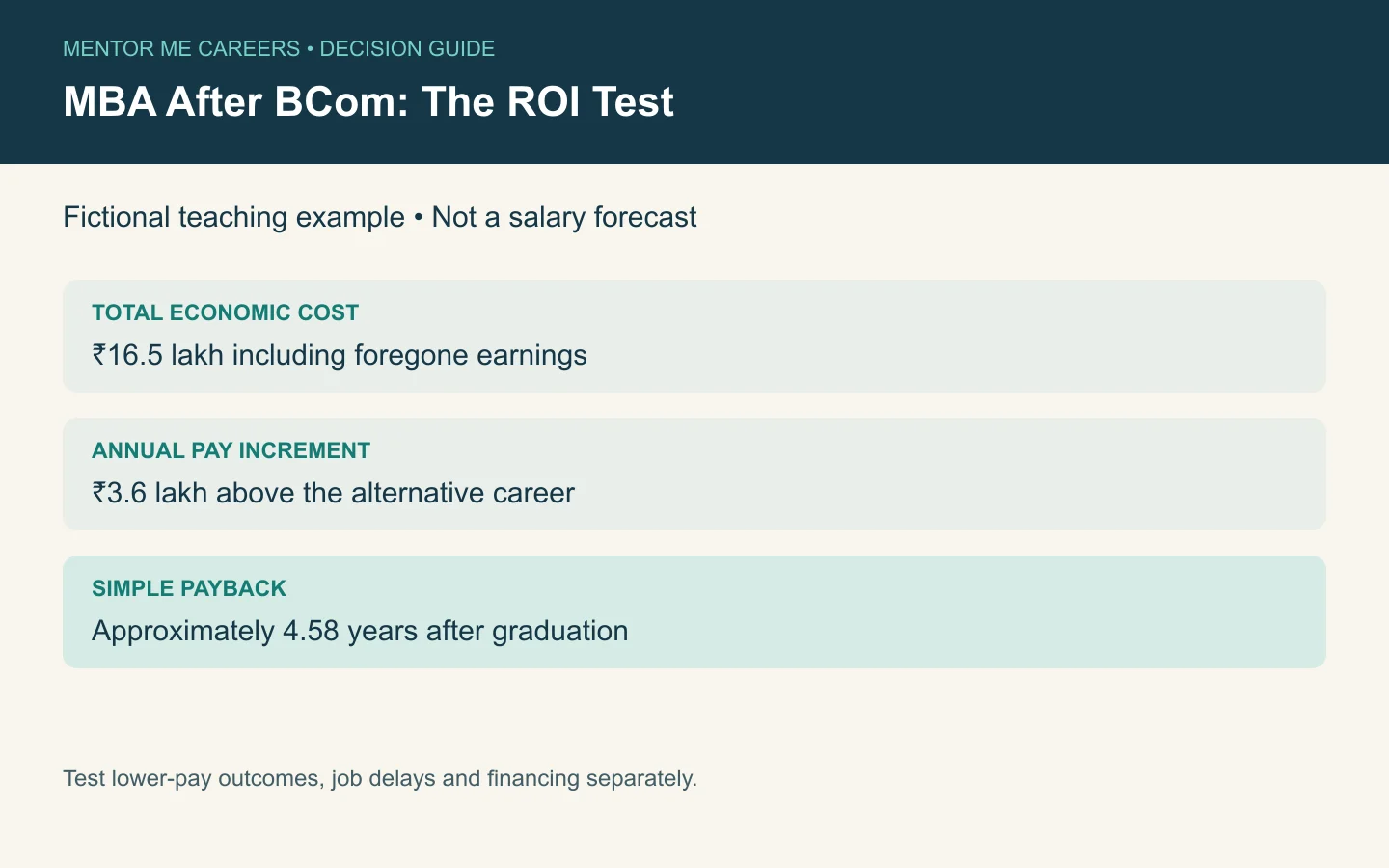
Here is one fictional example, used only to explain the calculation. Assume two years of full-time study, no income during the course and no scholarship. Tuition is ₹8 lakh, additional living and relocation cost ₹2 lakh, and other study costs ₹50,000. If you could otherwise earn ₹3 lakh per year, foregone earnings add ₹6 lakh.
| Cost component | Assumed amount |
|---|---|
| Tuition | ₹8,00,000 |
| Additional living and relocation | ₹2,00,000 |
| Applications, travel and equipment | ₹50,000 |
| Two years of foregone earnings | ₹6,00,000 |
| Total economic cost | ₹16,50,000 |
Now assume annual take-home pay after the MBA is ₹7.2 lakh. At the same point in time, the alternative career path would pay ₹3.6 lakh. The additional annual income is therefore ₹3.6 lakh. Simple payback is ₹16.5 lakh ÷ ₹3.6 lakh, or about 4.58 years after graduation. That is longer than a tuition-only calculation would suggest.
Test the result when the salary is lower
| Fictional outcome | Annual take-home after MBA | Increment above the ₹3.6 lakh alternative | Simple payback |
|---|---|---|---|
| Lower-pay case | ₹5.4 lakh | ₹1.8 lakh | 9.17 years |
| Base assumption | ₹7.2 lakh | ₹3.6 lakh | 4.58 years |
| Higher-pay case | ₹9 lakh | ₹5.4 lakh | 3.06 years |
The calculation holds the annual difference constant. It does not forecast your salary or include growth, discounting, financing charges or a delay before joining a job. If the MBA outcome does not exceed the alternative earnings, there is no positive earnings-based payback in this simple model. Those assumptions matter more than making the final number look attractive.
Financing an MBA after BCom
Economic value and repayment affordability are separate tests. You may believe the course is worthwhile over time but still struggle with a large monthly payment immediately after graduation. Model the loan with the actual rate, fees, moratorium treatment and repayment dates offered by the lender. Do not assume that interest stops during study.
Also avoid double counting. If tuition is funded with a loan, the loan principal is not a second tuition cost. Keep the course-cost comparison and the loan repayment schedule separate, then reconcile them. For practice with forecasts and assumptions, see our financial-model building guide.
MBA after BCom: read the placement report carefully
Use the report for the exact programme, campus and cohort. Check the number eligible for placement, the number participating and the number placed. Then look at the roles and compensation distribution. An average can be affected by a small number of large offers; a median describes the middle observation in the reported population, not a guaranteed offer.
Separate fixed compensation, variable pay, joining benefits and other CTC components. Take-home pay is a different measure. Likewise, internships, pre-placement offers and final placements should not be added together as if they were separate employed graduates. Read the reporting date and methodology before comparing colleges.
Dated reporting provides a useful reminder of the risk. In August 2024, Mint described stagnant or falling median pay at some IIMs while fees increased. That is historical context, not a claim about every current cohort. Its lesson for your decision is simple: do not assume that a more expensive course automatically produces a proportionately higher salary.
MBA after BCom: shortlist colleges for your target role
For each college, record the all-in cost, programme structure, internship access, relevant recruiters and actual roles. Speak to recent alumni from the same programme where possible. Ask what they learned, what the recruitment process required and what they would investigate more carefully before enrolling. Treat an individual story as one experience, not a replacement for cohort data.
If your target is financial analysis, examine whether students build models and explain business assumptions, or mainly study management theory. If your target is sales leadership, look at field exposure and the nature of the first role. A college can have a good overall reputation and still be a poor match for your particular goal.
What if you do not want an MBA immediately?
You can work, build practical skills and revisit the decision later. For finance roles, accounting knowledge, Excel, financial modelling and business writing can give you useful work to show. Professional qualifications may suit a more specific objective, but they differ in time, cost and eligibility. They are not interchangeable substitutes for an MBA.
Our financial modelling course is one practical learning route to examine for an analysis-focused goal. Compare the actual projects and support with what you need. If you are weighing professional study against your existing background, the CFA after CA discussion illustrates why the career objective should come before collecting another qualification.
My view: an MBA is a decision about your next role
An MBA after BCom can be a strong move when the programme fits the work you want, gives you credible opportunities and remains affordable under a realistic downside case. It becomes harder to justify when the decision depends on a highest-package headline, an optimistic loan calculation or the belief that any MBA will solve an unclear career plan.
Write down the role you want, the evidence that the course helps you reach it and the alternative path you would take. Then do the numbers. You do not need certainty about the next ten years. You do need a better reason than “everyone is doing it”.
Questions about MBA after BCom
Can I do MBA after BCom or BCom Honours?
Both can provide an undergraduate route to MBA applications. Check the college’s current academic thresholds, accepted entrance tests, final-year rules and selection process.
Is MBA Finance compulsory for BCom graduates?
No. Choose a specialisation that fits your interests, target roles and the programme’s actual teaching and recruitment access. Your BCom background does not restrict you to finance.
Which MBA has the highest ROI?
There is no universal answer without a defined cost and outcome comparison. Include foregone earnings and financing, compare like-for-like compensation and test a lower-pay case. A cheap programme with weak role access can still be a poor investment.
Will an MBA make me a manager immediately?
The first role depends on the programme, employer, your background and selection results. Many graduates begin as trainees, associates or analysts. Progression needs performance and experience as well as education.

A CFA charterholder with hands-on experience across investment analysis and finance education. At MentorMeCareers, he writes and reviews content on CFA, financial modeling, and investment banking careers — grounded in real market data rather than generic advice, and shaped by what actually helps candidates and professionals succeed.