
A company can book a sale, report a profit and still be waiting for the customer’s money. The cash flow statement helps explain that gap. It follows cash and cash equivalents through operating, investing and financing activities, showing how the business generates money, spends it and obtains funding.
Receivables are only part of the story. Inventory can absorb cash before a sale, equipment can require a large payment and a loan repayment can fall due without reducing accounting profit. Read the cash flow statement alongside the income statement and balance sheet to see how these events fit together.
The worked example follows Meridian Components, a fictional non-financial company, using an Ind AS 7 classification framework. Both the direct and indirect methods arrive at the same operating cash flow, and the full statement reconciles opening cash to closing cash. All example amounts are in ₹lakh unless stated otherwise.
What does a cash flow statement show?
The statement tracks cash movements rather than every accounting entry. Cash includes cash on hand and demand deposits. Cash equivalents are short-term, highly liquid investments meeting the relevant convertibility and value-risk criteria; an investment does not qualify merely because it can be sold.
The IFRS Foundation’s IAS 7 overview describes the operating, investing and financing structure and distinguishes direct and indirect operating presentations. Indian reporting requires checking the applicable Indian standard, rather than assuming every international presentation choice carries across unchanged.
Before analysing the movements, establish which balances the company counts as cash and cash equivalents. Read the policy and reconciliation, especially where balances are restricted or held in foreign currencies. A management spreadsheet’s “cash” total may use a different definition.
Cash flow statement format: three sections and a reconciliation
| Section | Typical question | Examples for a non-financial business |
|---|---|---|
| Operating activities | Does the business collect cash from its core activity? | Customer receipts, supplier and employee payments, operating taxes |
| Investing activities | Where is cash being committed for longer-term benefits? | Purchases and sales of property, equipment and investments |
| Financing activities | How is the business funded? | Share issues, borrowings, loan repayments and dividends paid |
| Reconciliation | Why did the cash balance change? | Net cash movement plus relevant exchange effects reconciles opening and closing balances |
Classify the transaction by what happened. Buying inventory generally belongs in operating activities; buying production equipment generally belongs in investing. A customer payment and a new bank loan both increase cash, but the first comes from trading and the second from financing.
Our guide to financial statements explains the links between the three reports. Following one transaction through each statement is a useful way to see why profit, asset balances and cash can move differently.
Direct and indirect methods: what changes?
The direct method presents major operating receipts and payments, such as cash received from customers and cash paid to suppliers. The indirect method begins with an appropriate profit measure and adjusts for non-cash items, working-capital movements and amounts whose cash flows belong elsewhere.
Both methods present operating cash flow. You still need the investing and financing sections under either approach. With the same information and classifications, they should arrive at the same operating total.
Starting with profit and balance-sheet movements often makes the indirect method convenient. But a balance can change without cash moving: an acquisition, exchange-rate movement or write-off may also explain part of the difference. Use the supporting schedules to separate those effects.
A complete cash flow statement example
Fictional company: Meridian Components. During the year, revenue is ₹500 lakh, operating expenses excluding depreciation are ₹355 lakh, depreciation is ₹20 lakh and interest expense is ₹10 lakh. A gain on sale of equipment is ₹5 lakh. Therefore profit before tax is 500 − 355 − 20 − 10 + 5 = ₹120 lakh.
For simplicity, assume tax expense and cash tax paid are both ₹18 lakh, leaving profit after tax of ₹102 lakh. Also assume the company pays all ₹10 lakh of interest, with no acquisitions, exchange effects or other non-cash balance movements. Real accounts usually need more adjustments; these assumptions let us follow the cash without obscuring the calculation.
Here are the balance movements and cash transactions needed to complete the statement:
| Item | Movement or cash amount |
|---|---|
| Trade receivables | Increase of ₹15 lakh |
| Inventory | Increase of ₹10 lakh |
| Operating trade payables | Increase of ₹8 lakh |
| Equipment purchases paid in cash | ₹80 lakh |
| Equipment sale proceeds | ₹15 lakh; carrying amount ₹10 lakh |
| New cash borrowing | ₹40 lakh |
| Loan principal repaid | ₹20 lakh |
| Interest paid | ₹10 lakh |
| Dividends paid | ₹15 lakh |
| Opening cash and cash equivalents | ₹30 lakh |
The disposal explains the ₹5 lakh gain: the company receives ₹15 lakh for equipment with a ₹10 lakh carrying amount. We will remove the gain from the operating bridge and put the full sale proceeds in investing, so that the same transaction is not counted twice.
Step 1: calculate operating cash flow using the indirect method
Begin with ₹120 lakh profit before tax. Add back depreciation, which reduced profit without a current cash payment. Also add back interest expense: in this non-financial Ind AS example, its cash payment belongs in financing. Finally, remove the equipment gain, because the sale proceeds will appear in investing.
| Indirect operating calculation | ₹lakh |
|---|---|
| Profit before tax | 120 |
| Add depreciation | 20 |
| Add interest expense | 10 |
| Deduct gain on equipment sale | −5 |
| Operating profit before working-capital changes | 145 |
| Increase in trade receivables | −15 |
| Increase in inventory | −10 |
| Increase in operating trade payables | 8 |
| Cash generated from operations before tax | 128 |
| Income taxes paid | −18 |
| Net cash from operating activities | 110 |
The working-capital movements explain the next adjustments. Some sales are still tied up in receivables, and more cash has gone into inventory. Meanwhile, the increase in operating payables means the company has not yet paid some of the costs it has recognised. Under the example’s assumptions, these movements take cash generated before tax from ₹145 lakh to ₹128 lakh.
Apply those signs to operating working capital, rather than to every asset or liability. A new loan is financing, and a non-cash lease liability is not a cash receipt. Establish what caused the movement before deciding where it belongs.
Step 2: check operating cash flow using the direct method
Customer cash receipts equal ₹500 lakh revenue less the ₹15 lakh increase in receivables: ₹485 lakh. Cash operating payments equal ₹355 lakh operating expenses plus ₹10 lakh inventory accumulation less ₹8 lakh unpaid operating payables: ₹357 lakh.
Therefore direct-method operating cash flow is ₹485 − ₹357 − ₹18 tax paid = ₹110 lakh. It matches the indirect-method answer. Interest is excluded here because the example classifies its payment in financing.
| Direct operating calculation | ₹lakh |
|---|---|
| Cash received from customers | 485 |
| Cash paid for operating costs | −357 |
| Income taxes paid | −18 |
| Net cash from operating activities | 110 |
The two routes agree at ₹110 lakh. That agreement is a useful check on the working-capital signs. In a real set of accounts, you would also investigate separate cost categories, unusual journals and non-cash movements instead of relying on the simplified aggregate calculation.
Step 3: calculate investing cash flow
Equipment purchases use ₹80 lakh and the equipment disposal brings in ₹15 lakh. Net investing cash flow is therefore −₹65 lakh. The ₹5 lakh gain is not a separate cash inflow: including both the gain and full proceeds would double count part of the disposal.
Depreciation belongs to a different part of the story. It spreads the asset’s depreciable amount across accounting periods; it is not another cash payment for the equipment. The purchase may have taken place years before the current depreciation charge.
Step 4: calculate financing cash flow
The company receives ₹40 lakh of new borrowing, repays ₹20 lakh of principal, pays ₹10 lakh interest and pays ₹15 lakh dividends. Net financing cash flow is 40 − 20 − 10 − 15 = −₹5 lakh.
The principal repayment uses cash even though it does not reduce profit as an interest expense would. That distinction matters when debt falls due: a business can have a profitable year and still need funding to meet its repayment schedule.
Step 5: reconcile opening and closing cash
| Cash flow summary | ₹lakh |
|---|---|
| Net operating cash flow | 110 |
| Net investing cash flow | −65 |
| Net financing cash flow | −5 |
| Net increase in cash | 40 |
| Opening cash and cash equivalents | 30 |
| Closing cash and cash equivalents | 70 |
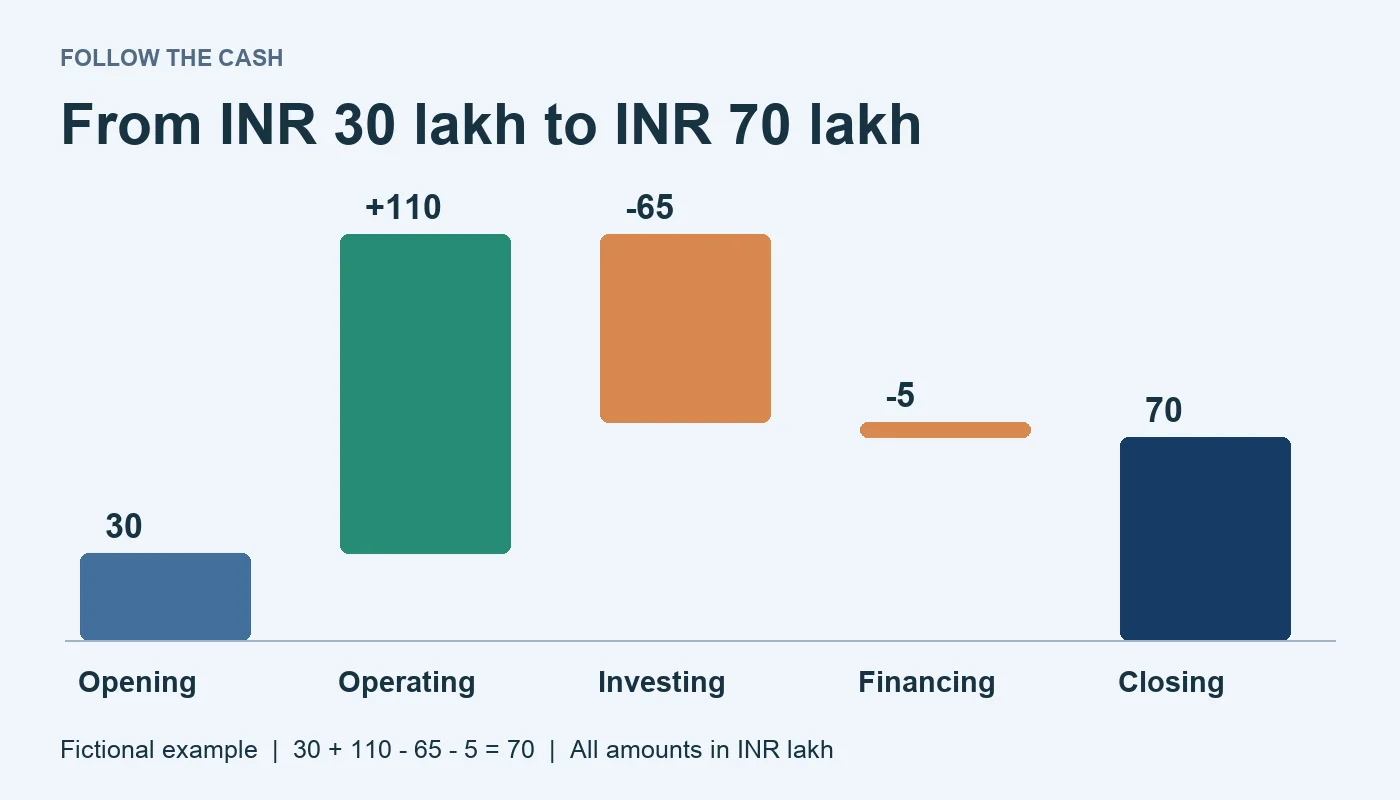
The closing check is ₹30 + ₹110 − ₹65 − ₹5 = ₹70 lakh. Agree that figure to the cash and cash-equivalent reconciliation. If it differs, find out whether a movement is missing or the two totals use different definitions.
We now have three different answers: ₹102 lakh profit after tax, ₹110 lakh operating cash flow and a ₹40 lakh increase in cash. Profit describes the accounting result. Operating cash shows cash generation from operations under the stated classification. The final ₹40 lakh movement also includes the equipment purchases, borrowing, repayments and dividends.
Interest, dividends and taxes: state the accounting framework
Under Ind AS 7, paragraphs 31–35, a non-financial entity classifies interest paid and dividends paid as financing, and interest and dividends received as investing. The standard treats relevant interest and dividend receipts and interest payments differently for financial institutions. Income taxes are normally operating unless specifically identifiable with investing or financing activities.
Do not copy these classifications into every jurisdiction without checking its rules. IAS 7 has historically allowed choices in some areas, while IFRS 18 introduces related amendments for annual periods beginning on or after 1 January 2027, with earlier application permitted. An IFRS change does not by itself establish that the same change applies to an Indian company’s Ind AS reporting.
In an interview, name the framework and entity type before classifying interest. The phrase “interest is always operating” skips both. When comparing companies, check their policies too, or a difference in presentation may look like a difference in performance.
Non-cash transactions: important, but not cash flows
An asset acquired entirely through a non-cash financing arrangement is not a cash purchase merely because both an asset and liability appear on the balance sheet. Similarly, conversion of debt into equity is not a new cash receipt. Relevant non-cash investing and financing transactions require appropriate disclosure outside the cash-flow totals.
This is why two balance sheets are not enough on their own. A rise in an asset balance may come from a cash purchase, an acquisition, a revaluation or another movement. The notes and schedules help you identify which part involved cash.
How to analyse a cash flow statement
Compare operating cash with profit over several periods
If profits keep rising while collections weaken, investigate the receivables. Longer credit terms, disputed invoices, rapid growth and weaker customers can all produce that pattern. The statement points you towards the question; the ledger and business evidence help answer it.
In Meridian’s example, operating cash exceeds profit after tax by ₹8 lakh. To understand why, follow the adjustments in the bridge, including the interest classification. The difference alone cannot tell you whether the earnings are high quality.
Read investing outflows in the business context
An investing outflow may mean the company is expanding. Look at what it bought, how much is maintenance spending and how the investment is funded. An investing inflow needs interpretation as well: selling assets raises cash today, but repeated disposals may leave a weaker business tomorrow.
Assess dependence on external funding
Borrowing or issuing shares can increase cash even while operations consume it. During an investment phase, that may be part of the plan. The next questions are how long the funding lasts, when repayments fall due and what evidence supports the expected improvement in operating cash.
Our guide to financial statement analysis tools helps combine these questions with profitability and balance-sheet analysis.
Cash flow versus free cash flow
Free cash flow is an analytical measure, so establish its definition before using it. Subtracting capital expenditure from operating cash is a common starting point, but interest, leases and other adjustments affect comparison and valuation. A financial statement’s operating total is not automatically the cash flow required by your valuation model.
Using the simple “operating cash flow less gross equipment purchases” definition here gives ₹110 − ₹80 = ₹30 lakh. This is a stated analytical calculation, not automatically free cash flow to the firm or free cash flow to equity. Those valuation measures require consistent treatment of financing, tax and reinvestment.
How to prepare a cash flow statement from your records
Start with comparative balance sheets, the income statement and the schedules behind them. Bank statements help you trace receipts and payments, but they will not explain every accrual, non-cash adjustment or classification. The same review is necessary when accounting software produces the first draft for you.
| Records needed | What they help establish |
|---|---|
| Opening and closing trial balances | The starting balances and movement in each account |
| Bank and cash-equivalent reconciliations | Which balances belong in the opening-to-closing cash bridge |
| Receivables, inventory and payables schedules | Operating working-capital movements, excluding unrelated non-cash changes |
| Fixed-asset register and disposal documents | Cash purchases, sale proceeds, depreciation and disposal gains |
| Debt, lease and equity schedules | Funding receipts, principal repayments and non-cash financing movements |
| Tax, interest and dividend records | Cash payments, accrual differences and framework-specific classification |
Build the three activity schedules, then reconcile their combined movement to cash and cash equivalents. Review unusual journals and disposals before signing off. Also watch transfers between bank accounts: when both accounts sit inside the same cash-and-cash-equivalent total, moving money between them does not create an external cash inflow.
What is the cash flow statement formula?
In a simple case without exchange effects or other reconciliation items: closing cash = opening cash + operating cash flow + investing cash flow + financing cash flow. The example gives 30 + 110 − 65 − 5 = ₹70 lakh. Where foreign-currency effects apply, show them separately in the reconciliation rather than forcing them into operating receipts.
A historical cash flow statement is not a cash forecast
A statement looks back; a forecast looks ahead. The first explains where cash went during the period, while the second estimates when the next receipts and payments will arrive. A small business may need both to understand past performance and plan the next payroll or supplier payment.
Fictional timing example: a business opens the month with ₹2 lakh, expects ₹3 lakh from customers and has ₹4 lakh to pay. It forecasts ₹1 lakh at month-end. But suppose the bills fall due before the customers pay: the business can still face a shortfall during the month. Check weekly or daily timing when a month-end total would hide that pressure.
A reusable cash flow statement format
Use this outline to organise the schedules, then adapt it to the company and reporting framework. Leave a line marked “to establish” until you have the evidence; an empty cell is not the same as zero. The Meridian example above shows how the completed totals fit together.
| Line | What to enter |
|---|---|
| A. Operating activities | Direct receipts/payments, or an indirect profit-to-cash bridge; separately show applicable cash taxes |
| B. Investing activities | Relevant cash asset/investment purchases and proceeds, under the applicable classification |
| C. Financing activities | Relevant funding receipts, repayments and distributions, under the applicable classification |
| D. Net change from activities | A + B + C |
| E. Other cash reconciliation effects | Separately identified effects such as exchange-rate changes where applicable |
| F. Opening cash and cash equivalents | Agreed opening balance using the same definition as the closing balance |
| G. Closing cash and cash equivalents | F + D + E; reconcile to the financial statements |
The outline is a starting point, rather than a statutory filing format for every entity. Check the classifications and disclosures that apply to the company. For the non-financial Ind AS example here, that means keeping interest paid in financing when you adapt the template.
Common preparation mistakes
| Mistake | Why it matters |
|---|---|
| Putting every bank receipt into revenue | Borrowing and share issues raise cash without being revenue |
| Adding depreciation twice | Only reverse the non-cash expense once in the indirect bridge |
| Treating equipment sale gain as proceeds | The gain and cash received are different amounts |
| Using all balance-sheet differences as cash | Non-cash movements can change balances |
| Mixing principal and interest | They have different profit effects and potentially different cash classifications |
| Failing to reconcile closing cash | An unexplained difference signals an incomplete statement |
Give the model separate working-capital, fixed-asset, debt and tax schedules, then link their cash movements into the statement. A cash reconciliation check should expose an unexplained difference, not hide it with a balancing figure. Our sample financial model guide shows how the schedules fit into a wider model.
Frequently asked questions
Can a profitable company run out of cash?
Yes. Customers may pay slowly, inventory and investment may absorb cash, or debt repayments may fall due. Profit measures performance under accounting recognition rules; it does not guarantee that enough cash is available when obligations mature.
Is negative operating cash flow always bad?
Look at the reason and the duration. Seasonal trading or rapid growth can create temporary operating outflows; a persistent shortfall without a convincing explanation deserves closer attention. Check the funding available and the evidence behind management’s expected recovery.
Why is depreciation added back?
It reduced accounting profit without a cash payment in the current period. The add-back removes that non-cash expense from the operating bridge. It does not mean equipment was free or that future replacement expenditure can be ignored.
Are cash flow and fund flow the same?
No. A cash flow statement focuses on cash and cash equivalents. Fund-flow analysis commonly examines changes in working capital or a separately defined measure of funds. Our cash flow versus fund flow comparison explains the distinction.
What should I check first when a statement does not balance?
Confirm the opening and closing cash definitions, then inspect omitted cash movements, signs, double counting and non-cash balance changes. Check financing and equipment disposals carefully. Trace the difference to evidence instead of forcing an unexplained adjustment.

A CFA charterholder with hands-on experience across investment analysis and finance education. At MentorMeCareers, he writes and reviews content on CFA, financial modeling, and investment banking careers — grounded in real market data rather than generic advice, and shaped by what actually helps candidates and professionals succeed.