
CFA Level 2 changes the way you have to study. You may know a valuation formula and still choose the wrong answer because you used the wrong earnings figure, missed a date in the exhibit or misunderstood the case. The exam asks you to work with information, not just recognise it. Good preparation needs to make room for that shift.
Here is what to expect from CFA Level 2: the syllabus, costs, case-based format, practical-skills requirement and the study decisions that follow. Exam information was checked against CFA Institute sources on 26 November 2026. Match the curriculum and deadlines to the window you actually register for.
What is CFA Level 2?
CFA Level 2 follows Level 1 and puts more emphasis on analysing an investment situation. You read a case, select a method and work out what the result means. This can expose gaps that a familiar, standalone calculation does not: a neat valuation is of little use if its earnings measure or assumptions are inappropriate.
An exhibit might give you an earnings forecast, planned capital expenditure and details of the company’s financing. Before reaching for the calculator, decide which figures belong in the cash flow and which affect the discount rate. That sorting-out process is part of the question.
Passing Level 2 takes you further through the programme, but you still have examination and charter requirements ahead. Our guide to becoming a CFA charterholder explains how the stages fit together.
CFA Level 2 exam pattern
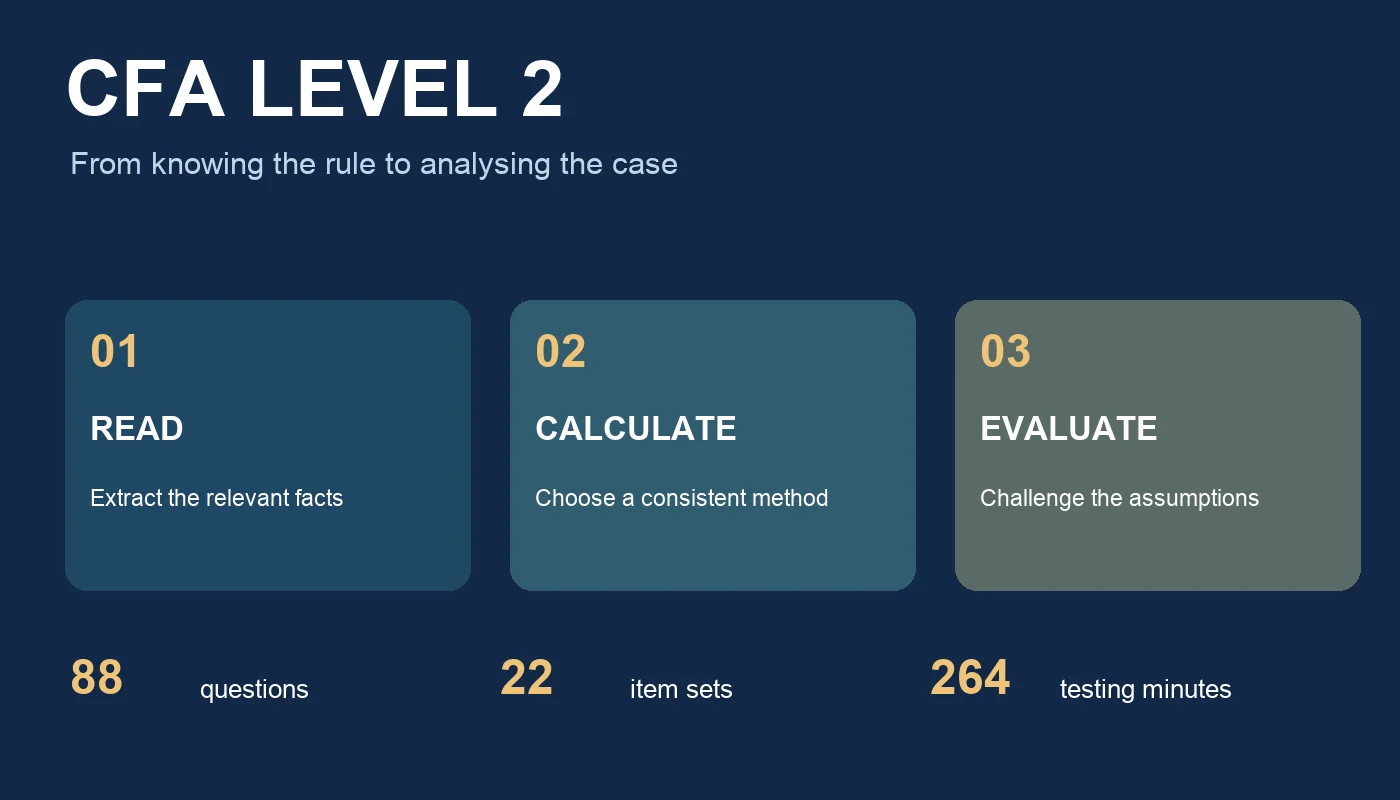
CFA Institute’s official Level II exam page specifies 22 case-based item sets with 88 multiple-choice questions. Two sessions of 132 minutes give 264 minutes of testing time. Each session has 11 item sets; 20 sets count towards the score and two are unscored trial sets.
You have an average of three minutes per question, including time to read the case. That is a useful pace to practise, rather than a stopwatch rule for every answer. A quick conceptual question may leave you more time for an exhibit that needs careful calculation.
| Feature | What it means for preparation |
|---|---|
| Vignette-based questions | Practise extracting facts from a narrative and exhibits |
| 88 questions across two sessions | Build endurance for both sessions, not only short quizzes |
| Multiple-choice format | Show yourself why the rejected choices are wrong |
| Two unscored item sets | Treat every set seriously; you cannot identify the trial sets |
| No penalty for incorrect answers | Make an informed selection rather than leaving unanswered questions |
Question-bank progress can be misleading once the answers start to look familiar. Record how you perform on fresh questions separately from repeat attempts. Otherwise, remembering a solution can feel much like understanding it.
CFA Level 2 syllabus and topic weights
The current official outline groups the curriculum into the following ten areas. The names below follow CFA Institute’s current public presentation; use the learning outcome statements for your registered year when selecting study materials.
| Topic | Exam weight | A useful way to approach it |
|---|---|---|
| Quantitative Methods | 5–10% | Interpret model outputs and recognise when assumptions fail |
| Economics | 5–10% | Connect economic relationships to investment implications |
| Financial Statement Analysis | 10–15% | Assess comparability and the effect of accounting choices |
| Corporate Finance | 5–10% | Evaluate financial decisions and their economic consequences |
| Equities | 10–15% | Link business assumptions, cash flows and valuation |
| Fixed Income | 10–15% | Understand prices, yields and sources of bond risk |
| Derivatives and Risk Management | 5–10% | Keep payoff, value and risk exposure distinct |
| Alternative Investments | 5–10% | Study structure, valuation and investor economics |
| Portfolio Construction | 10–15% | Evaluate investments within a portfolio context |
| Ethical and Professional Standards | 10–15% | Apply professional duties to the facts of a case |
Treat the weights as planning ranges. Their upper limits are not meant to add up to 100%, and they do not reveal the question count for a future exam. Give important topics enough time, but also look at your own weak areas: a low-weight topic can still cost marks you could have earned.
Why financial statement analysis matters beyond its own questions
Accounting choices travel into valuation. Two companies can report similar business activity differently, making a quick multiple comparison unreliable. As you revise an adjustment, follow it through profit, assets, equity and the relevant ratios. You are more likely to remember the direction of the change when you understand its route.
Our overview of financial statements can help repair foundational gaps. At Level 2, however, preparation must go beyond recognising statement headings: you need to evaluate what the reported numbers conceal or reveal about the business.
Why valuation requires consistency
A cash flow measure and its discount rate must describe the same claim on the business. Equity cash flows belong with an equity return requirement; enterprise cash flows require a consistent enterprise approach. Similarly, a nominal forecast should not be mixed casually with a real discount rate.
Write down whose cash flow you are valuing before putting numbers into the formula. It is a small habit that can prevent a long calculation with the wrong discount rate or the wrong starting date.
Worked example: a correct formula can still produce a weak valuation
Original teaching example, not an actual CFA exam question: assume a company is expected to generate a stable equity cash flow of ₹12 per share next year. The required equity return is 12%, and sustainable growth is assumed to be 4%. Under a simplified constant-growth equity model, value is ₹12 ÷ (12% − 4%) = ₹150 per share.
Now change the required return to 13%, leaving everything else unchanged. Value becomes ₹12 ÷ (13% − 4%) = ₹133.33. That ₹16.67 reduction is about 11.1% of the original estimate. It shows why valuation judgement matters even when the arithmetic is short.
That estimate rests on stable growth, an appropriate equity cash flow and a required return above growth. It is especially sensitive when growth approaches the discount rate. So a value of ₹150 does not, by itself, make a ₹140 share attractive: a modest change in the assumptions could remove the apparent upside.
After each calculation, spend a moment on the interpretation. What caused the result? Which assumption would change your view? That extra step helps you prepare for an unfamiliar case instead of another version of a formula you already know.
Eligibility: what to check before paying
You must progress from Level 1 and meet the applicable programme requirements. For candidates entering through the undergraduate route, CFA Institute states that the Level II exam window must fall within 11 months of graduation. Programme enrollment has other qualifying routes; do not apply the student timing rule to every candidate without checking the relevant pathway.
Before paying, check your passport and registered name, eligibility, testing location and the current identification policy. Take any unresolved eligibility question to CFA Institute. Coaching advice can help you plan, but it cannot change the Institute’s admission rules.
CFA Level 2 fees and the real cost of preparation
CFA Institute’s pricing announcement for exams from February 2026 onwards sets Level II registration at USD 1,140 early and USD 1,490 standard. The difference is USD 350. Check your selected window on the official dates and fees tool before making a payment.
| Budget item | How to treat it |
|---|---|
| Exam registration | Use the applicable early or standard fee for the selected window |
| Tax and foreign exchange | Check the actual checkout amount and card conversion charges |
| Study materials or coaching | Optional separate spending; compare access and support terms |
| Travel and leave | Allow for test-centre travel and time away from work |
| Retake contingency | Consider financial and calendar consequences without assuming failure |
A rupee estimate is only a budget, because exchange rates, taxes and payment charges can change the actual amount. For a simple illustration excluding tax and charges, USD 1,140 at an assumed ₹85 per dollar is ₹96,900; USD 1,490 is ₹1,26,650. These are fictional exchange-rate calculations, not today’s quoted INR fees. See our CFA fee guide for India for the wider cost framework.
The USD 350 saving is worth considering, but so is the sitting you choose. An early deadline only helps if you can realistically prepare for that window. Allowing more time may be the better financial decision when work or other commitments make the earlier attempt doubtful.
Exam dates: registration and scheduling are different steps
Use CFA Institute’s dates tool for the exact Level II window you intend to sit. Registration deadlines, scheduling deadlines and the exam dates are distinct. Paying the fee does not automatically select an appointment at your preferred centre.
The registration and scheduling guide explains that scheduling becomes available after registration and payment processing. Record the appointment confirmation and check the centre details. Availability can constrain your options even when the broader exam window remains open.
Keep the official calendar handy when arranging leave or travel. Check registration, scheduling, cancellation and deferral terms separately; a deadline for one step is not a deadline for all of them.
Practical Skills Module: plan for it separately
CFA Institute requires completion of at least one Practical Skills Module at each level to receive the examination result. Modules typically take 10–20 hours, which should be budgeted in addition to exam revision. Follow the completion deadline and policy for your registration.
For 2027, the public Level II list includes Python Programming Fundamentals, Python, Data Science, and AI, and Equity Analyst Skills. The 2026 list uses Analyst Skills for the corresponding analyst module. Check which option you can take: a module already completed at another level cannot simply be repeated to satisfy the next level’s requirement.
Choose a module you can use, then complete the required tasks and check that the learning system records it as finished. Watching the teaching videos alone may leave part of the requirement outstanding.
A six-month CFA Level 2 study plan
The following is a planning example, not an official preparation requirement. Twenty-four weeks averaging 15 hours provide 360 hours before the separate PSM allocation. Your available time and starting knowledge may require a different schedule.
| Period | Primary work | Evidence of progress |
|---|---|---|
| Weeks 1–8 | Build topic understanding with immediate question practice | Can explain a method without looking at notes |
| Weeks 9–16 | Complete coverage and revisit weak areas | Can solve unfamiliar item sets and explain errors |
| Weeks 17–20 | Mixed timed practice and cumulative revision | Can switch topics without depending on chapter cues |
| Weeks 21–24 | Full-session practice, targeted repair and exam logistics | Pacing and recurring errors improve under realistic conditions |
One way to find 15 hours is five 90-minute weekday sessions plus 7.5 hours across the weekend. Try that routine for a fortnight before relying on it for six months. If it repeatedly collides with work, change the calendar early rather than leaving a growing backlog for the final weeks.
Read, retrieve, apply and review
Close the book after studying a concept and explain it in your own words. Then try a new question and compare your reasoning with the solution. The uncomfortable pause when you cannot explain a step is useful: it tells you where to return to the material.
Keep an error log with the mistake, its cause, the corrected reasoning and a review date. A wrong sign needs a different fix from a concept you have never understood. If you keep mixing up beginning and ending values, for example, a short date check may help more than another complete reading of the chapter.
Use mock exams as diagnosis
Review uncertain answers even when you guessed correctly. Look for patterns: perhaps your accuracy drops late in a session, or you lose time moving between exhibits. A mock’s overall percentage can conceal both problems.
No mock score guarantees a pass. Difficulty varies between question sets, and repeated attempts can flatter your results. Look for consistent performance on fresh material and explanations you can defend. Our CFA study guide offers a wider approach to organising revision.
Which CFA Level 2 study materials should you use?
Start with the curriculum for your registered year and use questions to find out whether you can apply it. Add another resource when it solves a particular problem—an explanation you cannot follow, too little fresh practice or feedback you cannot get elsewhere. Several overlapping packages can take time away from the work you bought them to support.
| Resource | Best use | What to verify |
|---|---|---|
| Official curriculum and Learning Ecosystem | Resolve the method and practise against the assigned learning outcomes | Correct exam year, errata and your registered access |
| Official practice questions and mocks | Diagnose knowledge gaps and practise vignette pacing | Fresh attempts rather than answers recalled from repetition |
| Condensed notes or teaching videos | Build an initial explanation and organise revision | Coverage, examples and ability to explain the reasoning |
| Tutor feedback or an additional question bank | Repair persistent errors and test unfamiliar applications | Quality of explanations, support terms and access duration |
The Learning Ecosystem brings together curriculum, practice and planning resources. The optional Practice Pack supplies extra questions and mocks, whereas coaching supplies teaching and support. Those are different purchases. Check what your registration already gives you before deciding where an additional resource would help.
A short CFA Level 2 practice case: test the reasoning
Original fictional exercise, not CFA Institute examination material. An analyst forecasts stable next-year equity cash flow of ₹12 per share, growth of 4% and a required return of 12%. The market price is ₹140. A risk review increases the required return to 13%, with other inputs unchanged.
| Question | Answer and reasoning |
|---|---|
| 1. What is the initial estimated equity value? | ₹150: 12 ÷ (0.12 − 0.04). Use next-year cash flow, not a mismatched historical figure. |
| 2. What is the revised value? | ₹133.33: 12 ÷ (0.13 − 0.04). A higher return requirement reduces present value. |
| 3. How does the price comparison change? | ₹140 is below the initial estimate but above the revised estimate. The apparent attraction depends on the risk assumption. |
| 4. What must the analyst challenge? | Whether stable perpetual growth and the equity cash-flow forecast are defensible, and whether the required return is consistent with the cash flow. |
Write a solution before looking at the answers. If it differs, identify where the reasoning changed: reading the exhibit, choosing the model, doing the arithmetic or interpreting the output. One carefully reviewed case can teach more than several familiar questions answered from memory.
Books, notes, question banks and coaching
Check the exam year and errata before settling into a set of notes. Concise material is useful for revision, but you may need the fuller curriculum when a difficult step has been compressed into a sentence. Being able to reproduce the formula is not always the same as knowing why it applies.
If you are considering classes, ask to see how a teacher explains a difficult topic and reviews a wrong answer. Also confirm exam-window coverage, support and access terms. Recorded hours are easy to count; the quality of the explanation takes closer inspection. A Level 1 course listing does not confirm Level 2 tuition.
CFA Level 2 classes or self-study: which fits your situation?
Self-study can work well when you can keep a routine, recognise gaps in your understanding and learn from written solutions. Classes may be useful when you need a timetable, a clearer explanation or feedback on persistent mistakes. Either way, you still need to solve vignettes independently. Choose the support you will actually use.
| Your situation | Consider | Check before committing |
|---|---|---|
| Strong foundations and a reliable weekly routine | Official resources with selected supplementary practice | Whether you can explain unfamiliar solutions without help |
| Persistent conceptual gaps | Targeted instruction or a structured class | A sample lesson and how the tutor resolves your actual errors |
| Irregular work schedule | Flexible learning with a protected study calendar | Recording availability, support response times and access expiry |
| Limited budget | Use registered official resources before adding packages | The specific gap an extra purchase will solve |
Before buying a large package, test your approach on one difficult module and a fresh set of questions. Did you struggle with the concept, or did you simply never sit down to study it? More teaching may help with the first problem; another video library is unlikely to solve the second. Confirm any provider’s current Level II coverage before committing.
What passing Level 2 can contribute to a career
The career value comes from what you can do with the learning: analyse accounts, value an investment, assess risk and explain a view clearly. Those skills fit research, credit, valuation and portfolio-related work. The examination result alone does not determine which job or level of seniority an employer will offer.
Build a small evidence portfolio alongside study: a company analysis, a clearly documented valuation and a concise risk discussion using public information. Label assumptions and distinguish historical facts from forecasts. Our financial model guide can help structure that practical work.
Salary figures need the same care as valuation inputs. A range quoted for “CFA professionals” may include charterholders with years of experience; it cannot automatically stand in for the pay of someone who has just passed Level 2. Compare roles and experience before drawing a conclusion about earnings.
Frequently asked questions about CFA Level 2
Is CFA Level 2 harder than Level 1?
Many candidates find the move to case-based application demanding, but difficulty depends on preparation and prior knowledge. Level 1 familiarity helps; it does not remove the need to practise interpretation, calculations and topic switching under time pressure.
Can I prepare while working full time?
Start with the hours you can protect, including during busy periods at work. Then leave space for revision and the PSM. If that calendar supports your target sitting, working full time and preparing may be manageable. Another candidate’s three-month timetable tells you little about whether yours will work.
What is the latest available Level 2 pass rate?
As checked on 26 November 2026, CFA Institute reported that 45% of 10,004 candidates passed the August 2026 Level II examination. A sitting’s pass rate describes that candidate group; it is not your personal probability of passing. Do not confuse the November examination window with a result already released.
Is Level 2 enough to call myself a CFA charterholder?
No. Passing Level 2 does not award the charter. Describe your examination achievement accurately and follow CFA Institute’s rules for references to the designation and candidature. Do not place “CFA” after your name solely because you passed an examination level.
Should I skip a low-weight topic to save time?
That creates a predictable weakness and can also harm related topics. Prioritise intelligently, but build basic competence throughout the curriculum. Use your error log to identify where another hour produces the greatest improvement.

A CFA charterholder with hands-on experience across investment analysis and finance education. At MentorMeCareers, he writes and reviews content on CFA, financial modeling, and investment banking careers — grounded in real market data rather than generic advice, and shaped by what actually helps candidates and professionals succeed.