
Fund accounting interview questions can look deceptively simple. Subtract liabilities from assets, divide by the units, and you have a NAV. But what happens when the price file is stale, a fee is missing or the custodian’s cash balance disagrees with yours? That is where the calculation becomes an accounting problem—and where a clear explanation matters most.
The fund accounting interview questions below work through those situations, from the basics to cases for experienced candidates. Each numerical case is fictional. Use it to practise the reasoning, then check how the fund’s own documents, accounting policies and local rules would affect the treatment.
This article focuses on investment funds. In nonprofit and government accounting, “fund accounting” can mean tracking resources with particular purposes or restrictions. The terminology overlaps, but an answer about restricted donations will not explain how an investment fund calculates NAV.
What the job involves before the interview begins
A Kroll Fund Solutions job description published by CFA Society India, reviewed on 26 November 2026, puts NAV preparation alongside reconciliations, investor reports, fees, capital calls and distributions. The role calls for two to five years of relevant experience. It offers a concrete picture of the work, rather than a list of questions the employer has confirmed it asks.
Use those responsibilities to organise your preparation. Work through a NAV, explain a fee accrual and practise tracing a cash difference to its source. If the transaction itself is unfamiliar, start with our trade lifecycle guide; the accounting becomes easier to follow once you understand what has actually happened.
Watch the fund accounting interview lesson
Watch Fund Accounting Interview Questions & Answers | NAV, GAV, Fees & High Water Mark alongside the written examples. Pause before the answer and try the calculation on paper. Then use the investigation cases below to think through what you would check before accepting the result.
Fund accounting interview questions for freshers
1. What is fund accounting?
Fund accounting records a fund’s investments, transactions, investment income, expenses, liabilities and investor capital. The resulting books support valuation, investor reporting and financial statements. It differs from simply recording a company’s sales and purchases because the fund must also allocate economic outcomes to investors or share classes under its governing terms.
The books must support a value investors can rely on. That means checking more than whether an entry balances: even a correctly posted transaction can distort NAV if it lands on the wrong valuation date. Include that control perspective in your answer.
2. What is NAV, and how is NAV per unit calculated?
Net asset value is assets less liabilities. NAV per unit divides that amount by the relevant outstanding units. The SEC’s Investor.gov explanation of NAV confirms the basic relationship. In practice, use the correct valuation date, currency, share class and unit population.
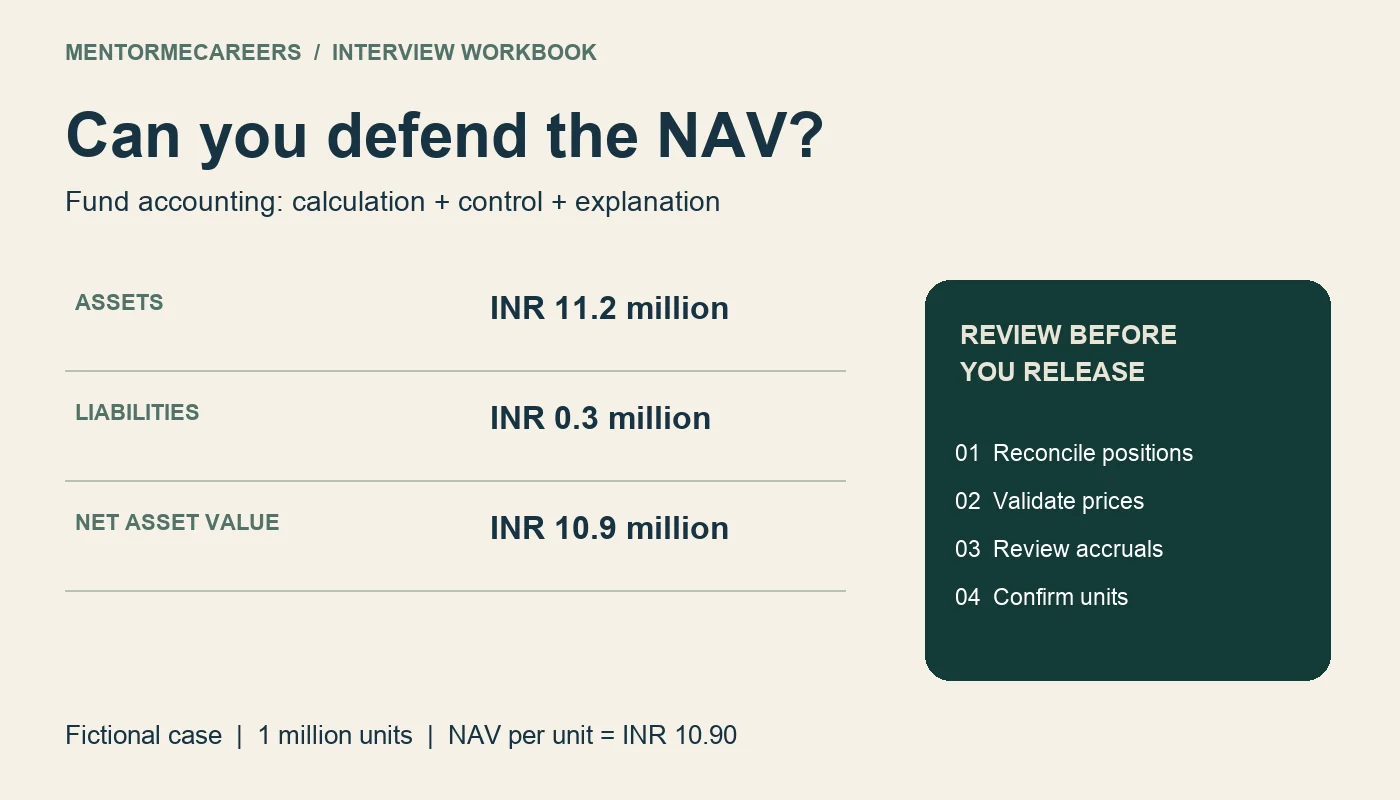
Fictional case: a fund holds securities worth ₹1,00,00,000, cash of ₹10,00,000 and receivables of ₹2,00,000. It owes ₹2,50,000 of other liabilities and ₹50,000 of accrued management fees. With 10,00,000 units outstanding, the calculation is:
| Calculation | Amount |
|---|---|
| Total assets | ₹1,12,00,000 |
| Total liabilities | ₹3,00,000 |
| Fund NAV | ₹1,09,00,000 |
| NAV per unit | ₹10.90 |
The answer is ₹10.90 per unit. Before releasing it, though, you would still need to reconcile the holdings and cash, validate the prices, check the receivables and accruals, and agree the unit count. The division is the last step; most of the work sits behind its inputs.
3. How are GAV and NAV different?
Gross asset value generally describes assets before deducting liabilities, while NAV is the residual after liabilities. However, GAV is not a universally identical contractual measure: a financing agreement or fund document may define adjustments. State the definition you are using before comparing figures. In the simplified case above, gross assets are ₹1.12 crore and NAV is ₹1.09 crore.
AUM is another figure to keep separate. It can cover several funds or mandates, with a reporting definition of its own. Neither total AUM nor a fund’s NAV tells you how much revenue the manager earns.
4. Why does an expense affect NAV before it is paid?
Suppose a fund has incurred a ₹20,000 administration expense but has not yet paid the invoice. Under accrual accounting, the simplified entry is debit administration expense, credit accrued expenses. Recognising the expense reduces NAV. When the fund pays, debit the liability and credit cash—the payment clears the amount owed instead of creating a second expense.
There is an allocation question here too: does the invoice belong to this fund, this period and this share class? An invoice can be genuine while the allocation is wrong.
5. What is the difference between trade date and settlement date?
Trade date is when a transaction is agreed; settlement date is when the securities and cash are exchanged. Recognition follows the applicable accounting policy. Under a simplified trade-date approach, buying a security creates an investment and a payable before cash moves. Settlement clears the payable against cash.
The absence of a bank movement is therefore not enough to leave the trade out. Follow the trail from the trade confirmation to the expected settlement, checking the recognition policy and whether the trade has failed to settle.
6. What are realised and unrealised gains?
A realised gain arises when an investment is disposed of relative to its relevant carrying or cost basis under the accounting presentation. An unrealised gain reflects a valuation movement on a holding that remains open. Reporting can reclassify previously recognised unrealised amounts on disposal; do not count the same economic gain twice.
For a simple cost illustration, buy 100 shares at ₹200 and value them at ₹230: the holding is ₹3,000 above cost. Selling at ₹235 produces a total gain of ₹3,500 above purchase cost before charges, not ₹6,500. Separate the lifetime gain from the current-period movement.
How would you describe a fund accountant’s daily workflow?
A fund accountant turns portfolio activity into reviewed books and investor values. A typical valuation cycle gathers trades and investor movements, reconciles cash and positions, validates prices and income, accrues expenses, calculates the relevant NAV and submits exceptions for review. The frequency and sequence depend on the fund: a private-equity capital-account process is not simply a daily mutual-fund NAV with a different name.
| Stage | Evidence to check | Interview explanation |
|---|---|---|
| Transactions and investor activity | Trade confirmations, subscription/redemption records or capital notices | Explain recognition date, currency and the applicable capital treatment |
| Cash and holdings | Custodian/broker statements and the accounting ledger | Identify timing differences separately from unresolved breaks |
| Valuation and expenses | Approved prices, FX rates, fee terms and accrual schedules | Explain why the NAV changed and challenge unusual inputs |
| Review and reporting | NAV bridge, exception log and documented approval | Show who reviewed the result and which issues remain open |
The responsibilities can sit with different teams. A custodian safeguards assets under its service arrangements; an administrator may maintain the books and calculate NAV; a manager or designated reviewer may oversee the result. The Kroll description covers several parts of this process, but an interview answer should reflect the operating model of the role you are applying for.
Software names are less useful than an explanation of the work they support. For fund accounting interview questions about systems, describe how you would keep positions, post to the ledger, reconcile cash or allocate investor activity. Excel is useful for learning and independent checks. If you have only watched a platform demonstration, say so rather than presenting it as hands-on experience.
How does private-equity fund accounting differ?
Prepare to discuss capital commitments, calls, distributions and investor capital accounts when the role concerns private funds. A commitment is not the same as cash already received: a ₹1 crore commitment with a ₹20 lakh call does not justify booking ₹1 crore as bank cash. Allocation, carry and reporting follow the governing agreement; a simple hedge-fund high-water-mark calculation is not a substitute for its distribution waterfall.
Fund accounting interview questions on NAV and fees
7. How would you explain a management fee calculation?
Start with the fee agreement: rate, charging base, calculation frequency, day-count convention, class allocation and any waivers. If a fictional agreement charges 1% annually on a fixed ₹10 crore base using actual/365, one day’s accrual is ₹10,00,00,000 × 1% ÷ 365 = ₹2,739.73. That is an assumption-led example, not a universal fund rule.
The charging base deserves as much attention as the rate. Does the agreement use opening, closing or average NAV? Is that before or after fees? Once you have calculated the accrual, follow it through to invoices and payments so that the balance makes sense as well as the formula.
8. What is a high-water mark?
A high-water mark is a contractual reference used in some performance-fee arrangements to prevent charging again on recovery of earlier losses. Its operation depends on the fund terms, including subscriptions, redemptions, share classes, equalisation, hurdles and crystallisation dates. It is not simply a fixed return target shared by every fund.
Fictional fee case, amounts in ₹million: opening value 100, investment gain 10 and management fee 1 give a value of 109 before performance fees. Assume a high-water mark of 105, no hurdle, no investor flows and a 20% performance fee on the excess after management fees. Eligible gain is 109 − 105 = 4; performance fee is 0.8; closing investor value is 108.2.
Explain the order of the fees before giving the answer. Deducting management fees before the performance calculation can produce a different result from deducting them afterwards. A private-equity carry waterfall may follow another set of rules altogether.
9. Does a subscription increase the NAV per unit?
It increases fund capital, but a correctly priced subscription does not itself create investment performance. Suppose NAV is ₹1,00,00,000 across 10,00,000 units: ₹10 per unit. A ₹10,00,000 subscription at ₹10 issues 1,00,000 units. Assets become ₹1,10,00,000 and units 11,00,000, leaving NAV per unit at ₹10, ignoring transaction costs and other adjustments.
Separate those capital flows when explaining a NAV movement. Otherwise, a large subscription can make a fund look as though it has earned a return when investors have simply put more money in.
10. How can an omitted liability affect investors?
If a ₹1,00,000 liability is omitted while 10,00,000 units are outstanding, NAV is overstated by ₹0.10 per unit. Investors transacting at that price may be affected. The response is to investigate, quantify and escalate under the fund’s error policy; any correction, compensation or re-release follows authorised procedures and applicable requirements.
If the NAV has already gone out, preserve the original evidence. The reviewer will need to know which valuation dates, classes and investor transactions could be affected before deciding how to correct or re-release it.
Fund accounting interview questions on reconciliation
11. The cash balance differs from the custodian by ₹5 lakh. What next?
First confirm that both reports use the same account, currency and cut-off. Match opening balances and transactions using independent references. Separate timing items from unexplained differences. Potential causes include unsettled trades, pending bank charges, duplicated postings, FX conversions and omitted income.
Give each break an amount, age, owner, supporting evidence and expected resolution. A matching trade reference is a lead, not the end of the investigation: you still need to establish whether the trade settled and whether the books use the right date. Our reconciliation guide follows this process in more detail.
12. Yesterday’s price appears again today. Is it wrong?
Not necessarily: a market may be closed or an instrument may genuinely have no new quotation. Check the valuation policy, price source, timestamp, market calendar and security liquidity. Compare independent evidence where required. An unchanged price should trigger the appropriate stale-price control, not an invented replacement price.
If the price remains uncertain, calculate how much it could move NAV and take that evidence to the authorised reviewer. Replacing it with a more convenient number would hide the uncertainty rather than resolve it.
13. How do you handle a corporate action?
Identify the event, entitlement, key dates and accounting treatment. Reconcile the position eligible for the action, calculate the expected entitlement and compare it with the custodian record. For a dividend recognised as a receivable, later receipt normally clears that receivable rather than recognising the same income twice.
Splits, mergers and optional elections require different processing. Confirm the election instructions and deadlines instead of assuming every corporate action is a cash dividend. Review both position quantity and price after the event.
14. What would make you hold a NAV for review?
Examples include an unexplained material reconciliation difference, a missing price for a significant position, an unusual fee movement or unreconciled investor units. Explain the evidence and potential impact to the reviewer before the release deadline. The approval matrix and escalation policy determine who can authorise release.
Your reviewer needs a usable update: the issue, its possible NAV impact, who is investigating and when to expect the next answer. That is a more convincing response to deadline pressure than promising that you would always finish on time.
15. How would you check a large day-on-day NAV movement?
Build a bridge from opening to closing NAV: investor flows, investment gains and losses, income, expenses and other recognised adjustments. Separate the total fund movement from the per-unit return. Compare market and FX movements with the portfolio exposures, then investigate residual differences.
For example, a ₹10 crore fund receiving a ₹2 crore subscription has not earned 20%. If investments lose ₹10 lakh and expenses are ₹1 lakh, closing NAV before other items is ₹11.89 crore. The inflow explains the size increase while performance is negative.
Fund accounting interview questions for experienced candidates
Fund accounting interview questions for experienced candidates often move towards judgement: reviewing an administrator’s NAV, allocating shared expenses or dealing with a recurring break. Explain the policy you used, the evidence you examined, the financial effect and the approval you obtained. An anonymised example is helpful if you can discuss it without revealing client information.
A recurring fee error needs more than another correction. Perhaps the fee master still carries an old rate, or a change took effect before the team updated the system. Trace the cause, explain the review that would catch it next time, and leave enough documentation for someone else to reproduce your work.
A practical preparation plan
A small workbook is a useful way to rehearse fund accounting interview questions. Give it a transaction ledger, positions, a cash reconciliation, accruals, a unit roll-forward and a NAV summary. Use SUMIFS and lookups where they help, but make unmatched items visible. Then check the totals independently; an attractive dashboard can still sit on top of an unreconciled ledger.
Practise a two-minute explanation of one break and one fee calculation. Freshers can use a clearly labelled academic case; experienced candidates should use anonymised examples without disclosing client data. If you need the transaction foundations, review the investment banking operations programme and confirm its current curriculum with the team. Training does not guarantee a fund accounting role.
Frequently asked questions
Is fund accounting the same as investment banking?
No. Fund accounting supports investment funds through books, valuation and investor reporting. Investment banking includes other activities such as advisory and financing, while operations roles support transaction processing and controls. Titles can overlap in service organisations; read the actual responsibilities.
Do I need to know private equity accounting for every interview?
No. A mutual-fund role, hedge-fund administrator and private-equity role can involve different valuation, capital and reporting processes. Understand the employer’s fund structures before prioritising questions. Learn capital calls and waterfalls when the role requires them rather than treating them as identical to daily unit pricing.
What is the best way to answer a question I cannot calculate immediately?
Ask for the assumption that determines the answer. A fee calculation needs its base and period; a reconciliation needs a currency and cut-off. You can then explain the method and the evidence you would consult. That gives the interviewer something to assess even before you have a final number.
Are these confirmed employer interview questions?
No. They are original practice questions mapped to fund-accounting responsibilities and the accompanying MentorMeCareers lesson. The cited job description supports the relevance of the skills, not a claim that Kroll or another firm asked these exact questions.

A CFA charterholder with hands-on experience across investment analysis and finance education. At MentorMeCareers, he writes and reviews content on CFA, financial modeling, and investment banking careers — grounded in real market data rather than generic advice, and shaped by what actually helps candidates and professionals succeed.