
Last updated on April 8th, 2026 at 04:15 pm

Investment banking is a specialised field of finance that focuses on helping companies, governments, and institutions raise capital, make strategic decisions, and execute complex financial transactions. The investment banking subjects combine accounting, finance, economics, and business strategy to build a strong understanding of how companies operate and grow.
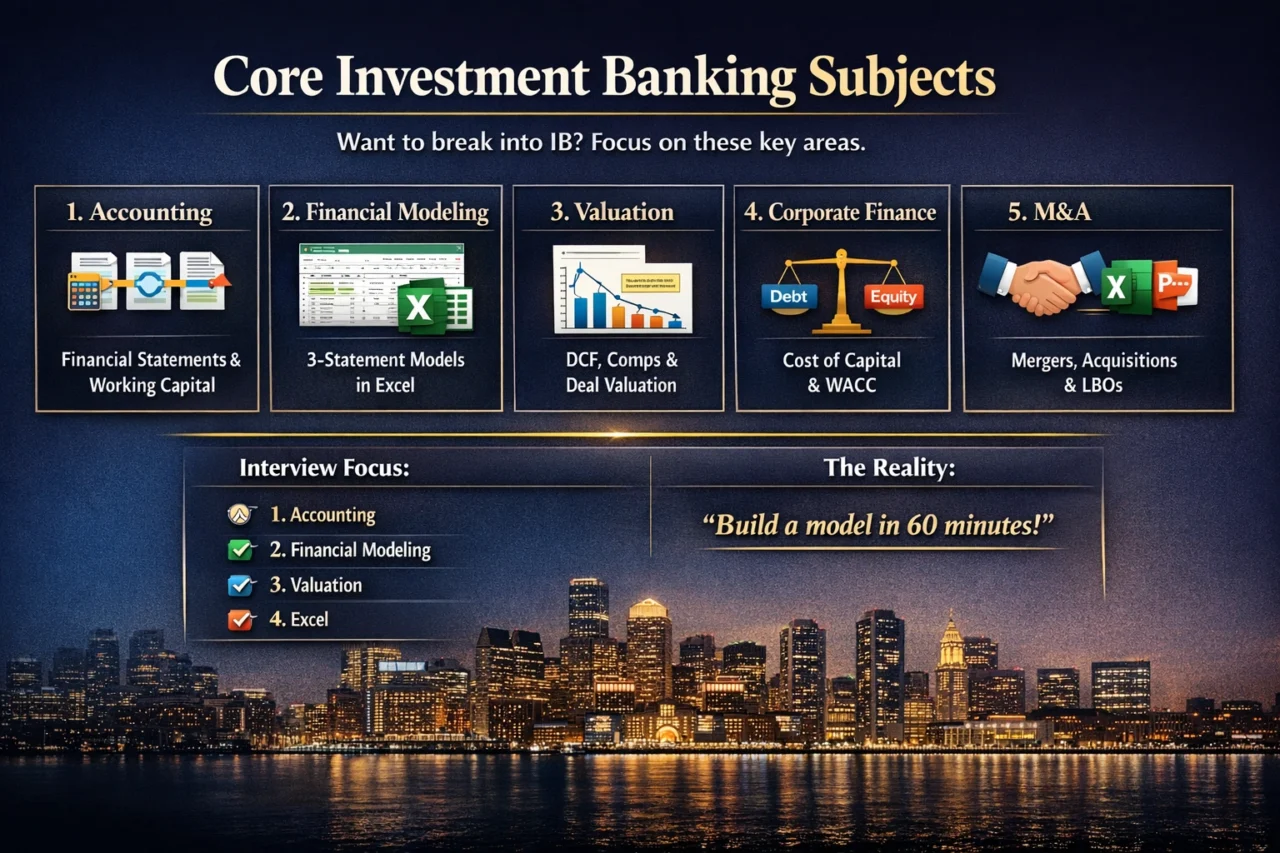
This guide explains the key investment banking subjects you need to master, how they map to real tasks, and how a course or self-study can land you a job. Read this to understand what topics matter, which skills you’ll build, and how to structure study over weeks.
Core Investment Banking Subjects (Academic + Practical)
At the core, investment banking deals with business, business’s publish financial statements. Which is followed by investor analysts who try to make sense of the these financial statements, using certain tools. Eventually after this the final leg of work is decision making and risk management. Given that this would the flow of actual investment banking work, now lets discuss the investment banking subjects.
Financial Accounting & Statement Analysis
Financial statement analysis is the first and is one of the most important investment banking subjects. All information about a companies information is solely primarily based on the published income statement, balance sheet and cash flow statement. Now when I mention financial statement analysis, it might appear so that this is straight forward and simple. However the reason for this being so important is because it includes
- Read income statement balance sheets, and cash flow statements.
- Learn to makeadjustments: non-recurring items, one-offs, and normalized earnings.
- Real use: check “quality of earnings” and spot accounting tricks in due diligence.
Example of Its Importance
Let me try to prove this point , look the information below. Which company do you think probably has better earnings quality?
| Metric | Company A | Company B |
|---|---|---|
| Revenue | ₹500 Cr | ₹500 Cr |
| EBITDA | ₹100 Cr | ₹105 Cr |
| Net Profit | ₹60 Cr | ₹62 Cr |
| Growth | 10% | 12% |
Ofcourse at the surface level looks like company B is better, thats where adjustments and analysis becomes important. Now look at the adjustments below.
The analyst on looking deeper finds that company B recognises revenue aggressively( revenue recognition principles). Also that company B deals financially with relatives business’s. Both of which are a red flag for poor governance.
| Adjustment Item | Company A | Company B |
|---|---|---|
| One-time gains | ₹0 | ₹15 Cr |
| Aggressive revenue recognition | No | Yes |
| Capitalized expenses | ₹2 Cr | ₹10 Cr |
| Related party transactions | Minimal | High |
Finally the analyst adjusts and creates a new normalised earnings report, which shows that Company A now is better than company B.
| Metric | Company A | Company B |
|---|---|---|
| Reported EBITDA | ₹100 Cr | ₹105 Cr |
| Less: One-time items | ₹0 | (₹15 Cr) |
| Less: Capitalized expenses | (₹2 Cr) | (₹10 Cr) |
| Adjusted EBITDA | ₹98 Cr | ₹80 Cr |
Hence, financial statements understanding is the most important investment banking subjects of all.
Corporate Finance
Corporate finance falls under one of the hidden investment banking subjects. Its not vast but some of the critical topics can be the difference between win or loss. Corporate finance has the following major coverage;
- Capital budgeting- this is the decision making tool on allocation of capital to the most efficient returns on investments. Key topics include
- Net Present Value (NPV)
- Internal Rate of Return (IRR)
- Payback Period
- Project cash flow estimation
- Cost of Capital- each source of money has an associated cost, and deciding on the proportion of debt vs equity. Key topics include
- Cost of equity (CAPM)
- Cost of debt
- Weighted Average Cost of Capital (WACC)
- Capital Structure- What is the optimum mix of debt vs equity
- Debt vs equity mix
- Leverage impact
- Modigliani-Miller theory
- Trade-off theory
- Working capital Management-Understanding of short term obligations management
- Accounts receivable & payable
- Inventory management
- Cash conversion cycle
Although these data points are internal to a company, but the analyst should understand these topics as a part of his investment banking syllabus.
Capital Market Structure & Instruments
So, after knowing tools like financial statement analysis, what are you eventually valuing. And its not always plain common equity. There are can be many types of equity securities. Moreover, there can be also multiple routes of raising capital. The same also goes with debt instruments. I have listed below some important coverage that should be a part of investment banking course syllabus
Equity Capital Markets (ECM)
Study IPOs, follow-on offers, rights issues, and book-building.
Learn pitchbook structure and how to pick market timing for offerings.
Valuation Techniques
DCF project cash flows and discount them to present value.
Comparable company analysis (comps) value relative to peers.
Precedent transactions look at prices paid in similar deals.
Real pitch use: choose the right valuation method and explain assumptions.
Debt Capital Markets (DCM)
Learn about bonds, term loans, and credit rating basics.
Study structured finance, securitisation, and leveraged loans.
Mergers & Acquisitions (M&A)
Mergers and Acquisitions (M&A) refers to the process where companies combine (merger) or one company purchases another (acquisition) to achieve strategic goals such as growth, market expansion, cost efficiencies (synergies), or competitive advantage. It is a core function in investment banking and corporate finance because it directly impacts company valuation, capital structure, and long-term strategy. For a candidate, learning M&A is crucial because it integrates multiple high-value skills—financial modeling, valuation, accounting, and strategic thinking—into real-world deal execution. More importantly, M&A concepts are heavily tested in interviews (e.g., accretion/dilution, deal structuring, synergies), and mastering them signals that a candidate can think like an investor or advisor, not just a student.
Understand the deal process: target screening → valuation → execution.
Learn accretion/dilution analysis and basics of due diligence.
Market Analysis & Macroeconomics
Understand interest rates, inflation, GDP growth, and their effects.
Know FX markets, central bank actions, and the yield curve’s meaning.
Financial Modeling (Practical)
This is where all of the above investment banking subjects come into the application level. This is the combination of the following concepts practically
- Excel and advance excel
- Financial mathematics
- Ratio analysis
- Project Finance & Equity valuation
Advanced & Specialised Investment Banking Subjects (Tier 2 skills)
Supporting subjects like Market Analysis, Macroeconomics, Risk Management, and Derivatives help bankers understand market conditions and manage financial risk. Together, these subjects build the technical, analytical, and presentation skills required for roles such as Investment Banking Analyst, Equity Research Associate, Corporate Finance Executive, and Capital Markets Analyst.
Risk Management
Market risk, credit risk, and Value at Risk (VaR).
Learn regulatory capital rules (Basel norms) and stress testing.
Derivatives & Structured Products
Options, futures, swaps basics and use cases.
Learn how derivatives hedge risk or create structured payoffs.
Portfolio Management & Wealth Advisory
Asset allocation, diversification, and portfolio optimization.
Learn practical tools used by asset managers and PMs.
Investment Banking Technology Tools
Bloomberg, Capital IQ, and other market data platforms.
Automation: Python for finance, VBA in Excel, and AI tools used in deal sourcing or research.
Typical Investment Banking Course Syllabus
Most good courses follow a three-phase path: Foundation to Core to Advanced. Below is a sample 12-week plan you can adapt.
Sample structure
| No. | Subject | Learning Outcome |
| 1 | Accounting basics | Read financial statements |
| 2 | Advanced accounting adjustments | Normalize earnings |
| 3 | Corporate finance fundamentals | NPV, IRR, WACC |
| 4 | Valuation I | DCF building |
| 5 | Valuation II | Comps & precedent transactions |
| 6 | Financial modeling I | 3-statement model setup |
| 7 | Financial modeling II | Forecasting & linking statements |
| 8 | M&A theory | Deal process & accretion/dilution |
| 9 | ECM & IPO mechanics | Pitchbook & market timing |
| 10 | DCM & credit | Bond math & ratings |
| 11 | Derivatives & risk | Options basics & VaR |
| 12 | Case study & mock test | Full model + presentation |
Assessment types: MCQs for theory, case studies for application, timed modeling tests for speed and accuracy.
Investment Banking Syllabus For IB Operations
Deals and valuations are just two aspects of investment banking. Investment banking operations the teams that make sure trades, funds, and securities move smoothly and safely power a sizable portion of the sector. These positions are the foundation of many entry-level finance positions in India.
1. Basic Tools for Finance (Excel & Financial Math)
What you learn
Excel fundamentals for finance (VLOOKUP, INDEX-MATCH, Pivot Tables)
Financial mathematics: TVM, NPV, IRR, XIRR, MIRR
Basic statistics and return calculations
Why it matters
Excel is tested in almost every finance interview
Used daily for reporting, reconciliations, and analysis
Job relevance
Operations Analyst
Financial Analyst
Trade Support Analyst
2. Investment Banking Foundation
What you learn
Basic trading terminology
How investment banks are structured
Roles of front, middle, and back office
How trades flow across departments
Why it matters
Helps you understand how banks actually work
Interviewers expect this conceptual clarity
Job relevance
Investment Banking Operations Analyst
Capital Markets Operations
KPO / Offshore Banking Roles
3. Equity Markets
What you learn
Market structure (primary vs secondary markets)
Equity securities and market indices
Order types, execution, clearing instructions
Why it matters
Essential for roles supporting equity trading desks
Helps understand how stock market transactions settle
Job relevance
Equity Operations Analyst
Market Operations Executive
Research Support Roles
4. Derivatives (Futures, Options, Swaps)
What you learn
Exchange-traded vs OTC derivatives
Pricing basics of futures and options
Hedging, arbitrage, and risk concepts
Why it matters
Derivatives desks require strong process accuracy
Common interview topic for global banks
Job relevance
Derivatives Operations Analyst
Risk & Control Analyst
Middle Office Roles
5. Fixed Income Markets
What you learn
Bonds, yields, duration, and credit risk
Issuance and trading of debt instruments
Repos and short-term funding
Why it matters
Fixed income dominates institutional trading. Strong demand in global capability centers (GCCs)
Job relevance
Fixed Income Operations
Treasury Support Analyst
Debt Market Operations
6. Trade Life Cycle (MOST IMPORTANT OPERATIONS SUBJECT)
What you learn
Trade execution and capture
Confirmation, settlement, and reconciliation
Role of custodians and clearing corporations
Settlement failures and funding of trades
Securities lending and borrowing
Why it matters
Core knowledge for investment banking operations jobs
Frequently asked in interviews
Job relevance
Trade Settlement Analyst
Custody Operations
Clearing & Reconciliation Analyst
7. Risk Management & AML/KYC
What you learn
Market and operational risk basics
AML guidelines and KYC processes
Regulatory expectations and compliance
Why it matters
Banks focus heavily on compliance and risk
Mandatory knowledge for regulated roles
Job relevance
Risk Analyst
AML / KYC Analyst
Compliance Operations
8. Corporate Actions & Asset Management Basics
What you learn
Dividends, bonus issues, splits, mergers
ESG and governance concepts
Mutual funds and asset management structure
Why it matters
Corporate actions errors can cause huge losses
Important for custody and fund operations roles
Job relevance
Corporate Actions Analyst
Fund Operations Analyst
Asset Management Support
9. Communication & Interview Preparation
What you learn
Professional communication
HR interview handling
Technical interview practice (markets, equity, fixed income)
Why it matters
Operations roles require accuracy + communication
Improves placement success
What Roles Do These Investment Banking Subjects Prepare You For?
Investment banking Subjects to Career Mapping
| Subject | Job Role | Example Task |
| Valuation | Investment Banking Analyst | Build DCF for acquisition |
| Financial Modeling | Equity Research Associate | Project financials for reports |
| Market Analysis | Capital Markets Associate | Advise on IPO timing |
| Corporate Finance | Corporate Finance Executive | Evaluate project financing |
| Risk Management | Risk Analyst | Run stress tests on loan portfolios |
Internships & pipeline: Many students start with internships, work in KPOs or boutique firms, and then move to larger banks or buy-side roles.
Top Investment Banking Course Syllabus That Cover These Subjects
| Provider | Program Name | Duration | Price (approx.) | Placement Support |
| NSE Academy / CIIB | Certificate in Investment Banking | 3–6 months | Medium | Limited to network |
| Imarticus / Wall Street School | Advanced IB & Modelling | 6–12 weeks | Medium–High | Yes (career services) |
| Mentormecareers | Certified Investment Banking Analyst | 3.5 Months | Medium -Low | Guranteed Placements |
| UpGrad / Great Learning | PG programs in Finance | 6–12 months | High | Yes (placements) |
| Boutique providers | Financial Modeling Bootcamps | 2–6 weeks | Low–Medium | Mock interviews |
Where to start: internships or KPO roles (TresVista, boutique IBs) give hands-on model-building practical models.
Conclusion Investment Banking Course Syllabus
The technical tools and confidence you gain from investment banking subjects will teach you how to value companies, build financial models, and make recommendations to work on deals that are often worth hundreds of millions of dollars.
If you are starting out, choose a course that has lots of hands-on modeling, mock interviews, and real case studies.
Get a free 1-on-1 counseling session to pick the right course?
Book a free call with our career mentors
FAQ Investment Banking Subjects
The main investment banking subjects include financial accounting, corporate finance, valuation, financial modeling, mergers & acquisitions (M&A), equity and debt capital markets, and market analysis. These form the core skill set used in IB roles.
Yes. Non-finance students (engineering, science, arts) can learn investment banking subjects with proper training. Many courses start from basics like accounting and Excel before moving to advanced valuation and deal analysis.
Financial modeling and valuation are the most important subjects. They are used daily to analyze companies, price deals, and support M&A, IPOs, and fundraising decisions.
They are necessary but not always sufficient. Along with subjects, recruiters expect practical Excel skills, internships, case studies, and interview preparation to convert knowledge into a job offer.
You can practice by building Excel models, analyzing annual reports, valuing listed companies, following live deals, and solving case studies. Free resources like company filings, investor presentations, and mock interview questions also help.
Related Articles
- How to become an Investment Banker in India?
- Investment Salary in India
- Scope of investment analysis
- Scope of investment banking
- Importance of corporate finance
- Top 10 finance for commerce graduates in India