
Last updated on February 16th, 2026 at 06:19 pm

Aml analyst or kyc aml analyst are much needed in finance sector. As technology advances, so do the methods used by criminals. This makes the work of AML and KYC analysts even more vital. They must stay updated on the latest trends in financial crime and utilize advanced tools and software to detect anomalies in financial transactions. Their expertise not only helps in preventing losses but also protects the reputation of the organizations they work for.
Moreover, the demand for aml analysts is growing across various sectors, including banks, investment firms, and insurance companies. Organizations are increasingly investing in training and resources to build strong compliance teams. This trend highlights the importance of having skilled professionals who can navigate the complex landscape of financial regulations and ensure that organizations operate within the law. If you are passionate about Legal and Finance this might be the best job for you!
Finance is the sector where there is maximum chance of frauds and money laundering. Money is a important asset for organizations and also individuals working for the organizations. Organizations need team to handle the situations of frauds and money laundering. As financial crimes are increasing and getting more sophisticated. Need for individuals who can analyze and solve these issues is increasing.
Who is AML Analyst?
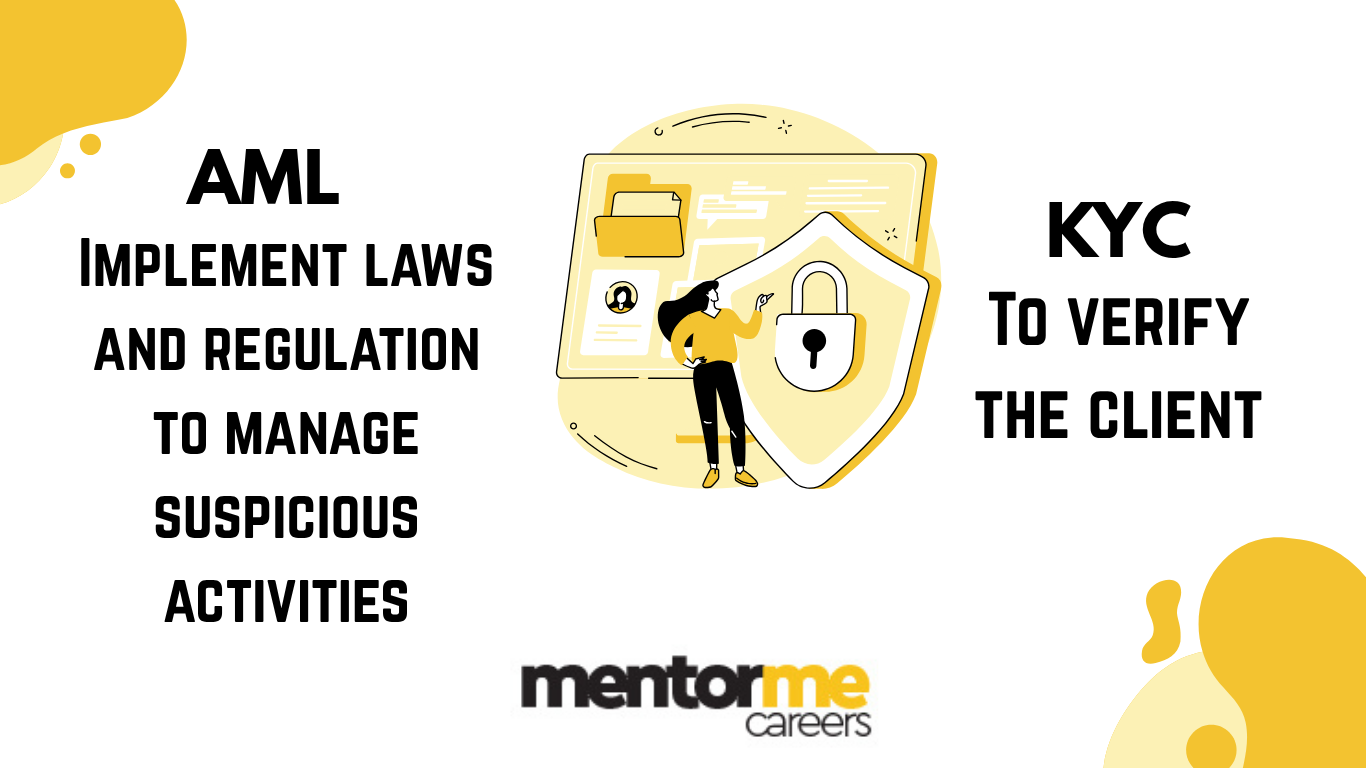
Aml analysts professionals play a crucial role in safeguarding the integrity of financial institutions. An AML (Anti-Money Laundering) analyst is responsible for monitoring transactions, identifying suspicious activities, and ensuring compliance with regulations designed to prevent financial crimes. Similarly, a KYC (Know Your Customer) AML analyst focuses on verifying the identities of clients and assessing their risk levels to prevent potential fraud. Why aml analyst are important is because they safeguard any risky financial activity happening around.
The main tasks of aml analyst includes:
Monitoring:
Analyzing large volume of data, financial data to detect any weird activity patterns like layering, smurfing, structuring. Tracking the account movement including location, amount, time and date. Basically analyzing any out of line activities.
Verification:
Proper kyc (know your customer) steps taken is verified by aml kyc analyst. Verifying customer’s identity, going by the rules and regulations of kyc is the main role, also performing the due diligence on high risk clients. Every customer has to go through kyc for any account.
Suspicious Activity Reporting (SAR):
Investigating red flags like changed patterns in the transactions and escalate it by filing suspicious transaction report (SARS). Reporting fraud and any anti-terrorist financing. This is also one of the types of anti-money laundering.
Compliance documentation:
Drawing and maintaining the documentation for internal and external teams. Keeping a check on new regulations and implementing them. Managing audit ready documentations.
Risk Assessment:
Evaluate the AML risk associated with certain clients, geographies, or transaction types. Investigating and assessing the financial risks posed by a company’s operations. Mitigating money laundering risk.
Essential skills & qualifications an aml analyst needs
Generally, these roles don’t need much advanced level skills that we speak of. The skill level is basic easy to learn, most of skills include soft skills which maximum candidates already have.
Critical Thinking
To make the right decisions in any situation critical thinking is important for any role in the industry. An ability to think from all of the perspectives, brainstorming is essential part of being a aml analyst.
Interpersonal skills
Interpersonal skills are needed in day-to-day role of kyc aml analyst as they have to work with teams and understand the problem, effective find a solution. They build relationship which help professionals in difficult situations, this also increase productivity at work.
Technology skills
Knowing the tools and software to be used for the activites also having basic computer knowledge to maintain documents, file reports and utilize tools effectively. An AML analyst relies heavily on advanced technology and specialized tools to detect suspicious financial activity, monitor transactions, and ensure compliance with global regulatory standards. Whether working in a bank, fintech firm, or financial services company, mastering the right tools is essential for any aspiring AML KYC analyst.
Communication skills
Kyc aml analyst must have good communication skills to explain the issues and writing the reports. Maintain relationships, work with teams for coming up with right solutions and strategies. To clear any doubts and problem while working on report.
Aml Analyst Certifications
There are national aml certifications and also global certifications for aml. The certifications given below are for training and placement. These certifications will enable you to enter into anti-money laundering field easily.
IIFB E-learning
Indian Institute of banking & finance provides aml kyc certification is available which is remote. They provide virtual or live 2-3 days of workshop on kyc aml certifications. IIBF has exam and also preparatory training which is optional. The exam is of 2 hours and doesn’t need much of preparation within 3-4 days you will be done preparing for the exam. IIBF kyc aml certification is recognized by RBI, FIU-IND, test is MCQ based.
Mentor me careers
Mentor me careers provides proper guided course which is for 1.5 months. In this course syllabus starts from basic to advance where mentor me careers also cover the core topics needed to understand in kyc aml analyst role. This course can be done self paced as students get login to their individual portal for the study material and videos. This course is more practical application driven than theory which helps students understand the application of the role they are aiming. In future thus helps getting a good job role in this field which mentor me career also help with. This is the course you need to reach your goal to be a kyc aml analyst.
Click here to know more about this course!

AML career Path
Getting into aml kyc doesn’t need a specific degree or background. This is a skill which be mastered as you learn more about finance and security. AML don’t have a specific anti money laundering career path but here is a common path you can refer to know the future in aml.
Stage 1: Entry level (0-2 years)
Roles
KYC Executive
AML Analyst (Junior)
Client Due Diligence (CDD) Analyst
Key Responsibilities
Customer identity verification (KYC)
Document checks (PAN, Aadhaar, Passport, etc.)
Basic customer risk profiling
Reviewing low-risk alerts
Updating compliance records
Skills Required
Basic AML & KYC knowledge
Attention to detail
Documentation & reporting
Communication skills
Certifications (Helpful)
IIBF AML/KYC
Entry-level AML certifications
Salary (India)
₹3–6 LPA
Stage 2: Transaction Monitoring Analyst (2–4 Years)
Roles
Transaction Monitoring Analyst
AML Operations Analyst
Key Responsibilities
Monitoring large volumes of transactions
Identifying suspicious patterns:
Structuring
Smurfing
Layering
Escalating alerts
Writing investigation summaries
Skills Required
Analytical thinking
Understanding of AML typologies
Excel, dashboards, AML tools
Salary (India)
₹5–8 LPA
Stage 3: AML Investigator / Senior AML Analyst (4–6 Years)
Roles
AML Investigator
Senior AML Analyst
Key Responsibilities
End-to-end investigations
Drafting & filing SAR / STR reports
Handling high-risk customers (EDD)
Interacting with regulators & auditors
Mentoring junior analysts
Skills Required
Risk assessment
Strong report writing
Regulatory understanding
Case management systems
Salary (India)
₹7–12 LPA
Stage 4: AML Manager / Compliance Manager (6–10 Years)
Roles
AML Manager
Compliance Manager
Risk & Compliance Lead
Key Responsibilities
Managing AML teams
Designing AML frameworks
Ensuring regulatory compliance
Audit & inspection handling
Training internal teams
Skills Required
Leadership
Regulatory expertise
Stakeholder management
Strategic decision-making
Certifications (Recommended)
CAMS (Certified Anti-Money Laundering Specialist)
Advanced compliance certifications
Salary (India)
₹12–20+ LPA
Stage 5: Leadership / Specialist Roles (10+ Years)
Roles
MLRO (Money Laundering Reporting Officer)
Head of AML
Chief Compliance Officer (CCO)
Financial Crime Risk Head
Key Responsibilities
Enterprise-wide AML strategy
Regulatory reporting
Risk governance
Policy design
Board-level reporting
Salary (India)
₹20–40+ LPA (can go higher in MNCs & global banks)
AML analyst job descriptions
Mainly as a fresher you are expected to know basics of aml kyc and be good with communication also if you know any tools related to aml kyc then its a add on.
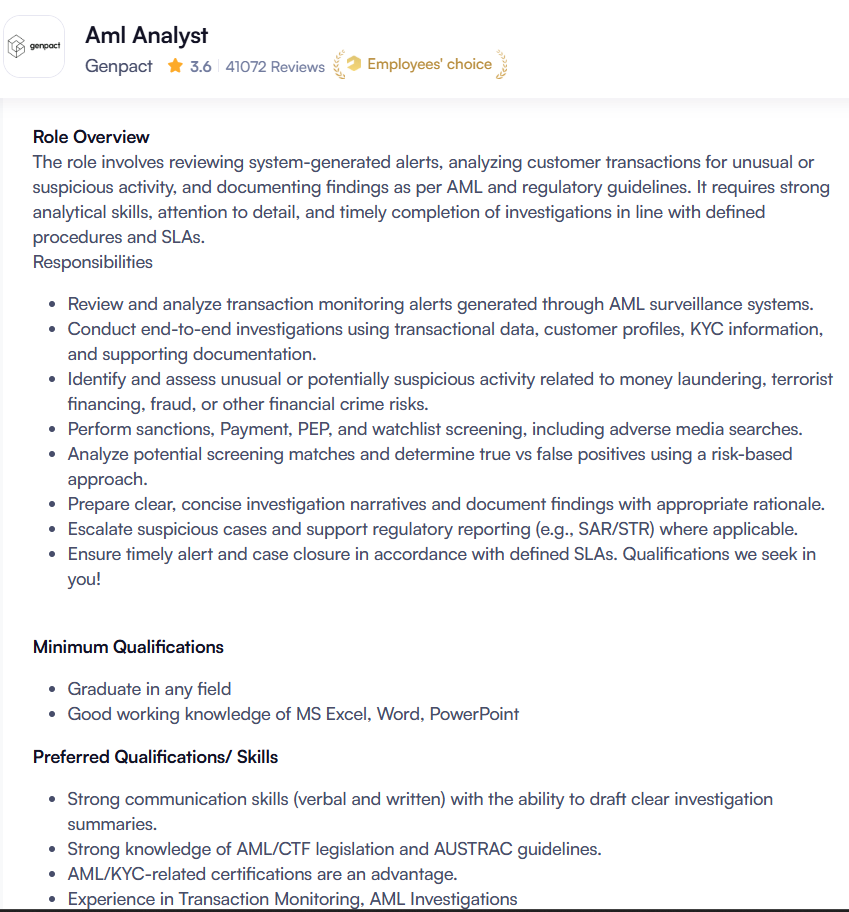
Naukri.com
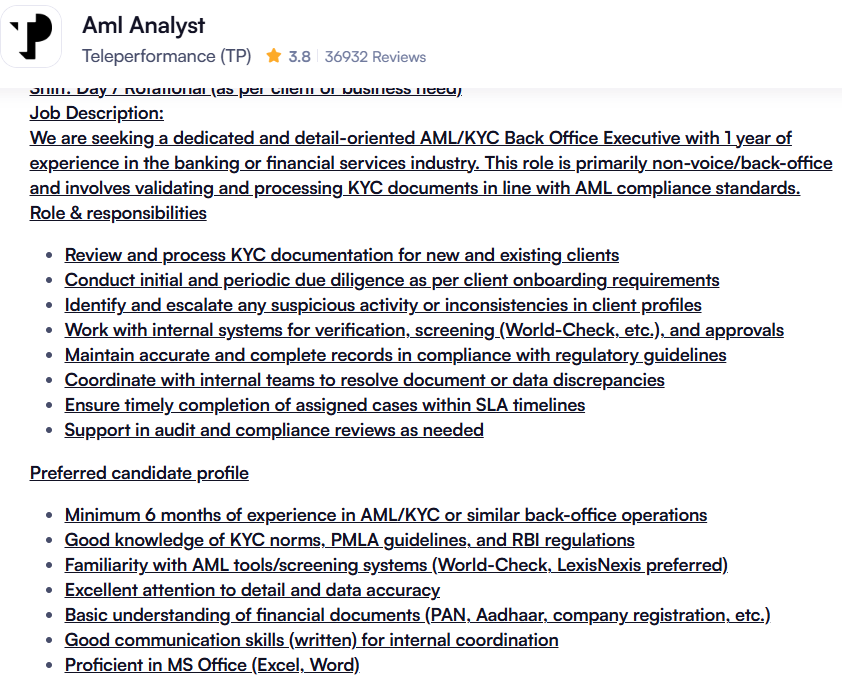
Source: Naukri.com
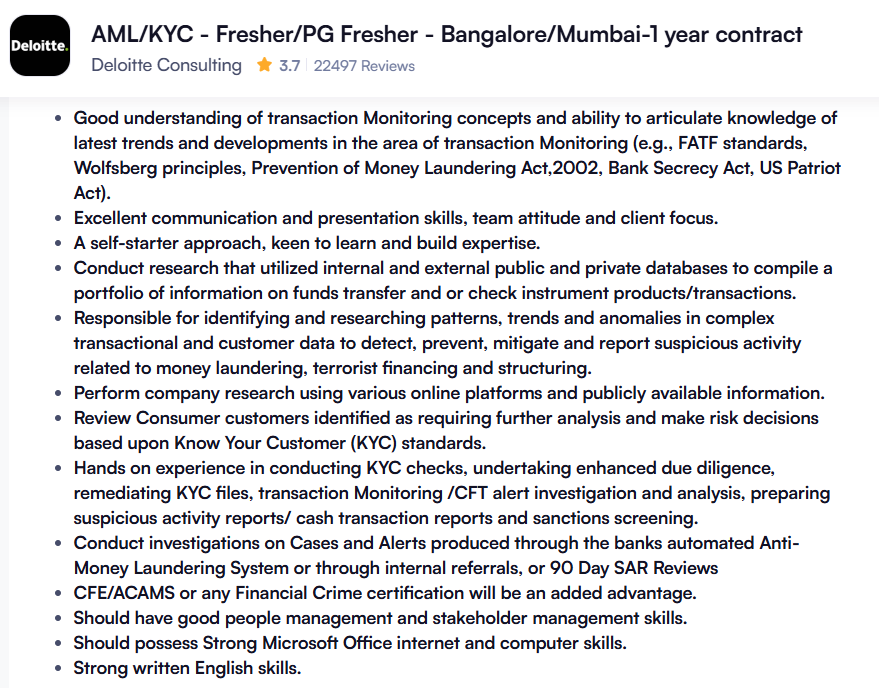
Naukri.com
Tools used by AML Analyst
One of the most important categories is Transaction Monitoring Systems (TMS). Tools like Actimize (by NICE), SAS AML, and Oracle FCCM help AML analysts automatically detect red flags in large volumes of financial data. These systems are rule-based or AI-driven and are designed to flag potential money laundering behaviours such as structuring, layering, and circular transactions.
In addition to monitoring, AML KYC analysts also rely on KYC and customer screening tools. Platforms like World-Check, LexisNexis, and are used to screen individuals against global watchlists, politically exposed persons (PEPs), and negative media. For real-time ID verification, tools such as Trulioo, Jumio, and offer facial recognition and document verification capabilities.
Another key area is case and workflow management. AML professionals use platforms like Actimize Case Manager, and custom-built CRM tools such as Salesforce to track the progress of investigations, manage alerts, and maintain documentation for regulatory audits.
To analyze large datasets, AML analysts frequently turn to Excel, SQL, and increasingly, Python for automation and risk scoring. Visualization tools like Power BI and Tableau are also used to create dashboards and identify trends in suspicious activity.
In short, a successful AML analyst or AML KYC analyst must be proficient in a mix of compliance platforms, data tools, and investigative software to effectively safeguard financial systems from illicit activity.
Global AML KYC Regulatory Bodies
1. Financial Action Task Force (FATF)
Role: Global standard-setter for AML & Counter-Terrorist Financing (CTF)
Key Functions:
Issues 40 AML recommendations
Evaluates countries via mutual evaluations
Maintains:
Grey List (increased monitoring)
Black List (high-risk jurisdictions)
Why It Matters for AML Analysts:
National AML laws are aligned with FATF standards
AML risk assessments and SAR filings are FATF-driven
2. International Monetary Fund (IMF)
Role: Financial stability & AML capacity building
Key Functions:
Helps countries implement AML frameworks
Conducts AML/CFT assessments
Works closely with FATF
3. World Bank
Role: AML implementation & governance support
Key Functions:
Supports developing countries in AML compliance
Provides technical assistance & risk frameworks
Focus on corruption & illicit financial flows
4. Egmont Group
Role: Global network of Financial Intelligence Units (FIUs)
Key Functions:
Secure information sharing between FIUs
Supports cross-border AML investigations
Why Important:
India’s FIU is a member
SAR/STR data sharing internationally
5. United Nations Office on Drugs and Crime (UNODC)
Role: AML laws, terrorism financing & drug crime prevention
Key Functions:
Drafts AML model laws
Assists countries in AML legal frameworks
Focus on terror financing & organized crime
AML & KYC Regulatory Bodies In India
India follows FATF-aligned AML laws, enforced by national regulators.
1. Reserve Bank of India (RBI)
Role: AML/KYC regulator for banks & NBFCs
Regulates:
Banks
NBFCs
Payment system operators
Responsibilities:
Issues KYC Master Directions
Conducts inspections & audits
Penalizes non-compliance
For AML Analysts:
Most KYC rules come from RBI circulars
2. Financial Intelligence Unit – India (FIU-IND)
Role: Central agency for receiving & analyzing STRs/SARs
Key Functions:
Receives:
Suspicious Transaction Reports (STR)
Cash Transaction Reports (CTR)
Shares intelligence with enforcement agencies
Why Important:
AML analysts file STRs to FIU-IND
Core reporting authority in India
3. Securities and Exchange Board of India (SEBI)
Role: AML regulator for capital markets
Regulates:
Stock brokers
Mutual funds
Portfolio managers
Investment advisors
AML Focus:
Investor KYC
Market manipulation
Insider trading
4. Insurance Regulatory and Development Authority of India (IRDAI)
Role: AML/KYC regulator for insurance sector
Regulates:
Life insurance
General insurance
Health insurance companies
AML Focus:
Policyholder KYC
High-risk insurance products
Premium payment monitoring
5. Ministry of Finance
Role: Policy-making authority for AML laws
Key Functions:
Oversees AML legislation
Supervises FIU-IND
Coordinates FATF compliance
6. Enforcement Directorate (ED)
Role: Enforcement of money laundering laws
Key Functions:
Investigates money laundering cases
Attaches assets under PMLA
Prosecutes offenders
For AML Analysts:
STRs may trigger ED investigations
7. Central Board of Direct Taxes (CBDT)
Role: Tax-related financial crime oversight
AML Link:
High-value transaction reporting
Black money & tax evasion tracking
Core AML low in India
Prevention of Money La undering Act (PMLA, 2002)
Defines:
Money laundering offences
Reporting obligations
Punishments & penalties
Role of FIU, ED, regulators
AML KYC Trends (2025-2026)
AI & Machine Learning Integration
Why It Matters
As financial crime becomes more sophisticated, traditional rule-based monitoring isn’t enough.
AI/ML is being used for:
anomaly detection
pattern recognition
link analysis
predictive investigations
What Recruiters Want
Experience with AI-driven AML tools
Understanding of how models reduce false positives
Ability to interpret AI alerts for investigators
Tools / Concepts to Learn
SAS AML with AI modules
NICE Actimize ML capabilities
Python for ML-driven risk scoring
Analysts who can blend compliance + AI literacy are in demand everywhere.
Robotic Process Automation (RPA) & Workflow Automation
Why It Matters
Repetitive tasks (KYB/KYC checks, SAR preparation, data extraction) are being automated.
Recruiters look for:
Knowledge of RPA tools (e.g., UiPath, Automation Anywhere)
Ability to optimize compliance workflows
Experience in reducing manual overhead
Impact
Faster alerts-responses
Lower operational cost
Higher analyst productivity
Blockchain & Crypto AML Compliance
Why It Matters
Crypto, digital assets, and DeFi are huge growth areas and weakly regulated yet highly targeted by criminals.
What employers want:
Understanding of blockchain analysis
Address clustering & transaction tracing
Crypto AML tools (Chainalysis, Elliptic, TRM Labs)
Very High Demand:
Crypto exchanges
FinTech firms
Global banks’ digital asset teams
API-Driven Risk & Data Integration
Why It Matters
Data used to be siloed (CRM, core banking, payment systems). Now real-time APIs allow:
instant KYC verification
automatic risk rule application
faster monitoring
Skills that help
Understanding API integrations
Using data from risk scores, PEP/sanction checks, watchlists
Building real-time alert dashboards
Cloud-Native AML Platforms
Why It Matters
Legacy on-prem AML systems are being replaced with cloud-hosted platforms.
Hiring managers want:
Familiarity with cloud setups (Azure, AWS)
Understanding how cloud improves scalability and monitoring
Knowledge of cloud-based data lakes for compliance
Global Sanctions & Geopolitical Risk Awareness
Why It Matters
Sanctions regimes change fast (Russia, Iran, Africa, East Asia, global finance).
Non-compliance is costly.
Skills employers prefer:
Up-to-date sanction lists
Ability to interpret sanction risk
Implementation of dynamic sanction rule sets
Compliance professionals who understand geopolitics = high edge
Cross-Border Payment Monitoring
Why It Matters
International transfers are prime avenues for money laundering.
Key skills:
SWIFT MT/MX formats knowledge
Technology that flags cross-border anomalies
Regulatory expectations for cross-border checks (FATF + national)
Integrated Risk Scoring Systems
Why It Matters
Instead of static risk categories, modern systems compute dynamic risk scores using ML + rule engine + behavior history.
Hireable capabilities:
Explaining risk models
Combining transaction risk + customer risk + watchlist risk
Building meaningful dashboards
Enhanced Due Diligence (EDD)
Why It Matters
EDD is not optional anymore especially for high-risk and cross-border customers.
What helps you stand out:
Performing EDD efficiently
Documenting investigations professionally
Escalating findings to compliance leadership
Investigative Storytelling for SARs
Why It Matters
A good SAR is not a checkbox. it’s a story demonstrating:
What happened
Why it’s suspicious
What evidence supports it
Strong communication + investigation skill = major advantage
Regtech & Compliance Platforms Mastery
Why It Matters
Regtech solutions are transforming AML workflows.
Recruiters value:
Expertise in tools (world-check, LexisNexis, AMLWatch, Trulioo)
Experience with data enrichment platforms
Ability to automate rule updates
ESG + AML Integration
Why It Matters
Environmental, Social & Governance risk factors are now considered in AML compliance.
Banks and regulators are connecting AML performance with ESG risk frameworks.
Understanding ESG + AML = future-ready skill.
High value AML roles in India
These jobs are growing in popularity:
| Role | Why It’s In Demand |
| Transaction Monitoring SME | Core compliance need |
| Crypto/Blockchain AML Analyst | Fastest-growing space |
| AML Tech & Automation Specialist | Reduces cost |
| AML Data Analyst with Python | Blends tech + compliance |
| AML Auditor | Quality & regulatory focus |
| Global Sanctions Analyst | Critical for multinational institutions |
Industries With Exploding AML/Hiring Needs
Banks & NBFCs
FinTech & Digital Payments
InsurTech
Investment Banking
Crypto & Digital Asset Exchanges
RegTech & Compliance Technology Companies
Consulting firms (Big 4 risk advisory)
India follows FATF-aligned AML laws, enforced by national regulators.
Market Demand
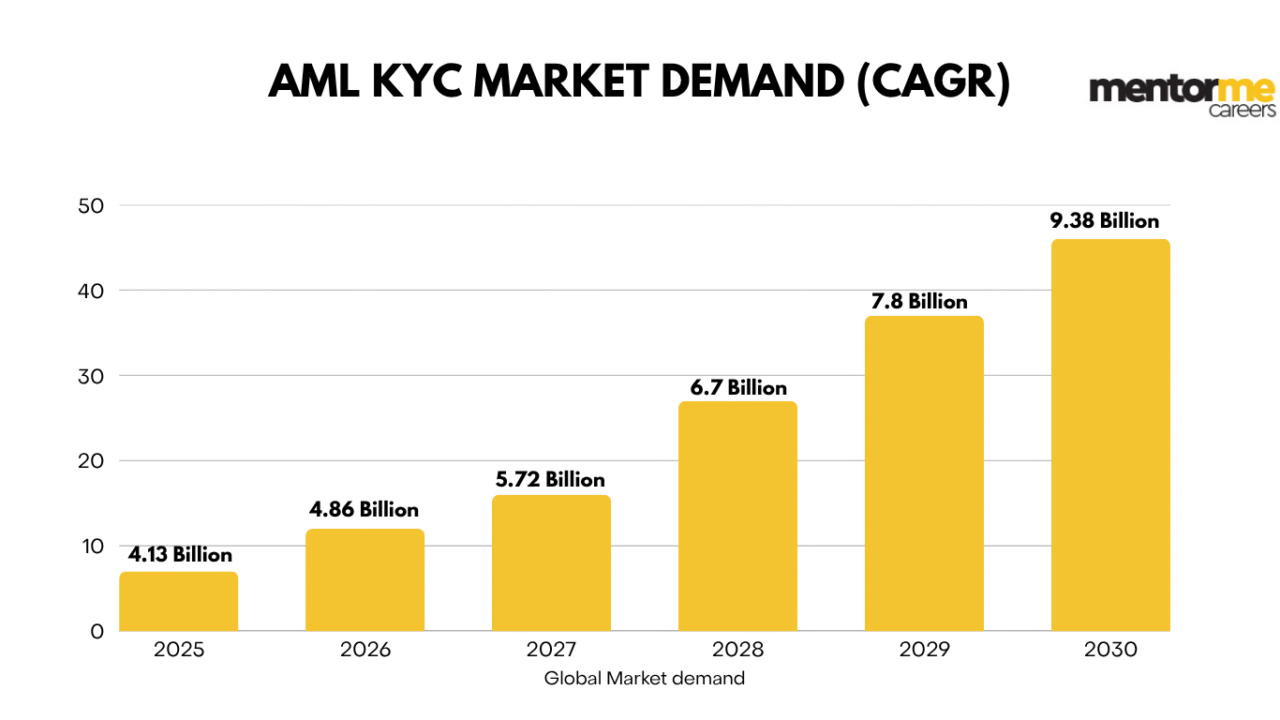
There is more need for professionals who want to pursue finance and especially kyc aml in finance. As the world is moving towards digital world and becoming more prone to frauds and money laundering. India or any country need professionals who can handle these situations save country’s money and keep the country safe from any crimes happening. Money is becoming more important for human kind than it ever has, more people are immigrating to urban cities in search of jobs and better life style. Money has increase and these have increased the chances of the digital crimes, frauds. If you go looking for jobs in this field and for these positions you will see many jobs, the demand never stops. Opportunity is there you just have to grab it and move forward for progression.
In conclusion, the finance sector is in dire need of AML and KYC analysts. Their work is essential in combating fraud and money laundering, ultimately contributing to a safer and more secure financial environment for everyone. As the industry continues to evolve, the role of these analysts will only become more significant, making it a promising career path for those interested in finance and compliance.
FAQ
With relevant skills and certifications, guidance not difficult at all to enter the industry.
Networking helps in times also try applying on LinkedIn and institutes like mentor me careers who help students get placed is too a great option.
Not much jobs in the market for work from home, the who are providing are international companies who need experienced individuals.