
“AML KYC Full Form” stands for Anti-Money Laundering, and “KYC” for Know Your Customer. Together, they form the cornerstone of financial compliance. Anti-Money Laundering laws prevent criminals from “cleaning” illicit funds by imposing rules on banks and other financial entities, while Know Your Customer is the process of verifying a customer’s identity to assess risk.
Just to give you the scale of the problem, check below the fine and penalties that banks had to bear for violation of Anti money laundering regulations. This is the major reason for the surge in AML jobs and regulations.
| Bank | Fine | Reason |
|---|---|---|
| BNP Paribas | ~$9 billion | Violated sanctions and facilitated illegal transactions |
| TD Bank | ~$3 billion | Major AML control failures and weak monitoring |
| HSBC | ~$1.9 billion | Allowed drug cartel money laundering |
| Westpac | ~$1.3 billion | 23 million AML reporting breaches |
| Standard Chartered | ~$1.6 billion+ | Sanctions violations and AML failures |
How Money Laundering Actually Happens Today?
Gone are the days when money laundering only happens with evading taxes, times have changed and so have the techniques. Below are some prominent ways on how money laundering works.
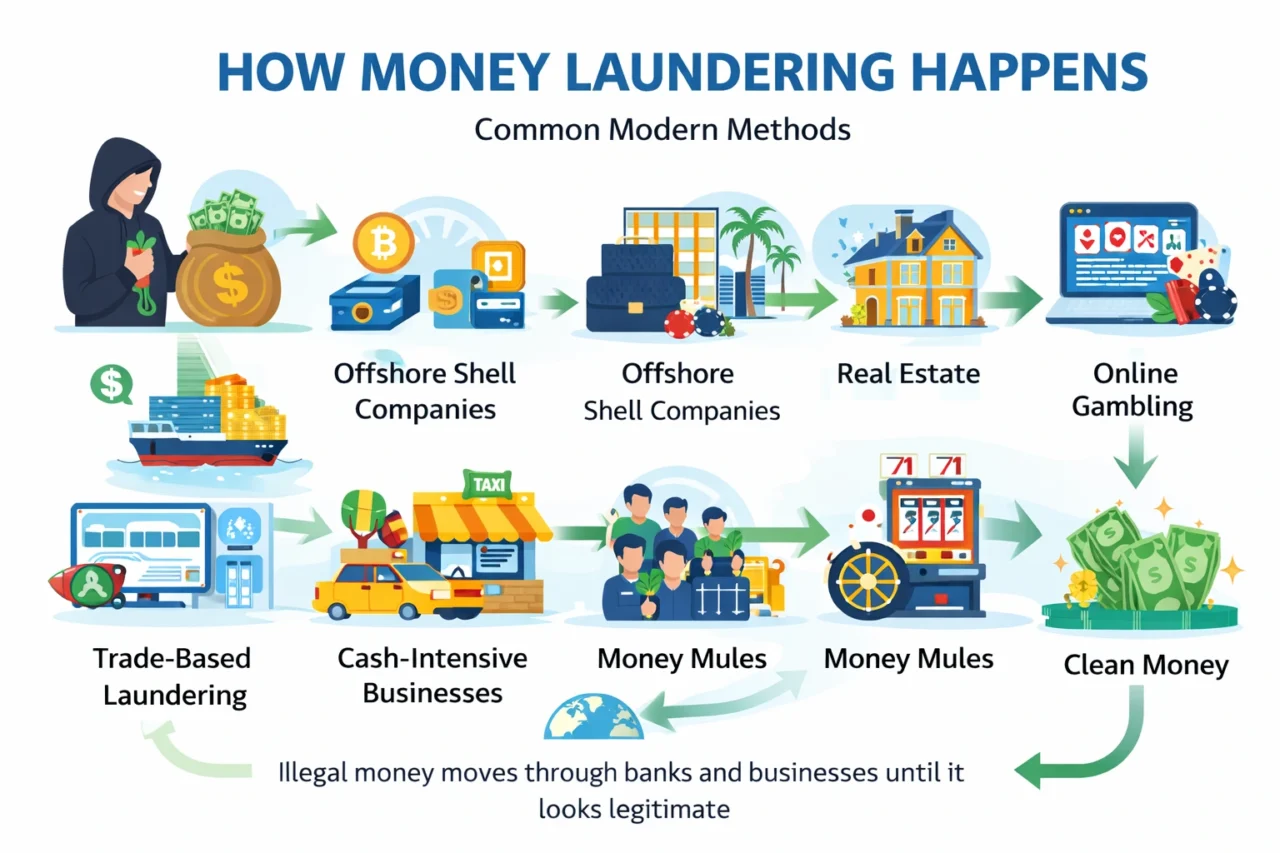
- Trade-Based Money Laundering (One of the Biggest Global Methods)
- Cryptocurrency Laundering
- Shell Companies and Offshore Structures
- Money Mules and Mule Accounts
- Cash Intensive business
- Gambling
- Real Estate Laundering
Stages of Money Laundering
Money laundering usually happens in three main stages, which criminals use to hide the illegal origin of money and make it appear legitimate.
- The first stage is placement, where the criminal introduces illegal money into the financial system.
- The second stage is layering, where the money is moved through multiple transactions to make it difficult to trace.
- The final stage is integration, where the money re-enters the economy as seemingly legitimate funds.
What is AML? (Anti-Money Laundering)
AML KYC Full form stands for anti money laundering. It refers to the broader set of laws and controls that target the process of money laundering. As the EU Commission explains, money laundering is the process criminals use to “clean” illicit profits and disguise their illegal origin.AML regulations require financial institutions to implement transaction monitoring, sanctions screening, and suspicious activity reporting. For example, FATF standards (the global benchmark) mandate a risk-based AML/CFT framework.
In India, AML measures are codified in the Prevention of Money Laundering Act (PMLA 2002, as amended), which obliges banks and other reporting entities to maintain transaction records and report suspicious cash/transaction reports to FIU-IND. In short, KYC is about identifying customers, while AML is about preventing misuse of the financial system
| Aspect | KYC (Know Your Customer) | AML (Anti-Money Laundering) |
|---|---|---|
| Scope | KYC is a component of AML compliance. It focuses on verifying the identity of customers during onboarding. | AML is the broader regulatory framework that includes KYC, ongoing monitoring, reporting, and controls to prevent financial crimes. |
| Purpose | KYC ensures the institution knows the true identity of the customer and helps prevent identity fraud. | AML aims to prevent the flow of illegal money through the financial system and detect suspicious financial activities. |
| Activities | Customer identification, document verification, address verification, and customer due diligence at onboarding. | Includes KYC plus transaction monitoring, sanctions screening, risk profiling, and filing Suspicious Transaction Reports (STRs). |
What is KYC in Banking & Finance (Know Your Customer)
KYC is the process whereby a bank or financial institution collects and verifies basic information about a customer (identity, address, business nature) at account opening The goal is to “know” the customer to prevent fraud or abuse. You might have come across a form like this if you were had any work related to a bank or financial services.
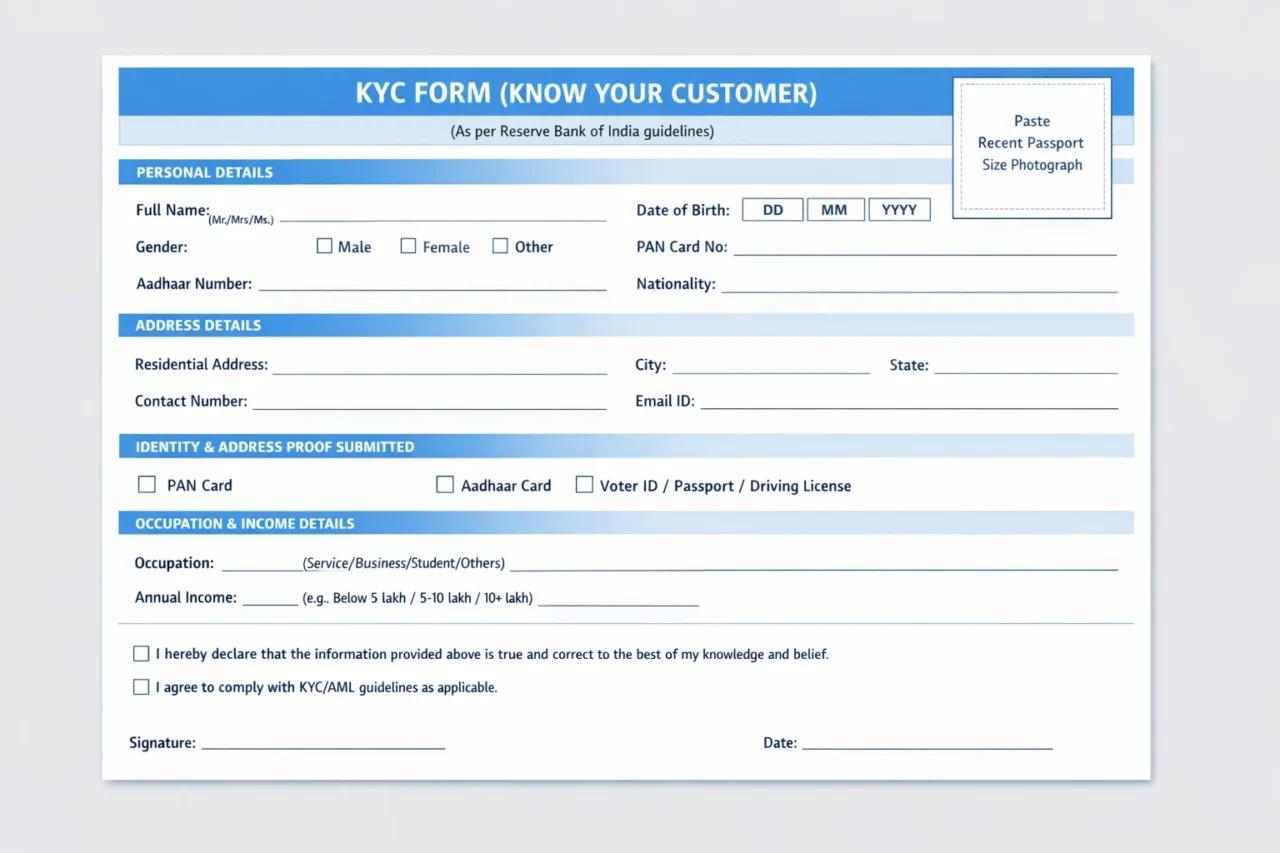
K. Effective KYC involves verifying government-issued ID, proof of address (utility bill, rental agreement, etc.), and, for companies, the ultimate beneficial owner. In India, the RBI’s KYC Directions (2016, updated 2023) require all Regulated Entities (REs) – banks, NBFCs, mutual funds, etc. – to conduct Customer Due Diligence (CDD) on clients KYC is typically done at onboarding and refreshed periodically.
Global AML/KYC Regulatory Overview
FATF (Global Standard)
United States
European Union
United Kingdom
Singapore
Hong Kong
India AML/KYC Laws & Guidelines
India follows strong AML (Anti-Money Laundering) and KYC (Know Your Customer) laws that align with global FATF standards.
1. Prevention of Money Laundering Act (PMLA), 2002 & Rules, 2005
The PMLA defines money laundering as a criminal offense. It requires reporting entities such as banks, NBFCs, financial institutions, and intermediaries to verify customer identities and report suspicious or large cash transactions.
2. RBI Master Direction on KYC
The Reserve Bank of India (RBI) issued the KYC Master Direction in 2016 and updated it in 2023.
Banks and NBFCs must follow these directions to conduct Customer Due Diligence (CDD). The 2023 update aligned RBI’s rules with the latest PMLA Rules and FATF standards.
RBI also requires institutions to follow a risk-based approach, where customers are categorized into low, medium, or high risk, and their KYC information is updated regularly.
3. FIU-IND Guidelines for Crypto / Virtual Digital Assets
India’s Financial Intelligence Unit (FIU-IND) issued guidelines for Virtual Digital Asset (VDA) service providers, including crypto exchanges. These rules require exchanges to:
- Register with FIU-IND
- Implement stronger KYC verification (such as live photo verification and geotagging)
- Verify bank accounts through small “penny-drop” transactions
- Report suspicious crypto transactions through STR filings
Anonymous crypto accounts or tokens are not allowed.
4. SEBI and IRDA Regulations
Other regulators such as SEBI (Securities and Exchange Board of India) and IRDAI (Insurance Regulatory and Development Authority of India) also enforce AML/KYC rules.
For example, SEBI requires mutual fund investors and brokerage clients to complete KYC verification through KYC Registration Agencies (KRAs), which includes identity verification and FATF screening.
AML/KYC Best Practices & Process
Financial institutions usually follow these steps to ensure proper AML/KYC compliance.
1. Collect Customer Information (KYC / CIP)
At onboarding, institutions collect basic customer details such as:
- Full legal name
- Date of birth
- Address
- Identity documents (PAN, Aadhaar, passport, etc.)
They verify these documents through e-KYC systems or in-person verification.
2. Perform Customer Due Diligence (CDD)
Compliance teams assess the money-laundering risk of each customer.
They evaluate factors such as the customer’s business activity, country of origin, and purpose of the account, and then classify the customer by risk level.
3. Conduct Enhanced Due Diligence (EDD)
If a customer has a high-risk profile (for example, a Politically Exposed Person (PEP) or someone linked to high-risk countries), institutions perform additional checks.
They may ask for proof of source of funds or source of wealth.
4. Monitor Transactions Continuously
Banks and financial institutions continuously monitor transactions using automated AML software.
These systems generate alerts if a transaction does not match the customer’s expected behavior or risk profile.
5. Screen for Sanctions and PEPs
Institutions regularly screen customers and transactions against global sanctions lists such as:
- United Nations (UN) sanctions lists
- OFAC sanctions lists
- EU sanctions lists
- Politically Exposed Persons (PEP) databases
They document and investigate any potential matches.
6. Report Suspicious Activity
If an institution detects suspicious activity, it must report it to regulators.
Common reports include:
- Suspicious Transaction Report (STR) for suspected money laundering or fraud
- Cash Transaction Report (CTR) for large cash transactions
RBI generally requires institutions to file an STR within 7 days of detecting suspicious activity.
7. Maintain Records
Institutions must maintain KYC records and transaction data for at least 5–10 years, as required by RBI and SEBI guidelines. These records must be ready for regulatory inspections.
8. Staff Training and Audits
Financial institutions must regularly train employees on AML/KYC rules.
They must also conduct independent audits to ensure compliance with RBI’s KYC Master Direction and other regulations
AML Compliance Checklist
- Identity Verification: Passport, PAN/Aadhaar, utility bills, etc. for individuals; incorporation docs and BO for entities.
- Risk Categorization: Assign risk levels; update on trigger events (e.g. new PEP status).
- Screening: Against sanctions lists and PEP/watchlists at onboarding and at review intervals.
- Transactions: Flag and review unusual transfers; file CTRs/STRs as per RBI/FIU limits.
- Reporting Entity Registration: Crypto/VDA providers must register with FIU-IND.
- Policy & Oversight: Board-approved AML policy; designated AML officer; regular training and compliance reporting.
Key Use Cases
| Use Case | Description | Example |
|---|---|---|
| Customer Onboarding | Financial institutions verify a customer’s identity before opening accounts to prevent fraud and ensure compliance. | Banks verifying PAN, Aadhaar, and address proof before opening a savings account. |
| Customer Due Diligence (CDD) | Institutions assess customer risk levels based on identity, occupation, transaction patterns, and geography. | A bank classifying a customer as low, medium, or high risk. |
| Enhanced Due Diligence (EDD) | Higher scrutiny for high-risk customers such as politically exposed persons (PEPs) or customers from high-risk countries. | Extra verification for a politician opening a bank account. |
| Transaction Monitoring | Banks monitor customer transactions to identify suspicious activity or unusual patterns. | Detecting frequent large transfers that do not match the customer’s profile. |
| Sanctions Screening | Institutions check customers against global sanctions lists to ensure they are not dealing with banned individuals or entities. | Screening customers against UN, OFAC, or EU sanctions lists. |
| Suspicious Activity Reporting | Financial institutions report suspicious transactions to regulators or financial intelligence units. | Filing a Suspicious Transaction Report (STR) to the Financial Intelligence Unit. |
| Ongoing Monitoring | Customer accounts are periodically reviewed to ensure continued compliance and detect new risks. | Periodic KYC updates required by banks every few years. |
Frequently Asked Questions (FAQs)
What are AML and KYC procedures?
AML (Anti-Money Laundering) and KYC (Know Your Customer) procedures are compliance processes that financial institutions use to prevent financial crimes such as money laundering, fraud, and terrorism financing. KYC focuses on verifying a customer’s identity during account opening, while AML includes broader monitoring activities such as transaction monitoring, risk assessment, sanctions screening, and reporting suspicious transactions to regulators.
What is AML in banking?
AML in banking refers to the set of policies, regulations, and monitoring systems that banks use to detect and prevent money laundering activities. Banks analyze customer transactions, identify unusual patterns, perform customer due diligence, and report suspicious activities to financial intelligence units. AML compliance is required by regulators worldwide to maintain the integrity of the financial system.
What is an AML KYC job?
An AML KYC job involves reviewing customer information, verifying identities, monitoring transactions, and ensuring that financial institutions comply with anti-money laundering regulations. Professionals in these roles analyze alerts, investigate suspicious activities, conduct customer due diligence, and prepare compliance reports. These roles are common in banks, financial institutions, consulting firms, and fintech companies.
What are the 4 pillars of AML KYC?
The four main pillars of an effective AML compliance program include:
- Internal policies and procedures to prevent money laundering.
- Appointment of a compliance officer responsible for AML oversight.
- Employee training programs to ensure staff understand AML risks and regulations.
- Independent audits and monitoring to evaluate the effectiveness of AML controls

A CFA charterholder with hands-on experience across investment analysis and finance education. At MentorMeCareers, he writes and reviews content on CFA, financial modeling, and investment banking careers — grounded in real market data rather than generic advice, and shaped by what actually helps candidates and professionals succeed.