
MENTOR ME CAREERS

CAMS & AML KYC Certification Course | MentorMeCareers
AML, KYC & Compliance Career Training

Get AML KYC Certified — India's #1 AML Career Programme

Placed in Goldman Sachs, Apex,Teleperformance,PWC,WNS  |  50K students enrolled Trained by MMC

50+ Companies Placed In
4.9★ Student Rating
100% Practical Training

Start Your AML Career

Speak with a course advisor about eligibility, fees, batches and placement support.

✓ Get a callback from our expert
✓ Real Learners. Real Placements.

AML KYC Placement Tracker

Our learners placed across AML, KYC, transaction monitoring, fraud detection and treasury roles.


Nisha G placed at WNS in Bangalore

Nisha G

Placed At
WNS
Bangalore
Gaurav Gupta placed at Teleperformance

Gaurav Gupta

Placed At
Teleperformance
Transaction Monitoring
Mumbai
Sangeeta Kumari placed at Teleperformance

Sangeeta Kumari

Placed At
Teleperformance
Transaction Monitoring
Mumbai
Vishaka Kanodia placed at Teleperformance

Vishaka Kanodia

Placed At
Teleperformance
Transaction Monitoring
Mumbai
Nikita Jadhav placed at Teleperformance

Nikita Jadhav

Placed At
Teleperformance
Transaction Monitoring
Mumbai
Roshan Patil placed at Teleperformance

Roshan Patil

Placed At
Teleperformance
Transaction Monitoring
Mumbai
Maria Charlson placed at Apex

Maria Charlson

Placed At
Apex
Transaction Monitoring
Bangalore
Gowtham P placed at Goldman Sachs

Gowtham P

Placed At
Goldman Sachs
Transaction Monitoring
Bangalore
Rohit Tambe placed at Teleperformance

Rohit Tambe

Placed At
Teleperformance
Fraud Detection
Mumbai
Chandana Versha placed at Goldman Sachs

Chandana Versha

Placed At
Goldman Sachs
Treasury Services
Bangalore

✅ What You’ll Be Able to Do After This AML KYC Course

This is not a theory-only AML certification course. You’ll learn practical AML/KYC workflows used in banking, compliance operations, transaction monitoring, sanctions screening and customer due diligence roles.

Understand real AML and money laundering red flags

Identify placement, layering, integration, suspicious customer behaviour and transaction risk indicators.

Perform KYC, CDD and EDD checks

Work on customer onboarding, beneficial ownership, high-risk customers, PEP checks and documentation review.

Handle transaction monitoring alerts

Understand alert triage, investigation, escalation, false positives, QA review and STR/SAR referral logic.

Work on sanctions and adverse media screening

Learn screening logic, match handling, adverse media relevance, escalation and risk-based decision-making.

Job-oriented AML training
These outcomes prepare you for AML analyst, KYC analyst, transaction monitoring, sanctions screening and compliance operations interviews.

🎥 See How AML KYC Jobs Actually Work

Watch this session to understand how AML/KYC operations work in real financial institutions, what recruiters expect in interviews and how transaction monitoring, sanctions screening and compliance workflows are handled practically.

Understand real AML/KYC analyst workflows used in banks and compliance teams.

Learn what interviewers ask in AML/KYC, transaction monitoring and sanctions roles.

Get clarity on AML career growth, compliance operations and job opportunities.

AML KYC Course
Syllabus & Modules

Job-Oriented Anti Money Laundering Course

This AML KYC certification course is designed for learners who want practical AML, KYC, transaction monitoring, sanctions screening and compliance skills. The program is suitable for learners looking for an anti money laundering course online, AML courses online, AML certification courses and job-focused AML training.

AML Certification KYC / CDD / EDD Transaction Monitoring Sanctions Screening Mock Interviews

Built for AML/KYC Job Roles

Learn practical workflows used in AML operations including customer due diligence, enhanced due diligence, adverse media screening, suspicious activity reporting, sanctions checks, risk-based approach and real compliance case studies.
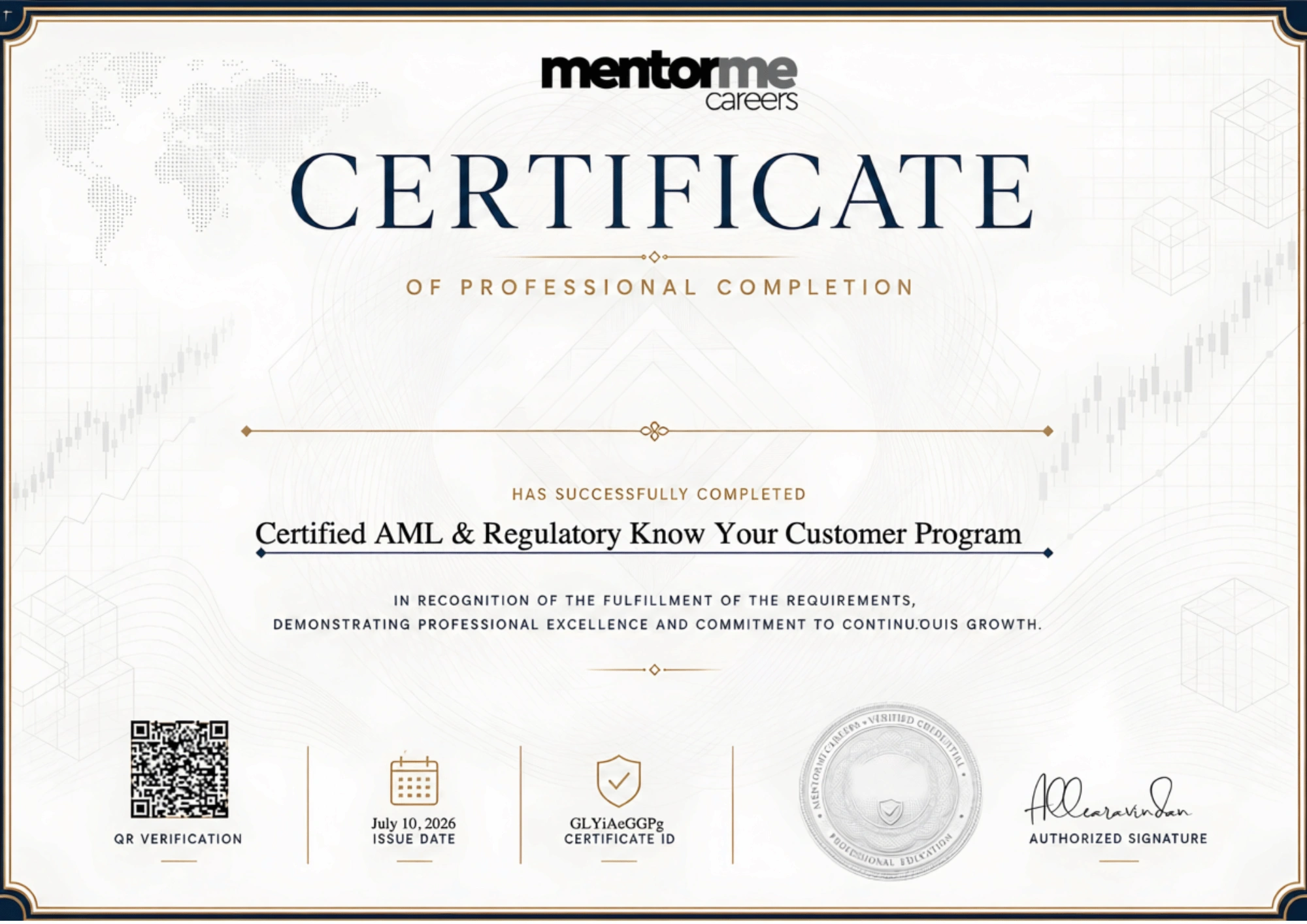
Industry Recognised Certificate - AML KYC Course
Industry Recognised AML KYC Certificate
Syllabus Overview
Module 1: Introduction to Money Laundering & Why AML Matters+

Build a strong foundation in money laundering, financial crime and the purpose of AML controls. This module explains how illegal funds are introduced, moved and made to appear legitimate, while also showing why banks and financial institutions invest heavily in compliance teams.

  • ML stages: placement, layering and integration: Understand how illicit funds enter the financial system, move through complex transactions and eventually reappear as apparently legitimate money.
  • Key red flags across customer and transaction segments: Learn to identify unusual behaviour such as unexplained cash activity, rapid fund movement, inconsistent profiles and complex ownership structures.
  • Regulatory, reputational and operational risk impact: Explore how weak AML controls can lead to penalties, licence restrictions, customer loss and serious damage to an institution’s reputation.
  • AML roles and career path: Understand the responsibilities and progression from AML analyst and investigator roles to quality assurance, team leadership and MLRO-level positions.
Module 2: Key Regulators & Legislations+

Learn how AML regulations are created, enforced and applied across financial institutions. The module introduces the legal and regulatory framework that guides customer verification, monitoring, reporting and record retention.

  • CDD, EDD, record-keeping and reporting requirements: Understand the minimum compliance obligations institutions must follow when onboarding and monitoring customers.
  • Regulatory governance and compliance expectations: Learn how regulators assess governance, internal controls, accountability and the effectiveness of an AML compliance program.
  • Practical AML training aligned with global standards: Connect regulatory principles with real operational workflows used by banks, fintech companies and compliance service providers.
Module 3: Transaction Monitoring+

Understand how financial institutions monitor customer transactions for unusual patterns and potential suspicious activity. This module focuses on the practical investigation process followed by transaction monitoring analysts.

  • Alert lifecycle: Follow the complete process from alert generation and triage to investigation, decision-making, quality review and possible STR referral.
  • Transaction red flags and unusual customer behaviour: Review examples involving sudden spikes in volume, round-value payments, rapid pass-through activity and transactions inconsistent with a customer profile.
  • Skills required for AML analyst roles: Develop analytical thinking, documentation, evidence review and decision-making skills needed in transaction monitoring teams.
Module 4: Negative / Adverse Media Screening+

Learn how adverse news and publicly available information are used to identify possible financial crime, corruption, fraud or reputational concerns connected with a customer or business.

  • Understanding adverse media and reputational risk: Identify the types of news that may indicate bribery, fraud, organised crime, sanctions exposure or other serious concerns.
  • Screening workflow and relevance assessment: Learn how to distinguish a true match from irrelevant information by checking names, dates, locations, organisations and contextual details.
  • Documentation and escalation: Understand how material findings are recorded, risk-rated and escalated for enhanced review or approval.
Module 5: Sanctions Screening+

Explore how sanctions restrictions affect customer onboarding, payments and ongoing account activity. The module explains how analysts review possible matches against sanctions lists and determine whether escalation is required.

  • Onboarding vs payment screening: Understand the difference between checking customers at the start of a relationship and screening parties involved in financial transactions.
  • Sanctions list updates and screening hygiene: Learn why institutions must maintain current lists, accurate customer data and effective matching rules.
  • Common interview and exam concepts: Review false positives, true matches, ownership and control, name variations and escalation procedures.
Module 6: Correspondent Banking & Business Types+

Understand the higher AML risks associated with correspondent banking and complex business relationships. This module helps learners assess institutional clients, products, geographies and transaction channels.

  • EDD for financial institution clients: Review ownership, licensing, regulatory status, AML controls, customer base and geographic exposure before establishing a relationship.
  • AML controls, assurance and product mapping: Learn how risk differs across products such as wire transfers, trade finance, remittances and cross-border banking.
  • Business risk understanding: Develop the ability to evaluate how a customer’s industry, delivery channels and operating model influence financial crime risk.
Module 7: Politically Exposed Persons+

Learn why politically exposed persons may present elevated corruption, bribery and misuse-of-office risks. The module explains identification, classification, approval and monitoring requirements.

  • PEP, RCA and close associates: Understand how risk may extend beyond the individual to relatives, business partners and connected entities.
  • Domestic, foreign and international organisation PEPs: Learn the different categories of politically exposed persons and why risk levels may vary.
  • Source of wealth and source of funds checks: Review how analysts establish whether a customer’s wealth and specific transactions are reasonable and supported by evidence.
Module 8: Risk-Based Approach+

Understand how institutions allocate compliance resources according to the level of financial crime risk. This module explains how customer risk is identified, scored, reviewed and reported.

  • Customer, product, channel and geography risk factors: Examine the major factors used to classify customers as low, medium or high risk.
  • Risk scoring frameworks and calibration: Learn how institutions combine different risk indicators into a consistent and explainable scoring model.
  • Residual risk and board-level reporting: Understand the risk that remains after controls are applied and how management receives information on significant exposures.
Module 9: KYC / CDD / EDD & High-Risk Customers+

Gain practical knowledge of customer onboarding, identity verification and ongoing due diligence. This module covers the documents, checks and decisions involved in establishing who the customer is and whether the relationship is acceptable.

  • KYC packs for different customer types: Learn the information and documents required for individuals, SMEs, corporates, trusts, non-profit organisations and financial institutions.
  • Beneficial ownership discovery: Understand how to identify the natural persons who ultimately own or control a legal entity.
  • Periodic reviews and remediation: Learn how customer records are refreshed, risk changes are assessed and missing or outdated information is corrected.
Module 10: STR / SAR Reporting+

Learn how suspicious activity is escalated and formally reported. This module focuses on identifying reportable concerns, organising supporting evidence and writing clear investigation narratives.

  • Suspicious transaction and activity report triggers: Understand the behaviours and investigation findings that may justify filing a report.
  • Narrative writing, evidence and timelines: Learn how to explain who was involved, what happened, when it occurred, why it is suspicious and what supporting evidence exists.
  • Confidentiality and do-not-tip-off rules: Understand why customers must not be informed about an internal escalation or regulatory filing.
Module 11: Typologies & Evasion Techniques+

Study common methods used by criminals to disguise ownership, movement and purpose of funds. The module uses practical typologies to improve pattern recognition during investigations.

  • Smurfing, structuring, funnel and mule accounts: Learn how transactions may be split, routed through multiple accounts or carried out through third parties to avoid detection.
  • Trade-based money laundering: Understand how invoices, goods, pricing and shipping documents may be manipulated to transfer value.
  • NPO misuse, cash couriers and remittance abuse: Review how legitimate organisations and payment channels can be exploited for illegal movement of funds.
Module 12: Terrorist Financing+

Understand how terrorist financing differs from conventional money laundering and why even small-value transactions can be significant. The module covers funding sources, movement methods and control measures.

  • Difference between terrorist financing and money laundering: Compare the source, purpose and movement of funds in both forms of financial crime.
  • Small transfers, NPO misuse and informal channels: Learn how apparently ordinary payments may support prohibited activities when viewed in context.
  • CTF controls and reporting pathways: Review sanctions checks, geographic risk indicators, transaction monitoring and escalation procedures relevant to counter-terrorist financing.
Special Guest Lecture: Crypto & Fintech Risk Add-On+

Explore emerging financial crime risks in digital finance. This add-on session introduces virtual assets, fintech platforms and the compliance challenges created by faster, technology-driven financial services.

  • Virtual assets and the VASP ecosystem: Understand the roles of exchanges, wallets, custodians and other service providers.
  • Wallet and exchange risk: Review common concerns involving mixers, stablecoins, privacy tools and decentralised finance.
  • Fintech onboarding and monitoring challenges: Learn how digital identity, high transaction speed and automated products affect AML controls.
  • Case walk-through and policy implications: Apply the concepts to a practical scenario and consider how institutions may respond.
Additional Activities Career Prep+

Strengthen your ability to apply AML concepts in recruitment tests and interviews. These activities are designed to improve confidence, communication and practical problem-solving.

  • Mock interviews for AML/KYC roles: Practise common technical, scenario-based and behavioural questions asked by employers.
  • Case studies and timed assessments: Work through realistic customer files, alerts and investigation scenarios within a defined time limit.
  • QA feedback and interview support: Receive guidance on analysis quality, decision-making, written responses and areas requiring improvement.
Free Learning Resources

AML KYC Certification Resources

Explore practical resources on AML KYC interviews, career growth and professional certification options. These cards use lightweight image thumbnails only and do not load any YouTube iframe, player or JavaScript.


AML KYC Interview Guide video thumbnail
Interview Preparation

AML KYC Interview Guide

Career Growth in AML KYC video thumbnail
Career Guidance

Career Growth in AML KYC

CAMS Certification Review video thumbnail
Certification Review

CAMS Certification Review

AML KYC Certification Course

Anti Money Laundering (AML) and Know Your Customer (KYC) have become some of the fastest-growing career domains in banking, financial services and fintech. Every financial institution is required to comply with strict AML regulations to detect and prevent money laundering, terrorist financing and financial crime. At MentorMe Careers, our AML KYC Certification Course is designed to help graduates and working professionals build practical, job-ready skills required for careers in AML, KYC, compliance and financial crime operations. Unlike a purely theoretical AML course, our program focuses on real-world processes followed by global banks, fintech companies and financial institutions.

The MentorMe Careers AML KYC Certification Course is delivered by experienced industry professionals and is available in both Live Online and Classroom formats. The program has been created with a strong focus on practical learning, interview readiness and career outcomes. Learners develop the skills required to work in AML operations, KYC compliance, customer onboarding, transaction monitoring, sanctions screening and financial crime investigations. If you are looking to build a rewarding career in compliance and financial crime risk management, our AML KYC Certification provides the industry-relevant knowledge, practical exposure and career support needed to succeed.

Certified AML & Regulatory KYC

AML KYC Course Fees

Enrol in the placement-oriented live training programme for AML, KYC and compliance careers.

Popular

Certified AML & Regulatory KYC

Live training, practical case studies and placement support

Programme Fee
42,373
+ GST
Enrol Now
Secure payment powered by Zoho

What is included

  • 3.5 Months of Training Structured live learning with practical AML and KYC applications.
  • Guaranteed Interviews* Interview opportunities are provided subject to the programme's placement eligibility requirements.
  • Lifetime Portal Validity Continue accessing course recordings and learning resources after programme completion.
  • Practical Compliance Training Learn CDD, EDD, sanctions screening, transaction monitoring and regulatory KYC workflows.

*Guaranteed interviews are subject to successful course completion, attendance, assessment performance and compliance with the placement policy. Fees shown are exclusive of applicable GST.

Certification Comparison

Mentorme Careers vs CAMS vs ICA vs CFCS

Compare leading AML and financial crime qualifications based on career fit, fees, recognition, India-specific demand and practical job support.

Compare all four options side by side.
ComparisonMentorMe CareersCAMSICACFCS
Best ForExperienced AML ProfessionalsCompliance ProfessionalsSenior Financial Crime Professionals
Approximate FeesUS$2,095*Varies*US$1,395*
Placement Support
Interview Preparation
Global Recognition★★★★★★★★★☆★★★★☆
India Job Demand★★★★☆★★★☆☆★★★☆☆
Training StyleExam PreparationProfessional QualificationCertification Exam
Note: Update pricing from official providers before publishing. MentorMe Careers is positioned around practical training, interview preparation and placement support for the Indian job market.

AML KYC Placement Support & Career Assistance

Our AML KYC Certification Course goes beyond classroom training to prepare you for AML/KYC interviews, compliance operations roles and transaction monitoring opportunities.Eligible candidates receive interview opportunities for up to one year

Interviews Guaranteed for 1 Year*

What’s Included

  • 3.5 Months of AML KYC Training
    Practical AML, KYC, sanctions screening and transaction monitoring workflow training
  • Interview Preparation + Case Studies
    AML interview questions, case handling, compliance scenarios and investigation exercises
  • Mock Interviews & Readiness Checks
    Structured mock interviews before actual interview opportunities
  • Interviews Guaranteed for 1 Year*
    Interview opportunities shared with eligible students over 12 months
  • Lifetime LMS Access
    Continue revising AML/KYC workflows, concepts and interview preparation material anytime
*Note: “Interviews guaranteed” refers to interview opportunities shared for eligible students over 1 year. Final selection depends on interview performance and employer requirements.

Frequently Asked Questions

AML Stands for anti money laundering, While KYC is a know your customer process. Since a decade, the banking process has been going through severe regulatory changes as instances of terrorism funding, cyber attacks, Frauds have increased. Hence this process are adopted by major financial institutions.

At entry level AML KYC associate levels, salaries are usually in the range 4-5 LPA

AML KYC certification is a recongised certifiation of your knowledge about the various global rules followed in anti money laundering, and KYC. This certification is demanded by recruiters as minimum proof of processing a candidate’s resume.

There are various types of AML KYC certifications in the market ranging from INR 1500 to INR 2 Lacs. However, for entry level jobs we recommend doing courses which are more geared towards placement.

In mentormecareers’ AML KYC course, eligibility has the following criteria

  • Completion of the AML KYC Exam
  • Interview Preparation Technical
  • Interview Preparation Soft Skills

The Certified AML & Regulatory KYC Professional is the best certification for aml kyc careers in India for freshers.

You can get AML certified by enrolling in an AML/KYC training program offered by a recognized institute or association. The process usually includes completing coursework, practical assignments, and passing a final assessment covering regulatory compliance, due diligence, and transaction monitoring. MentorMeCareers provides job-oriented AML & KYC training with live sessions and placement guidance, making it ideal for beginners.

Typically, AML/KYC certification courses last 4 to 8 weeks, depending on the institute and learning mode (online or classroom). At MentorMeCareers, the program is designed to be completed in 6 weeks, including both conceptual learning and hands-on case analysis sessions.

The passing mark for most AML/KYC certification exams is 60% or higher. Some global certifications like CAMS or ICA may have specific grading criteria, but generally, candidates must demonstrate clear understanding of compliance frameworks, risk assessment, and customer due diligence principles.

The cost of AML/KYC certifications varies depending on the institution. Global programs like CAMS may cost ₹60,000–₹90,000, while domestic job-oriented programs such as MentorMeCareers’ AML KYC Certification start from around ₹15,000–₹25,000, inclusive of training, assessments, and placement assistance.


Yes, KYC and AML are among the fastest-growing career paths in finance and compliance. With increasing regulatory oversight, banks, NBFCs, and fintech firms are hiring professionals for AML, KYC, transaction monitoring, and client onboarding roles. It’s an excellent career for those who enjoy analytical work, risk management, and compliance operations, with steady growth and global demand.

ACAMS Certification has a 2 years minimum AML KYC experience requirement, with graduation. It’s an advance AML KYC course with a minimum exam cost of around INR 2 LAC.  You can check more details on this on our detailed article on the same:ACAMS Certification Guide

The right certification depends on your career stage. If you’re a fresher or early-career professional, a job-oriented domestic program — like MentorMeCareers’ Certified AML & Regulatory KYC Professional (CARK) course — is usually the better starting point, since it combines RBI/FIU-IND-aligned training with placement support. If you already have 2–3 years of AML/KYC experience and want a globally recognized credential, CAMS from ACAMS is considered the gold standard, though it’s costlier and has eligibility requirements. Most professionals in India get the best ROI by starting with a practical, placement-focused certification and adding a global credential like CAMS or ICA later.

MentorMeCareers’ AML KYC Certification Course runs about 2.5 months of live, instructor-led training covering KYC policy, customer due diligence (CDD/EDD), transaction monitoring, and sanctions screening — a bit longer than many purely exam-focused AML/KYC courses (2–8 weeks), because it’s built around job readiness, not just certification prep.

Common roles include KYC Analyst, AML Analyst, Transaction Monitoring Analyst, Compliance Analyst, and Screening Analyst at banks, NBFCs, fintechs, and Big 4 consulting/risk-advisory firms. Entry-level AML/KYC roles in India typically start around ₹4–5 LPA, with progression into Compliance Officer or Risk Manager roles as you gain experience. MentorMeCareers includes placement assistance to help convert this training into a first role.

Both are globally recognized but suit different profiles. CAMS carries more weight with MNCs and global banks but requires 40 qualifying credits and is a bigger investment — best for candidates with a few years of AML/KYC experience. ICA (accredited by the University of Manchester) is more foundational and accessible, good for earlier-career professionals. Most freshers do best starting with a job-oriented domestic certification, then adding ICA or CAMS later.

₹42373+ GST including live training, case-study-based learning, mock interviews, timed assessments, and placement assistance.