
Last updated on November 16th, 2026 at 06:31 pm
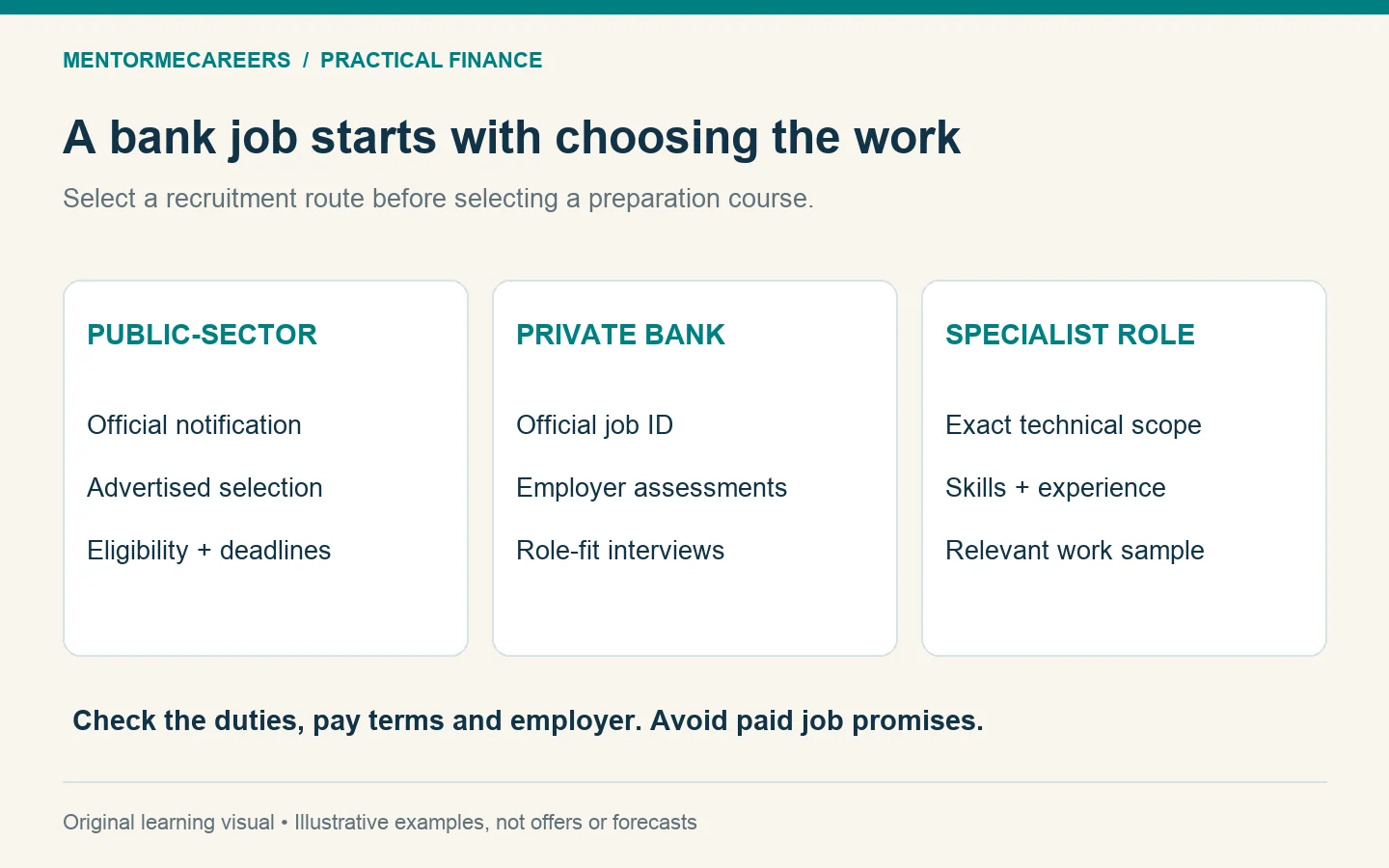
To get a job in a bank after graduation, first choose the recruitment route: a public-sector examination, a private bank’s direct hiring process, or a specialist role matched to your skills. However, the degree requirement, selection stages and daily work vary by post. A banking certificate does not replace the official recruitment process.
Often, the mistake is to apply for “a bank job” before deciding what you are willing to do. Branch sales, customer service, credit, investment operations and wealth management can sit under the same employer, yet have different targets, tests and career paths. Start with the work and then choose the preparation.
How to get a job in bank after graduation: compare the routes
| Route | Where to verify it | Preparation focus |
|---|---|---|
| Public-sector PO/management trainee | The current IBPS notification or the bank’s own recruitment page. | Eligibility, advertised examination stages, timed practice and interview preparation. |
| Public-sector clerical/customer-service route | The specific customer-service or junior-associate advertisement. | Required exams, language requirements and document checks. |
| Private-bank direct hiring | The bank’s official careers portal and a specific job ID. | Role-fit CV, aptitude/skill assessments and interviews. |
| Specialist credit/risk/technology role | The actual specialist vacancy. | Relevant degree, experience and technical evidence. |
| Graduate or training programme | The bank’s official programme terms. | Selection conditions, fees if applicable, role, location and employment terms. |
Importantly, a recruitment examination fee and a request to pay a stranger for an offer letter are not the same thing. Therefore, use official channels and read the terms. The label “banking programme” does not establish that a role is guaranteed, permanent or on the bank’s own payroll.
Public-sector bank jobs: work from the current notification
IBPS coordinates recruitment for participating public-sector banks; SBI runs its own recruitment processes. RBI and other institutions also issue their own advertisements. However, do not assume one examination covers every bank, post or employer.
For example, the 2026 IBPS PO/MT-XVI notification specifies preliminary and main examinations, a personality test and interview before provisional allotment. It is a dated example, not an invitation to apply after its registration window. Later notices and corrigenda can alter details.
First, build an eligibility checklist from the advertisement: qualification, result/degree cut-off, age calculation date, category rules, nationality, required certificates and applicable language conditions. “I am a graduate” answers only one of those questions. In particular, a final-year candidate must check the specific proof-of-passing deadline.
Use IBPS’s official process page and SBI’s current-openings page to locate the current advertisement. Save the notification and job reference with your application record so that you can check later changes against the correct recruitment cycle.
How to get a job in a bank after graduation through direct hiring
Private banks can recruit through direct applications and their own selection processes. “Without IBPS” does not mean “without assessment”. A bank may use aptitude tests, job-related tasks, interviews and background checks. You must still meet the vacancy’s requirements.
HDFC Bank’s careers page describes online application, assessment where relevant, interviews and subsequent checks. It also states that the bank does not seek recruitment payments from candidates. Treat this as that employer’s published process, not a guarantee that every bank or sponsored training scheme uses identical terms.
Next, use the vacancy’s exact title and job ID. For example, tailor your CV to the work: a customer-facing role needs evidence of communication and service judgement; an operations role needs accuracy and exception handling; a credit role needs financial analysis. Sending the same list of certificates to every opening misses those differences.
Which bank role suits your skills?
| Role family | What the work may involve | Question to ask before accepting |
|---|---|---|
| Branch sales/relationship | Acquiring and servicing customers, meeting product or revenue targets. | What are the targets, fieldwork expectations and fixed/variable pay? |
| Customer service/branch operations | Transactions, records, service requests and controls. | Which responsibilities and cash-handling duties belong to this post? |
| Credit | Reviewing borrowers, statements, cash flows and documentation. | Is it underwriting, collections, sales support or independent credit analysis? |
| Investment operations | Trade support, reconciliation, settlement or corporate-action processing. | Which product, process, shift and exception responsibilities apply? |
| Risk | Monitoring exposures, controls, models or risk reports. | What technical skills and experience does this specific team require? |
| Wealth/advisory support | Client servicing, product support and possibly sales. | Is the role sales, support or regulated advice, and what certifications apply? |
First, read the verbs in the description. “Acquire”, “cross-sell” and “meet targets” signal something different from “reconcile”, “investigate breaks” or “analyse cash flows”. None is inherently the wrong career, but accepting a sales role while expecting valuation work creates an avoidable mismatch.
Investment banking operations is also distinct from front-office deal advisory. An operations training course should not be presented as a guaranteed route to mergers-and-acquisitions work. Our investment banking career guide explains the distinction.
A worked example: three graduates, three preparation plans
Consider three fictional graduates. Asha wants a public-sector officer route and is prepared to study for the advertised selection process. Bilal is comfortable with customer acquisition and wants a private-bank relationship role. Charu prefers analytical or process work and is testing entry-level operations and credit-support vacancies.
| Candidate | Immediate task | Evidence to build |
|---|---|---|
| Asha | Read the current notification and take a timed diagnostic. | Eligibility checklist, topic-wise error log and regular mock analysis. |
| Bilal | Compare direct-hire roles and clarify sales expectations. | A targeted CV, customer scenario answers and examples of ethical persuasion. |
| Charu | Separate operations from credit vacancies and identify skill gaps. | A reconciliation case for operations, or a borrower cash-flow case for credit. |
However, their degrees alone do not determine the route. Preferences, eligibility, skills, time and available vacancies matter. For example, Asha should not buy a modelling course as a substitute for exam preparation. Charu should not assume that a role called “banking executive” involves financial analysis.
How to get a job in a bank after graduation: show practical skills
For an operations example, create a fictional reconciliation between a trade record and a cash record. A purchase of 100 shares at ₹250 creates ₹25,000 of principal. Add an assumed ₹50 charge to reach expected cash of ₹25,050. If the cash record shows ₹25,000, identify the ₹50 difference, check the fee treatment and document the investigation. Do not invent an adjustment simply to make the totals match.
Alternatively, for a credit example, take a fictional borrower with ₹12 lakh of annual operating cash available for debt service and ₹10 lakh of annual scheduled debt service. The simplified coverage is 1.2 times. If available cash falls to ₹9 lakh, coverage falls to 0.9 times. Explain that this is a teaching calculation, not a lending decision or a universal bank threshold.
Therefore, each case should contain a question, source/input table, method, result, limitations and next action. Practise explaining it in two minutes. A transparent small case is more useful than an impressive-looking spreadsheet you cannot defend.
How to get a job in a bank after graduation: a 30-day plan
| Period | Deliverable | Check |
|---|---|---|
| Days 1–3 | Choose a route and shortlist genuinely matching job descriptions. | Record required education, experience, location and selection method. |
| Days 4–10 | Prepare a role-specific CV and diagnose skill gaps. | Remove unsupported claims and explain every listed tool. |
| Days 11–20 | Complete timed exam practice or one relevant work sample. | Track mistakes and revise the method, not just the score. |
| Days 21–30 | Submit targeted applications and practise interviews. | Record job IDs, dates, stages, follow-up dates and outcomes. |
This is a planning template, not a promise of an offer within a month. Also, keep the activities realistic alongside college or work. If your chosen public-sector window is closed, plan for the next official notification while considering only direct-hire roles that you actually want.
Use our Excel interview preparation for spreadsheet practice. For analysis-focused gaps, review the financial modelling course. For operations, inspect the investment banking operations programme and confirm its current eligibility and fully online delivery. These are training options, not substitutes for a bank’s recruitment criteria.
Salary and offer checks: basic pay is not take-home pay
The IBPS PO/MT-XVI notification lists a starting basic pay of ₹48,480, with allowances and perquisites under the participating bank’s rules. However, that figure is not the monthly take-home salary of every graduate bank employee. Deductions, location, post and employer matter.
By contrast, for a private-bank offer, separate fixed annual pay, variable incentives, employer benefits, deductions and conditions attached to any training cost or bond. In addition, ask who employs you, where you will work, whether shifts or transfers apply, and what happens if you leave. Therefore, compare written terms rather than a headline “up to” package.
Avoid recruitment scams and unsuitable paid promises
- Verify the vacancy and recruiter through the bank’s official portal.
- In particular, do not pay a personal account or unrelated agent for an interview, offer letter or guaranteed selection.
- Distinguish an official application fee from a private training fee; neither proves you will be hired.
- Read any programme’s refund, loan, bond, placement and location terms before paying.
- Keep application credentials and identity documents within verified recruitment channels.
Our retail banking guide gives background on the products and services involved. Once you choose the intended role, deepen that knowledge rather than memorising generic bank-interview scripts.
How to get a job in bank after graduation: FAQs
Can I join a bank after graduation?
Yes, there are graduate recruitment routes. Check the specific post’s qualification, age and other eligibility rules, then complete the required selection process. Graduation does not guarantee selection.
Can I get a private-bank job without a competitive bank exam?
Some roles use direct hiring instead of IBPS-style recruitment. Expect the employer’s own screening, assessments and interviews, and verify the vacancy on its careers portal.
Can I join SBI without an exam?
Follow the selection method in the specific SBI advertisement. Do not assume a general no-exam route for regular graduate PO or junior-associate recruitment. Specialist or contractual posts may use different processes.
Which bank job has the highest salary?
Pay depends on seniority, responsibility, location and employer. A senior specialist’s package is not a fair comparison with a graduate role. Compare matching positions and the fixed/variable breakdown.
Is a finance course compulsory for a bank job?
There is no universal rule. Some posts need particular qualifications or certifications; others recruit eligible graduates and train them. Buy training to close a verified skill gap, not because someone promises it bypasses recruitment.

A CFA charterholder with hands-on experience across investment analysis and finance education. At MentorMeCareers, he writes and reviews content on CFA, financial modeling, and investment banking careers — grounded in real market data rather than generic advice, and shaped by what actually helps candidates and professionals succeed.